

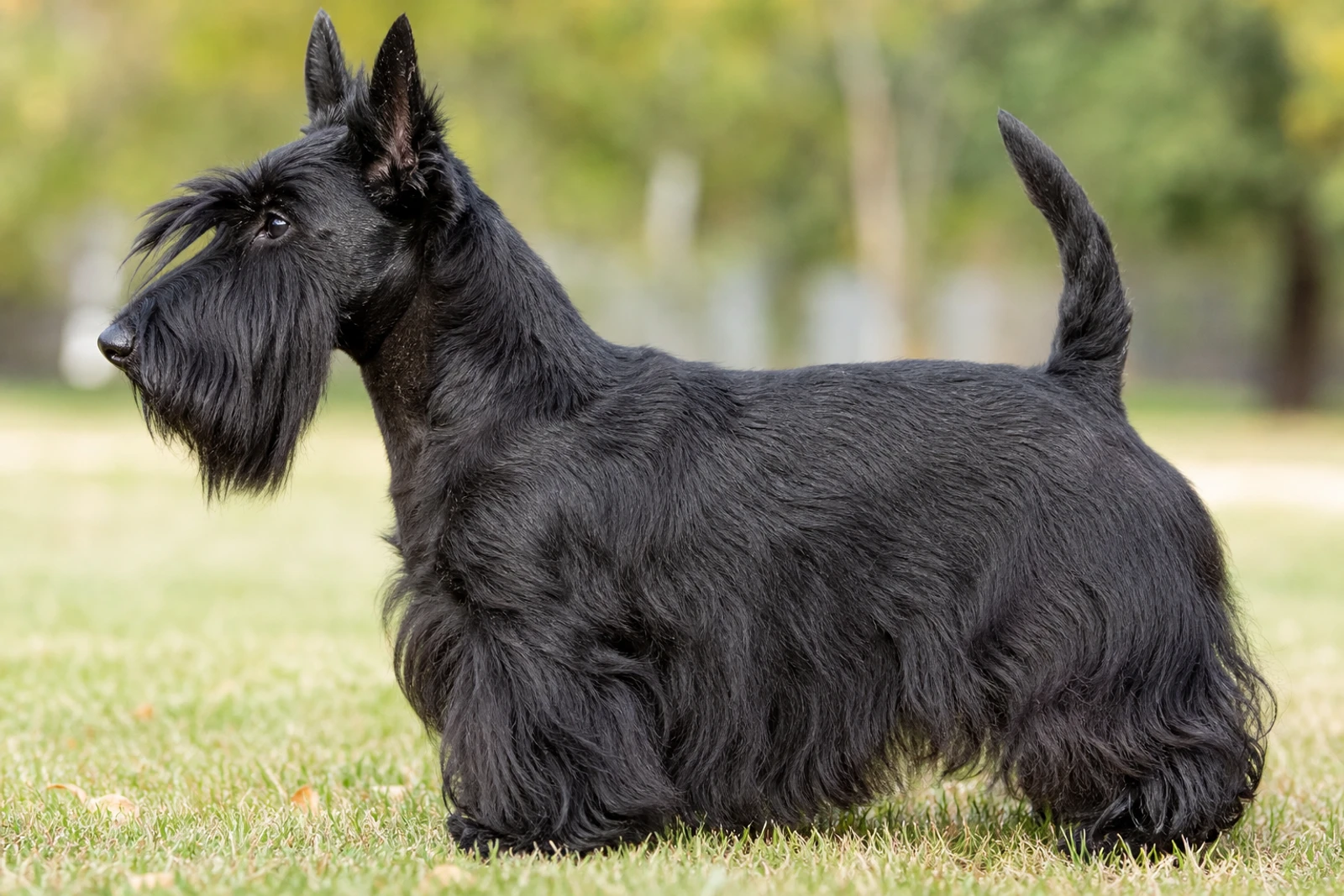
A detailed Scottish Terrier guide is coming soon.
At a glance
- Size
- Small
- Height
- 10–11 in
- Weight
- 20–24 lb
- Life span
- 9–15 years
- Coat colors
- Black, Black Brindle, Brindle, Red Brindle, Silver Brindle, Wheaten
How much does a Scottish Terrier cost?
Adopt / rescue
$75–$400
Usually includes spay/neuter, first shots, and a microchip.
Buy from a breeder
$700–$2,000
From a reputable, health-testing breeder.
Approximate USD. Prices vary widely by region, breeder, pedigree, age, and coat colour — adopting is the lower-cost and recommended route. Avoid suspiciously cheap “breeders”; they’re often puppy mills.
Estimate the full cost of a Scottish Terrier →Want the ongoing number? Estimate the monthly food bill for a Scottish Terrier with our dog food cost calculator.
Scottish Terrier photos
Views
Front, side, rear and top — the full silhouette.Poses
How the breed sits, lies, moves and plays.Puppy to senior
The breed across its whole life.Expressions
The breed’s range of moods.Close-up details
Eyes, ears, nose, paws, tail and coat.Coat colors
The breed’s recognized colors.Click any photo to enlarge. We show the Scottish Terrier from every angle — three views, poses, life stages, expressions, close-ups, coat and colors.
Appearance & size
The Scottish Terrier packs a serious dog into a small, low-slung frame. You’re looking at a stubby-legged powerhouse that stands just 10 to 11 inches at the shoulder and tips the scales at 20 to 24 pounds. Males often hit the upper end of that range, while females tend to sit a little lighter, but either way, the weight feels surprising the first time you pick one up — the bone is dense, the muscle is real, and there’s nothing fragile about this build.
From the side, the silhouette is unmistakable. The neck is thick and arched, blending into a deep chest that drops well below the elbows. The back is short, strong, and perfectly level, ending in a sloping croup and a tail that shoots straight up like a poker. That carrot-shaped tail, thick at the base and tapering gradually, is one of the breed’s signature features — never curled over the back, always bold and vertical. The front legs are dead straight, with heavy bone and compact, round feet, while the hindquarters are broad and muscular, with short, parallel hocks that drive a surprisingly powerful stride. Seen from behind, the rear is equally robust, with the tail centered high and no slack in the stance.
The head is long for the size, with a flat skull and a slight but distinct stop. The muzzle is strong and deep, not snipy, and the whole front end is framed by a profuse beard and iconic shaggy eyebrows that give the Scottie his famously stern, assessing expression. Dark, almond-shaped eyes sit wide apart and seem to take in everything. The ears are small, sharply pointed, and pricked, set well up on the skull — they telegraph every mood.
Coat is the finishing touch on the whole picture. A true double coat: a soft, dense undercoat and a crisp, wiry outer coat about 2 inches long on the body, built to turn weather. That outer layer feels harsh to the hand, never silky. Longer furnishings cover the legs, the belly forms a distinct skirt, and the face gets that full beard and brow. Colors that always show up in the ring are black, wheaten (which can range from pale cream to deep reddish tan), and brindle in any shade. The coat wraps the dog in a neat, sculpted outline that looks crisp even without constant fussing, though that tousled face does collect the occasional crumb.
Taken all together — the deep chest, the erect tail, the keen face with its shaggy trimmings, and the determined little front — the Scottie presents a profile that hasn’t changed much in over a century. It’s the same outline that once trotted across Scottish highland farms, condensed into just 10 inches of attitude.
History & origin
The Scottish Terrier we know today took shape in the Highlands of Scotland, but its ancestors had been working the rugged moors for centuries. Small, hard-bitten dogs were used to bolt fox and badger from rocky dens, hunt rats, and keep farms clear of vermin. Their low-to-the-ground build, double coat, and fierce tenacity weren’t luxury traits — they were survival gear for a landscape that punished the soft. Before the breed had a single name, these dogs were simply “Scotch Terriers” or “Aberdeen Terriers,” lumped in with what are now separate breeds like the Cairn, Skye, and West Highland White.
The push to define a distinct Scottish Terrier began in the late 1800s, when a group of fanciers led by Captain W. W. Mackie and J. A. Adamson worked to stabilize the type. They wanted a dog with a harsh, weather-resistant outer coat, a dense undercoat, a powerful head, and those unmistakably short, sturdy legs — a compact powerhouse, not a leggy terrier. In 1881, they produced a written standard, and by 1883 the breed had its first dedicated club in Scotland. The name “Scottish Terrier” was officially settled around 1886, which ended much of the earlier confusion with other Scottish earth dogs.
The breed landed in the United States quickly. The American Kennel Club registered its first Scottish Terrier in 1885, and the Scottie soon became a fixture in American life. The most famous one belonged to President Franklin D. Roosevelt — a black Scottie named Fala who followed him everywhere and was buried alongside him. That celebrity turned the breed into a mid-century icon, appearing in everything from Monopoly to Disney’s Lady and the Tramp. The dogs earned a reputation for dignified loyalty and a stubborn streak a mile wide, which owners either adored or found humbling.
Today’s Scottish Terrier still carries that Highland grit under a polished exterior. He stands 10–11 inches tall and 20–24 pounds of muscle and bone, with a lifespan of 9–15 years. Responsible breeders screen for health issues that show up in the line, like von Willebrand’s disease and patellar luxation. While most Scotties now rule living rooms instead of barns, their instinct to dig, chase, and patrol a territory hasn’t faded. You’re living with a working terrier that happens to wear a handsome, bearded profile.
Temperament & personality
A Scottie isn’t a lapdog in a skirt — he’s a rugged individualist condensed into 20–24 pounds of wiry muscle. You get quick intelligence, a deeply loyal bond with his people, and a aloofness toward strangers that can look like snobbery but is really just a terrier’s version of “I’ll decide when we’re friends.” Expect a dog who walks through the house like he owns it, because in his mind, he does.
Affection is on his terms. He’ll lean against you or follow you room to room, but he rarely turns into a velcro dog. This independence can read as stubborn, especially during training. A Scottie doesn’t respond well to being bossed around; he responds to consistency, a fair sense of humor, and a handler who respects that he’s a thinking dog, not a biddable one. Force just hardens his resolve.
Energy sits in the “busy” zone. A solid 45–60 minutes of purposeful daily exercise — sniffing walks, a good dig at the beach, a game of chase in a secure yard — keeps him level-headed. Without that outlet, his problem-solving brain may redirect into barking marathons, redecorating the baseboards, or obsessive patrolling of windows. He’s a first-rate watchdog, and he’ll announce the mail carrier with genuine conviction, not just noise.
In the household, he tends to gravitate toward one or two adults he respects most. Kids who understand dog body language — a stiff posture and direct stare means “back off,” a loose body and soft eyes mean “all good” — do fine. Teach children to give him peaceful meals and never interrupt him when he’s eating; he can be food-guardish. Other pets can be tricky. His prey drive runs high, and he often has little tolerance for assertive same-sex dogs. Early and ongoing socialization doesn’t erase his instincts, but it teaches him to manage them without a fight.
Quirks come standard. He may roll in something foul just because it smells interesting to a scavenger’s nose, or leave a urine mark in a room that doesn’t smell enough like family. These aren’t spite — they’re a terrier operating by scent on a landscape only he fully grasps. Ignoring his need for mental connection will trigger anxiety-driven behaviors faster than most; a Scottie left alone for long stretches gets sharp, not sad. He thrives when treated as a partner, not an ornament.
Good with kids, dogs & other pets
A Scottie’s idea of a good time is often “I’ll be in the room with you, just don’t expect me on your lap.” With kids, that translates to a dog who can be loyal and patient—but only when treated with a light touch. Young children who squeal, grab, or crowd a Scottish Terrier may get a sharp warning growl. This is a low-to-the-ground, sturdy 20–24-pound dog, not a fragile toy, so a well-socialized Scottie can handle quiet, respectful handling. In homes with toddlers, constant adult supervision is non-negotiable. Teach kids to leave the dog alone during meals and never yank toys away; Scotties can be surprisingly possessive about their things.
The real foundation is early, positive exposure. Start between 3 and 14 weeks, introducing the puppy to all kinds of calm, gentle people—including children following the rules. Without that, a Scottie can become standoffish and reactive when someone moves too fast. Forced interactions later, after the socialization window closes around 16 weeks, often backfire and increase anxiety.
With other dogs, Scottish Terriers are a mixed bag. Many are same-sex aggressive, especially two females together. They brim with terrier confidence and may not back down from a challenge, even against much bigger dogs. Early, structured socialization with varied, mellow dogs helps build tolerance, but don’t expect a dog-park social butterfly. An adult Scottie who’s comfortable just with his family may resent being pushed into rough playgroups. If you want a dog who’ll frolic with every new canine friend, the Scottie likely isn’t it.
Cats and small pets tap straight into the Scottie’s hard-wired vermin-hunting instinct. Raised from puppyhood alongside a cat, with careful management, some Scotties coexist peacefully indoors. But the prey drive rarely switches off completely. A fleeing cat, a pet hamster, or even a backyard chicken can trigger a chase-and-grab reaction that’s tough to interrupt. Never leave a Scottish Terrier unsupervised with small furry animals, no matter how solid the training has been. For homes with rabbits or guinea pigs, solid, high enclosures and separate rooms are the safest route.
Trainability & intelligence
Scottish Terriers are whip-smart problem solvers, but don’t mistake intelligence for an eagerness to please. These independent thinkers want to know what’s in it for them — usually a high-value treat, a quick game, or an enthusiastic “yes!” — before they’ll cooperate. Push too hard or lean on corrections, and a Scottie will dig in his heels or simply ignore you.
That terrier stubbornness isn’t a training dead end; it’s a signal that you need to build trust first. Reward-based methods get results here. A short, upbeat session of five minutes three or four times a day works far better than a twenty-minute drill. Use treats, praise, and tug toys to reward what you want, and skip punishment entirely — it damages the relationship and increases anxiety in a breed that already trends toward wariness with strangers.
- Start young. Begin shaping behavior the day your puppy comes home. House rules, handling exercises, and a few simple commands (sit, down, touch) set the tone early.
- Socialization is non-negotiable. Between 3 and 14 weeks, introduce your Scottie to a wide range of people, sounds, surfaces, and calm, vaccinated dogs. Keep every new experience positive and reward calm responses. Ongoing exposure through the first year helps prevent the aloof, bark-first reactivity that can crop up in an undersocialized adult.
- Teach a bulletproof recall eventually, but don’t expect it overnight. A Scottie’s prey drive and independent nose can make “come” the hardest command to install. Practice in quiet, fenced areas with high-value reinforcers. A long training line keeps him safe while he learns. Never punish a slow return — always make coming back to you the best part of his day.
- Focus on impulse-control skills. “Leave it,” “watch me,” and “settle” channel his smart, busy brain into real-world manners and give you a way to interrupt a chase before it starts. These are the commands that save your sanity when a squirrel appears on a walk.
The breed learns fast and remembers forever, but reliable obedience hinges on consistency from everyone in the household. If one person lets him on the couch and another doesn’t, he’ll exploit the loophole. Match his sharp mind with clear, patient, reward-driven communication, and you’ll end up with a quick, willing partner — not a push-button robot, but a dog who constantly keeps you on your toes.
Exercise & energy needs
Forget long, lazy walks on a single loop around the block — a Scottish Terrier needs short, purposeful outings that engage his nose and brain. Aim for 30 to 45 minutes of total daily exercise, split into two brisk 15- to 20-minute walks plus a couple of indoor play sessions. These dogs were built to work independently on farms, not to trot alongside you for miles. A pair of 15-minute sniffaris, where you let him set the pace and investigate every bush, often satisfies him more than a single 40-minute forced march.
Because the breed has a long body and relatively short legs, skip high-impact activities like repetitive jumping off furniture, hard turns in fetch on slick floors, or agility A-frames that stress the spine. A Scottie can be prone to intervertebral disc issues, so keep play grounded: a flirt pole in the yard, a gentle tug session, or free romping in a securely fenced area works well. If you notice him launching himself off the couch, redirect to a ramp or steps — his back will thank you years later.
Physical exercise alone won’t cut it with this terrier. Mental work is non-negotiable. A bored Scottie turns into a champion digger, a persistent barker, or a tiny dictator who makes his own rules. Tap into his vermin-hunting roots with puzzle toys that dispense kibble, scatter feeding in the grass, or scent games where you hide a favorite toy for him to find. Many Scottish Terrier owners swear by Earthdog events — the breed practically invented the sport. In these controlled trials, dogs navigate underground tunnels to locate caged rats (rats are safe and unharmed). It gives your Scottie the closest thing to his original job and burns mental energy faster than any walk. A 15-minute Earthdog practice run can leave him more satisfied than an hour on leash.
On hot or rainy days, lean into indoor brain games: a snuffle mat, a roll-and-treat ball, or teaching new tricks in 5-minute bursts. A Scottie’s independent streak means he won’t perform just to please you, but he’ll bend over backward for a clever puzzle that delivers a high-value reward. Skip the mindless throwing of a tennis ball down a hallway; instead, make him work for every toss by hiding it behind a pillow first. End each session with a calm chew or a frozen Kong to let him wind down.
Grooming & coat care
A Scottie’s double coat is what gives the breed its crisp, no-nonsense outline — but it doesn’t take care of itself. The wiry outer coat and soft undercoat trap dead hair and can mat close to the skin if you slack off on brushing.
Brushing
Two to three passes a week with a metal slicker brush (rounded pins) keeps the coat free of debris and loose undercoat. During spring and fall, when shedding ramps up, bump that to every other day. Work the brush down to the skin in small sections — the thick hair around the neck and hindquarters hides tangles easily. A grayhound comb or fine-toothed comb afterward catches any knots the slicker missed. That legendary beard collects food and water, so wipe it down daily with a damp cloth to prevent odor and staining.
Bathing
Bathe only when the dog gets truly grubby — typically every 6 to 8 weeks. Over-washing softens the harsh topcoat and strips the natural oils that make it weather-resistant. Use a gentle dog shampoo, rinse thoroughly, and towel-dry well. A quick blast with a cool dryer can help lift the coat without fluffing it into a puffball.
What about trimming?
Here’s where many owners outsource. A professional hand-strip every 6 to 10 weeks removes dead topcoat by the root, maintaining that crisp, wiry texture and rich color. If you choose clipping instead, the coat will feel softer and may fade slightly over time, but it’s a lower-maintenance option. Whichever route you pick, the hair between the paw pads and around the ears should be kept trimmed for comfort.
Ears, nails, and teeth
Ears stand up, but debris still sneaks in — check them weekly and gently wipe with a vet-approved cleaner if you see wax or dirt. Nails typically need trimming every 3 to 4 weeks; if you hear them clicking on the floor, you’ve waited too long. A quick tooth-brushing session two or three times a week (use dog-safe paste) goes a long way toward keeping that small jaw healthy into old age.
Shedding & allergies
You won’t find much Scottie hair on your black pants. The Scottish Terrier’s wiry, double coat does a great job of trapping loose fur, so day-to-day shedding is minimal compared to breeds that leave a constant dusting. That said, they do shed—just not heavily. Most of the dead hair stays tangled in the wiry topcoat until you brush it out.
Seasonal changes can trigger a more noticeable blowout, typically in spring and fall. During those few weeks, you’ll want a slicker brush or a comb in your hand three or four times a week to pull the dead undercoat before it mats. Daily quick sessions during a blowout keep the fur off your floors and furniture.
Drool is rarely an issue. Scotties have tight, dry mouths, so you’re not dealing with slobber on your knees or couch.
On the allergy front, the breed often gets labeled “hypoallergenic,” but that’s a marketing word, not a medical promise. No dog is 100% allergen-free. Allergies are triggered by proteins in dander, saliva, and urine, not just hair. Because Scotties shed so little and produce less airborne dander than many dogs, some people with mild allergies react less. The catch: that dense coat can trap dander and dust from the environment, releasing it when you do brush. If someone in your home is allergic, spend time with an adult Scottie before committing. Regular grooming—ideally hand-stripping a couple times a year to remove dead hair entirely—cuts down significantly on the allergens floating around your home.
Diet & nutrition
A Scottie at a healthy weight feels solid, not squishy—and keeping them that way takes vigilance because they pack on pounds easier than many owners expect. Those short legs and a long back don’t need extra stress, so you’ll save on vet bills by managing portions from day one.
Feeding your adult Scottie
For a 20-to-24-pound dog, you’re typically looking at 1 to 1¼ cups of high-quality dry food per day, split into two meals. That’s a starting point; the kibble bag numbers are often generous. Use your hands: if you can’t easily feel ribs with a light touch, cut back a tablespoon or two per meal. Scotties aren’t marathon runners, so most do fine on the lower end—especially if they’re mostly a house dog with a few good walks.
Protein comes first. Pick a food where a named meat or fish leads the ingredient list. A home-prepared mix of roughly 60% meat, 20–30% fruits and veggies, and 10% extras like eggs or a spoonful of pearl barley gives you control. Even with a commercial diet, throwing in some steamed green beans, a sardine, or a dollop of plain yogurt adds variety and keeps meals interesting.
- Slow them down: If your Scottie inhales food, a puzzle bowl or food-dispensing toy turns mealtime into a brain game and prevents gulping air.
- No grazing: Set the bowl down, pick it up after 15 minutes. Free-feeding leads to round dogs fast.
- Table scraps are trouble: A fatty piece of roast or holiday ham can trigger pancreatitis—something Scotties can be sensitive to. Any extras go into their bowl from the kitchen counter, never from your plate. Cook extra batches of plain grains, chopped carrots, or shredded chicken so you’ve always got a healthy topper ready.
Puppy feeding schedule
Tiny Scottie bellies need frequent refueling. From 8 weeks to 4 months, feed four small meals a day. Drop to three meals until about 6 months, then settle into the adult twice-a-day routine. When you bring a pup home, transition slowly over a week—start with gently cooked, puréed meats and veggies or a premium puppy kibble softened with warm water. A raw meaty bone like a chicken wing can be introduced around 12 weeks under supervision, but never leave a pup alone with it.
Senior Scotties and special considerations
As your dog ages and naturally slows down, scale back calories before the scale climbs. Many older Scotties thrive on three smaller meals rather than two large ones. If teeth are missing or the mouth is tender, purée the meal to improve nutrient absorption—dogs’ jaw motion and lack of salivary enzymes mean blending genuinely helps them get more out of their food. A bland meal of white rice and poached chicken can also settle a sensitive stomach that pops up now and then.
Health & lifespan
A healthy Scottish Terrier can live anywhere from 9 to 15 years, with the higher end most likely when you start with a well-bred dog and stay proactive about the breed’s known weaknesses.
Cancer is the heavyweight worry. Scotties are diagnosed with transitional cell carcinoma (TCC) of the bladder far more often than the average dog. There’s no single gene test that rules it out, so you watch for early signs: straining to pee, blood in the urine, or housebreaking lapses in a previously reliable adult. Lymphoma and mast cell tumors also appear more frequently than in many other small breeds.
Scottie Cramp is a peculiar, non‑painful movement disorder triggered by excitement or stress that causes exaggerated, stiff‑legged hind‑limb action. It doesn’t progress and most dogs live normally with it, but a DNA test lets breeders avoid producing affected pups. Von Willebrand’s disease (poor clotting), slipping kneecaps (patellar luxation), and hypothyroidism are other inherited conditions responsible breeders screen for. Ask to see thyroid panels, knee evaluations, and von Willebrand’s DNA results before you commit.
That dense double coat insulates well against cold, but on hot days keep walks to early morning or evening to avoid overheating. For a 20‑ to 24‑pound frame, portion control matters enormously. Free‑feeding turns a sturdy terrier into an overweight terrier fast, and extra pounds strain joints and can bring on pancreatitis. A daily 30‑ to 45‑minute walk and measured meals keep weight in check. Small, crowded terrier mouths collect tartar quickly; brush teeth several times a week and stay on top of professional dental cleanings.
Heartworm prevention during mosquito season (plus one month after) and a legally required rabies vaccine are bare‑minimum protections. Book an annual exam with bloodwork once your dog hits middle age. A sudden increase in water intake, a drop in energy, or unexplained weight loss isn’t just a quirk—it’s your cue to get a urinalysis or blood panel running. Caught early, many Scottie‑specific conditions can be managed for years.
Living environment
A Scottish Terrier packs big-dog confidence into a 10–11 inch, 20–24 lb body, and that shapes where they’ll be happiest. An apartment or a house both work, but nobody should mistake small size for a low-maintenance indoor ornament.
Apartment vs. house
Apartments suit a Scottie provided their daily energy gets a real outlet. Two sessions of brisk walking, 20–30 minutes each, plus indoor scent games or puzzle toys, balance the terrier drive without overstressing a long back. A house with a securely fenced yard is ideal—not for marathon romps, but so a Scottie can patrol and sniff on his own terms. The fence must be sunk into the ground; these dogs were bred to dig and can excavate under a barrier in startlingly short order.
Yard and physical activity
- Exercise: two sessions daily; think quality over distance. Short, fast-paced walks, flirt pole games, or hide-and-seek beat one long plodding stroll.
- Spine safety: avoid repeated jumping off furniture or high-impact landings. Provide ramps or steps if your Scottie insists on joining you on the couch.
- Mental work: this is non-negotiable. A bored Scottie will invent his own job—and that usually means destructive digging, chewing, or nuisance barking.
Climate tolerance
The wiry double coat handles cold weather well; many Scotties enjoy snow and crisp mornings. Heat is the bigger risk. In summer, walk during early morning or late evening, and always offer shade and cool water indoors. A cooling mat or a damp towel to lie on helps indoors on stifling days.
Noise and barking
Scotties are natural watchdogs—alert, opinionated, and quick to sound off at the doorbell, a passing dog, or a suspicious squirrel. Early training and a strong “quiet” cue can reduce the volume, but you won’t get a silent dog. If you have thin walls or noise-sensitive neighbors, be realistic about what you can manage.
Alone-time tolerance
A Scottie bonds deeply with family but carries an independent streak. Left alone for long stretches without preparation, they can slide into anxiety, excessive barking, or shredding. Build tolerance with short, positive practice absences from puppyhood. Before you leave, give them a physical workout and a stuffed puzzle toy to turn solo time into a satisfying challenge. A tired Scottie usually snoozes until you return.
Respect the terrier brain, protect that long spine, and give him a daily job—then a Scottie will manage as comfortably in a downtown loft as on a rural plot.
Who this breed suits
The Scottish Terrier suits someone who genuinely enjoys a dog with a mind of its own. If you want a furry yes-man who hangs on your every word, look elsewhere. A Scottie questions commands, and you’ll need patience, consistency, and a sense of humor to win the argument — over and over again. They bond fiercely but aren’t slavish. Affection arrives on their terms, which makes them a perfect fit for singles or couples with terrier experience, especially those who appreciate a loyal, alert companion with a comically dignified streak.
Active retirees and owners who work from home often click with the breed. Two 20–30 minute brisk walks, plus puzzle toys or scent games, keep a Scottie happy; they’ll match your energy but won’t pester you for non-stop entertainment. Apartment living works if you can accept the piercing bark that announces every delivery and squirrel. Their exercise needs are moderate, but a bored Scottie redirects that drive into digging, chewing, and home-redesign projects.
Think twice if your household includes toddlers or grabby children. A Scottie corrects rough handling with a quick snap and much prefers a calm, adult environment. The breed carries a high prey drive — cats, hamsters, and backyard squirrels will trigger an instant chase, so a sturdy fence and leash discipline aren’t optional. Same-sex dog aggression is common, ruling out many multi-dog homes unless you’re an expert manager. First-time owners often stall out because Scotties are not biddable pushovers. This breed respects a leader, not a friend who whispers suggestions. You need to be firmer than the dog and clever enough to make them think your idea was theirs first. If that sounds like a partnership you’d enjoy, a Scottie will reward you with a decade-plus of sharp, devoted company.
Cost of ownership
Bringing a Scottish Terrier home starts with a serious upfront commitment. A responsibly bred puppy from a breeder who screens for von Willebrand’s disease, patellar luxation, and craniomandibular osteopathy typically costs $1,500 to $2,500. Puppies from champion lines or with rare wheaten coats can push toward $3,000. Beware of “bargain” prices under $800 — they often skip health clearances, and you’ll pay the difference in vet bills later. Adoption through a breed-specific rescue runs a much lower $200–$400, though Scotties don’t pour into shelters.
Once that bearded face is through your door, plan on these real-world monthly expenses:
- Food: A high-quality kibble for a 20–24 lb dog runs about $40–$60 per month. Scotties can be picky, so you may cycle through a few recipes.
- Grooming: That wiry double coat doesn’t maintain itself. A professional hand-strip or clip every 6–8 weeks costs $60–$80 per visit, averaging out to $30–$50 monthly. You’ll also need a pin brush, comb, and stripping knife at home to keep the undercoat from matting between appointments.
- Routine vet care: Annual exams, vaccinations, heartworm and flea/tick prevention total roughly $500–$700 a year, or about $40–$60 monthly. Dental cleanings under anesthesia, often needed by age 3 or 4, can add $300–$800 as an episodic cost.
- Pet insurance: Scotties are prone to bladder stones, allergies, and certain cancers. A solid accident-and-illness policy runs $35–$55 per month depending on your deductible and location. Skipping insurance is a gamble on a breed that often lives into its early teens.
One-time costs — spay/neuter ($200–$500), a crate, sturdy leash, and a proper harness (never a collar alone, given their thick necks and trachea sensitivity) — add another $300–$500 upfront. Factoring in the occasional chew-proof toy and replacement remote control, a realistic first-year total lands between $3,000 and $5,000, with subsequent years settling around $1,800–$2,500. Budget for the grooming and the “just in case” fund, and you won’t resent the independent little terrier who cost it.
Choosing a Scottish Terrier
You can go two solid routes — a responsible breeder or a Scottie-specific rescue — but both demand homework. This is a tough little terrier with a mind of its own, and where you start shapes everything.
Starting with a responsible breeder
A good breeder isn’t just selling puppies; they’re safeguarding the line. For Scotties, that means health clearances you can verify on the OFA website. Ask to see:
- von Willebrand’s Disease (Type III) DNA test — a bleeding disorder that can be severe. Both parents should be clear, or at most a carrier bred to a clear dog.
- Patellar luxation certification — knees that slip out of place, common in small dogs. Look for OFA or PennHIP results.
- Thyroid and cardiac evaluations — Scotties can be prone to hypothyroidism and certain heart issues as they age.
- Eye exam by a veterinary ophthalmologist — not always standard, but a plus.
A breeder who waves off any of these or says “my vet checked them” without paperwork is a red flag. Also, run from anyone who won’t let you meet at least one parent on-site. The dam should be confident, not skittish, and look you in the eye — Scottie temperament runs strong in the blood.
Red flags and puppy mill alerts
Avoid breeders who have multiple litters on the ground year-round, claim their dogs are “teacup” or “royal” anything, or ship a puppy without a conversation. A real breeder interviews you as much as you interview them. They’ll ask about your fence, your other pets, your schedule — because a 20–24 lb dog that thinks it’s a full-sized defender needs a handler who gets terriers.
Picking your puppy from a litter
When you visit, watch the puppies together first, then interact with a few one-on-one. A well-socialized Scottie pup should be curious, not cowering, and willing to engage. Sit on the floor. If one boldly climbs into your lap, that’s a good sign — but the one that hangs back and watches for 10 minutes before approaching might simply be more thoughtful, not fearful. Both can work; a shutdown pup is a concern. Expect some independent stalking of toys; that’s the breed. Avoid the puppy that bullies littermates relentlessly or the one that startles and can’t recover. At 10–11 inches and a dense, low-slung build, even an 8-week-old has a distinct presence — you want the one whose confidence feels manageable, not frantic.
The rescue option
Scottie rescue groups exist nationwide and often have young adults or older dogs whose owners underestimated the breed’s stubbornness and exercise needs. If you go this route, ask about any known health history and whether the dog has been assessed around cats or kids. A good rescue will be upfront about any behavioral quirks; they’d rather place the right match than rush a placement.
Pros & cons
Pros
- Compact but sturdy: 10–11 inches tall, 20–24 pounds — built like a tank in a small package, fits apartments and tight spaces easily.
- Very low shedding. The wiry, single coat releases almost no hair into the house; a practical choice for neatniks and allergy-conscious homes (though no dog is truly hypoallergenic).
- Fierce loyalty. A Scottie bonds deeply with his favorite person and becomes a devoted shadow, without the neediness of a velcro breed.
- Sharp watchdog. They notice everything — unexpected knocks, squirrels 50 yards away — and alert you with a big-dog bark that belies their size.
- Independent thinker. They don’t hover for constant instruction, which means you can leave them alone for a few hours guilt-free once they’re settled.
- Long life of 9–15 years gives you well over a decade of steady companionship.
- Moderate exercise requirements. Two solid walks and a yard-sprint session are usually enough; they’re up for a hike but won’t dismantle your couch if you skip a day.
Cons
- Intensive grooming. That handsome, crisp coat requires regular hand-stripping or skilled professional grooms; just clipping softens the jacket and dulls the coat’s weatherproof qualities.
- World-class stubbornness. Training a Scottie is a battle of wits — they’ll weigh every cue against what they want to do, so consistency and a poker face are non-negotiable.
- High prey drive. Bred to dig after badgers and rats, they’ll bolt after small animals and forget everything you’ve taught them, so off-leash life in unfenced areas is a gamble.
- Can be scrappy with other dogs, especially same-sex pairs. Early, careful socialization helps, but a Scottie often prefers being the only canine on the payroll.
- Not a rough-and-tumble family clown. They tolerate well-behaved kids who respect their space but will walk away from grabby toddlers without a backward glance.
- Willful recall. A Scottie who spots something more interesting than your treat pouch will conveniently “not hear” you, so reliable obedience requires lifelong reinforcement, not just puppy class.
Similar breeds & alternatives
If the Scottie’s reserved, independent mind is what draws you in but you’d like a bit more everyday warmth, the West Highland White Terrier is the obvious place to look. Both sit at 10–11 inches tall, but the Westie runs lighter at 15–21 pounds—and that leanness matches a more outgoing, persistently cheerful personality. Where a Scottie might side‑eye a stranger, a Westie is far more likely to wag his whole body and invite play. Training is still a negotiation with both, but Westies tend to be a little easier to win over. You’ll trade the Scottie’s steady, serious dignity for a dog who lives with the volume turned up.
If you want the small‑terrier toughness in a scruffier, arguably more adaptable package, consider the Cairn Terrier. At 9–10 inches and 13–18 pounds, Cairns are the original Toto—fearless, busy, and built to work. They share the Scottie’s digging drive and high prey instinct, but they’re generally less aloof and quicker to warm up to new people. A Cairn won’t give you the same iconic silhouette, but you get a dog who’s a little easier to take to a patio brunch without the breed‑standard suspicion of strangers.
For an alternative that steps away from pure terrier intensity, the Miniature Schnauzer makes sense. They’re taller (12–14 inches) but often overlap in weight (11–20 pounds). The key split is biddability. Schnauzers are alert, smart, and far more trainable than the average Scottie—they’ll actually care what you want. They shed less than the wire‑coated terriers and bring a more sociable, clownish edge, but they still have enough watchdog bark to make you feel protected.
Frequently asked questions
- Are Scottish Terriers good with children?
- Scottish Terriers can be good with older, respectful children who understand how to interact calmly with dogs. Their independent and sometimes stubborn nature means they may not tolerate rough handling, so supervision is always recommended. Early socialization helps them accept kids, but they tend to prefer a more predictable environment.
- Do Scottish Terriers shed a lot?
- Scottish Terriers have a wiry, dense double coat that sheds minimally compared to many breeds, but they are not completely hypoallergenic. Regular brushing and professional grooming every few months help control loose hair and maintain coat health. While shedding is low, seasonal changes can increase it slightly.
- How much exercise does a Scottish Terrier need?
- A Scottish Terrier needs moderate daily exercise, typically a couple of brisk walks and some playtime to stay happy and fit. They have bursts of energy but are not hyperactive, and mental stimulation through puzzles or training is just as important. Without enough activity, they may develop nuisance behaviors like barking.
- Are Scottish Terriers easy to train for first-time owners?
- Scottish Terriers are intelligent but have a strong independent streak, which can make training a challenge for first-time owners. They respond best to firm, consistent, positive reinforcement methods and can be stubborn if they sense inconsistency. Patience and early obedience classes are often recommended to manage their willful nature.
- Do Scottish Terriers bark a lot?
- Scottish Terriers tend to be alert and vocal, often barking to announce strangers or unusual noises, making them good watchdogs. They can become excessive barkers if bored or left alone too long, but with proper training and socialization, barking can be kept under control. This instinct is deeply rooted in their terrier heritage.
- Is a Scottish Terrier suitable for apartment living?
- Scottish Terriers can adapt well to apartment living if their exercise and mental stimulation needs are met. Their small size and moderate energy make them manageable indoors, but they may bark at hallway noises, so training and sound-proofing considerations can help. Access to regular walks and outdoor time is essential for their well-being.
Tools & calculators for Scottish Terrier owners
Quick estimates tailored to Scottish Terriers — pre-filled with this breed’s size where it matters.
Articles & stories about the Scottish Terrier
Sources & standards
This profile follows recognized breed standards from the American Kennel Club (AKC) and the Fédération Cynologique Internationale (FCI), along with established veterinary and breed-club guidance. These describe general breed tendencies — every dog is an individual.