

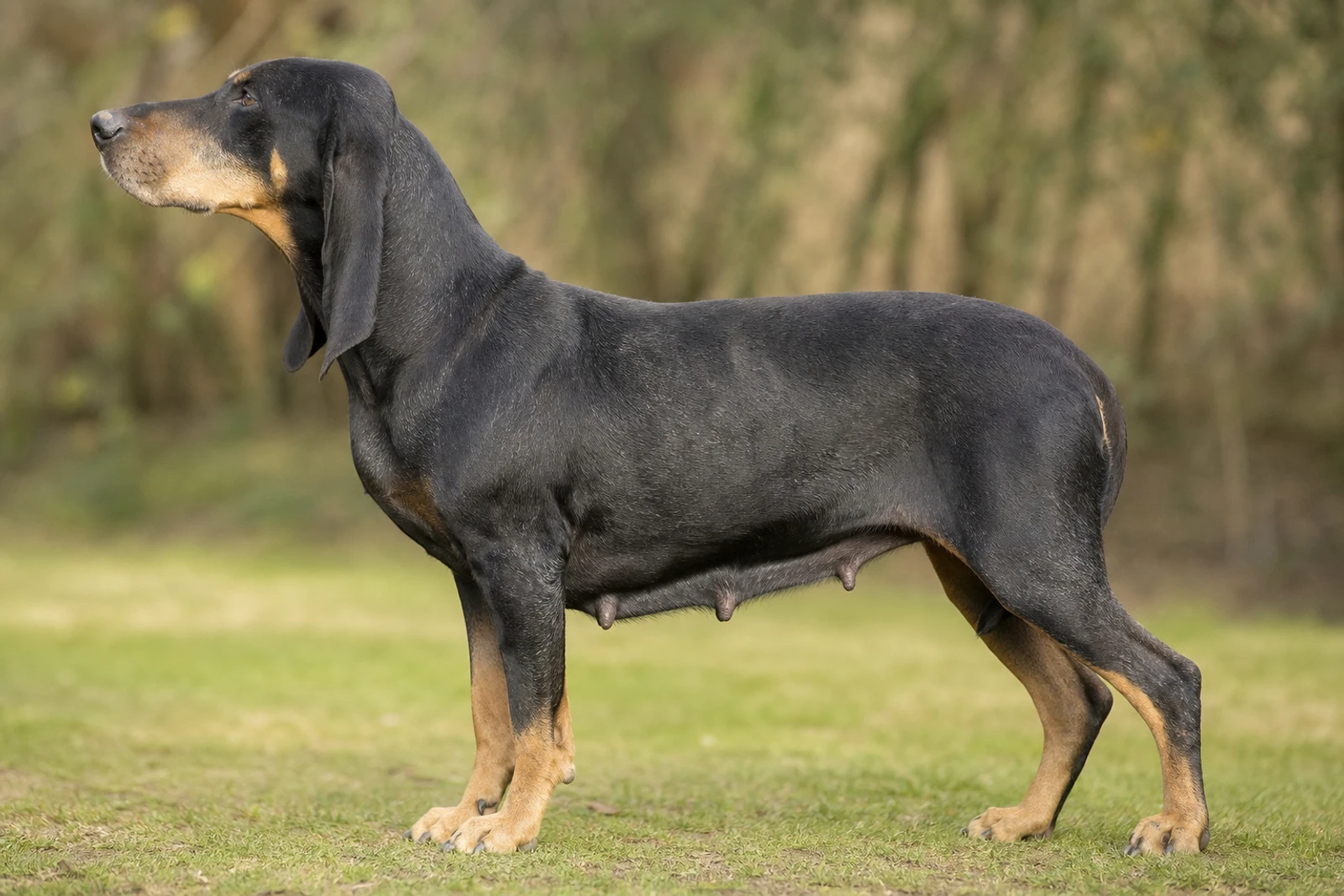
The Segugio Italiano is a rugged, large-sized scenthound from Italy, traditionally used for hunting hare and wild boar. This breed is best suited for active individuals or families who can provide extensive daily exercise and mental stimulation. With a strong prey drive and independent nature, they require consistent training from an experienced owner. They thrive in homes with secure, spacious yards and are not suited for apartment living. Affectionate with their family but reserved with strangers, they make loyal companions for those who understand their working-dog heritage. Their deep, melodious bark is a hallmark of the breed.
At a glance
- Size
- Large
- Height
- 19–23 in
- Weight
- 40–62 lb
- Life span
- 10–14 years
- Coat colors
- fawn, black and tan
- Coat type
- Short, dense coat
How much does a Segugio Italiano cost?
Adopt / rescue
$75–$400
Usually includes spay/neuter, first shots, and a microchip.
Buy from a breeder
$700–$2,000
From a reputable, health-testing breeder.
Approximate USD. Prices vary widely by region, breeder, pedigree, age, and coat colour — adopting is the lower-cost and recommended route. Avoid suspiciously cheap “breeders”; they’re often puppy mills.
Estimate the full cost of a Segugio Italiano →Want the ongoing number? Estimate the monthly food bill for a Segugio Italiano with our dog food cost calculator.
Segugio Italiano photos
Views
Front, side, rear and top — the full silhouette.Poses
How the breed sits, lies, moves and plays.Puppy to senior
The breed across its whole life.Expressions
The breed’s range of moods.Close-up details
Eyes, ears, nose, paws, tail and coat.Coat colors
The breed’s recognized colors.Click any photo to enlarge. We show the Segugio Italiano from every angle — three views, poses, life stages, expressions, close-ups, coat and colors.
Appearance & size
If you picture an old-world scent hound built to trot all day across the Italian countryside, you’ve already got the gist. The Segugio Italiano is a large, square-proportioned dog with a lean, athletic frame—built for stamina, not bulk. He stands 19 to 23 inches at the shoulder and weighs anywhere from 40 to 62 pounds, with a noticeable range because the breed splits into two coat varieties that can differ slightly in substance. Neither should ever look heavy; you want to see a hint of the last few ribs under a sleek coat, not a soft, couch-potato silhouette.
The head is long and lean, with a slightly rounded skull and a muzzle of equal length. Eyes are large, dark, and softly expressive, set well apart. The ears are the classic scenthound giveaway: low-set, hanging flat, and long enough to reach the tip of the nose when pulled forward. From the front, the chest is deep but notably narrow—two fingers should fit between the elbow and the ribcage—the forelegs are straight as posts, and the feet are oval with well-arched toes. Everything about that front view says “narrow and efficient” rather than wide and powerful.
In profile, a long, slightly arched neck flows into a level topline with just a slight rise over the loin. The underline tucks up sharply behind a deep ribcage, giving the dog that “cut-up” look typical of an endurance trotter. The tail is set high and carried saber-style, never curled over the back. From the rear, the thighs are muscular and the hocks are well let down—the kind of drive-train you’d expect on a dog that can cover miles without a second thought.
The coat comes in two distinct types. The short-haired version has a dense, tight, glossy coat that lies flat. The rough-haired version tops out around 2 inches with a wiry texture and coarse guard hairs. Both shed seasonally and both shrug off weather surprisingly well. Colors stick to a no-nonsense palette:
- Various shades of fawn, from pale wheaten to deep mahogany red
- Black and tan, with crisp, well-defined markings
- White is common on the chest, feet, and sometimes the tail tip; a solid white chest blaze is practically a breed signature
Rough-haired dogs often sport a subtle beard and tufted eyebrows that add a quizzical, slightly shaggy expression. Don’t let that distract you—once a scent catches this hound’s attention, that face turns laser-focused.
History & origin
The Segugio Italiano traces its roots straight back to the rugged hills and marshes of the Italian peninsula, where a hound with a tireless nose and a booming voice was worth its weight in game. It’s one of the oldest scenthound types in Europe, with ancestors likely arriving from the eastern Mediterranean — Egyptian and Phoenician traders brought slender, prick-eared hounds that merged with local dogs. By the time Renaissance artists started painting hunting scenes, the Segugio was already a fixture: compact, elegant, and working in choruses that could be heard for miles.
For centuries, the breed developed in two coat varieties — the smooth pelo raso and the wiry pelo forte — but they were always considered the same dog under the skin. Italian nobles and contadini alike ran large packs after hare, fox, and wild boar. The Segugio’s job was to unravel cold trails with a methodical, ground-scenting style, then push the quarry with a ringing bay that told the hunter exactly where every dog was. Speed mattered less than endurance and the ability to keep working a difficult scent until it told the full story.
The late 19th and early 20th centuries brought more formalization. The first breed standard appeared in 1899, but the two world wars nearly erased the breed. Food shortages and the collapse of traditional hunting culture pushed many pack dogs to the brink. In the 1950s and 60s, a handful of Italian fanciers — especially Mario Braccini for the wire-haired type and Giuseppe Benetti for the smooth — painstakingly gathered surviving dogs from remote farms and revived the bloodlines. Without their work, the Segugio Italiano would exist only in old paintings.
Today, the breed is recognized by the Fédération Cynologique Internationale and sits in the AKC’s Foundation Stock Service. Hunters in Italy still keep it close to its ancient purpose, especially in the Apennines, where the deep-throated music of a Segugio pack on a boar scent is a sound you don’t forget. Outside its homeland, the breed remains rare, usually spotted with serious scent-work owners or in the homes of people who appreciate a centuries-old hound that can switch from a tireless hunter to a laid-back house companion as long as you give its nose a job.
Temperament & personality
Your Segugio Italiano lives through his nose. He reads the world in scent trails, and that drive shapes everything—from the way he marks every lamppost with urine (saving those scent cues for future reference) to the single-minded intensity he brings to a hike. If he sniffs something interesting, expect him to pull; a casual walk around the block won’t cut it. Plan on at least an hour of off-leash running or long-line exploring each day, with plenty of sniff breaks. A tired, nose-satisfied Segugio is a calm housemate. Without that outlet, you’ll hear his full, baying voice—a deep, rolling howl that can carry for blocks.
Inside the home, he’s an affectionate, steady presence with his people. He leans into scratches, follows you from room to room, and settles in for a nap right against your leg. Early on, though, he can be reserved with strangers; he’s not aggressive, just discerning. He’ll watch before warming up, and his alert bark when someone approaches the door makes him a decent watchdog, even if he’d probably just sniff a burglar and demand a belly rub.
- Pack mentality: He thrives with another dog (or two). Isolation sparks anxiety, and that fast becomes barking or destructive chewing. If everyone works during the day, a dog friend or a midday walker can prevent a nervous, vocal mess.
- Stubborn but fair: He’s strong-willed, so heavy-handed corrections backfire. Respectful, consistent training—short, positive sessions—earns his cooperation. He’s biddable when you make him think it’s his idea.
- Quirks to expect: His scavenger roots mean he’ll happily roll in dead things or foul smells. Theories range from masking his own odor for the hunt to simply announcing a find to his pack. You’ll want a vinegar spray in the car (white or cider vinegar). A few spritzes break down the stink and discourage repeat rolling. Indoors, the same spray neutralizes urine odors that would otherwise prompt him to mark the same spot again.
- House training: He’s clean-natured but will re-soil areas that still smell like urine or feces. Enzyme cleaners that eliminate the scent are non-negotiable. Reward him immediately with a treat the second he goes outside, and never punish indoor accidents—that just teaches him to hide his messes.
- Body talk: Learn his signals. A forward-leaning, stiff posture and a hard stare usually mean he’s locked onto a scent or a small animal and ready to bolt. A loose, wiggly body and soft, blinking eyes? That’s him at ease. Lip licking, a yawn, or turning his head away are his calm-down signals, often when a child’s hug gets a little too tight.
Around kids, he’s generally gentle and patient, but two things matter: never interrupt him while he eats, and teach children to give him space during meals. Food guarding isn’t breed-defining, but any dog can become defensive if cornered at the bowl. With other pets, his prey drive is real. A cat that holds its ground might earn a wary truce; one that runs becomes a siren song. Early, careful socialization helps, but don’t bet the cat on it.
Chewing is a fact of life. Teething puppies gnaw to relieve sore gums, and adults will crunch hard objects to keep jaws strong and teeth clean. Provide tough, safe chews and redirect with a citrus spray (boil citrus peels, strain, and mist) on furniture legs—most dogs hate the taste and smell.
His world revolves around scent memories, spatial cues, and his family pack. When you work with that instead of fighting it, the Segugio Italiano is a loyal, entertaining partner who makes every walk feel like an adventure.
Good with kids, dogs & other pets
If you’re looking for a family hound that genuinely enjoys the chaos of a household with kids, the Segugio Italiano is built for it. These dogs are naturally patient and non-aggressive, so they rarely take offense at tail tugs or clumsy toddler hugs. The real safety note isn’t temperament — it’s physics. At 40 to 62 pounds and standing up to 23 inches, a young, wiggly Segugio can easily bowl over a small child, so you’ll need to supervise those early years until the dog learns to modulate its body around little ones. Teach kids to give the dog space when it’s eating or resting, and you’ll have a steady, affectionate companion that melts into the couch-mountain of afternoon cartoons.
With other dogs, the Segugio’s pack-hunting background shines. They typically read canine body language well and prefer company over solitude. This isn’t a breed you can stick in the backyard alone all day and expect to thrive; they need the companionship of people or other dogs. Because they live so easily in multi-dog homes, adding a Segugio to an existing pack is usually straightforward, especially if you introduce them on neutral ground. Puppies raised in isolation — whether in a kennel run or a quiet apartment — often grow into fearful, reactive adults. So start early: the critical socialization window slams shut around 12 to 16 weeks, and you want to pack those weeks with gentle exposure to every sort of person, dog, sound, and surface you can. That early investment creates the confident, unflappable adult dog you’re after.
Cats and small pets are where your management hat goes on. This is a scent hound bred to pursue game, and while some individuals learn to live peacefully with the family cat, that prey drive never fully disappears. Fast-moving, furry creatures — rabbits, ferrets, even a darting cat — can trigger an instinctive chase. If you already have small animals, you’ll need slow, controlled introductions in a space where the smaller pet feels safe, and never leave them unsupervised together. For homes with a lot of pocket pets or bird cages at floor level, the Segugio might be more stress than it’s worth. But for kids and dogs, with consistent socialization and realistic supervision, this breed slides into family life like it’s been there all along.
Trainability & intelligence
You can teach a Segugio Italiano almost anything — as long as you make it worth their while. This is a scenthound through and through, bred to work independently over miles of countryside, following a trail with single-minded focus. Their intelligence isn’t the eager-to-please, command-obedient kind you find in a retriever. It’s a calculating, “what’s in it for me?” intelligence that requires a trainer who’s patient, consistent, and armed with high-value rewards.
The power of scent — and how it hijacks attention
The nose wins. That’s your biggest training challenge. A Segugio’s scent drive can override months of reinforcement in a heartbeat. Your dog may sit politely in the kitchen, but step outside where a deer trail crosses the yard, and your commands become background noise. Reliable off-leash recall in unfenced spaces is genuinely rare for the breed. Many experienced owners simply don’t chance it, instead relying on long lines or securely fenced areas.
What motivates a Segugio
Forget a stern voice — that’ll make a Segugio shut down or look for the nearest exit. Beneath that stubborn streak, these dogs are actually quite sensitive. Positive reinforcement with food, a favorite tug toy, or a fast game of chase builds trust and speeds up learning. Smelly, tiny treats (freeze-dried liver, a pea-sized bit of cheese) delivered the instant the dog gets it right work wonders. Punishment-based methods — yelling, leash jerks, shock collars — damage the relationship and often spike anxiety and avoidance. You want a dog that checks in with you freely, not one that’s afraid of you.
Start early, stay consistent
Puppyhood is your golden window. Begin handling, basic cues (sit, down, touch, and a reliable “check in”), and gradual exposure to new people, surfaces, and sounds before 16 weeks. A well-socialized Segugio is far less likely to become a fear-reactive adult that erupts at every passing bike. Short, upbeat sessions — five to ten minutes, several times a day — work better than long drills. Always end on a win.
The recall workaround
Teach a super-charged recall cue using something the dog can’t resist, like real meat. Practice indoors first, then in a fenced yard, then slowly add distractions. Even with all that, never bet the dog’s safety on it near traffic or open woods. A 30-foot training leash lets you practice without risking a bolt. Some owners train a secondary recall: the squeak of a toy or the crinkle of a treat bag, anything that might cut through a scent trance.
Other practical commands to prioritize: a rock-solid “leave it” and “drop it” are non-negotiable — these dogs will hoover up anything interesting with their nose. “Wait” at doorways and before crossing streets is just as critical.
You don’t dominate a Segugio; you outsmart him. Build a partnership where cooperation pays off, and you get a clever, quick-learning companion. Just don’t expect him to choose your voice over a fresh rabbit trail without a really good reason.
Exercise & energy needs
A quick spin around the block won’t even make a dent. The Segugio Italiano is a long-legged scenthound bred to trail hare and boar for hours over rugged ground, and that engine is still very much intact. Count on 60 to 90 minutes of hard exercise every day, broken into at least two sessions. This is not a dog satisfied by a leashed stroll; he needs to run — really run — in a safely fenced area or on a long line while his nose works overtime.
Intensity matters as much as the clock. A brisk jog alongside a bike (once his joints are mature, usually after 12–18 months), a challenging off-leash hike, or a fast game of chase with other large dogs all fit the bill. Without an outlet for that sustained gallop, a Segugio can turn vocal, anxious, and creatively destructive — think reconfigured couch cushions and howled concertos that neighbors will not appreciate.
Mental fatigue is just as critical. This is a nose-on-legs, so lean into scent work. Skip the basic puzzle toy and hide a stinky treat under logs in the yard, take a tracking class, or join a formal nose work group. Even a simple “find it” game with dinner kibble scattered across a grassy patch puts his brain to meaningful use. A ten-minute scent session can leave him more satisfied than twenty minutes of fetch he doesn’t naturally care about.
- Good activities: canicross, skijoring (winter), long hikes on a 30-foot drag line, barn hunt trials, and advanced obedience with heavy scent discrimination.
- Watch the joints: avoid repetitive high-impact pounding on pavement until growth plates close. Stick to softer surfaces like dirt, grass, or woodland trails during the first year and a half.
- Recall is a work in progress: if a scent trail lights up, his ears shut off. A rock-solid emergency recall takes months of proofing, so never trust him off-leash near traffic or livestock.
A Segugio who gets stretched-out runs and real nose time is a settled, affectionate partner indoors. Shortchange that, and he’ll invent his own exercise program — and you won’t be the one running the show.
Grooming & coat care
Your Segugio’s grooming routine hinges on which coat you’re dealing with — smooth or wire-haired — but both are refreshingly low-drama. A quick weekly once-over keeps the hound looking sharp and gives you a chance to catch any scrapes, ticks, or hot spots before they turn into a vet visit.
For the smooth-coated variety, a pig-bristle brush or a rubber curry mitt does the job. It pulls out dead hair, distributes natural oils, and leaves a glossy finish that makes the fawn or black-and-tan coat glow. Expect heavier shedding twice a year when the undercoat blows out; during those few weeks, bump brushing to every other day and keep a lint roller handy. Bathing is an as-needed event — maybe a few times a year or after a particularly fragrant romp in something dead. Use a mild dog shampoo so you don’t strip the skin’s barrier.
The wire-haired Segugio has a dense, rough outer coat around 1.5–2 inches long. This coat doesn’t shed as much on its own, but dead hair gets trapped and can mat if ignored. A slicker brush with rounded pins and a steel comb work through the wiry texture every few days. Twice a year, typically in spring and fall, the coat benefits from hand-stripping — pulling out the dead topcoat by hand or with a stripping knife — to keep the texture harsh and weatherproof. Clipping a wire coat will soften it and ruin that natural protection, so resist the urge to just buzz it down.
Ears are the one spot you can’t coast on. Those long, low-set drop ears trap moisture and block airflow, making them a prime spot for yeast and bacterial infections. Lift each ear weekly, give it a sniff (you’ll know if something’s off), and wipe the inner flap with a vet-approved ear cleaner on a cotton pad — never jam anything down the canal. After a hunt or a swim, dry the ears thoroughly.
Nails grow fast on a dog that’s often trotting on soft ground. If you hear clicking on the floor, it’s time for a trim — usually every 3–4 weeks. Teeth need a brush with dog-safe toothpaste two or three times a week. Start early if you have a puppy, so it becomes routine. And don’t overlook the post-run check: Segugi will run through brambles and brush without a second thought, so run your hands over the coat, check between the toes, and rinse off any mud or debris before it cakes into a skin irritant.
Shedding & allergies
A Segugio Italiano’s short, dense coat sheds a surprising amount. She'll drop fine hairs all year long — not in tufts, but as a steady dusting on furniture, floors, and dark clothing. During spring and fall, that baseline shedding doubles for a few weeks as she blows her seasonal coat. If you own a Segugio, invest in a good vacuum and a rubber curry brush.
The coat itself is low-maintenance. A quick weekly once-over with a hound glove or rubber bristle brush will catch the worst of the loose hair and keep her glossy. Baths are rarely needed beyond the occasional muddy outing; her coat naturally repels dirt. But that simplicity doesn’t mean a hair-free home. You’ll still find short, stiff hairs woven into couch fabric.
Drool falls into the “sometimes” category. Segugi aren’t heavy, pendulous jowlers like a Bloodhound, but those loose flews can leak after a long drink or when she’s hot and panting. Keep a hand towel near her water bowl.
No scenthound is hypoallergenic. The real issue isn’t just shed hair — it’s dander and the proteins in saliva and urine. A Segugio’s moderate shedding can spread those allergens throughout the house. If someone in your home has allergies, spend time around adult dogs of this breed before committing. Regular brushing, HEPA air purifiers, and keeping her out of the bedroom can help, but you’ll never eliminate the allergen load entirely.
Diet & nutrition
Segugio Italiani love food, and they’re clever enough to talk you into an extra meal. That makes portion control the single most important part of their daily routine. Even a couple of extra pounds can strain their joints as they age, so keep them at a working weight where you can easily feel the ribs but not see them.
An adult Segugio typically weighs 40–62 pounds. Aim for around 1,000–1,200 calories a day—roughly 2 to 3 cups of high-quality dry kibble split into two meals. If your dog runs scent lines for hours, add more. If he’s a weekend walker, pull back. Always measure with a standard cup, not a mug or a guess.
Puppy feeding schedule
Puppies under four months need four evenly spaced meals a day. At four months, drop to three meals, and by six months transition to the adult plan of two daily meals. Introduce new foods slowly: start with lightly cooked and puréed meats, fish, fruits, and vegetables. Around twelve weeks you can offer supervised raw meaty bones like chicken wings to build jaw strength and clean teeth.
What to put in the bowl
A good baseline for adults is about 60% raw or cooked meat (lean beef, chicken, turkey, fish), 20–30% vegetables and some fruit, and the remaining 10% from eggs, plain yogurt, or easily digestible grains such as pearl barley or white rice. Because dogs’ jaws only move vertically and they lack salivary enzymes, blending or roughly processing the whole meal helps them absorb more nutrients. That goes double for seniors with tender mouths.
Many Segugio Italiani gulp their food without tasting it. Slow them down with a puzzle bowl or scatter half the ration on a lick mat—it works their brain and their stomach at a gentler pace.
Senior years
As your dog’s daily mileage drops, reduce food gradually to prevent creeping obesity. Don’t cut protein; there’s no strong reason to. Instead, split the daily amount into three smaller meals if he seems hungrier, and blend or purée the food for aging teeth. Weigh him monthly so you catch any gain before it becomes a problem.
A few non-negotiables
Never feed rich, fatty table scraps—ham, gravy, bacon, or holiday leftovers can trigger pancreatitis overnight. Serve any plain, cooked extras like vegetables or lean meat in the dog’s own bowl, far from the dinner table. And skip the vegetarian or vegan route entirely; this breed’s digestive system is built for animal-based protein.
Health & lifespan
A well-bred Segugio Italiano typically lives 10 to 14 years. That’s a solid working-dog lifespan, but it depends heavily on genetics, preventive care, and the owner’s willingness to stay ahead of a handful of recurring issues.
What to watch for
The breed’s deep chest and athletic build come with a real risk of bloat (gastric dilatation-volvulus). You need to know the early signs — restlessness, unproductive retching, a distended belly — and get to a vet immediately. Feed two or three smaller meals a day instead of one large one, and avoid running the dog hard right after eating.
Floppy, drop ears are a hallmark of the Segugio, but they trap moisture and debris. Without weekly cleaning and drying, chronic ear infections set in fast. A sour smell or head shaking is your cue to check.
Large, active dogs can also inherit hip and elbow dysplasia. Responsible breeders screen breeding stock with OFA or PennHIP x-rays and don’t reproduce dogs with poor scores. Puppies from tested parents drastically lower your risk. A few lines may carry eye disorders like progressive retinal atrophy; a CERF or CAER exam on the parents is a green flag.
Staying ahead of trouble
Weight creeps up easily on a food-motivated hound. An extra ten pounds stresses joints and raises the chance of arthritis as the dog ages. Keep your Segugio lean — you should feel ribs without a thick layer of fat. Pair a measured diet with the serious daily exercise this breed demands (a solid hour of off-leash running or scent work, not just a short walk).
- Heartworm prevention is nonnegotiable. Give the monthly medication throughout mosquito season and for one month after it ends — in many US regions, that means year-round coverage.
- Rabies vaccination is required by law. There’s no treatment once symptoms appear, so keep it current.
- The short, dense coat sheds dirt but offers little insulation. In freezing weather, limit exposure or use a coat. In summer, provide shade and water; the Segugio will push through heat to follow scent, so you have to call the breaks.
Vet visits and early signs
Schedule an annual wellness exam, and bump it to twice a year once the dog hits 7 or 8. Your vet will check joints, eyes, heart, and condition. At home, pay attention to subtle shifts — a dog that suddenly slows down on the trail, loses its appetite, or drinks way more water than usual is telling you something’s off.
Early socialization does more than shape temperament — it lowers lifelong stress, which directly affects immune health. A confident, well-adjusted Segugio is easier to handle for nail trims, ear cleaning, and vet visits, cutting the risk of stress-triggered issues like diarrhea or barking spirals.
Stay on top of ear hygiene, weight, and joint screenings, and this hardy hound often hunts happily into its early teens.
Living environment
A Segugio Italiano is a dedicated scent hound with real staying power, not a casual apartment companion. If you live in a condo or have shared walls, you’ll very likely run into trouble — their deep, carrying bay carries for blocks. Even a house in a tight suburban cul-de-sac can test neighborly goodwill if the dog sounds off every time a leaf blows by.
Yard and space
A securely fenced yard is practically non-negotiable. These dogs trace a scent with single-minded drive, and a 4-foot fence won’t slow a determined Segugio for long. They need room to trot, sniff, and pace. That yard won’t exercise itself, though — you’ll still need to get out and work them. Think 60 minutes of vigorous exercise twice a day, broken into scent walks, off-leash runs in a safe area, and a solid chance to use their nose. Without that outlet, a bored Segugio turns your landscaping into a cratered excavation site.
Climate tolerance
The short coat handles warmth decently, but this isn’t a dog you leave outside without shade and water in summer. In cold or wet weather, the coat offers little insulation. A waterproof coat or fleece is smart on icy mornings. They can adapt to most climates as long as you protect them from temperature extremes and provide shelter indoors.
Noise and barking
Hounds must vocalize when they’re on a trail or when something interesting passes by. It’s not a slight whimper — it’s a full-throated bay built to communicate with hunters a mile away. Training a quiet command from puppyhood helps, but you’ll never fully erase the instinct. A shared wall or a landlord with zero tolerance for noise makes this breed a poor fit.
Being left alone
Segugi were bred to work in packs, and they form tight bonds with their people. Leaving one alone for a standard 8-to-5 workday can trigger howling, chewing, and pacing — classic isolation distress. If your schedule demands long absences, plan on a midday dog walker, doggy daycare, or plenty of gradual desensitization starting young. A tired Segugio with a frozen Kong and a scent trail in the yard might snooze for a few hours. Ignore the breed’s social wiring, and you’ll come home to a dog who’s already told the whole street about it.
Who this breed suits
A Segugio Italiano doesn’t just bark—he bays, and he does it with gusto whenever his nose catches a scent. If you’ve got close neighbors or a low tolerance for noise, this isn’t your dog.
This is a hunter’s hound, built to course game for hours over rough terrain. The right owner is an active, experienced dog person who loves the idea of a partner for trail runs, hikes, or actual hunting. They thrive when they have a job that uses their nose—think scent work, tracking, or long off-leash rambles in safe, open spaces. Because they’re pack hounds by nature, a multi-dog household often makes them happier than being the only pet.
With their family, they’re friendly and good-natured, but they’re not Velcro dogs. They’re independent thinkers, which means training takes patience and consistency—not a great match for a first-time owner. They can be wonderful with older kids who understand how to handle a 40- to 62-pound dog that may barrel around with enthusiasm, but toddlers can easily get knocked down.
Who should think twice:
- Apartment dwellers or anyone without a large, securely fenced yard. An underground electronic fence won’t stop a dog who’s locked onto a scent and willing to take the zap.
- Homes with cats, rabbits, or other small animals. The prey drive is hardwired and very difficult to manage.
- Families with babies or very young children, not because the dog is mean, but because the Segugio’s play style is physical and oblivious.
- Anyone who prizes a spotless house. Expect moderate shedding, some drool, and muddy paws from a dog that loves being outdoors.
- Owners who want a quiet companion. The baying is frequent, loud, and carries.
If you can’t commit to a solid hour or more of running or purposeful exercise every day, plus the mental challenges that keep a scenthound’s brain busy, this breed will turn your yard into a moonscape and your living room into a howlfest.
Cost of ownership
A Segugio Italiano from a responsible breeder in the U.S. typically runs $1,500 to $2,500. Because the breed is rare here, you may wait for a litter; importing from Italy can push the price past $4,000 once you add shipping, import fees, and health paperwork. Always budget for the initial vet visit, microchip, and quality gear like a tall-gauge wire crate and a well-fitted harness, which can add another $300–$500 upfront.
Monthly costs settle into a rhythm, but these are active, lean hounds with appetites to match. A 40–62 lb dog burning energy on daily runs or long scent walks eats about 2½–3 cups of high-quality kibble per day, putting food around $55–$75 a month.
- Grooming: A short, dense coat means minimal shedding and no pro clips. Plan on $15–$25 a month for occasional baths, good ear cleaner (those pendulous ears trap moisture and can get infected), and nail trims if you don’t do them yourself.
- Routine vet & preventatives: Annual exams, vaccines, heartworm, and flea/tick meds average $40–$65 a month. Ear infections are a common hound complaint, so a few unplanned vet runs can spike that figure.
- Pet insurance: For a Segugio, a solid policy usually lands between $30 and $50 a month, depending on your deductible and location. It’s worth considering, since accident-prone field work or an impulsive chase can lead to a torn pad or worse.
- Extras: Factor in replacement chew toys, puzzle feeders for that nose, and the occasional training class if their independent streak tests you. $25–$45 a month covers that easily.
All in, expect to spend $165–$260 a month for the dog’s lifetime of 10–14 years. Emergency surgeries or chronic issues will swing that number, so having a separate savings buffer of $1,000–$2,000 makes sense for a breed that lives to run full tilt.
Choosing a Segugio Italiano
You won’t stumble on a responsible Segugio Italiano breeder with a quick Google search. These dogs are rare in the U.S., so your first job is patience — expect to get on a waiting list and travel for the right litter. Rescue is a valid path, but purebred Segugi rarely land in general shelters. When they do, it’s often through breed-specific rescue networks or as a stray found far from home. An adult rescue can be a great fit if you click with the dog’s temperament and are ready for the breed’s intense nose-and-go drive.
Health clearances that matter
Responsible breeders screen breeding stock for issues that can crop up in a large, active scent hound. Ask for written proof of:
- Hips: OFA or PennHIP evaluation (ideally rated fair or better).
- Elbows: OFA elbow dysplasia screening — less common but worth confirming.
- Eyes: A current CERF or OFA Eye exam from a veterinary ophthalmologist. Additionally, a good breeder can talk openly about ear health (those drop ears trap moisture) and will have a plan for early socialization that prevents timidity in a naturally pack-oriented hound.
Red flags to walk away from
A breeder who can’t produce health certificates on both parents is a non-starter. Other hard stops: puppies raised in kennel isolation with no home exposure, release before 8 weeks, an always-available litter list, and no questions about your fencing, schedule, or experience with driven hunting dogs. The Segugio Italiano is a working hound, so a breeder who never hunts, tracks, or competes with the breed is preserving a shape, not a mind. Also run from anyone who shrugs off the breed’s volume — these dogs bay.
Picking your puppy
Look for a pup that’s neither the bully nor the one hiding under the deck. A stable Segugio puppy will trot over, sniff you with a wagging tail, then go back to dismantling the toy pile. Avoid a puppy that skitters away constantly or stiffens when handled. Eyes should be clear, ears clean, belly soft — no potbelly or diarrhea. The breeder should hand you a health record, a contract with a solid return guarantee, and proof that the litter was raised underfoot. Expect them to grill you, too; if they don’t, keep looking.
Pros & cons
-
Gentle, people-oriented hound that bonds tightly with its family and is patient with older children who respect its space.
-
Built for endurance: a Segugio will happily tackle all-day hikes, long runs, or scent-work sessions without slowing down.
-
Coat care is refreshingly simple — a short, dense double coat that sheds moderately and needs just a weekly brush and the occasional bath.
-
Typically dog-social, thanks to a pack-hunting heritage; often does well in multi-dog homes with proper introductions.
-
Minimal drooling and a clean, low-odor hound smell, even after a wet outing.
-
A booming, musical bay that can be heard blocks away; not a breed for apartment living or neighbors who value quiet.
-
Nose-first intensity means off-leash reliability is unlikely — a secure, high fence is essential to prevent self-guided hunting expeditions.
-
Demands a real workout: a quick walk won't cut it; plan on 60–90 minutes of vigorous exercise daily or find your flower beds excavated.
-
Stubborn and independent-minded, training requires creativity, rock-solid consistency, and plenty of high-value treats, not drill-sergeant commands.
-
Can develop separation anxiety when left alone for long stretches; this is a dog that wants to be with its people, not isolated in a yard.
-
Floppy ears need routine drying and cleaning to avoid infections; responsible breeders screen for hip dysplasia, so ask for health clearances.
Similar breeds & alternatives
If you’re after the Segugio’s all-day nose, lean build, and pack-dog friendliness but can’t track down a breeder, a few other scenthounds come close — each with clear trade-offs in size, voice, and how easily they settle indoors.
Beagle
The Beagle is the most common scenthound around, but it’s a serious downsize. Where the Segugio stretches between 19–23 inches and 40–62 pounds, a Beagle stays 13–15 inches and under 30 pounds. That means a shorter daily run — a solid 45 minutes of sniff-walking and sprinting rather than the Segugio’s hour-plus of rugged terrain work. The baying is just as operatic, the prey drive just as hair-trigger, and the fence requirements just as strict. A Beagle fits a smaller yard and a less athletic household but still brings the classic, nose-first stubbornness.
Harrier
A Harrier lands in almost the same footprint: 19–21 inches and 45–60 pounds, bred to chase hare in a loud, fast pack. Its short, hard coat is easy maintenance, though you lose the wire-coat option some Segugios have. Harriers match the Segugio’s stamina and independent decision-making, but they tend to be more aloof with strangers, whereas a Segugio often forms a tight, slightly velcro-like bond with its family once the hunt is over. Availability in the U.S. is limited, so you’ll wait for either breed.
Petit Basset Griffon Vendéen
If the wire-haired Segugio catches your eye, the PBGV delivers a rough, tousled coat on a more compact frame — 13–15 inches and 25–40 pounds. That’s a lot of hound attitude in a shorter package, with a big, happy bark and zero off-leash reliability. The PBGV fits better in a small home but still needs serious mental workouts. Like the Segugio, it lives around 12–14 years and will cheerfully dismantle a quiet afternoon to follow a trail.
Basset Hound
The Basset offers the same 40–65 pound mass but on short, bowed legs that prefer a brisk walk over a hard run. If you want the baying soundtrack and scent-drive stubbornness without the athletic demands of an endurance hunter, the Basset swaps the Segugio’s lean muscle for drool, long ears, and a much lower center of gravity. His off-switch is strong, but his recall is no better — the nose writes the script either way.
One name-alike that often trips people up: the Italian Greyhound is a 7–14 pound sighthound, not a scenthound. They share only a country-of-origin label, not a trace of the Segugio’s working style.
Take the nose seriously no matter which scenthound you bring home — secure fencing, a long line for hikes, and a willingness to live with a dog who hears you about 50 percent of the time when a scent is down.
Fun facts
- The Segugio Italiano exists in two coat varieties: short-haired and wire-haired, though the short-haired is more common.
- They possess an extraordinary sense of smell and are capable of following cold trails for hours.
- Their baying voice is deep and harmonious, often compared to a bell-like tone.
- This ancient breed is believed to descend from primitive Egyptian hounds, refined in Italy over centuries.
Frequently asked questions
- Are Segugio Italianos good with children?
- This breed tends to be gentle and affectionate with family members, including children. However, because of their large size and high energy, interactions with small kids should be supervised to prevent accidental knocks. Early socialization and training can help ensure they are patient and tolerant.
- How much exercise does a Segugio Italiano need?
- As a hunting breed, the Segugio Italiano has high stamina and requires at least an hour of vigorous exercise daily. Long walks, runs, or scent games are ideal to keep them physically and mentally stimulated. Without adequate activity, they can become destructive or develop nuisance behaviors.
- Do Segugio Italianos shed a lot?
- They have a short, dense coat that sheds moderately throughout the year. Weekly brushing with a rubber curry brush helps remove loose hair and keep shedding manageable. They are not considered a heavy-shedding breed, but regular grooming is still necessary.
- Are Segugio Italianos suitable for apartment living?
- Apartment living can be challenging for this breed due to their high energy and tendency to bark loudly. They do best in homes with a securely fenced yard where they can safely explore and run. If their exercise needs are met and they receive training to curb vocalization, they may adapt, but it's not ideal.
- Do Segugio Italianos bark excessively?
- This breed is known for its powerful, baying bark, especially when it picks up an interesting scent. While not neurotic barkers, they can be vocal if left alone without enough exercise or mental engagement. Training from an early age can help manage the barking, but some vocalization is innate to the breed.
- Are Segugio Italianos easy to train for first-time owners?
- They are intelligent but can be independent and stubborn, which may present challenges for novice owners. Consistent, positive reinforcement training methods work best, along with patience and a sense of humor. They respond well to short, engaging sessions that keep them mentally stimulated.
Tools & calculators for Segugio Italiano owners
Quick estimates tailored to Segugio Italianos — pre-filled with this breed’s size where it matters.
Articles & stories about the Segugio Italiano
Sources & standards
This profile follows recognized breed standards from the American Kennel Club (AKC) and the Fédération Cynologique Internationale (FCI), along with established veterinary and breed-club guidance. These describe general breed tendencies — every dog is an individual.