

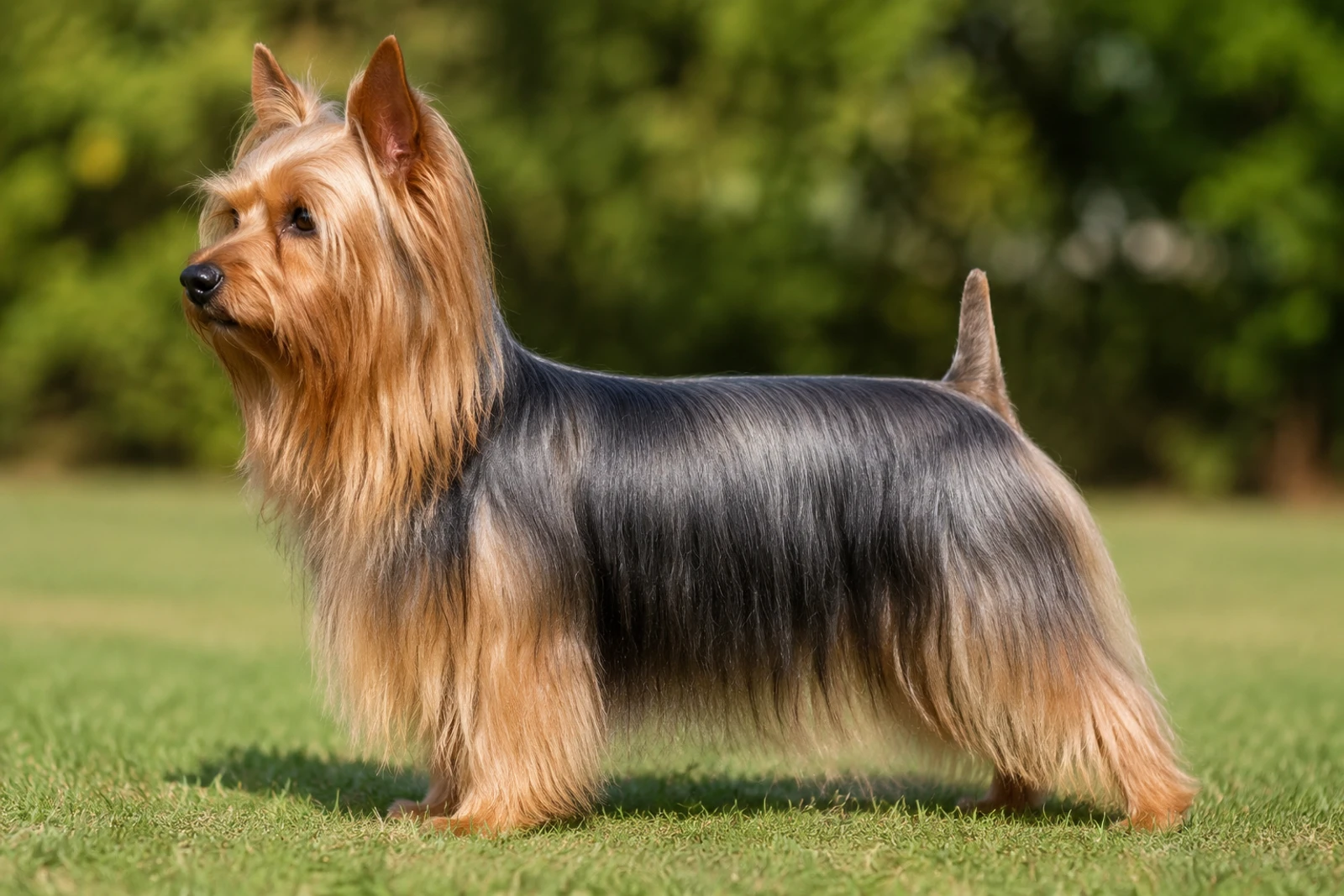
The Silky Terrier is a tiny Australian toy terrier with a long blue-and-tan coat and a lively watchdog personality. It is apartment-sized but not sleepy; barking, brushing, and terrier confidence all need management.
At a glance
- Size
- Small
- Height
- 9–10 in
- Weight
- 8–10 lb
- Life span
- 13–15 years
- Coat colors
- Blue and tan
- Coat type
- Long fine silky coat
- Group
- Terriers
- Origin
- Australia
How much does a Silky Terrier cost?
Adopt / rescue
$75–$400
Usually includes spay/neuter, first shots, and a microchip.
Buy from a breeder
$700–$2,000
From a reputable, health-testing breeder.
Approximate USD. Prices vary widely by region, breeder, pedigree, age, and coat colour — adopting is the lower-cost and recommended route. Avoid suspiciously cheap “breeders”; they’re often puppy mills.
Estimate the full cost of a Silky Terrier →Want the ongoing number? Estimate the monthly food bill for a Silky Terrier with our dog food cost calculator.
Silky Terrier photos
Views
Front, side, rear and top — the full silhouette.Poses
How the breed sits, lies, moves and plays.Puppy to senior
The breed across its whole life.Expressions
The breed’s range of moods.Close-up details
Eyes, ears, nose, paws, tail and coat.Coat colors
The breed’s recognized colors.Click any photo to enlarge. We show the Silky Terrier from every angle — three views, poses, life stages, expressions, close-ups, coat and colors.
Appearance & size
Even at a glance, this is a small dog with big Terrier attitude. The Silky Terrier packs a sturdy, compact frame into just 9–10 inches at the shoulder and 8–10 pounds—a body built to go to ground but refined enough to look graceful on a lap. He’s slightly longer than tall, giving him a low-set, rectangular silhouette that still reads as balanced and agile, never dumpy.
The head is wedge-shaped and moderately broad between the ears, with a flat skull and a shallow but defined stop. Dark, almond-shaped eyes sit under a relatively flat brow, giving a keen, inquisitive expression that brightens the whole face. Small, V-shaped ears are set high on the skull and carried erect, though some dogs keep a slight fold at the tip. A black nose and fine, tight lips complete a clean muzzle that isn’t too long or snipy.
The coat is the breed’s calling card. It’s a single coat—no undercoat—so what you see is a long, straight, glossy cascade of texture more like human hair than typical dog fur. It hangs flat and parted down the center of the back from the base of the skull to the tail. The color is always some version of blue and tan, with a slate-blue or silvery-blue body and rich, deep tan markings on the face, ears, lower legs, and under the tail. Puppies are born black and tan, and the blue gradually emerges as they mature, often fully developing by 18 months. The long hair on top of the head falls to either side of the skull, usually secured with a small band or bow to keep it out of the eyes, revealing that alert, terrier expression.
From the side, the topline is level from withers to tail set, and the neck is medium in length, sloping into well-laid-back shoulders. The tail is set high and carried erect—docked where legal, or left natural and upright. The hindquarters appear strong and moderately angulated, with the tail’s long fringe flowing straight up. Viewed from the rear, the legs are straight and parallel, and the tail stands out like a plume.
Look from the front, and the dog shows a neat, self-possessed bearing: the distinct central part, the dark eyes catching the light, and the ear fringes swinging as the head turns. The whole picture is one of refinement on top of real working-terrier substance—elegant but not fragile. That delicate-looking coat does demand daily brushing, but on a well-kept Silky, it’s a shimmering, unmistakable feature.
History & origin
The Silky Terrier got its start in late 19th-century Australia, around the bustling cities of Sydney and Melbourne. Settlers had already brought along a motley crew of British terriers — Scotch Terriers, Skye Terriers, Dandie Dinmonts — that eventually gave rise to the rough-and-tumble Australian Terrier. By the 1890s, a handful of fanciers began crossing those little Aussies with imported Yorkshire Terriers, hunting for a slightly more refined, blue-and-tan dog that kept the terrier’s fire but shed the harsher coat. The result was a small, swift ratter with a long, silky parting down the back, equally game for chasing vermin through a stable or curling up in a city apartment. People originally called them Sydney Silkies.
The breed’s identity sharpened in the early 1900s, though it got tangled in a friendly rivalry between two Australian states. In New South Wales, breeders leaned into a dog that looked more like a compact Australian Terrier with a silky coat; in Victoria, they were deliberately crossing back to Yorkshire Terriers to refine the coat and keep the size even smaller. For a few years, you’d see the same dog shown under two names — Sydney Silky in one state, Australian Silky Terrier in another. A single breed standard was finally hammered out in 1906, then revised in 1909 and again in 1926, gradually settling the split. By the time World War II ended, the breed was widely recognized in its homeland simply as the Australian Silky Terrier.
American soldiers stationed in Australia during the war took a shine to the little blue-and-tan dogs and brought a few home. The American Kennel Club recognized it as the Silky Terrier in 1959, and while it’s never been as numerous as the Yorkie, a dedicated following has kept it going strong. Today’s Silky still packs plenty of terrier spirit into a 9- to 10-inch, 8- to 10-pound body. Its job has shifted from ratting to pure companionship, but you’ll spot the old instincts the moment a squirrel dares to cross the fence.
Temperament & personality
Don’t let the 9-inch frame fool you. The Silky Terrier packs every ounce of that 8–10 pounds with the self-assurance of a dog twice his size. These are true terriers: inquisitive, tenacious, and entirely sure they’re in charge — until you prove otherwise with calm, consistent leadership.
At home, a Silky bonds hard with his people. Expect a little shadow that wants to be part of whatever you’re doing, whether that’s supervising your laptop work from your lap or chasing a tossed toy down the hall. Many choose one favorite person, though they’ll happily accept affection from the whole family. With strangers, they tend to be reserved at first — not hostile, but watchful. That alertness makes them excellent little watchdogs, and they will announce visitors, passing squirrels, and suspicious leaves with a surprisingly robust bark. Without early socialization and daily mental outlets, that barking can slide into a habit that frays nerves.
Energy is moderate but tightly coiled. A Silky needs a genuine outlet — not a lazy stroll. Plan for at least 30–45 minutes of brisk walking, backyard fetch, or a good indoor lure-chase session. A bored Silky invents his own entertainment, which often means redecorating your baseboards or unrolling the toilet paper. They’re smart, but they think for themselves, so training works best when it feels like a negotiation, not a command. Use short, upbeat sessions with high-value treats, and never, ever rely on force — it backfires with this breed.
Inside the home, a few quirks surface. That terrier digging instinct may send your throw pillows flying or drill a hole through sofa cushions. Prey drive runs high, so a Silky who’s been raised with a cat might still bolt after the neighbor’s barn cat. And yes, like many small, confident dogs, an untrained or insecure Silky may urine mark furniture or doorways to remind everyone whose house this is. Neutering and a rock-solid housetraining routine with immediate outdoor rewards usually solve it.
With kids, a Silky can thrive if children are old enough to respect a small dog’s space: never disrupt a meal, don’t grab, don’t chase. Younger toddlers move unpredictably and may trigger a warning snap. Other dogs get typical terrier sass — he’ll boss around a 70-pound Labrador with zero sense of scale, so monitor play and skip dog parks where rough play is the norm.
Lived with thoughtfully, the Silky Terrier is a whip-smart, affectionate sidekick who glues himself to your day. Give him consistent boundaries, enough action, and a job to do (even if it’s just keeping the kitchen free of dropped crumbs), and he repays you with 13–15 years of outsized personality.
Good with kids, dogs & other pets
A Silky Terrier’s tiny frame — just 8 to 10 pounds — makes playtime with young children a one-sided affair. They’ve got a patient, non-aggressive temperament that works in a family’s favor, but a toddler’s clumsy grab or a dropped dog can mean a broken bone. Supervise every interaction. Teach children to sit on the floor when they hold or pet the dog, and never allow hugging or roughhousing. With respectful handling, these terriers become devoted, easygoing companions.
With other dogs, Silkies often do well, especially when they’ve grown up together. Early puppy socialization is the key that unlocks this. Expose your Silky to a variety of calm, friendly dogs before 16 weeks of age, and keep those positive meet-ups going through adulthood. Without that foundation, a Silky can turn reactive or act pushy. Even a well-socialized adult has terrier confidence that can outsize his body — a larger dog’s rough play can go sideways fast, so stay close and step in the moment you see one-sided chase or mounting.
Cats require a realistic eye. A Silky raised from puppyhood with a confident cat can learn to coexist peacefully, but the breed’s vermin-chasing past means a fleeing feline often flips a switch. Expect the chase, and manage it. Never leave them alone together until you’ve seen consistently calm behavior over weeks — not days. Pocket pets like hamsters, gerbils, or birds are a non-negotiable “separate rooms” situation. A secure, elevated enclosure isn’t a suggestion; it’s the only way to keep those animals safe.
Beneath all of this sits the Silky’s deep need to be with his people. This isn’t a dog you can banish to the backyard when company comes or when the kids get loud. He’ll pick up on household rhythms and form tight bonds, which makes his interactions with everyone in the home richer — but also means isolation breeds anxiety. Start socialization the moment your puppy comes home, while the critical window is wide open (birth to about four months), and continue it for life. Adopted an adult who missed that boat? Don’t force meet-and-greets. Gradual, cheerful introductions — treat by treat — build the kind of calm that raw exposure never will. A Silky Terrier doesn’t need to be best friends with every creature he meets. He needs to feel safe and unrushed in your busy, noisy world.
Trainability & intelligence
A Silky Terrier can learn just about anything you’re willing to teach — but don’t mistake that quick mind for a dog who lives to please you. These are true terriers: clever, independent, and capable of weighing whether your request is worth their time. That means training isn’t about breaking a stubborn streak; it’s about convincing a 10-pound problem-solver that cooperating is the best game in the house.
What motivates them. Treats, squeaky toys, a game of tug — most Silkies will work for any of the three, but they bore easily with repetition. Keep sessions short (five to seven minutes) and switch up rewards often. A Silky who’s been drilled with the same biscuit ten times in a row may simply walk away. You’ll get far more mileage from a happy voice and a tossed toy than from a stern tone.
The recall reality. Terrier prey drive is no joke, and a Silky off-lead who spots a squirrel is a Silky who goes deaf. Reliable recall takes months of proofing in gradually more distracting environments, and even then, many owners keep a long line handy in unfenced spaces. This isn’t disobedience — it’s instinct. Accepting that early prevents you from taking it personally and allows you to train strategically rather than punitively.
Socialization, not just manners. Expose a Silky puppy to new people, friendly dogs, traffic sounds, and strange surfaces before 16 weeks — and keep those positive exposures going through the first year. A poorly socialized Silky can become snappy, reactive, or hyper-alert to every noise. Gentle, early introductions build the confidence that turns a sharp watchdog into a stable companion. Never flood or force a nervous pup; let them approach at their own speed and reward every brave sniff.
The approach that works. Rely on positive reinforcement and relationship-based training. Mark and reward the behaviors you want with a clicker or a short “yes,” then pay with whatever floats your dog’s boat that day. Punishment — even a harsh tone — can damage trust and trigger anxiety in a breed this sensitive. Because Silkies care deeply about their people, they work hardest when the bond feels safe and clear. Consistency is non-negotiable, but patience gets you further than any demand. If you find yourself in a battle of wills, lower the bar, set your dog up to succeed, and reward lavishly. A Silky who trusts you will eventually give you focus, but never blind obedience — and that independent spark is exactly what makes the breed so entertaining to live with.
Exercise & energy needs
Don’t let the size fool you — a Silky Terrier is a terrier through and through, with the spark-plug energy to match. Aim for 30 to 40 minutes of active movement each day, broken into at least two sessions. One long, leisurely stroll rarely satisfies this little hunter; he’s built for quick bursts, sharp turns, and anything that mimics the chase.
What works beautifully are short, focused activities that get his brain and body engaged. A brisk 15-minute walk in the morning, followed by a rowdy game of fetch or a flirt-pole chase in the yard, can burn more excess energy than an hour of plodding along on a leash. Indoors, a rainy-day solution is a hallway retrieve or a fast round of hide-and-seek with a favorite squeaky toy. Just be mindful of slippery floors — a Silky at full throttle doesn’t always brake well, and hard stops can tweak tiny joints.
Mental exercise hits the same buttons as physical exercise for this breed. Silky Terriers are cunning problem-solvers, and an understimulated one will invent his own job, which often means digging, barking, or rearranging your throw pillows. Puzzle feeders, snuffle mats, and nose-work games take the edge off on days when outdoor time is limited. Teaching a new trick — even a silly one — can tire him out faster than another lap around the block.
Organized dog sports are a natural fit. Earthdog trials let your Silky tunnel and “rat” with purpose, tapping into the DNA that made him a fearless ratter on Australian farms. Agility (using jumps scaled for a small frame) and rally obedience also keep that quick mind and tight turning radius working hard. Even beginners can join in scent-work classes, which require zero gear and exhaust a dog mentally.
Protect those little legs. While Silky Terriers are generally sturdy, some can be prone to patellar luxation. Skip repetitive high jumps onto hard surfaces — teach a “paws up” cue instead of letting him launch off the back of the sofa, and provide a ramp or steps for furniture access if he likes to perch. Watch his cues in warm weather, too; a Silky hellbent on chasing a ball will push through heat, so keep a close eye and enforce water breaks.
Twice-daily sessions of 15 to 20 minutes apiece — half physical, half mental — usually keep a Silky Terrier balanced and content indoors. Skimp on either, and you’ll be living with a tiny, determined drill sergeant who lets you know he’s bored.
Grooming & coat care
The Silky Terrier’s long, straight, single coat is what gives the breed its elegant look, but it’s also a daily commitment. This isn’t a dog you can brush a couple of times a week and forget. The hair is fine, silky, and prone to tangling — skip a day and you’ll spend twice as long working out mats the next.
Tools and daily brushing
Keep two go-tos on hand: a pin brush with rounded ends (or a slicker brush with coated pins) and a fine-toothed metal comb. Use the brush first all over the body, parting the hair down the back as you go, to remove loose hair and dirt. Then run the comb through the entire coat — especially behind the ears, under the front legs, and inside the thighs, where friction mats form quickly. Brushing distributes skin oils and keeps that trademark shine, and the daily routine gives you a chance to catch any skin irritation, hot spots, or hitchhiking fleas early.
Bathing and drying
Bathe your Silky Terrier about every three to four weeks, or when the coat feels dirty. Use a mild dog shampoo and follow with a conditioner to prevent the hair from going brittle. Thorough rinsing is critical; any leftover product will dull the coat and attract grime. Always blow-dry while you brush — letting the coat air-dry invites tangles you’ll have to cut out. Many owners who prefer a lower-maintenance routine opt for a shorter pet clip, trimming the body coat to an inch or two and neatening the face and feet every six to eight weeks.
Nails, ears, and teeth
Small dogs often put weight on their nails with every step, so trim them every two to three weeks — if you hear clicking on the floor, you’ve waited too long. Check the drop ears weekly for wax buildup and gently clean with a dog ear cleanser; moisture trapped inside can lead to infections. Daily toothbrushing with a dog-safe toothpaste is the most effective way to keep periodontal disease at bay, something this breed can be prone to.
Seasonal notes
Because the coat has no undercoat, Silky Terriers shed very little and don’t experience heavy seasonal blowouts. Dry indoor air in winter can make the skin flaky, though. A humidifier or a fish-oil supplement (with your vet’s okay) helps keep the coat supple year-round. Regular outdoor exercise also supports healthy skin turnover, so a good run in the yard does double duty.
Shedding & allergies
Silky Terriers shed about as much as you do — a few strands here and there, but no tumbleweeds of fur rolling across the floor. That’s because they have a single coat of long, human-like hair, not the dense double coat responsible for most dramatic canine blowouts. No fluffy undercoat means there’s no heavy seasonal shed to dread when the weather warms up.
- Shedding level: Extremely low. You’ll spot the occasional hair in your brush or on a dark shirt, but don’t expect to vacuum daily for dog hair.
- Seasonal blowout: Nonexistent. Without an undercoat, there’s simply no big seasonal release cycle.
- Drool factor: Practically zero. A Silky Terrier’s tidy mouth stays dry, so you won’t be wiping slobber from furniture or your clothes.
That low-shed, low-drool combination makes the breed a popular pick for neat freaks and many allergy sufferers. But here’s the honest picture: no dog is 100% hypoallergenic. The proteins that trigger reactions live in dander (skin flakes), saliva, and urine — not just hair. Because a Silky drops very little hair and produces less airborne dander, many people with mild allergies do well with them. Weekly baths and regular brushing catch loose hair and dander before they spread around the house, which helps even more.
The only way to know for sure is to spend real time with an adult Silky Terrier before committing. A hands-on visit tells you what no description can — and responsible breeders are usually happy to arrange one.
Diet & nutrition
Weight gain sneaks up on a Silky Terrier. A dog this small—8 to 10 pounds at a healthy weight—carries every ounce on a compact, somewhat long-backed frame. Even an extra half-pound strains the knees and spine, so skipping that second treat or measuring the kibble matters more here than it does with a big barker.
How much to feed
An adult Silky usually does well on about ½ to ¾ cup of a high-quality small-breed kibble per day, split into two meals. That’s a starting point—not a hard formula. A dog who zips through an hour of yard play daily burns more calories than one who patrols the sofa. Keep an eye on the waistline: you want to feel the ribs with light pressure, not see them, and there should be a visible tuck behind the ribcage when you stand at the side.
- Puppies (8 weeks–4 months): Four small meals a day to steady blood sugar in a tiny body. Use a soft, transition-friendly puppy food—lightly cooked, puréed meats and veggies or a premium commercial puppy formula.
- 4–6 months: Three meals daily.
- 6 months and up: Transition to two meals. Start mixing in adult food gradually over a week; watch the stool to know when you’re going too fast.
Older Silkies often slow down. If yours does, cut the calories a hair before you see the scale creep up. Smaller, more frequent meals can help a senior with a fussy stomach, and there’s no evidence you need to slash protein at this stage. For a dog with missing teeth, simply purée the meal so they absorb nutrients properly.
What goes in the bowl
A meat-centric diet works best. Quality commercial food or a balanced homemade plan built around muscle meat, some organ meat, and a mix of dog-safe vegetables and grains gives you plenty of options. If you cook at home, simple combos like canned fish (in water, no salt), steamed green beans, a hard-boiled egg, and a little pearl barley or white rice make a solid meal. Pearl barley is gentle and fiber-rich; white rice works if the stomach is sensitive.
Raw feeders can introduce raw chicken wings or necks around 12 weeks, always under your nose—small bone, small dog, so you watch every second. Never feed cooked bones, and steer clear of anything fried, salty, or loaded with holiday fat. Rich foods (think pan drippings, ham trimmings) can flip a Silky into a bout of pancreatitis fast.
Keeping weight off without losing your mind
Silkies are terriers; many act like a starved backpacker around food. If yours inhales meals, a puzzle bowl or slow-feeder stretches a 30-second meal into a couple of minutes and wears out the brain a little. No matter what, measure the food. Those “just a little more” pour-outs add up on an 8-pound frame.
- Treats count toward the daily calorie total, not on top of it. Use tiny cubes of lean meat or a single freeze-dried liver bit instead of commercial biscuits full of mystery meal.
- Feed leftovers in the dog’s own bowl—not from the table—so you don’t build a beggar. Once a Silky learns that a stare at dinner equals a morsel, unteaching that habit is miserable.
Health & lifespan
A well-cared-for Silky Terrier typically lives 13 to 15 years, and many reach the upper end of that range with smart preventive care and a little luck. This is a generally sturdy small breed, but a handful of inherited and size-related issues do show up often enough to keep on your radar.
What responsible breeders screen for
Silky Terriers can be prone to patellar luxation (a kneecap that slips out of place), Legg-Calvé-Perthes disease (a hip joint degeneration that shows up in young dogs), and tracheal collapse — that telltale goose-honk cough, often triggered by pulling on a collar. Eye conditions like progressive retinal atrophy (PRA) and cataracts also appear in the breed, so reputable breeders run both patella and eye clearances on their adults before breeding.
Daily health watchpoints
Because the Silky has a tiny jaw, dental disease is a lifelong battle. Without daily brushing and routine cleanings, tartar buildup leads to early tooth loss and can stress the heart and kidneys. Hypoglycemia — a sudden blood sugar drop — can hit puppies under four months or any adult who skips a meal, so you’ll want to feed small, frequent meals and learn the early signs: wobbliness, lethargy, or a dazed look.
Skin allergies and sensitivities are another recurring theme. Silkies can react to certain proteins, dust mites, or seasonal pollen, resulting in itchy ears, licked paws, or dry flaking skin. You’ll likely need to experiment with diet and minimize common triggers. The breed’s fine, single coat offers little insulation, so they chill easily and overheat quickly — plan on canine outerwear in cold weather and keeping outdoor sessions short when it’s really hot.
Setting them up for a long run
- Weight management matters. An extra pound on a 9-pound dog is a lot. Keep your Silky lean to protect those knees and windpipe from added strain.
- Use a harness, not a collar. A harness distributes pressure across the chest and avoids yanking a vulnerable trachea.
- Stay on top of preventives. Monthly heartworm medication during mosquito season (and one month after) is non-negotiable. Rabies vaccination is legally required and protects a disease with no effective treatment once symptoms start.
- Vet checkups catch things early. Annual exams — and twice-a-year visits for seniors — let your vet catch subtle changes in heart rhythm, joint stability, or vision before they spiral. Small dogs often hide discomfort, so pay attention to shifts in jumping, appetite, or play style.
Early socialization and low-strain handling from puppyhood don’t just shape a polite dog — they reduce the chronic stress that can aggravate skin issues and anxiety-driven over-barking. A Silky who feels safe and mentally stretched is a healthier dog, full stop.
Living environment
Silky Terriers come with terrier lungs—sharp, persistent, and always ready to announce a stranger, a squirrel, or a leaf blowing by. If you share walls, that barking can become a dealbreaker unless you start training a quiet cue the day your puppy comes home and give them plenty of mental work to burn.
A flat works fine, as long as you meet their exercise needs. A house with a securely fenced yard is a bonus, but don’t count on the yard to do the entertaining—a Silky wants to be under your feet, not off patrolling alone. Two daily walks of 15–20 minutes each, plus a rousing game of fetch or a puzzle toy session, will keep a healthy adult satisfied. If there’s a yard, check for gaps; a 9‑pound dog can slip through surprisingly small openings.
That silky, single coat is beautiful but thin. They get cold easily and may need a sweater in winter. In hot weather, limit exercise to mornings and evenings, and remember pavement heats up fast for those tiny paws. Because they’re little, jumping down from high beds or sofas can stress their spine—pet steps or ramps are a smart investment.
As for time alone, Silkys bond tightly and can tip into separation anxiety if left by themselves for a full workday. A midday break or a dog walker can help, but ideally someone’s home more often than not. Left bored, they’ll find their own entertainment—and it’s usually noisy.
Who this breed suits
A Silky Terrier is 8–10 pounds of self-assurance wrapped in a flowing blue-and-tan coat. This is not a fragile lap dog—it’s a compact terrier that needs an owner who appreciates a sharp, active mind and an independent streak. You’ll get a shadow that follows you from room to room, a watchdog that takes its job more seriously than you’d expect, and a companion that thrives when it’s part of everything you do.
A good match if you …
- Enjoy a daily routine that includes a brisk 30–45 minute walk plus a couple of short, lively play sessions indoors. A Silky needs genuine exercise, not just a stroll around the block.
- Take grooming seriously. That silky, human-hair-like coat mats painfully without daily brushing and a professional trim every 4–6 weeks. You’ll be touching a brush or comb every single day.
- Appreciate an alert watchdog. Silkys notice every doorbell, passing dog, and squirrel. You’ll need to train a reliable “quiet” early, but if you want a dog that misses nothing, this is your breed.
- Include your dog in daily life. Because of their portable size and people-focused nature, Silkys travel well, hang out at café patios, and hate being left behind. They suit singles, retired couples, and active families where someone is home often.
- Have children old enough to respect a small dog’s space. Kids 8 and up who can follow rules about gentle handling work best. Roughhousing or clumsy grabs will earn a defensive snap.
- Want a small dog that can handle apartment living—provided you manage the barking. Their exercise needs are indoor-friendly, but thin walls and a terrier voice don’t always mix.
Think twice if …
- You want a low-maintenance lap dog. The Silky’s coat is a part-time job, and ignoring it leads to painful matting. If daily brushing and regular grooming bills give you pause, keep looking.
- A quiet home is non-negotiable. Terrier barking is baked in. You can tone it down with training, but you’ll never eliminate it completely. A Silky will always have opinions about the leaf blower, the mail carrier, and the neighbor’s cat.
- You have toddlers or very young children. The combination of small size, low patience, and a zero-tolerance policy for tail-pulling makes this a poor match for households with little kids who can’t yet control their hands.
- You’re away for long hours regularly. Silkys form tight bonds and are prone to separation anxiety and nuisance barking when left alone day after day.
- You’re a first-time owner who envisions an easygoing, eager-to-please dog. Silkys are smart and trainable, but they come with a full helping of terrier stubbornness. They’ll test your consistency, and they quickly learn who they can outwait. If you’re not ready to be the more persistent half of the partnership, this breed will run the house.
A Silky Terrier won’t let you phone it in. If you’re looking for a small dog that keeps you on your toes, demands to be a true sidekick, and repays you with loyalty and humor, you’ll get along. Just don’t expect a quiet, wash-and-wear ornament.
Cost of ownership
Bringing home a Silky Terrier usually costs $1,500 to $3,000 from a breeder who screens for patellar luxation, Legg-Calvé-Perthes, and other hereditary issues. Puppies with show potential often land higher. Adoption fees through breed-specific rescue groups typically run $200 to $500 and frequently include spay/neuter and initial shots. Skip the cheap pet-store or online-ad puppy; what you “save” up front almost always reappears as vet bills.
- Food: A high-quality small-breed kibble runs $20–$30 a month. At 8–10 pounds, a Silky makes a bag last. Toss in $10 for treats.
- Grooming: That straight, silky coat mats without steady effort. A professional groom every 4–6 weeks costs $50–$80 a session. Learning to do it yourself requires a pin brush, metal comb, and clippers (roughly $150 up front), plus several hours of your time every couple of weeks. Either way, between-appointment brushing and bathing are non-negotiable.
- Veterinary and insurance: Annual exams, vaccines, heartworm, and flea/tick prevention average $300–$500 a year. The breed can be prone to patellar luxation, a collapsing trachea, and dental crowding. Pet insurance that covers hereditary conditions usually runs $30–$50 per month; if you self-insure, set aside at least that much. Dental cleanings may become a recurring line item as the dog ages.
- Startup and extras: A leash, collar, crate, bed, and a few toys will set you back about $100–$150. Poop bags, license fees, and the occasional chewed-up harness add a little each month.
For a healthy adult Silky, a realistic monthly budget sits between $100 and $200—before any surprise orthopedic surgery. Over a 13-to-15-year lifespan, the grooming chair alone will quietly claim several thousand dollars, so factor it in from day one.
Choosing a Silky Terrier
A good Silky Terrier puppy starts with a good breeder — or the right rescue match. This is a plucky, compact terrier (8–10 pounds, 9–10 inches at the shoulder) whose 13- to 15-year lifespan means you are making a long-term bet on temperament and health. Don't leave that to chance.
Breeder or rescue?
Responsible breeders plan litters around health, sound nerves, and breed type. A well-raised Silky from tested parents costs more upfront but stacks the deck in your favor. Rescues — whether through a breed-specific group or a shelter — are a solid path if you want an adult dog whose quirks and energy level are already known. Either way, expect a self-assured, sometimes bossy little terrier who thrives on consistency and close human contact.
Health clearances to ask for
Silkies can be prone to orthopedic and airway issues. A breeder should readily show current clearances without you having to ask twice. The non-negotiables:
- Patellar luxation — OFA evaluation (or equivalent) on both parents. Slipping kneecaps are common in small terriers and can range from mild to crippling.
- Eye exam — by a board-certified veterinary ophthalmologist, ideally within the past year. Look for clear results registered with OFA or CERF.
- Legg-Calve-Perthes disease — a hip-joint degeneration that shows up in young small breeds. Many responsible breeders test for this and can explain what they screen for.
- Tracheal health — no certification exists, but a good breeder will discuss any history of collapsing trachea in the line and avoid breeding dogs with a chronic, honking cough.
Also ask about any incidence of diabetes or dental issues, because those crop up in the breed.
Red flags that should make you walk away
- No health testing or vague “vet checked” claims instead of official results.
- Won't let you visit in person or insists on meeting in a parking lot. You need to see where the puppies live, how they interact with people, and the condition of the adult dogs. A clean, home-raised litter smells like a house, not a kennel.
- Multiple litters available at once or a constant stream of puppies. A dedicated breeder usually produces one or two litters a year, not a dozen.
- Puppies sold before 8 weeks old. Ten to twelve weeks is even better for Silkies; they benefit from extra social learning with mom and littermates.
- Selling through a broker, pet store, or online shopping cart with no questions asked about you. A real breeder interviews you just as thoroughly as you interview them.
Picking your puppy
Spend time watching the whole litter. You want a Silky who is curious and forward, not the one trembling in the corner or the one who barrels in and won't back off. A well-bred Silky is alert, playful, and willing to engage with a stranger after a moment of assessment. Pick up each pup — gently — and note who relaxes when handled. Avoid a puppy that consistently snaps, freezes, or hides; early fearfulness in a terrier can become adult reactivity. Check the eyes for clarity, ears for smell, coat for flakes, and listen for any wheezing or repeated cough. Ask how the breeder introduced grooming, nail trims, and household sounds. A 10-week-old who already tolerates a brush and dries feet on a towel will save you weeks of wrestling later.
Meet at least the mother on-site. Her temperament gives you a preview of what’s likely hardwired into the puppy. A calm, friendly dam who approaches willingly is a strong green flag.
Pros & cons
Pros
- A true apartment companion: 8–10 pounds and 9–10 inches tall means this dog travels easily and doesn’t need a yard.
- Silky single coat sheds very little — a big plus for neat freaks and allergy-conscious homes.
- Long-lived (13–15 years) — you’ll have a loyal shadow for a long time.
- Quick to pick up tricks, agility, and house rules when motivated by praise or a treat.
- Devoted to their person, following you from room to room and curling up on the couch.
- Alert barker with a surprisingly big voice; you’ll never be surprised by a delivery.
Cons
- Terrier stubbornness is real. Training requires consistency and a sense of humor — this isn’t a push-button breed.
- Coat care is a daily task. Without brushing, that gorgeous silk mats fast; many owners keep it in a short clip to stay sane.
- Vocal to a fault. Without early training, a Silky will narrate the neighbor’s every move.
- Fragile underfoot. A tumble from a child’s arms or a rough encounter with a larger dog can break bones.
- High prey drive turns squirrels, cats, and even blowing leaves into must-chase drama — off-leash walks are risky.
- Best with gentle handling. They can snap if startled or manhandled, so homes with very young children need extra caution.
Similar breeds & alternatives
Yorkshire Terrier
The Silky gets mistaken for its Yorkshire Terrier cousin constantly, but the two aren’t interchangeable. A Yorkie is smaller—7 pounds max, against the Silky’s 8–10. The coat tells the real story: a Yorkie’s floor-length, fine hair is usually tied up, while the Silky’s straight, glossy coat parts naturally down the back. Both pack terrier nerve, but Silkies often carry a steadier temperament with less shrill yapping. If you want a more portable, high-fashion sidekick and can handle a little extra attitude per ounce, the Yorkie fits.
Australian Terrier
An Australian Terrier shares the Silky’s country of origin and sharp mind, but that’s about it. At roughly 10 inches and 14–16 pounds, he’s a sturdier, rough-coated working terrier built to kill vermin. His harsh double coat sheds lightly and handles weather; his digging and prey drives are intense. The Silky is a devoted toy companion with a single silky coat and lower exercise needs. Pick the Aussie if you want a scruffy, no-nonsense ratter for active outdoor time. Stick with the Silky for a sleek lap dog that still thinks like a terrier but demands less on a daily schedule.
Maltese
If the Silky’s flowing coat draws you in, but you’d prefer a quieter, gentler housemate, the Maltese is worth a look. He’s smaller—4–7 pounds—pure white, and entirely non-shedding. His personality is sweet, shadowy, and far less independent; he’d rather follow your routine than challenge it. Grooming is just as rigorous: that white coat stains fast and needs daily brushing and regular bathing. The Maltese lacks the terrier’s spunky, self-directed streak, making him a softer, more biddable alternative for owners who don’t mind keeping him pristine.
Fun facts
- Silky Terriers were developed in Australia.
- The breed is small but has a true terrier attitude.
- Its fine coat needs regular brushing to stay tangle-free.
Frequently asked questions
- Are Silky Terriers good with children?
- Silky Terriers can be good with older, respectful children, but their small size and spirited nature may not suit rough play. Supervision is recommended around younger kids to prevent accidental injury. Early socialization helps ensure a well-rounded family companion.
- Do Silky Terriers shed a lot?
- Silky Terriers shed very little, making them a potential choice for allergy sufferers, though no dog is truly hypoallergenic. Their coat tends to trap loose hair, reducing shedding around the home, but this also means regular grooming is needed to prevent mats.
- How much grooming does a Silky Terrier require?
- The Silky Terrier has a long, silky coat that requires brushing several times a week to prevent tangles and mats. Many owners opt for professional grooming every 4–6 weeks to maintain a manageable coat length. Without consistent care, the coat can become difficult to manage.
- Are Silky Terriers suitable for apartment living?
- Yes, Silky Terriers can adapt well to apartment living provided they receive sufficient daily exercise. Their alert nature may lead to barking at noises, which can be managed with training. A couple of brisk walks and playtime usually meet their high energy needs indoors.
- Do Silky Terriers bark excessively?
- Silky Terriers are alert watchdogs and tend to bark at unfamiliar sounds or visitors, so they can be quite vocal. Early training can help teach them when it’s appropriate to bark, but their terrier instincts mean they will likely always be somewhat reactive. Consistent socialization minimizes nuisance barking.
Tools & calculators for Silky Terrier owners
Quick estimates tailored to Silky Terriers — pre-filled with this breed’s size where it matters.
Articles & stories about the Silky Terrier
Sources & standards
This profile follows recognized breed standards from the American Kennel Club (AKC) and the Fédération Cynologique Internationale (FCI), along with established veterinary and breed-club guidance. These describe general breed tendencies — every dog is an individual.