

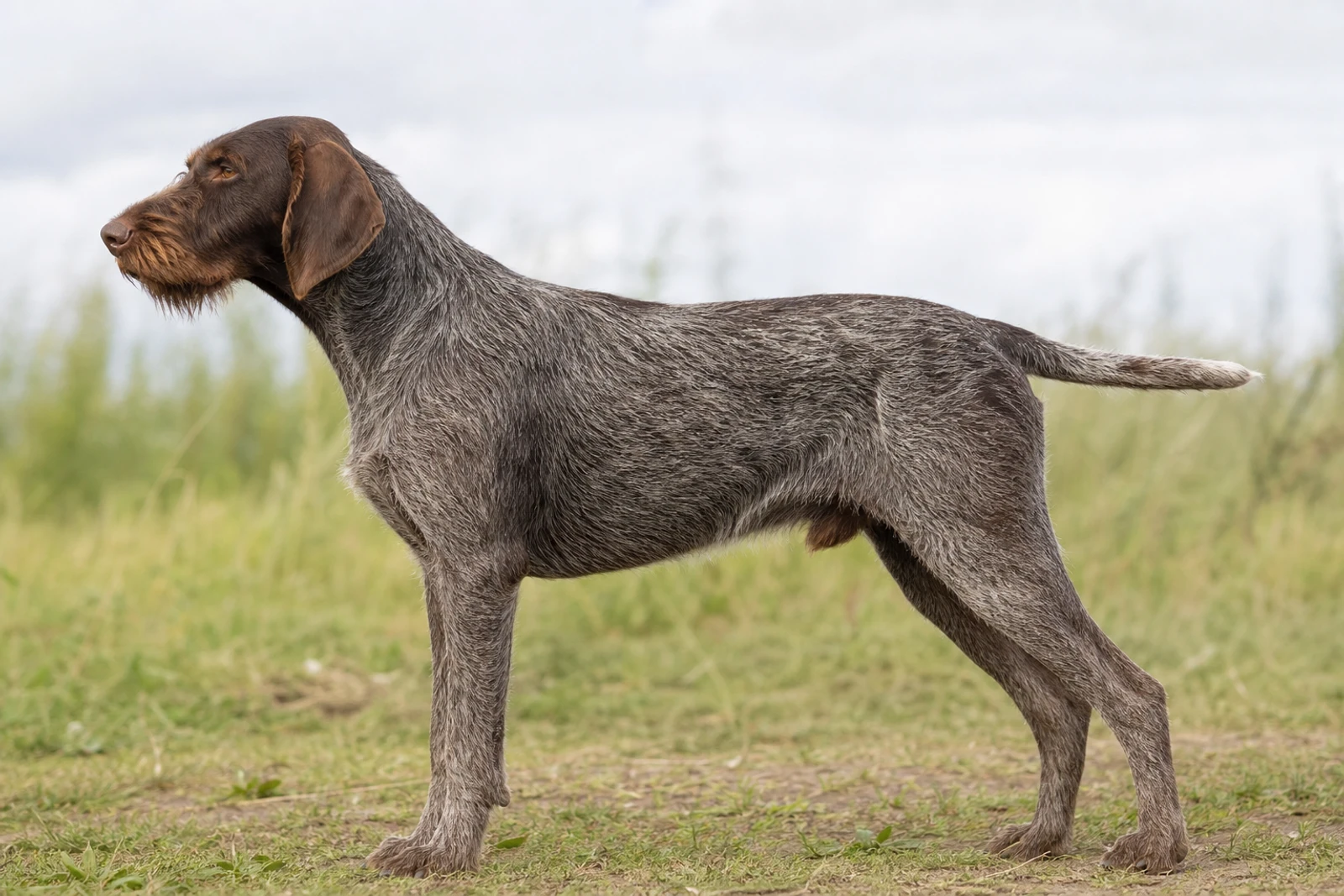
The Slovakian Rough-haired Pointer is a versatile hunting dog renowned for its endurance, intelligence, and unwavering loyalty. This medium-to-large breed sports a wiry gray coat that offers protection in rough terrain. Bred to work closely with humans, it forms deep bonds and thrives on companionship and consistent training. With a high energy level, it requires ample daily exercise and mental stimulation, making it best suited for active outdoor enthusiasts. While gentle and affectionate with family, its hunting instincts demand early socialization with smaller pets. This breed excels in rural settings but adapts if its exercise needs are met.
At a glance
- Size
- Giant
- Height
- 22–27 in
- Weight
- 55–77 lb
- Life span
- 12–14 years
- Coat colors
- Gray, Gray with brown markings
- Coat type
- Rough double coat
How much does a Slovakian Rough-haired Pointer cost?
Adopt / rescue
$75–$400
Usually includes spay/neuter, first shots, and a microchip.
Buy from a breeder
$700–$2,000
From a reputable, health-testing breeder.
Approximate USD. Prices vary widely by region, breeder, pedigree, age, and coat colour — adopting is the lower-cost and recommended route. Avoid suspiciously cheap “breeders”; they’re often puppy mills.
Estimate the full cost of a Slovakian Rough-haired Pointer →Want the ongoing number? Estimate the monthly food bill for a Slovakian Rough-haired Pointer with our dog food cost calculator.
Slovakian Rough-haired Pointer photos
Views
Front, side, rear and top — the full silhouette.Poses
How the breed sits, lies, moves and plays.Puppy to senior
The breed across its whole life.Expressions
The breed’s range of moods.Close-up details
Eyes, ears, nose, paws, tail and coat.Coat colors
The breed’s recognized colors.Click any photo to enlarge. We show the Slovakian Rough-haired Pointer from every angle — three views, poses, life stages, expressions, close-ups, coat and colors.
Appearance & size
The Slovakian Rough-haired Pointer is a no-frills working dog with a rectangular, athletic frame built for endurance rather than flashy speed. He stands 22 to 27 inches at the shoulder and weighs between 55 and 77 pounds—large enough to push through thick cover all day, yet lean and efficiently muscled to stay sound into his early teens.
His coat is what you notice first. It’s harsh, wiry, and dense: a straight, flat guard coat 1.5 to 2 inches long, backed by a fine, insulating undercoat that handles thorns, cold water, and miserable weather without complaint. The color is a unique grizzle—each hair is a blend of brown and gray, so the dog reads as a brown-gray roan overall. Solid brown patches on the head, back, or flanks are common, and a small white star on the chest or a white toe is perfectly normal. A liver-brown nose, deep-set amber to dark brown eyes, and thick, rough eyebrows frame the face, along with a pronounced beard and mustache that give him an old-timer’s sage expression. The ears hang flat and close to the head, set just above eye level, with gently rounded tips.
From the front, you get a broad skull, a moderate stop, and a strong, rectangular muzzle—never snipey. The rough brows sit well apart over intelligent eyes, and the chest is deep and wide without looking bulky. Viewed from the side, the body’s real proportions emerge: he’s about 10–12% longer from breastbone to buttocks than he is tall at the withers. The neck arches slightly into well-laid-back shoulders, a short, firm back, and a broad, powerful loin. The chest reaches all the way to the elbows, and the belly tucks up just enough to keep the silhouette clean. From the rear, the hind legs stand straight and parallel with thick, well-defined thighs, moderate angulation at the stifle, and low-set hocks. The tail—often docked by a third where legal, otherwise left natural—is a thick, tapered brush set moderately high and carried at or a little above the topline when the dog is keyed up.
Nothing about his build exaggerates or shouts; every inch reads “all-day hunter.”
History & origin
The Slovakian Rough-haired Pointer isn’t an ancient breed. It came together after World War II, when a group of Slovak breeders saw a need for a hard-hunting pointing dog that could handle the Carpathian Mountains’ rough terrain, dense forests, and icy water. Koloman Slimak, a dedicated hunter and cynologist, led the effort starting in the 1950s. His goal was straightforward: build a tireless, versatile gundog with a coat that shrugged off cold, wet brush and a temperament steady enough to work closely with a handler.
Slimak and his colleagues crossed three established rough-coated breeds: the German Wirehaired Pointer, the Weimaraner, and the Czech Fousek (the Bohemian Wirehaired Pointing Griffon). Each contributed something essential. The German Wirehaired Pointer passed on a strong pointing instinct and a harsh, weather-resistant coat. The Weimaraner added tracking ability, a sharp nose, and that distinctive silvery-gray color that many of today’s dogs still show. The Fousek brought local hardiness and a calm, cooperative nature well-suited to the region. From these roots, breeders selected for a medium-to-large dog with a deep chest, a powerful build, and a dense, wiry double coat — a dog that could point, track wounded game, and retrieve from water without hesitating.
The breed developed through the 1960s and 1970s under the name Slovenský Hrubosrstý Stavač. The Fédération Cynologique Internationale (FCI) granted full recognition in 1985, and the United Kennel Club followed suit in the United States. Even with formal recognition, the Slovakian Rough-haired Pointer stayed a working dog first. You’ll find most of the population in Slovakia and neighboring countries, often in homes of active hunters who appreciate a pointing breed that doesn’t specialize narrowly but does it all — upland birds, waterfowl, and big-game tracking.
Today the breed remains relatively rare outside Central Europe. A small but passionate community of owners in North America and elsewhere keeps the lines alive. While a few dogs transition into active family life, the breed’s identity is still firmly tied to its original purpose: a rugged, no-nonsense hunting partner built for long days in punishing terrain. If you’re after a piece of living gun-dog history that’s more niche than a German Wirehair, this is it.
Temperament & personality
Despite the “giant” label, this is a 55–77 pound dog who tops out around 27 inches—solid, not towering. You’re really getting a two-speed companion: a relentless, scent-obsessed worker outdoors and a calm, affectionate shadow once you step inside.
His fuel gauge runs hot. A couple of laps around the block won’t cut it. Plan on a solid hour to 90 minutes of off-leash running, swimming, or long-line tracking every day. Give him that outlet and he’ll settle quietly at your feet while you cook dinner. Shortchange the routine, and that unused drive leaks out as restlessness—chewed baseboards, fence pacing, or a hobby of dismantling couch cushions. From puppyhood on, the Rough-haired Pointer chews to soothe teething gums and later to keep his jaws strong. Invest in tough chews and teach the house rules early; a homemade citrus spray (boiled peels) can steer him away from chair legs without a fight.
With his own people, he’s famously gentle. Expect a dog who leans his weight against your leg, rests a heavy head on your knee, and follows you with soft, watchful eyes. Affectionate but not needy—unless you leave him isolated for long stretches. Alone for hours without training, he’s prone to anxiety-driven barking that sounds like a guard dog but is really just a bored plea for company. He’ll alert to an unfamiliar knock, but his default is curiosity, not aggression. That 26-inch frame and steady gaze act as a deterrent without crossing into menace.
He thinks for himself, a trait that shines in the field but demands respectful, consistent handling at home. You’ll get far more cooperation by showing him what you want than by clamping down hard. Firm and fair works; force backfires with a dog this smart.
Early socialization makes the difference around kids and other pets. Raised together, he’s patient and tolerant. Meeting a strange dog, his body language is your early-warning system. A stiff posture and a hard stare signal tension, while a relaxed stride and soft eyes mean he’s at ease. Watch his center of gravity: a forward lean usually says “let’s go sniff” rather than “I’m looking for trouble,” but you still read it in context. A quick lip lick, a yawn, or a head turn—those are calming signals that mean he’d like the pressure to drop a notch.
House training usually clicks fast if you make the rules plain. Like any dog, he may urine-mark to lay down scent cues, especially in spaces that don’t smell like family. Take him straight outside after sniffing and reward the spot-on potty with a treat immediately. If he has an accident indoors, clean it with a vinegar spray (white or cider) to erase the smell completely; otherwise that scent can trigger a repeat performance.
One quirk from his hunting ancestry: he may roll in the most obnoxious-smelling thing he finds. Whether it’s a rotting fish or worse, consider it a stinky souvenir he just had to bring home. A bath handles it. The calm, brave, gentle nature this breed is known for is a tendency shaped by breeding and upbringing, not a stamped guarantee. Meet his work drive and you get a steady, two-speed dog who can tear through a field at dawn and snore on the rug by noon.
Good with kids, dogs & other pets
A Slovakian Rough-haired Pointer who grows up with kids usually turns into a patient, steady shadow. The breed’s natural non-aggressive streak runs deep — you won’t see the hair-trigger defensiveness some working lines carry. That said, a 55–77 lb dog can knock over a toddler just by leaning in for a snuggle, so keep an eye on those enthusiastic greetings. Teach children to read canine body language (a hard stare, a yawn, a turned head) and never let them crawl on a resting dog. The payoff is a family dog who’ll follow your kids through the woods and then crash on the couch right next to them.
With other dogs, they tend toward easygoing. Most will happily coexist with a housemate dog and enjoy a good off-leash romp, provided the introduction isn’t forced. The catch is that their pointing and retrieving heritage means they can fixate on motion. That’s where cats and small furry pets come in. A pup raised alongside a cat from 10 weeks old often learns to watch without chasing; an adult introduced to a free-roaming rabbit is a complete unknown. Use baby gates and a solid “leave it,” and never trust them unsupervised until you’ve seen weeks of calm disinterest.
The real linchpin here is early, positive exposure — and lots of it. The socialization clock ticks loudest between 3 and 16 weeks. That’s when the puppy needs to meet gentle kids, confident but polite adult dogs, and a variety of people in hats, on bikes, and pushing strollers. Skip this, and you risk a dog who spooks at novel sounds or gets snappy out of fear. A dog with this breed’s size and stamina can’t afford those holes in his foundation. Even after the window closes, you can build confidence with gradual, reward-based training, but forcing an already-hesitant adult into chaotic dog-park greetings only adds stress and can provoke a fight. Quality interactions always beat quantity.
One more thing: these pointers are built for companionship, not solitary confinement. Leaving one alone in a yard all day while the family’s inside erodes the very tolerance that makes them good with children and other animals. Loneliness festers into barking, digging, or a dog who’s too wound up to settle calmly when the household is finally together. Integrate him fully — beside you in the living room, under the table during dinner — and that patient temperament stays intact.
Trainability & intelligence
This is a dog that learns fast when the payoff is clear. The Slovakian Rough-haired Pointer was built to work closely with a hunter, reading body language and responding to subtle hand signals at hundreds of yards. That genetic wiring means most individuals pick up new commands in fewer repetitions than the average retriever. But that same intelligence means they won’t waste energy on a handler who’s inconsistent or heavy-handed. You’ll see much faster progress if you treat training as a conversation, not a lecture.
Your pointer’s eagerness to please is real, but it’s tied directly to your relationship. He’ll run through a brick wall for someone he trusts; coercion just makes him shut down or dig in his heels. Use what he loves most — a thrown bumper, a quick game of tug, the chance to sprint — as the reward for a job well done. A dry biscuit and a pat won’t cut it when his nose has locked onto a running pheasant. Build a history of you being the most interesting thing in the field, and recall will stick even when temptation is high. Without that history, expecting a reliable off-leash return is wishful thinking.
The breed’s independent problem-solving side can look like stubbornness if you mistake it for defiance. He’s not blowing you off; he’s calculating whether coming now is more rewarding than following that scent trail. That’s why you want to start young and stay patient. The 3-to-14-week window for socialization isn’t optional — it’s when you imprint that new people, rattling trucks, and strange dogs are normal, not threats. A poorly socialized pointer of this size and drive can become a reactive, anxious handful by adolescence.
Consistency across all family members matters more here than with a softer breed. Decide on your cues, your release words, and what’s allowed, then stick to them. A “sometimes off the couch” rule just teaches him to check who’s watching. Positive reinforcement that marks the exact moment he gets it right — with a click or a quick “yes” followed by a high-value reward — will shape reliable behaviors without dampening his natural enthusiasm. Punishment-based corrections backfire badly; they erode the trust that this dog’s entire working ability depends on.
If you want a dog that can master advanced field work, scent detection, or competitive obedience, you’re in good company. Just remember: you’re partnering with an athlete who thinks. Short, focused sessions that end on a win will out-perform hour-long drills every time.
Exercise & energy needs
Plan on giving this dog a job every day. The Slovakian Rough-haired Pointer was built to hunt across rough terrain from dawn to dusk, and a couple of short leash walks won’t even scratch the surface. Count on at least 60 to 90 minutes of hard exercise, ideally split into two sessions — one in the morning, one in the evening. A leashed jog or a brisk neighborhood walk is a fine warm-up, but the real requirement is off-leash running, swimming, or fieldwork where he can stretch out and use his nose.
Physical effort alone rarely settles this breed’s mind. Tie exercise to a purpose and you’ll get a far calmer dog indoors. Scent work is your best ally: blind retrieves, tracking games, or searching for a hidden toy in tall grass can wear him out as effectively as an extra mile of running. A solid 20-minute nosework session often takes the edge off faster than another lap around the park.
If you hunt, you already know this dog excels at upland bird work, hunt tests, and field trials. Non-hunters have strong alternatives: scent work trials, agility, dock diving, or canicross. Pointers also take well to bikejoring, but train a bombproof “stop” command first — their prey drive doesn’t switch off just because they’re pulling a bike.
- Puppies and young dogs: Avoid repetitive high-impact work (hard pavement, forced jumping) until growth plates close, usually around 18 months. On soft ground, hiking and swimming are safer ways to meet their energy needs.
- Mature dogs stay active well into their senior years, often 10–12 years old, though you’ll gradually trade marathon runs for longer sniffy walks and swimming to protect aging joints.
Skimp on the mental piece and you’ll see the fallout: restlessness, digging, barking, or chewing drywall. A tired pointer who’s used his brain will curl up quietly at your feet. A bored one will create his own entertainment, and you won’t like what he comes up with.
Grooming & coat care
The Slovakian Rough-haired Pointer’s wiry double coat repels water and shrugs off brambles better than most, but it still demands a weekly routine to manage shedding and keep the skin healthy. A slicker brush with rounded pins is the tool you’ll reach for most often — it cuts through the long, harsh topcoat and pulls dead undercoat to the surface without scraping the skin. During spring and fall, when the undercoat blows out heavily, bump brushing to every other day. If your dog carries a roan pattern (white and liver hairs mixed together), the hair fall can be less obvious on lighter furniture, but the volume is the same — so stay on schedule.
For a working dog, this coat is practically self-cleaning, so overbathing does more harm than good. Shampoo only strips the natural oils that give the hair its rough, weatherproof texture. Bathe him every two to three months, or when he rolls in something truly regrettable. A lukewarm rinse and a gentle, unscented dog shampoo followed by a thorough dry is all you need. A heavy-shedding season bath can help loosen clumps of dead fur; pair it with a deshedding tool and a blow-dry on a cool setting to speed things along.
- Ears: Those drop ears trap moisture and debris fast, especially after a swim or a romp in tall grass. Lift the flap and wipe out the visible ear canal with a damp cloth or a vet-recommended cleaner once a week. A sour smell or head shaking means a vet visit, not a deeper clean at home.
- Nails: A 55–77 lb dog puts real pressure on his paws. Clip nails monthly, or as soon as you hear clicking on hard floors. If you’re nervous about the quick, a grinder gives you more control.
- Teeth: Brush two or three times a week with a dog-specific paste. Tartar buildup starts quietly and leads to expensive extractions, so make it part of the belly-rub routine.
- Paw pads and feathering: Check between the toes for matted fur, foxtails, or burrs after every off-leash outing. A quick comb-through of the leg feathering with a metal comb prevents tangles that can pull and irritate the skin.
Shedding & allergies
That wiry, weather-resistant coat cycles through hair year-round, so a Slovakian Rough-haired Pointer sheds more than you might picture from a scruffy dog. You’ll find short, bristly hairs lodged in couch fabric and truck seats — the stiff texture keeps them from drifting like fine fluff, but they’re still there. Under the harsh outer layer is a dense undercoat, and twice a year — typically spring and fall — they blow that undercoat in a concentrated mess. During these two- to three-week blowouts, daily brushing with a slicker brush or a pin rake becomes non-negotiable if you want to keep the tumbleweeds from taking over your baseboards.
Drool is a minor footnote. After a hard run, before meals, or when they’re panting heavily, a few strings might dangle, but this isn’t a breed you’ll be toweling dry around the clock. The larger daily annoyance is a wet beard. Post-water-bowl, a soaked muzzle can leave a trail of drips across the floor, so keep an old towel handy.
As for allergies: the harsh topcoat traps dead hair and dander until you brush it out, which means less becomes airborne. That can make the breed a reasonable choice for some mild allergy sufferers, but no wirehaired dog is genuinely hypoallergenic. Responsible owners and breeders won’t hand you a guarantee — they’ll push you to spend hours with the parents first. To keep the dander load down, strip or rake out dead coat every few weeks rather than just giving a superficial comb-over. For upkeep, plan on a solid brush-out twice a week, and accept that a lint roller stays in your life — you’ll just burn through sheets slower than you would with a retriever.
Diet & nutrition
A Slovakian Rough-haired Pointer is built to cover ground all day, so what you pour into the bowl directly fuels those working muscles—or, if exercise dips, pads the waistline. Since this is a large breed that can tip toward food obsession, weight control starts with strict portioning from day one.
For an adult in the 55–77 lb range, start with 3 to 4 cups of high-quality kibble split across morning and evening meals. A dog burning serious calories during hunting season or daily field training may need an extra cup; a weekend-warrior lifestyle requires the lower end to keep extra weight off. The real test: you should feel ribs under a thin layer of flesh, not see them, and there should be a visible waist tuck when you look from above.
Why the obsession matters. Even a couple of extra pounds add strain to growing and aging joints. Use a proper measuring cup—not a coffee mug—for every meal. Treats count as calories; swap in small bits of carrot or apple during training and subtract that from the day’s total.
Puppies need four evenly spaced meals until 4 months old, then three meals until 6 months, then the adult two-meal rhythm. Growth should be steady, not explosive. Transition to new foods slowly, starting with lightly cooked, puréed meats, fish, and vegetables or a high-protein commercial puppy formula. Raw chicken wings or necks can be introduced around 12 weeks under supervision—they aid teething and teach healthy chewing habits.
Seniors slow down, so watch the waistline closely. Shift to smaller, more frequent meals if appetite fades. There’s no strong evidence to slash protein; keep feeding high-quality sources to maintain muscle. If teeth get dodgy, purée the meal for better absorption.
If you go the homemade route, aim for roughly 60% meat (raw or cooked), 20–30% fruits and vegetables, and the rest from eggs, yogurt, or digestible grains like pearl barley or white rice. That said, a balanced high-performance kibble works for most families. Steer clear of vegetarian or vegan diets—this breed’s digestive tract is built for animal protein.
At the bowl. A puzzle feeder or snuffle mat turns a gulper into a 10-minute mental workout. Never feed from the table or hand out fatty holiday scraps; a sudden rich meal can trigger pancreatitis in a deep-chested dog. If you’ve got leftovers, put them in the dog’s own bowl after measuring, not from your plate.
Health & lifespan
A 12- to 14-year lifespan is realistic for this big, rugged dog — but only if you stay ahead of a few predictable pressure points. The single most impactful thing you can do is keep him lean. Extra weight punishes the joints of a dog built to cover ground fast, and this breed’s food drive makes portion control a daily discipline.
Screenings that matter
Responsible breeders don’t guess — they X-ray hips and elbows and register results with the OFA or PennHIP. Hip dysplasia and elbow dysplasia are the orthopedic conditions you’ll hear about most, and catching them early on a pre-breeding radiograph is far better than dealing with a limping two-year-old. Also ask about eye clearances. Some pointing breeds carry inherited retinal disorders, so an annual CERF or OFA eye exam is sensible even after you bring your dog home.
Bloat is a real threat
A deep chest and a tendency to gulp food are a dangerous combination. Gastric dilatation-volvulus (bloat) can kill a dog in hours. Split his daily ration into at least two meals, use a slow-feeder bowl, and enforce a solid hour of quiet before and after eating. No running right after breakfast. Know the early signs — retching without producing anything, restlessness, a distended belly — and treat them as a red-alert emergency.
Parasite prevention and routine care
- Rabies vaccination is non-negotiable; it’s legally required and has no cure once symptoms appear.
- Heartworm prevention must be given every month during mosquito season, plus one month after it ends. A missed dose can be the difference between a cheap chewable and expensive, risky treatment.
- Check those drop ears weekly. Moisture gets trapped easily, and a yeasty smell or head-shaking means an infection is brewing. Clean with a vet-approved drying solution, not cotton swabs.
- The rough, dense coat handles cold well but holds heat. In hot weather, exercise him early or late, provide shade and water, and don’t leave him in a parked car for even a minute.
The anxiety-exercise link
This isn’t a houseplant. A bored Slovakian Rough-haired Pointer will bark, chew, or pace himself into a state of chronic stress — and chronic stress depresses the immune system. An hour of hard running or field work each day, plus nose games and training sessions, isn’t a luxury; it’s health care. Pair that with consistent, calm handling from day one, because a dog who learns early that vet exams and nail trims aren’t battles is a dog you’ll actually examine thoroughly when something seems off.
What to watch at home
Subtle changes mean more than dramatic ones. If his appetite drops for two days, he’s stiff getting up after a long nap, or he starts lagging on walks he used to attack, skip the internet diagnosis and call your vet. Schedule a full physical annually through age seven, then twice a year after that. Bloodwork at those senior visits often flags kidney or thyroid issues before you’d notice a symptom.
Living environment
Apartment life is a terrible fit for a Slovakian Rough-haired Pointer. These are big, driven hunting dogs that need room to stretch out and burn off serious energy. A house with a securely fenced yard is the bare minimum—and that fence should be at least six feet tall. A bored pointer with a nose full of squirrel scent doesn’t pause to measure.
The yard itself needs to be more than a postage stamp. They want to run, sniff, and work, so a space where they can flat-out sprint for a few minutes between training sessions matters. Underground digging can become a hobby if they’re left to their own devices, so expect to reinforce boundaries.
Climate and coat
That rough, harsh double coat was built for cold, wet fieldwork. They handle snow, slush, and drenching rain without complaint. Hot weather is where you’ll need to be proactive. Schedule hard exercise for early mornings or late evenings, and always offer shade and water. The coat insulates both ways up to a point, but a 95-degree afternoon is not a time to run drills.
Noise level
These pointers were bred to alert a hunter to game, and that instinct doesn’t turn off at the back door. They’ll announce the mail carrier, the neighbor’s cat, and suspicious-looking leaves with a deep, carrying bark. Training can take the edge off, but a vocal, alert nature is baked in. If you share walls or have a noise-sensitive HOA, this is the wrong breed.
Being left alone
Slovakian Rough-haired Pointers form tight, working bonds with their people. Left alone for a full eight-hour workday—or even a long afternoon—they can spiral into serious separation anxiety. That often shows up as destructive chewing, nonstop howling, or escape attempts that put that six-foot fence to the test. They fit best in a home where someone works remotely, takes the dog along, or has a schedule that breaks the day into shorter stints. Crate training and puzzle toys help fill the gaps, but they’re not a substitute for real presence. If your day-to-day means no yard and nine-hour absences, you and the dog will both be miserable.
Who this breed suits
This dog is for someone who considers a brisk morning run and an afternoon hunt training session just another Tuesday. A Slovakian Rough-haired Pointer is a tireless, honest worker—not a pet that will settle for a leash stroll and a nap on the couch. If your weekends look more like off-trail hiking, duck marshes, or field trial courses, you’re on the right track. They need an owner who can deliver at least an hour of off-leash running, retrieving, or scent work daily, plus brain games inside the house—puzzle toys, hiding scents, or learning new tasks. Without that, you’ll get a creative destroyer.
Best-fit owners
- Hunters and dog-sport enthusiasts who want a versatile gun dog for upland birds, water retrieves, and tracking. This breed thrives on real work and repetition.
- Active singles or couples who run, bike, or hike hard and want a four-legged partner that won’t quit. The double coat handles rough weather well, so you have a year-round adventure buddy.
- Families with older, active children and a securely fenced yard. Deeply bonded, they are gentle with their own kids, but that 60-pound body in full zoomie mode can topple a toddler. Supervise roughhousing and teach the dog a rock-solid “settle.”
Think twice (or three times)
- First-time dog owners. These pointers are smart and independent problem-solvers. They need clear, patient, consistent training from day one, not a novice who’s learning on the fly. A trainer’s help is non-negotiable if you’re new to working breeds.
- Sedentary households or apartment dwellers. Without a large yard and daily hard exercise, frustration sets in fast—expect digging, barking, and chewing. A bored Rough-haired Pointer will dismantle your baseboards while you’re at work.
- Homes with small pets (rabbits, cats, even tiny dogs). Strong prey drive is baked into the breed. Early socialization helps, but the instinct to chase and grab can’t be fully trained out.
- Seniors or those with limited mobility. A dog that can cover miles at a full gallop doesn’t slow down much with age. Unless you’re a retired hunter with acres to roam and the stamina to match, the sheer physical demand will be too much.
If you live for early alarms, muddy boots, and a dog that thinks hardest on the retrieve line, the Slovakian Rough-haired Pointer is a fiercely loyal partner. If your ideal Sunday involves sleeping in and a lazy brunch, steer well clear.
Cost of ownership
Bringing home a Slovakian Rough-haired Pointer is a serious financial commitment that runs well beyond the purchase price. These dogs are large, high-energy, and not particularly common in the U.S., so you’ll want a clear picture of the numbers before you start contacting breeders.
Purchase price: $1,200–$2,500 from a responsible breeder who health-tests for hip dysplasia, eye issues, and other conditions common to working gun dogs. Rare imports or field-trial lines can push that toward $3,000. You won’t find many in rescues, but a well-run breed-specific rescue might charge $300–$500.
Food: Expect a monthly food bill around $70–$90 for a 55–77 lb adult eating high-quality, meat-forward kibble. Performance dogs or those run hard during hunting season burn more calories and can easily top $100. You’re feeding an athlete, not a couch potato.
Vet and preventive care: Annual exams, vaccines, heartworm prevention, and flea/tick control run $400–$600 per year. Factor in a dental cleaning every couple of years and the occasional emergency visit. As a larger breed, Slovaks can be prone to bloat, which may mean a prophylactic gastropexy (typically $500–$1,500) if you opt for it during spay/neuter.
Pet insurance: $45–$65 per month for a comprehensive plan with a decent deductible. Given the breed’s working drive and some hereditary orthopedic risks, skipping insurance is a gamble.
Grooming: The rough, wiry double coat needs hand-stripping two to three times a year to keep its weather-resistant texture. Plan on $50–$80 per session at a groomer who knows wire coats, or learn to do it yourself and invest in tools. Between appointments, a weekly brush and occasional nail trim are all you need.
Training and gear: These pointers thrive on structure. Budget $150–$300 for a puppy obedience class, plus another $100–$200 for a solid recall collar, long line, and a really bombproof crate. Ongoing training or field work adds gas money and club fees if you get into hunting tests.
A realistic monthly budget lands between $160 and $250, not counting the initial purchase or major medical surprises. Over the dog’s 12–14-year lifespan, you’re looking at a total north of $25,000—more if you hunt seriously and travel to events.
Choosing a Slovakian Rough-haired Pointer
Rescue or Responsible Breeder?
This isn't a dog you stumble across at a shelter every day. Slovakian Rough-haired Pointers are rare in the US, so your options come down to a small network of serious breeders or a breed-specific rescue that occasionally has a dog in need. If you want a puppy, expect a wait—responsible breeders typically plan just one or two litters a year, if that. A rescue dog can be a fantastic shortcut to owning the breed, but you'll need to be patient and ready to travel when one becomes available. Either way, start by contacting the national parent club for breeder referrals or rescue contacts.
Health Clearances to Demand
A giant, athletic dog built for all-day hunts owes you complete transparency on joints and eyes. Don't settle for a breeder who says “the vet checked them.” You want to see published results from recognized registries. Ask for:
- Hips: OFA or PennHIP scores on both parents. Look for OFA Good or Excellent, or a PennHIP score well below the breed’s average. “Fair” hips in a parent are a yellow flag if you want a working dog.
- Elbows: OFA elbow clearance. Even minor dysplasia can limp a dog early.
- Eyes: A current CERF or OFA Eye exam—within the last 12 months—screening for progressive retinal atrophy (PRA), hereditary cataracts, and other inherited eye disease.
- Thyroid & Cardiac: Not every breeder tests these, but the most meticulous ones include OFA thyroid panels and a basic cardiac echo, especially for a breed that works hard.
A breeder who hands you a stack of paper with those results isn't being pushy; they're showing you exactly what you're buying into.
Red Flags You Can’t Ignore
The gap between a good experience and a heartbreak often shows up before you ever meet a puppy. Watch for:
- No health clearances you can look up yourself on the OFA website.
- Puppies always available, multiple breeds on the premises, or a deposit that “secures your spot” without any conversation about your lifestyle.
- Letting puppies go before 8 weeks. Ten weeks is even better for a pointer with a strong pack drive.
- A breeder who won't take a dog back for any reason, ever.
- Breeding dogs younger than 2 years—that’s the minimum age for final hip clearances.
- No interest in the parents’ working instinct or temperament. If they don't hunt their dogs or at least test them in field trials, you're rolling the dice on a key breed trait.
Picking Your Puppy
When you finally visit the litter, forget the one that runs straight at you and the one that hides under the whelping box. Focus on the middle-of-the-road pup who investigates you with a wagging tail and recovers quickly from a startling noise. Ask to see the mother (and the sire if he's on-site). She should look fit, move freely, and show a level-headed, approachable temperament—even if she's reserved at first. Puppies raised indoors, exposed to kitchen sounds, crates, and car rides from their third or fourth week onward, transition into your home far more smoothly.
You're looking for a pup with clear, bright eyes, clean ears, and a solid coat without patches of missing fur. The breeder should ask you just as many questions as you ask them—and send you home with a contract, health guarantee, and a promise to be your first call if anything ever goes sideways.
Pros & cons
Pros
- A naturally versatile gun dog that doubles as a steady, loyal family companion — they form intense bonds and are typically gentle and patient with children when given proper exercise and structure.
- Highly trainable for motivated owners: their sharp intelligence and eagerness to work shine in field training, obedience, and tracking, rewarding consistent, positive methods with rapid progress.
- That wiry, rough coat isn’t just for looks — it repels water and dirt efficiently and sheds only moderately. Weekly brushing plus occasional hand-stripping keeps it healthy without salon-level grooming demands.
- A solid lifespan of 12–14 years and overall robust health; responsible breeders screen for hip dysplasia and eye conditions, so you can stack the deck in your favor by asking for clearances.
- Alert and watchful without tipping into aggression — they’ll bark to announce a stranger but settle once you acknowledge the situation, making them a practical, no-fuss watchdog.
- Generally tolerant of other dogs and pets when raised together, though their pointing heritage demands early, ongoing socialization to keep that tolerance rock-solid.
Cons
- This is not a neighborhood stroll dog. Count on a bare minimum of 60–90 minutes of hard, off-leash running, structured field work, or vigorous swimming every day — by a running partner, not a casual walker. Without that outlet, you’ll face chewing, barking, and full-blown indoor restlessness.
- Prey drive is non-negotiable and deep-wired. Squirrels, birds, and outdoor cats will trigger a hard chase, and a reliable recall around small animals takes months of proofing in controlled settings.
- An independent, problem-solving mind built for ranging wide in the field means they’ll test boundaries and can be stubborn, especially as adolescents. First-time owners often find the pushback overwhelming.
- Coat upkeep is breed-specific, not complicated, but it’s not optional. The harsh double coat requires hand-stripping to preserve natural texture and insulation; clipper cuts ruin it and may trigger skin issues. Finding a groomer who knows wire coats can be a hunt itself.
- A large, powerfully built dog standing 22–27 inches and 55–77 pounds with a full-throttle work ethic — apartment living only works if you’re a disciplined athlete with easy access to hundreds of acres of open land.
- They bond so deeply that extended alone time can trigger separation anxiety. A home where someone is around most of the day, or where the dog can be integrated into daily chores and outings, is close to a requirement.
Similar breeds & alternatives
-
German Wirehaired Pointer
The most common look-alike and the breed most people will mistake for a Slovakian. A GWP stands 22–26 inches and can weigh up to 70 lb — often stockier and slightly heavier boned than the Rough-haired Pointer’s 55–77 lb frame. Both have harsh, wiry double coats, but the Slovakian’s furnishings are typically a bit less profuse. Temperament is where they split: GWPs lean more aloof with strangers and can be sharper-edged; the Slovakian tends toward a workmanlike calm with a touch more sociability. If you can’t locate a Slovakian litter, a well-bred GWP from hunt lines will give you the same relentless nose and all-day stamina, just be ready for a dog that blows off leash walks and needs a job. -
Wirehaired Pointing Griffon
Often billed as the softer-hearted wirehair. Griffons are similar in height (20–24 inches) and weight, with a rough, low-shedding coat and the same devotion to water and upland work. Where the Slovakian pushes hard and thrives on pressure, the Griffon works with a steadier, more deliberate pace and typically carries less intensity indoors. That makes the Griffon a good family fit if you hunt on weekends but want a house dog that won’t pace the walls. The trade-off: you lose some of the crackling drive and pointy-end independence a Slovakian brings to the field. -
Pudelpointer
Not a poodle mix, but a purebred versatile gun dog with a similar wiry coat and a 40–70 lb weight range. The Pudelpointer often has a stronger off-switch than the Slovakian — quiet in the house, quick to settle after exercise — and a slightly more cooperative, less stubborn streak in training. If your household wants a rough-haired hunter that won’t constantly test the fencing or demand hard daily runs, the Pudelpointer is worth a look. A Slovakian expects a more active, structured home where the day really gets going on the second mile, not the first.
Fun facts
- Developed in Slovakia from crosses of the German Wirehaired Pointer, Weimaraner, and Czech Fousek.
- Nearly extinct after World War II, but breeders revived it using remaining stock.
- Exceptional scenting ability makes it a prized tracking and search-and-rescue dog.
- Also known as the Slovak Wirehaired Pointer or Slovenský hrubosrstý stavač.
Frequently asked questions
- Are Slovakian Rough-haired Pointers good with children?
- They can be excellent family dogs, typically gentle and patient with kids when properly socialized. Their large size may lead to accidental knocks, so supervision with small children is wise. They tend to be affectionate and protective.
- How much do Slovakian Rough-haired Pointers shed?
- This breed has a dense double coat that sheds moderately year-round, with heavier shedding during seasonal changes. Regular brushing, two to three times per week, can help manage loose fur. They are not considered hypoallergenic.
- How much exercise does a Slovakian Rough-haired Pointer need?
- As an energetic hunting breed, they require significant daily exercise, at least an hour of vigorous activity. Long walks, runs, and mental challenges like scent work are ideal to prevent boredom. Without enough exercise, they may become destructive.
- Can Slovakian Rough-haired Pointers live in an apartment?
- Due to their large size and high energy, they are not well-suited for apartment living. They thrive in homes with a large, securely fenced yard where they can run. With enough outdoor exercise, they might adapt, but space is preferable.
- Are Slovakian Rough-haired Pointers easy to train for first-time owners?
- They are intelligent and eager to please, but can be independent thinkers, so consistent, positive training is important. They may be a challenge for first-time owners without prior dog experience. Early socialization and obedience classes are recommended.
Tools & calculators for Slovakian Rough-haired Pointer owners
Quick estimates tailored to Slovakian Rough-haired Pointers — pre-filled with this breed’s size where it matters.
Articles & stories about the Slovakian Rough-haired Pointer
Sources & standards
This profile follows recognized breed standards from the American Kennel Club (AKC) and the Fédération Cynologique Internationale (FCI), along with established veterinary and breed-club guidance. These describe general breed tendencies — every dog is an individual.