

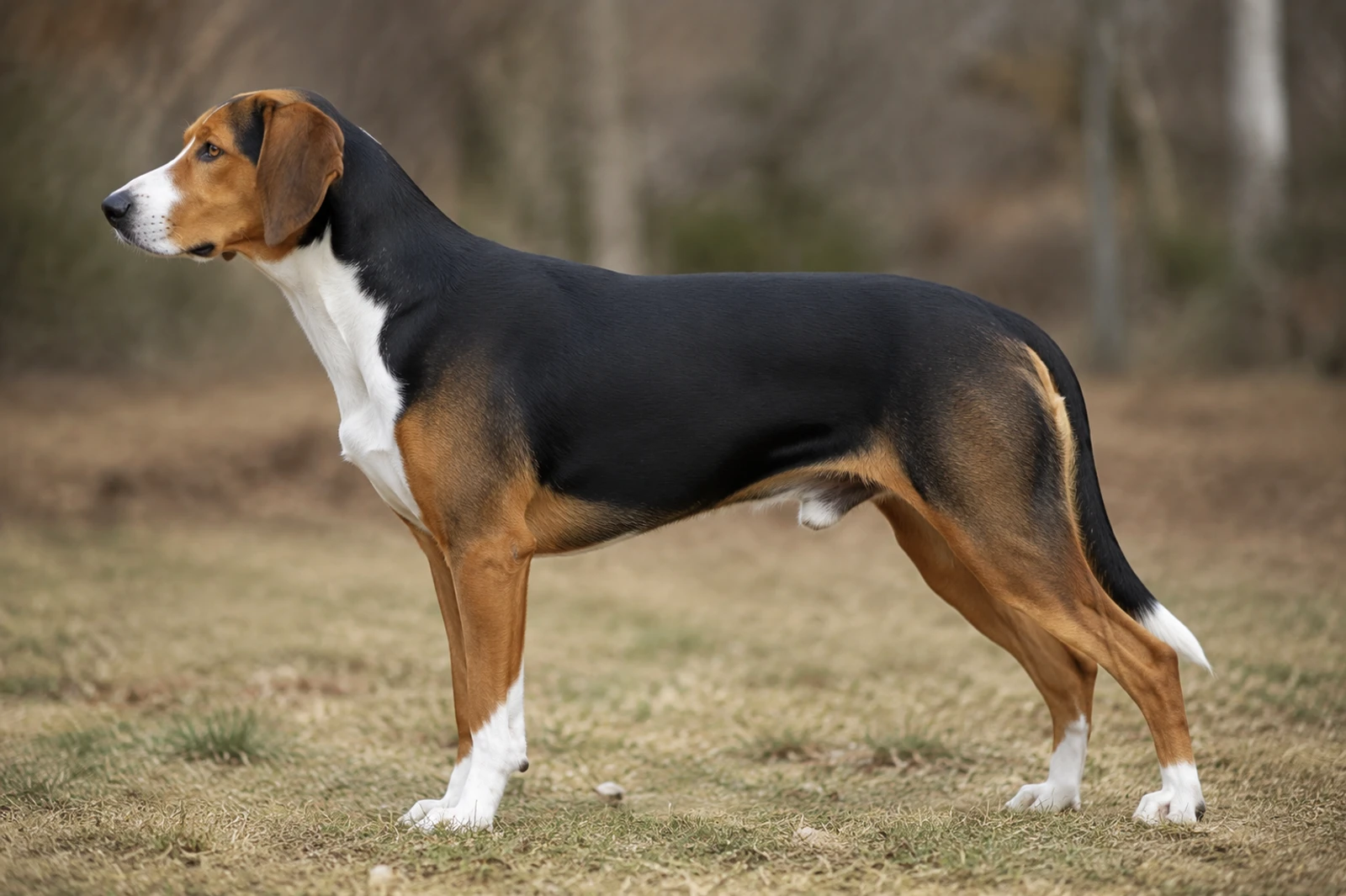
The Smålandsstövare is a versatile Swedish scenthound, originally bred to hunt hare and fox across rugged terrain. This medium-to-large breed (though often classified as medium by size) thrives with active, outdoor-oriented owners who can provide ample exercise and mental stimulation. Loyal and friendly with family, the Smålandsstövare suits experienced dog handlers familiar with independent hound temperaments. They are not ideal for apartment living or first-time owners due to their energy and strong prey drive. With proper socialization, they can coexist with children but may not be trustworthy with small pets. Their short coat is low-maintenance.
At a glance
- Size
- Large
- Height
- 17–21 in
- Weight
- 33–44 lb
- Life span
- 12 years
- Coat colors
- Black and tan, Black, tan and white
- Coat type
- Short, dense double coat
How much does a Smålandsstövare cost?
Adopt / rescue
$75–$400
Usually includes spay/neuter, first shots, and a microchip.
Buy from a breeder
$700–$2,000
From a reputable, health-testing breeder.
Approximate USD. Prices vary widely by region, breeder, pedigree, age, and coat colour — adopting is the lower-cost and recommended route. Avoid suspiciously cheap “breeders”; they’re often puppy mills.
Estimate the full cost of a Smålandsstövare →Want the ongoing number? Estimate the monthly food bill for a Smålandsstövare with our dog food cost calculator.
Smålandsstövare photos
Views
Front, side, rear and top — the full silhouette.Poses
How the breed sits, lies, moves and plays.Puppy to senior
The breed across its whole life.Expressions
The breed’s range of moods.Close-up details
Eyes, ears, nose, paws, tail and coat.Coat colors
The breed’s recognized colors.Click any photo to enlarge. We show the Smålandsstövare from every angle — three views, poses, life stages, expressions, close-ups, coat and colors.
Appearance & size
The Smålandsstövare walks a line between medium and large, but everything about it reads capable. You’re looking at a dog that stands 17 to 21 inches at the shoulder and carries 33 to 44 pounds on a frame that’s surprisingly dense for those numbers. This is a solid, workmanlike hound — never lanky, never delicate — built to push through underbrush all day without coming apart.
From the side, the body is distinctly rectangular: the length from breastbone to rear is about 10% longer than the height at the withers. A deep, well-sprung chest reaches down to the elbows, giving plenty of room for heart and lungs. The back is straight and firm, the loin short and broad, and there’s a moderate tuck-up at the belly. The tail is one of the first things you’ll spot in motion — it’s set high, thick at the base, and carried in a slight saber curve but never curled over the back. A completely straight tail or one that hooks too far forward is a fault.
Head-on, the expression is calm and intelligent, with a clean, wedge-shaped muzzle that’s only slightly shorter than the skull. The stop is well-defined but not sharp. Oval, dark brown eyes sit level and give the dog a steady, no-nonsense look. The ears frame the face: they’re high-set, medium-length, and hang flat and close to the cheeks, broadening slightly at the tips. A narrow, high-set ear or one that pulls away from the head would look wrong here. The nose is black on black-and-tan dogs, liver on liver-and-tan dogs, and always wide open with large nostrils.
The coat is a short, dense double layer that works in any weather. The outer hairs are straight, harsh to the touch, and tight to the body — not soft, not wiry, just hard enough to shed rain and keep burrs from digging in. Underneath, a thick, soft undercoat provides insulation. The breed’s color pattern is remarkably consistent: a base of black and tan, or less commonly liver and tan, with the tan markings appearing above the eyes, on the cheeks, under the tail, and on the lower legs. White is allowed (and common) as a small star on the chest, a white patch on the paws, or a white tip on the tail — but a dog that’s mostly white or heavily patched is not typical. When you watch a Smålandsstövare from behind trotting away, the strong hindquarters and parallel hocks give the rear its driving power, and that white tail tip acts like a flag in the field. It’s a purpose-built silhouette: compact, balanced, and honest.
History & origin
Few sights say “Swedish forest” like a compact black-and-tan hound working a scent line through granite outcroppings and thick underbrush. The Smålandsstövare is that dog — a determined, weather-proof scenthound born out of the rocky, densely wooded province of Småland in southern Sweden. It’s one of the country’s oldest native breeds, with roots that reach back at least to the 1500s.
Farmers and woodsmen needed a versatile hunter that could handle the rough terrain, track hare and fox over long distances, and still be a steady presence at home. They didn’t fuss over pedigree records; they crossed local farm dogs that had spitz-like traits with imported hounds, likely of German, Swiss, or Baltic origin. The result was a muscular hound of moderate size — 33–44 pounds and 17–21 inches at the shoulder — with a dense, close coat that shrugged off snow and rain, and a nose that could unpick a cold trail hours after the quarry passed. Those early Smålandsstövare also developed a reputation as alert property guardians, a job they took as seriously as chasing a fox.
For centuries the breed remained a practical, no-nonsense hunting partner. But by the late 1800s and early 1900s, the picture nearly dissolved. Rail and road opened up Småland, bringing in new dog breeds and different fashions in hunting style. Purposely bred Smålandsstövare numbers plummeted, and the type survived mainly as scattered, unregistered dogs on isolated homesteads.
A handful of enthusiasts at the newly formed Swedish Kennel Club decided the hound was too valuable to lose. In the 1910s and 1920s, they combed the backcountry for the last unspoiled specimens, wrote the first breed standard in 1921, and began a careful revival. The breed got its official name — Smålandsstövare, literally “Hound of Småland” — and the foundation stock that followed cemented the features we see today: a square, sturdy frame; those expressive, slightly pendant ears; and a black-and-tan coat with permissible white markings on the chest, paws, and tail tip.
The Smålandsstövare remains a rare breed by international standards, with the vast majority of dogs still living and working in Sweden. Outside its homeland, you’ll find only small pockets of enthusiasts. What the breed didn’t lose through its brush with extinction is its work ethic. A Smålandsstövare today hunts the same kind of terrain for the same sort of game, tracking with a ground-covering trot and a deep, resonant voice that carries through pine forest exactly as it did four hundred years ago.
Temperament & personality
At heart, the Smålandsstövare is a two-speed dog: methodical and tireless on a scent trail, but surprisingly calm and easygoing once you’re both indoors. He stands 17 to 21 inches at the shoulder and carries 33 to 44 pounds of lean muscle—enough substance to handle rough terrain, not so much that he bowls over small kids.
Indoors, you’ll get a dog who values a soft bed and a quiet corner, provided his exercise needs have been met. He’s affectionate without being needy; a nudge of the nose or a chin on your knee is his version of a hug. He won’t shadow you from room to room, but he’ll check in and enjoy a solid snuggle session on the couch.
That calm facade melts the moment you step outside. He was built to hunt hare and fox independently under harsh Scandinavian conditions, so his nose is always running. Expect him to follow scent trails with intense focus, sometimes forgetting you exist. This independent streak means training can’t rely on blind obedience. Strong-willed dogs like this one respond best when you engage them with respect and consistency—not force. If you push too hard, he’ll just dig in his heels.
A watchful presence
Bred to work alone in the woods, he’s naturally alert and vocal. A Smålandsstövare will sound the alarm when someone approaches the house, making him a reliable watchdog. But left alone for long stretches without mental stimulation, that same voice can turn into boredom barking or howling. Neglect and isolation often lead to anxiety-driven noise, so plan on having someone home or providing good daycare.
Living with a scent hound
Scent rules his world. Indoors, that means he may feel compelled to mark—especially if he catches a whiff of another dog’s urine. Uncured accidents become a self-fulfilling prophecy because the smell cues him to re-soil the same spot. A vinegar-based cleaner (white and cider vinegar) kills the odor and discourages repeat marking; it also works as a chewing deterrent. For table legs and such, a simple citrus spray from boiled peels can steer his mouth elsewhere. Puppies chew to explore and soothe teething pain, while adults work hard objects to keep jaws strong and teeth clean, so provide plenty of approved chews.
He’s also a connoisseur of stink. Don’t be surprised if he finds a rotting carcass or another dog’s droppings and dives in shoulder-first. This likely traces back to his scavenger ancestors—some dogs just enjoy the perfume, and others may be trying to advertise a rich food source to the pack. It’s gross, but it’s honest.
Body language worth learning
Because he can be reserved and independent, it pays to read him correctly. A forward lean with a stiff posture and a hard stare means trouble might be brewing; back off and redirect. A relaxed, loose body and soft eyes say he’s content. Lip licking, yawning, or turning his head away are calming signals that tell you he’s feeling pressured—ease up. And never, ever bother him when he’s eating. Even the gentlest dog can develop food guarding if his meals are interrupted, so teach children to give him peace at mealtime.
With an average lifespan of around 12 years, the Smålandsstövare is a loyal, quirky partner for an active family who appreciates his workmanlike drive and easy indoor manners. He’s not an entry-level dog; his independence and high exercise needs can overwhelm a first-timer. But if you’re ready to put in the miles and meet him on his terms, you’ll get a steady, honest companion who’s as content trotting through the forest as he is lounging at your feet.
Good with kids, dogs & other pets
Kids
A Smålandsstövare’s patient, steady temperament fits naturally into a family with kids. He’s generally gentle with respectful handling. At 33 to 44 pounds, he’s sturdy enough for the jostle of daily life but not so heavy he’ll bowl over a toddler by accident. These dogs bond tightly to their people – they don’t do well left alone for hours or banished to the backyard. They need to be in the middle of the household action. Introduce your puppy early and often to well-behaved children of various ages to cement that calm outlook. Always supervise dog-and-kid interactions, no matter how sweet the dog.
Other dogs
Bred to hunt in packs, Smålandsstövare usually greet other dogs with an easy, friendly attitude. They settle in well as part of a multi-dog home when socialization starts young. Keep an eye on high-value situations – a dropped treat or an irresistible scent can spark a scuffle. Off-leash parks are risky; a hot trail shuts down recall fast. Practice off-leash skills in securely fenced areas until you trust the nose’s pull won’t win.
Cats and small pets
Honesty is essential here. The Smålandsstövare was built to trail foxes and hares, so a fleeing cat, rabbit, or squirrel can ignite a chase that’s tough to break. Some dogs coexist with a cat they were raised alongside, but the peace is fragile. Supervision must be constant, and separate living spaces are your backup plan. In a home with free-roaming small animals, this breed is a very high-risk choice. If you have outdoor cats or backyard chickens, a secure fence and a drag line are bare minimums.
Trainability & intelligence
A Smålandsstövare learns anything that leads to a reward, but she’ll also decide for herself whether she’d rather follow that interesting scent instead. She’s an intelligent, independent hound — bred to track game for miles — so training is about building a partnership on trust, not just drilling commands.
What motivates her
Food. Almost always. Use small, smelly treats like cheese, freeze-dried liver, or meat rolls during sessions, and keep her absolute favorite reserved for high-distraction practice. Play and a genuinely cheerful “Good dog!” work too, once you’ve bonded — but the fastest learning happens when her stomach is involved.
Start early and stay positive
Begin puppy training the day she comes home. The critical socialization window closes around 14 weeks, so before then, expose her gradually to kids, strangers, different floor textures, traffic sounds, and friendly dogs. Every new experience needs to feel safe and rewarding. An under-socialized Smålandsstövare can grow up skittish or reactive — this part is non-negotiable.
Drop any thought of yanking, yelling, or punishment-based methods. With this breed, that erodes the trust you’re working to build. A clicker or a short marker word (“yes!”) tells her exactly which behavior earned the treat. She’s sharp; she’ll connect the dots quickly when you’re consistent.
The recall challenge
The nose rules everything. If she catches a scent on a hike or even in the backyard, your voice can become background noise. That’s not defiance — it’s genetics. A reliable recall takes months, sometimes years. Practice on a long line in calm areas, reward like you just won the lottery when she comes back, and never punish her for finally returning. Until she’s bombproof, keep her leashed or in a securely fenced area.
Leash manners and everyday structure
At 33–44 lb of compact muscle, she’s strong enough to pull, so loose-leash walking deserves early attention. Teach her that walking politely beside you earns a steady trickle of treats. Pair this with simple commands — sit, wait, off — to build a routine of polite behavior. Short, varied sessions work best: five minutes a few times a day beats a single long slog.
Keep rules clear and consistent. Smålandsstövare repeat behaviors that pay off for them. Patience, positive reinforcement, and a well-managed environment (baby gates, fenced yards) will help you raise a cooperative, happy dog who still gets to follow her nose in safe ways.
Exercise & energy needs
Plan on at least 90 minutes of movement every day, divided into two sessions. The Smålandsstövare was built to track game over rocky, wooded Swedish terrain, so a quick stroll around the block won’t cut it. Aim for a solid 45–60 minutes in the morning and another 30–45 minutes in the afternoon, mixing off-leash running in a secure area with long, sniff-heavy hikes.
Intensity matters as much as time. This dog wants to work. Straight-line jogging may leave him bored; instead, choose trails with elevation changes, let him follow scent trails, or set up hiding games with a favorite toy. A tired nose makes for a settled house hound. Pair physical work with mental tasks: puzzle feeders, scent detection games, and even hiding treats in the underbrush on a walk. These sessions tap into the breed’s true purpose and keep him from inventing his own entertainment—like dismantling the sofa or serenading the neighbors.
Short, frequent bouts often beat one marathon outing. If your schedule is packed, break the 90 minutes into three 30-minute walks paired with indoor nose-work puzzles. Watch the tail and ears: when the dog is still amped after a walk, add a 10-minute training drill to burn mental energy.
Steer clear of repetitive high-impact exercise on pavement while young joints are developing—trail surfaces and grass are kinder. A fit adult Smålandsstövare can handle rugged terrain easily, but avoid forced jumping onto hard surfaces.
Without enough daily outlet, you’ll see restlessness, howling, and obsessive sniffing indoors. A tired, mentally satisfied hound curls up calmly at your feet, no destructive antics required.
Grooming & coat care
The Smålandsstövare carries a short, dense double coat that’s built for all-weather hunting, which means your grooming routine is refreshingly simple — until the shedding season hits. Week to week, a quick once-over with a bristle brush is all you need to pull dead hair and distribute natural oils across that harsh, tight outer coat. The natural pig bristles grab loose debris without irritating the skin and leave a nice, healthy shine behind.
When the undercoat decides to let go in spring and fall, though, you’ll want to swap that brush for a rubber curry comb or a grooming glove. These will strip out the drifting clouds of fluff before they end up on your couch. Daily brushing for about 10 minutes during the heavy shedding window keeps the mess manageable and stimulates the skin — an easy trade-off for a dog this size.
- Bathing: Rare. Only when your dog has rolled in something truly memorable. Too-frequent baths strip the coat’s protective oils, which help repel dirt and moisture in the field.
- Trimming: None. This breed’s coat is meant to stay as-is. No fancy clips, no feathering to neaten.
- Nails: Check every 3-4 weeks. Active dogs often wear nails down naturally, but if you hear clicking on the floor, it’s time for a trim.
- Ears: A quick peek and a wipe after every outing in the brush or woods. Those drop ears can trap moisture and debris, setting the stage for a minor infection.
- Teeth: A few times a week. A finger brush with dog toothpaste goes a long way toward preventing tartar buildup as the years stack up.
Your Smålandsstövare’s coat condition also reflects the life he leads. Regular outdoor activity — real running, not just a yard stroll — boosts circulation and promotes healthy coat turnover, which in turn reduces stress-related shedding indoors. Keep him moving, and that simple bristle brush will stay your primary tool for the rest of the year.
Shedding & allergies
If you picture a short-coated dog dropping just the occasional hair, the Smålandsstövare will quickly reset your expectations. That dense, harsh double coat — built to protect a scent hound working through Scandinavian brush — sheds steadily all year and kicks into overdrive twice a year.
Year-round, you’ll find coarse, dark guard hairs woven into upholstery and clinging to clothing. It’s not a constant blizzard, but it’s persistent enough that a quick swipe of your hand down the dog’s side leaves you with a visible fistful. Then comes the seasonal blowout. During spring and fall, the undercoat loosens in clumps and can cover your floors in tufts. For a few weeks each cycle, expect to vacuum daily and brush the dog outdoors at least three or four times a week to get ahead of it. A rubber curry brush or a slicker followed by a metal comb does the heavy lifting. Baths during the worst of it help loosen the dead undercoat, but you’re still going to live with hair everywhere.
Drool, at least, isn’t part of the deal. This is a dry-mouthed breed. You might see a drip after a long drink, but you won’t be wiping slobber off walls or furniture.
As for allergies, no short-haired dog with a seasonal undercoat shed is a safe bet. The Smålandsstövare produces plenty of dander and saliva proteins, the real triggers for most allergic reactions. Calling any dog “hypoallergenic” is marketing, not biology. If someone in your home has dog allergies, spend time with adults of the breed before committing — and know that the twice-yearly coat dump will likely be the hardest stretch to manage.
Diet & nutrition
A Smålandsstövare will never turn down a meal, and that’s exactly why you need to be the one in charge of portions. This is a compact, muscular hound that packs on pounds easily—extra weight stresses joints and can cut into that impressive 12-year lifespan. Feed the dog in front of you, not the one the bag describes.
Feeding amounts by age and size
- Puppy (8 weeks–4 months): Four evenly spaced meals a day. Start with a high-quality commercial puppy food or gradually switch to lightly cooked, puréed meats, fish, fruits, and vegetables. Around 12 weeks, you can introduce raw chicken wings under supervision.
- 4–6 months: Drop to three meals daily.
- 6 months and older: Two meals a day works for most adults.
- Adult (33–44 lb): Expect to offer about 2–3 cups of quality dry food daily, divided into morning and evening portions. That amount shifts based on exercise—a dog running hard in the field will need more fuel than a weekend walker. Watch the rib cage: you want to feel ribs with a thin fat cover, not see them sharply or lose them under a blanket of padding.
- Senior: As the dog slows down, cut calories gradually. Smaller, more frequent meals are easier on an aging digestive system. Puréeing food helps when teeth go missing. Don’t reduce protein without a vet’s advice; there’s little evidence that healthy seniors need less.
What goes in the bowl
Aim for a diet that mirrors a hound’s carnivore-leaning system: roughly 60% raw and cooked meat, 20–30% fruits and vegetables, and about 10% other ingredients like eggs, plain yogurt, or grains. Pearl barley makes a digestible, high-fiber carbohydrate. White rice is a bland fallback for an upset stomach. Cook extra batches of grains or vegetables and freeze portions so you always have a base for a quick meal.
This breed often inhales food. A puzzle bowl or food-dispensing toy turns mealtime into a few minutes of mental work and prevents gulping air. Blending or lightly processing meals can improve nutrient absorption since dogs lack salivary digestive enzymes and their jaws move only up and down.
Weight management and pitfalls you can’t ignore
Obesity is the quiet threat here. Even a few extra pounds strain the spine and joints of a dog bred to move all day. Measure every scoop with a real measuring cup—not a coffee mug—and subtract treat calories from the daily total. Never free-feed.
Table scraps create beggars, and rich, fatty foods can trigger pancreatitis. Serve any leftovers in the dog’s own bowl, away from the dinner table. If you make a batch of unsalted vegetable cooking water, use it as a broth for kibble. Skip vegetarian or vegan diets entirely; a dog’s physiology demands meat-based nutrients to thrive.
Health & lifespan
A healthy Smålandsstövare typically reaches 12 years—a respectable innings for a working hound. The breed doesn't carry a long list of alarming genetic conditions, but that doesn't mean you can skip prevention.
Like many medium-to-large dogs, they can be prone to joint problems such as hip or elbow dysplasia. Responsible breeders screen parent dogs for these issues and may also test for hereditary eye diseases—ask to see the documentation. Keeping your dog at a lean 33–44 lb is one of the most effective ways to protect those joints and add extra seasons to their life. These are food-motivated dogs, so it’s easy for a few extra pounds to creep on if you’re not measuring meals and keeping treats in check.
Their dense, coarse coat evolved for tracking game through Scandinavian winters, which means they handle cold better than heat. In warm weather, move exercise to early morning or evening, and never leave them in a parked car. The same rugged build that lets them tackle rough terrain all day can mask early signs of an injury—watch for subtle shifts in gait or a reluctance to jump after a hard run.
Preventive care is straightforward but non-negotiable. A monthly heartworm preventive during mosquito season (and one month beyond) is essential. Rabies vaccination is legally required, and there is no effective treatment once symptoms appear. Annual wellness exams let your vet catch issues like early arthritis, vision changes, or skin allergies before they spiral. If your dog lives in a multi-dog household or boards frequently, ask about additional vaccines like kennel cough.
Early socialization and positive handling do more than shape good manners—they head off chronic stress that can suppress the immune system. A Smålandsstövare left isolated or handled harshly may develop anxiety-driven behaviors like obsessive barking. Keep vet visits and at-home grooming calm and matter-of-fact from puppyhood, and you’ll have a dog who tolerates pokes and prods without drama.
Above all, weigh your dog every few weeks, keep the diet tight, and show up for that yearly checkup. A fit, well-cared-for hound can easily make that 12-year mark trouble-free.
Living environment
This isn’t a dog that slides easily into just any floor plan. The Smålandsstövare was built to work a scent trail through Scandinavian forest for hours, so the single most important box to check is secure, room-to-move outdoor space. A house with a stoutly fenced yard is the natural fit — and that fence matters. His nose can override everything, and a squirrel or rabbit on the other side can trigger a single-minded escape attempt or barrier frustration.
Apartments aren’t impossible, but they demand real honesty about your schedule. You’ll need to commit to a minimum of 60–90 minutes of daily exercise, split into at least two sessions. A quick leash walk won’t cut it. Plan for off-leash running in a safely enclosed area, long sniffy hikes, or a couple of 30- to 40-minute outings plus scent games at home. Multiple shorter sessions often suit him better than one marathon walk, especially because his brain needs to work just as hard as his legs.
- Yard must-haves: A physical fence at least 5–6 feet high, with no gaps. He can be a digger when bored, so check the base regularly. Invisible fences don’t deter a dog who’s already locked onto a scent.
- Noise level: Inside the house, he’s typically calm and fairly quiet — not a nuisance barker. But when he hits a scent trail or gets excited in the yard, you’ll hear a deep, ringing bark or howl. Neighbors in close quarters may notice. If you’re gone all day and he’s under-exercised, that voice can become a loneliness soundtrack.
- Being left alone: With enough physical and mental work beforehand, a Smålandsstövare can handle a workday without falling apart. A tired hound who’s had a morning run and a stuffed puzzle toy is much more likely to snooze than redecorate. Without that outlet, restlessness, chewing, and escape artistry are real risks. Building up alone time gradually while you’re still home helps, and so does leaving scent-based enrichment (scatter feeding, hidden treats) when you walk out.
- Climate comfort: Bred for harsh Swedish cold, he’s in his element during fall and winter. A thick waterproof coat handles snow and freezing rain without drama. Hot summers are another story. Exercise early or late, keep the pace easy, and always have water and shade. Above 80°F, long sessions in the sun can push him toward overheating fast.
In practice, this means a Smålandsstövare settles best with an active owner who has a yard and a genuine love for nosework — not just a runner. If that’s you, he’ll turn that steady, moderate indoor energy into a deep-sleeping dog sprawled at your feet by evening, no problem. If the yard is tiny or the day is empty, you’ll be fighting instincts instead of enjoying them.
Who this breed suits
A Smålandsstövare needs an owner who already knows that a tired dog is a good dog—because without real work, this breed invents its own entertainment. You should be a runner, a hiker, a hunter, or someone with acres and a routine that gives the dog a genuine off-leash job several times a week. A stroll around the block won’t take the edge off.
Active families with a securely fenced yard and kids old enough not to be bowled over by a 33–44 lb dog chasing a scent can do well. The breed is generally steady and friendly indoors, but it isn’t a low-key companion. Singles or couples who spend weekends on trails and evenings on scent games or tracking will find a focused, loyal partner. A retiree who still logs five fast miles a day on foot could keep up, but it’s a rare match—most seniors will find the stamina and single-minded prey drive a lot to manage.
Think hard before bringing one into an apartment, a home with cats or rabbits, or a schedule that leaves the dog alone for eight hours. That nose governs everything, and it doesn’t switch off. A Smålandsstövare who catches a whiff of something interesting will tune you out, and a short fence is just a suggestion.
First-time owners often struggle with the independence. These dogs aren’t eager-to-please in the typical sense; they’re problem-solvers bred to make their own decisions in the field. Training takes patience, consistency, and a sense of humor—not harsh corrections. You’ll also need tolerance for barking. Expect a deep, carrying voice that announces every visitor, squirrel, and suspicious leaf.
Without a serious outlet, a bored Smålandsstövare becomes a vocal, fence-testing escape artist. Give it the work it was made for, and you’ll have a calm, even-tempered housemate that can go from a full-throttle run to curling up quietly at your feet.
Cost of ownership
The first number you’ll encounter is the purchase price. A well-bred Smålandsstövare from a breeder who screens hips, eyes, and thyroid — and raises pups underfoot with early scent exposure — typically costs $2,000–$3,500. Because the breed is rare outside Scandinavia, you may wait 6–12 months and add transport costs or a flight to pick up your puppy. A suspiciously cheap ad without documented health clearances is a gamble you don’t want to take; saving a few hundred dollars now can cost thousands in joint repairs later.
Once your dog is home, monthly outlay settles around $150–$250, not counting hunting gear or boarding.
- Food: An adult weighing 33–44 lb eats about 2½–3 cups of high-quality kibble daily. Budget $45–$75 a month, plus $10–$20 for training treats and a joint supplement.
- Vet and prevention: Annual exams, core vaccines, and year-round heartworm/flea/tick protection average $50–$80 a month. Periodic dental cleanings add a few hundred dollars every couple of years.
- Insurance: An accident-and-illness plan runs $35–$60 a month. Owners of this swift, driven hound often carry it — a barbed-wire gash or a torn cruciate during a hunt can land you with a four-figure vet bill.
- Grooming: The short, weather-resistant coat is blessedly low-effort. A rubber curry brush a few times a week and nail trims keep recurring costs under $10 a month. Even a pro groomer every 6–8 weeks only adds $30–$50 per visit.
One-time setup includes a crate, bed, harness, long training line, and safe chew toys ($250–$400). If you hunt, a GPS tracking collar is another $350–$800 — a necessity for a dog that can lock onto a scent and disappear over the horizon. A secure escape-proof fence or a well-built kennel run is often the biggest upfront expense, and it’s non-negotiable for a breed with this much prey drive.
Choosing a Smålandsstövare
If you’ve got your heart set on a Smålandsstövare, plan on working with a serious, health-focused breeder. These Swedish scenthounds are rare in the United States, so chances are you’ll join a waitlist for a well-bred litter. That’s a good thing — it filters out people pumping out puppies for profit without proving their dogs’ soundness.
Ask for OFA or PennHIP hip evaluations, no matter how athletic the parents look. Hips are the big one for a medium-large dog that covers rough ground at a gallop. Elbow dysplasia checks are wise, too; some breeders also screen patellas. Eye exams (CAER) and a full cardiac clearance through a board-certified cardiologist round out the minimum. Since this breed was built to hunt hare and fox all day in Scandinavian forests, don’t be surprised if a breeder also wants to show you field-trial records or hunting titles. Smålandsstövare who work have proven they can breathe easy, move soundly, and handle pressure — the same traits that make a stable family companion.
Red flags to walk away from: no health clearances you can verify in public databases, a litter raised in isolation instead of a busy household, puppies released before eight weeks, and an unwillingness to take a dog back if your situation changes. Run, too, from anyone who markets the breed as “easy” or low-energy. These are intense, independent scenthounds; a puppy from a breeder who won’t honestly talk about prey drive and nose-driven stubbornness is a time bomb in a pet home.
Rescue is a slim chance but possible. A retired hunting dog or young adult occasionally lands in a Swedish breed-club rehoming program or in an all-breed hound rescue that doesn’t even know what it has. You’ll need patience and a good network — join the Smålandsstövare clubs online and let people know you’re looking.
When you do meet a litter, ignore the puppy sprinting toward you and the one hiding in the corner. Look for the middle-of-the-pack pup who investigates you without sprawling her whole body in your lap, then shows interest in a toy or a dragged rabbit pelt before wandering off to sniff something else. That blend of easy confidence and independence is what you want in a dog that’s going to be a thinking partner as much as a pet.
Pros & cons
Pros
- A devoted, even-tempered companion at home. When the workday is done, a Smålandsstövare typically settles right into family life. They form tight bonds and are usually patient and gentle with children they’ve been raised with.
- Manageable medium size. At 33–44 lb and 17–21 inches at the shoulder, they’re sturdy enough for vigorous outdoor days but won’t bowl over a toddler or crowd a small living space.
- Low grooming demands. A short, dense double coat needs a weekly once-over with a brush most of the year. You’ll see a heavier shed twice a year, but a quick session with a rubber curry mitt handles it.
- An honest, straightforward worker. Bred to track hare and fox independently in harsh Scandinavian forests, they’re not clingy. You get a self-assured dog who can problem-solve and won’t shadow you every second indoors.
- Generally robust health. A 12-year average lifespan reflects a breed without a long list of common congenital issues. Responsible breeders screen for hip dysplasia, but overall this is a sound, athletic dog.
Cons
- Intense prey drive is non-negotiable. This is a scent hound built to locate and hold game at bay, sometimes for hours. Expect zero recall reliability around wildlife. A fenced yard and on-leash walks are not optional — a roaming cat or rabbit will override any training.
- You must deliver real exercise — every day. An hour of running or hard-paced hiking is the baseline, not a leisurely stroll. Without it, you’ll get a restless, destructive dog who turns your baseboards into a project.
- They can be noisy and independent. Baying was part of the job description, and they don’t outgrow it. A bored Smålandsstövare will serenade the neighborhood. Training-wise, they’re clever but not push-button; a “maybe later” attitude means you need patience and consistency.
- Not a fit for novice or laid-back owners. The combination of high stamina, stubbornness, and hardwired hunting instinct requires an owner who understands hounds and provides a structured outlet for those drives. First-time dog parents and apartment dwellers will find this breed overwhelming.
Similar breeds & alternatives
If the Smålandsstövare’s combination of rough-weather grit and an honest off‑switch indoors feels almost right, a handful of other scenthounds let you trade one trait for another without losing the nose.
Hamiltonstövare
The closest living relative and the most obvious comparison. A Hamiltonstövare gives you a slightly taller (18–23 ½ inches), noticeably heavier (50–60 pounds) frame and the classic black‑tan‑white tricolor coat, while the Smålandsstövare tops out around 44 pounds and typically wears a darker black‑and‑tan with minimal white. Both are methodical, steady hunters, but the Smålandsstövare’s harsh, close‑lying coat shrugs off thick brush and wet snow better; the Hamilton’s softer, flatter coat needs less stripping and mats less in the house. If you want more dog to grip when you grab a collar and don’t mind a few extra pounds on the leash, start here.
Drever
Think Swedish hound judgment shrunk down for apartment‑adjacent life. The Drever stands only 11–16 inches tall and weighs 30–35 pounds on short, turnout legs, yet it packs the same independent, tracking‑focused brain that won’t quit on a cold trail. The trade‑off is a longer back that makes furniture jumping a real orthopedic risk and a stubborn streak that can rival the Smålandsstövare’s. Where the Smålandsstövare is a square, athletic dog built to cover rough ground all day, the Drever is a more stop‑and‑go hunter that fits a smaller yard — provided you keep its mind busy with scent games.
Finnish Hound
A tricolor cold‑weather cousin that bridges the gap between the two Swedish stövare. The Finnish Hound stands taller (20–24 inches) and heftier (45–55 pounds) than the Smålandsstövare, with a shorter, dense coat that sheds heavily but feels less coarse to the hand. They tend to be slightly more outgoing with strangers and other dogs, while the Smålandsstövare can be more reserved at first. Both need a solid hour of off‑leash running, but the Finnish Hound often settles a little easier in a multi‑dog household if early socializing is done right. Bark volume runs neck‑and‑neck.
Beagle
On this side of the Atlantic, the Beagle is the familiar scenthound that comes closest to the Smålandsstövare’s merry, family‑tolerant nature — in a much smaller, noisier package. A Beagle weighs 20–30 pounds and stands under 15 inches, about half the weight of a Smålandsstövare, and it’s famously harder to recall off a rabbit. Smålandsstövare tend to be quieter indoors and less prone to frantic door‑dashing, and their square, leggy build handles deep snow and rocky terrain far better. If you can manage a louder, craftier escape artist, the Beagle’s smaller size and wider availability might tip the scale.
Fun facts
- The Smålandsstövare is one of Sweden's oldest native breeds, with roots dating back to the 16th century.
- After World War II, the breed nearly went extinct until dedicated breeders revived it.
- This hound is named after the Småland region of southern Sweden, known for its rocky terrain and dense forests.
- Unlike many hounds, the Smålandsstövare hunts silently until it finds its quarry, then gives voice.
Frequently asked questions
- Is the Smålandsstövare a good family dog?
- Yes, the Smålandsstövare tends to be affectionate and patient, making it a good companion for active families. They are typically gentle with children, but supervision is always recommended due to their size and energy. Early socialization helps them get along well with other pets.
- How much exercise does a Smålandsstövare need?
- This breed has high exercise needs and requires at least an hour of vigorous activity daily. Long walks, runs, or scent-based games are ideal to keep them mentally and physically satisfied. Without enough exercise, they can become restless or develop unwanted behaviors.
- Do Smålandsstövare shed a lot?
- Smålandsstövare have a short, dense coat that sheds moderately year-round, with heavier shedding during seasonal changes. Weekly brushing helps manage loose hair and keeps the coat healthy. They are not considered hypoallergenic.
- Is the Smålandsstövare suitable for apartment living?
- Generally, no. This breed is large and energetic, needing plenty of space to move and explore. They tend to bark, which can be an issue in close quarters. A home with a securely fenced yard is more suitable.
- Are Smålandsstövare prone to excessive barking?
- As a scenthound, the Smålandsstövare has a strong instinct to bay and bark, especially when tracking scents or alerting to strangers. With consistent training, the barking can be managed, but it is part of their nature. Potential owners should be prepared for a vocal dog.
- What is the typical lifespan of a Smålandsstövare?
- The average lifespan is around 12 years, which is typical for a breed of its size. Providing proper exercise, nutrition, and regular veterinary care can help ensure a long, healthy life.
Tools & calculators for Smålandsstövare owners
Quick estimates tailored to Smålandsstövares — pre-filled with this breed’s size where it matters.
Articles & stories about the Smålandsstövare
Sources & standards
This profile follows recognized breed standards from the American Kennel Club (AKC) and the Fédération Cynologique Internationale (FCI), along with established veterinary and breed-club guidance. These describe general breed tendencies — every dog is an individual.