

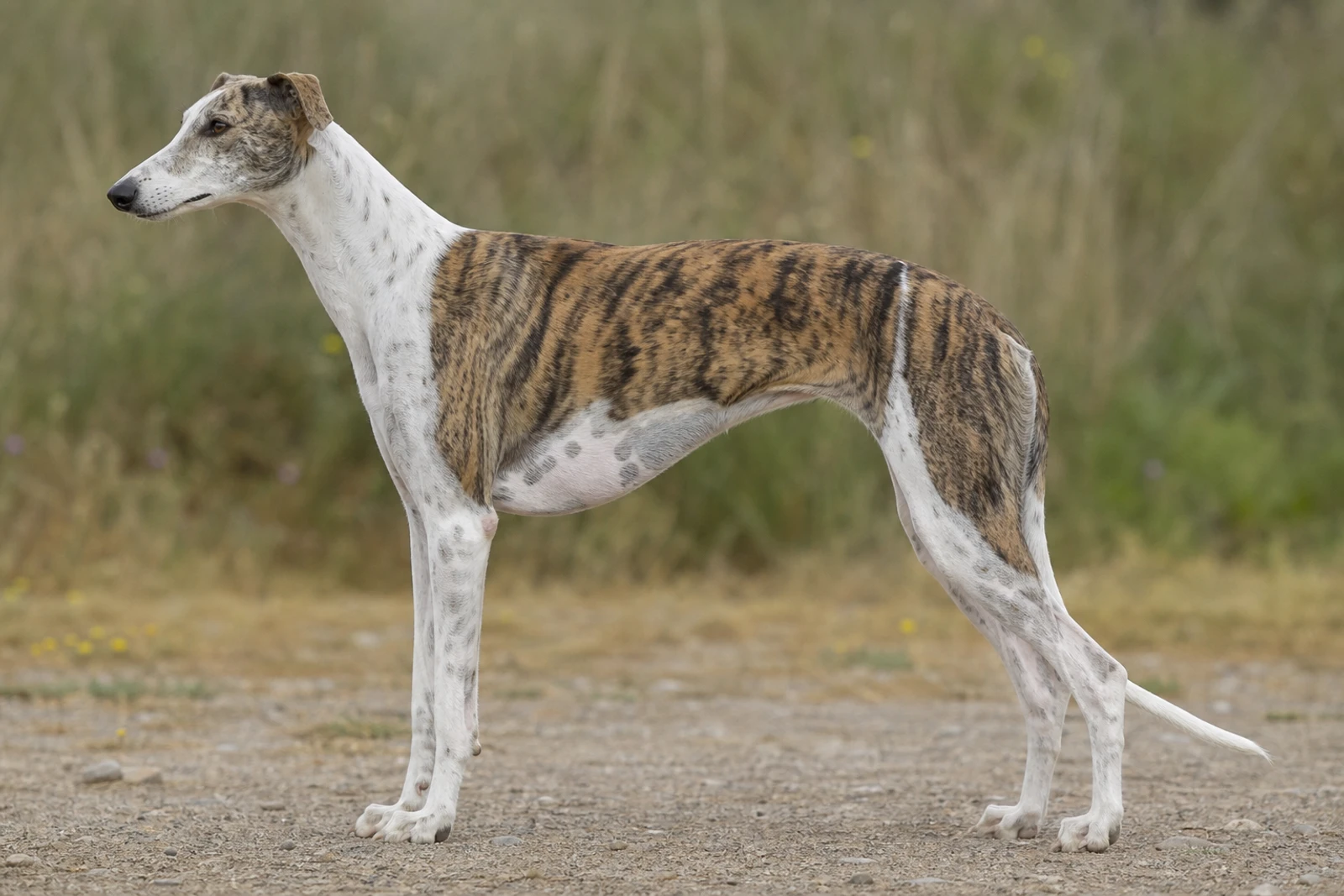
The Spanish Greyhound, or Galgo Español, is a lean, graceful sighthound built for speed but famed for its gentle, couch-potato demeanor indoors. Standing up to 28 inches at the shoulder yet weighing under 70 pounds, this ancient breed is affectionate with family, reserved with strangers, and surprisingly low-maintenance. Best suited for active owners who can provide daily sprints in a secure area, the Galgo thrives in calm homes, including apartments, and gets along well with other dogs. Its thin coat and sensitive nature mean it needs a warm bed and positive training. Ideal for those seeking a quiet, loving companion with a touch of aristocratic elegance.
At a glance
- Size
- Giant
- Height
- 23–28 in
- Weight
- 44–66 lb
- Life span
- 12 years
- Coat colors
- brindle, fawn, black, white, pied
- Coat type
- Short and smooth
How much does a Spanish Greyhound cost?
Adopt / rescue
$75–$400
Usually includes spay/neuter, first shots, and a microchip.
Buy from a breeder
$700–$2,000
From a reputable, health-testing breeder.
Approximate USD. Prices vary widely by region, breeder, pedigree, age, and coat colour — adopting is the lower-cost and recommended route. Avoid suspiciously cheap “breeders”; they’re often puppy mills.
Estimate the full cost of a Spanish Greyhound →Want the ongoing number? Estimate the monthly food bill for a Spanish Greyhound with our dog food cost calculator.
Spanish Greyhound photos
Views
Front, side, rear and top — the full silhouette.Poses
How the breed sits, lies, moves and plays.Puppy to senior
The breed across its whole life.Expressions
The breed’s range of moods.Close-up details
Eyes, ears, nose, paws, tail and coat.Coat colors
The breed’s recognized colors.Click any photo to enlarge. We show the Spanish Greyhound from every angle — three views, poses, life stages, expressions, close-ups, coat and colors.
Appearance & size
At first glance, a Spanish Greyhound looks like a greyhound stretched an extra couple of inches and stripped of any ounce of padding. The numbers back that up: 23 to 28 inches at the shoulder, yet only 44 to 66 pounds. That long, flat-muscled frame screams function — a hunter bred for stamina, not just a short burst of speed.
The side view tells the whole story. A deep, slab-sided chest drops well below the elbows, leaving plenty of room for heart and lungs. Then the body tucks up sharply into a wasp-waist and a pronounced arch over the loin. The back is long and firm, not a straight tabletop but a subtle curve that powers a double-suspension gallop. From the front, the chest is narrow rather than wide, so the elbows fit close to the ribs. That streamlined width, coupled with long, straight forelegs, cuts wind resistance. The neck is notably long and joins the shoulder smoothly, giving the dog a head-up, watchful carriage. At the rear, the muscles are long and lean — never bunchy — driving down into a low-set, thin tail that reaches past the hock and hangs in a slight hook when the dog is relaxed.
The head is long and fine, with almost no stop. The muzzle tapers slightly, and the eyes are almond-shaped, often a warm amber or hazel, set forward for binocular vision. Ears are set high. Most Galgos have rose ears that fold back when the dog is alert, though some individuals will prick them. The skin is thin and close, which makes every rib and vertebra visible on a fit dog — not a sign of neglect, but a hallmark of the breed.
Coat type comes in two varieties. The smooth coat is short, dense, and glossy, lying flat over the body. The rough coat is harder and wiry, with longer hair that can form a slight beard and eyebrows. Both are single-coated, so they dry fast and don’t trap much dirt. Color is anything goes: solid black, cream, or gold, various brindles, fawn, white with patches, and some stunning “cinnamon” or dark brindle patterns. White feet and chest markings are common, but there’s no disqualifying color. Every line of the Galgo’s body tells you it was built to spot movement and cover ground with a minimum of wasted energy.
History & origin
The Spanish Greyhound—known as the Galgo Español—has been a fixture on the Iberian Peninsula for over a thousand years. Most historians trace its arrival to ancient traders: Phoenician and Roman merchants likely brought slender sighthounds from North Africa and the Middle East, and those dogs then adapted to Spain’s arid plains and rugged meseta. What emerged wasn’t a dog built for short bursts on a manicured track, but a specialist bred to course hares across hard, open ground in all seasons.
By the Middle Ages, the Galgo was so prized that laws protected ownership rights to them. Spanish nobles and commoners alike ran them in open-field coursing, the dogs working by sight at dawn or dusk. The breed’s deep chest and long, flexible spine gave it surprising endurance for a sighthound—it could turn and brake sharply on rocky soil while chasing a zigzagging hare. Unlike England’s Greyhound, which was later refined for sprint racing, the Spanish Greyhound remained a working hunter, often used in packs and prized for stamina over pure speed.
That working identity kept the breed both widespread and largely unnoticed outside rural Spain. Into the 20th century, many dogs were kept by hunters, but as hare populations thinned and hunting traditions faded, the Galgo’s numbers dropped. Worse, a grim pattern set in: hunters often discarded dogs at the end of a short season. The breed became associated with neglect and abandonment, and for decades its plight was largely hidden from the rest of the world.
Change came in the 1990s and early 2000s, when Spanish rescue groups and international adoption networks stepped in. They spotlighted the dog’s gentle, quiet nature and made it a cause. Today, thousands of Spanish Greyhounds find homes across Europe and North America every year. The breed hasn’t lost its ancient build—still leggy, wiry, and capable of sprinting down a lure in seconds—but its survival now leans heavily on a growing fan club that sees it not just as a hunter, but as a calm, sofa-savvy companion.
Temperament & personality
You’re bringing home a gentle, laser-focused sprinter who spends most of the day impersonating a small deer on your sofa. The Spanish Greyhound lives in a sprint-and-snooze cycle: a brief, breathtaking explosion of speed in a safe, fenced area, followed by hours of motionless napping. Inside, they are eerily calm, quiet, and almost catlike — no frantic pacing, no demand barking. That 44–66 lb frame feels surprisingly light because it’s all lean muscle and long bone, so they tuck into impossibly tight balls and will happily steal the softest spot in the house.
Affection flows on their terms. Many bond deeply with their person and will follow you from room to room without being clingy, leaning gently against your leg or resting that long snout in your lap for a few seconds. With strangers, expect reserve, not rudeness — a polite sniff, maybe a yawn or lip lick to say “I’m not a threat,” and then they’ll go back to their bed. They are not watchdogs in any practical sense. A Spanish Greyhound might lift its head at an odd sound but rarely bothers to bark.
That sensitivity is the breed’s double edge. Harsh corrections or raised voices shut them down fast; they thrive on consistent, respectful handling and positive reinforcement. Neglect or long hours alone can trigger anxiety-driven behaviors like destructive chewing or, in some cases, indoor urine marking that’s reinforced by lingering scent. A vinegar spray cleanup can neutralize those odors, but the real fix is preventing the loneliness. Puppies, like all breeds, chew to explore and soothe teething discomfort, and adults will still want durable chews to keep their jaws strong. Give them appropriate outlets and a homemade citrus deterrence spray on forbidden items rather than punishment.
Prey drive is not a quirk you train away — it’s hardwired. A Spanish Greyhound can live peacefully with a cat it was raised alongside, but a fleeing squirrel or a small fluffball darting across a yard flips an ancient switch that no recall will override. This is why a securely fenced run or a long line in open areas is non-negotiable. At home, they are generally fine with respectful children who know not to interrupt meals or crowd a sleeping dog, though their thin skin and tucked-away nature mean they don’t handle rough-and-tumble play well. When they feel uneasy, you’ll spot calming signals — head turns, yawning, a backward weight shift — long before any growl. Learn to read those, and you’ll have a quiet, affectionate companion who thinks the greatest gift in the world is a plush bed and a 30-minute opportunity to fly at full stretch.
Good with kids, dogs & other pets
This 44–66 lb dog is genuinely gentle by nature—patient, non-aggressive, and often happy to lean against a familiar person. But a Spanish Greyhound’s height (up to 28 inches) and long, slender frame turn a casual zoomie into a potential hazard for a toddler. You’ll want hands-on supervision whenever kids under five are in the mix, not because the dog means any harm, but because one happy body-check can send a small child flying. For older, respectful kids who understand quiet handling, the breed is a calm, affectionate shadow.
Early socialization is the single biggest lever you have. The window between 3 and 16 weeks is when a puppy learns that new people, sounds, and dogs aren’t something to fear. Miss that, and you can end up with a dog that shuts down around strangers or startles easily. Keep introductions gentle, reward calm, and avoid flooding a shy pup with too much at once. Harsh corrections backfire badly on this sensitive breed—they’ll just check out.
With other dogs
Most Spanish Greyhounds do well with other dogs, especially when they’ve been raised with consistent, positive exposure from puppyhood. In fact, they’re so companion-driven that a second well-matched dog can help prevent the distress that shows up when they’re left alone for long stretches. That said, a poorly socialized adult may be fearful or awkward around new dogs, so forced “play dates” are a bad idea. Let any introduction happen gradually, on neutral ground, and watch body language. They aren’t looking for a wrestling match.
Cats and small pets
Here’s the hard truth: a sighthound is hardwired to chase what runs. A cat darting across the yard or a pet rabbit can flip a switch even in a dog that’s usually mellow indoors. Some Spanish Greyhounds learn to coexist with a household cat if raised together from puppyhood and never left unsupervised, but it’s a risk you take. Keep high-value spaces separated, use baby gates, and never leave them alone in the same room. The chase instinct doesn’t require malice—it’s pure reflex.
Because the breed bonds tightly to its people and hates being isolated, they do best in homes where someone is around most of the day. Left alone for hours without preparation, a Spanish Greyhound can slide into anxious pacing or destructiveness. Build alone-time tolerance slowly, provide puzzle toys, and consider a calm canine buddy if your schedule demands it.
Trainability & intelligence
The Spanish Greyhound is sharp in a quiet, cat-like way — they figure out routines and patterns almost before you do. What they aren’t is blindly obedient. Like most sighthounds, they were bred to spot and chase game independently, not to wait for a handler’s direction every step. That means training hinges on why they should listen, not just what you’re asking.
Motivation matters enormously. A Galgo will learn a down-stay or a reliable “leave it” in a handful of short sessions if the reward is something they genuinely value — high-value treats, a burst of play, or that favorite squeaky toy. Bore them with mindless reps or a flat tone, and they simply check out. Keep it upbeat, keep it brief, and end before their attention drifts.
The recall challenge is real and deserves honesty. These dogs can go from zero to 40 miles per hour in seconds, and instinct tells them to chase fleeing squirrels, rabbits, or a plastic bag skittering across a field. A 100% off-leash recall in an unfenced area is something many owners never fully trust, no matter how diligent the training. Use a securely fenced space or a long line for off-leash practice, and teach an emergency recall with jackpot rewards — turkey, cheese, whatever makes their eyes light up.
Sensitivity is the breed’s other big training variable. A hard voice, a yank on the leash, or even frustrated body language can cause them to shut down or avoid you. That’s why punishment-based methods backfire spectacularly here. You build reliability through trust, not fear. Positive reinforcement — clicker work, treat scatters, calm praise — gets the most willing, confident response from these dogs. They’re clever enough to hold onto a lesson, but they’ll only offer the behavior again if they feel safe.
Start from the day your Galgo puppy comes home. Socialization before 14–16 weeks is non-negotiable, filling their world with new people, smooth and strange surfaces, city sounds, and calm dogs of all sizes. A poorly socialized Spanish Greyhound can default to skittishness or fear-based reactivity, which tends to look like freezing or bolting rather than barking. Pair new experiences with tiny food rewards so the world becomes a menu of good things, not a threat. Ongoing positive exposure through adolescence cements that confidence and keeps them from becoming the dog who startles at a dropped spoon.
Once you’ve built that trust, you’ll have a dog who learns the rhythm of your household, gets the hang of polite lead walking, and even picks up silly tricks — just don’t expect a Border Collie’s obedient intensity. Expect an affectionate, somewhat independent thinker who cooperates because the partnership makes sense to them.
Exercise & energy needs
Think of the Spanish Greyhound as a world-class sprinter, not a long-distance runner. They’re built for explosive, full-tilt gallops that leave other dogs in the dust — then they’ll curl up on your couch and sleep half the day. Aim for about 60 minutes of daily exercise total, but break it into two distinct parts: a solid 30- to 40-minute walk to sniff and stretch, and an off-leash sprint session where the dog can really open up.
That sprint session is non-negotiable. This isn’t a breed that burns off energy with a brisk walk around the block. They need a securely fenced area — a ball field, a friend’s acre, or a fenced dog park with sighthound-savvy companions — where they can hit top speed for 10 to 15 minutes. A flirt pole or lure coursing setup lets you trigger that chase instinct without miles of walking. Without the chance to flat-out run, a Galgo can turn anxious, restless, or even destructive indoors.
Indoors, they’re famously calm. A properly exercised Spanish Greyhound is a quiet, gentle housemate. But their brains need a workout, too. Scent games, puzzle toys, and short training sessions that play to their prey drive (like hiding treats and releasing them with a cue) keep them mentally sharp. Snuffle mats and frozen Kongs go a long way on rainy days.
Watch the surface. Their lean frames and thin skin make them more vulnerable to cuts and joint stress. Let young dogs run on grass or dirt, not asphalt, until growth plates close (around 12–18 months). Even adults do better on softer ground. In cold weather, a coat helps — they carry almost no body fat.
Because they’re sighthounds with a hair-trigger chase reflex, off-leash time outside a fence is a gamble. A squirrel or a flapping plastic bag can trigger a bolt into traffic. Stick to enclosed spaces unless you’ve put in extensive recall training — and even then, instinct often wins. If you don’t have consistent access to a safe, open run area, this breed will struggle to settle. Without that release valve, they can develop the same pacing, whining, or reactivity as any under-exercised high-drive dog.
Grooming & coat care
Spanish Greyhounds come in two coat types, and which one you have largely sets the grooming routine. The most common is a smooth, single-layer coat — short, fine, and lying flat. There’s no insulating undercoat, so you’re not battling a seasonal blizzard of fluff, just a light, steady shed. A weekly once-over with a soft bristle brush or a rubber grooming mitt pulls out loose hairs and spreads natural oils for a glossy finish. It takes about five minutes.
If you have the rough-coated variety, the hair is longer, harsher, and often forms fringes on the legs, tail, and sometimes the face. That feathering tangles easily, especially behind the ears and under the thighs. Use a slicker brush with rounded pins first to break up any knots, then go through heavier areas with a wide-toothed metal comb. Start at the ends and work up to the skin to avoid hurting them. Two or three times a week keeps mats from taking hold.
Bathing is infrequent — Galgos are naturally clean dogs with almost no doggy odor. Wash only when they roll in something foul or start to feel greasy, using a mild, hypoallergenic shampoo. Over-bathing strips the thin skin’s natural barrier, making it dry or flaky.
Trimming is minimal. Smooth coats need nothing; a rough coat might get its feet tidied up with thinning shears when the tufts between toes collect burrs and mud, but it’s purely functional. No showy scissor work.
Nails grow fast on these light-footed runners. If you hear clicking on hard floors, they’re overdue. Trim every two to three weeks, just taking small slices to avoid the quick (often long in sighthounds). Ears are thin and can trap moisture, so check weekly for redness or wax buildup and wipe the outer ear with a damp cotton ball — never dig deep. Teeth get tartar quickly, so daily brushing with a dog-safe paste saves you costly vet cleanings down the line.
During colder months, the lack of body fat and undercoat means this breed loses body heat fast. A well-fitted dog coat on winter walks isn’t grooming, but it protects skin and coat condition by preventing dry, flaking skin from harsh winds. In summer, a light spritz with a detangler on the rough coat helps repel dust and stickers without over-brushing.
Shedding & allergies
The Spanish Greyhound is about as low-maintenance in the shedding department as a large dog gets. Its short, smooth, single-layer coat lacks the dense undercoat that powers the epic twice-a-year blowouts you see in huskies or shepherds. You’ll find a few fine hairs on the couch—impossible to avoid entirely—but you won’t pull a whole dog off the vacuum brush every week.
Shedding ticks up slightly when the seasons shift, mainly in spring and fall, yet it remains a trickle, not a storm. A quick once-over with a rubber curry brush or a hound glove once a week grabs the loose stuff, and your floors will barely notice the difference. Bonus: the coat has almost no “doggy” odor and sheds dirt easily after a romp.
Drool, thankfully, is a non-issue. These dogs aren’t loose-lipped; you might see a drip after a big drink of water, but jowls stay dry even post-meal.
As for allergies, no dog is truly hypoallergenic—dander, saliva, and urine all carry allergens. Still, a Spanish Greyhound’s minimal shedding and low dander output make it a more comfortable housemate for many people who usually sneeze around dogs. If allergies in your home are moderate, this is one of the safer bets among large breeds. Spend time with an adult dog before committing, because every immune system plays by its own rules.
Diet & nutrition
Thin to the eye doesn’t mean underweight. A Spanish Greyhound at a healthy weight shows the faint outline of ribs, a sharp tuck at the belly, and a defined waist when you look down from above. Letting him get heavy—even by a few pounds—puts real stress on that long spine and those fine-boned legs. This is a breed where you manage weight proactively, not reactively.
Puppies eat four small meals a day until 4 months old, then three meals until 6 months, then you settle into a twice-daily routine for life. Transition a new pup gradually: lightly cooked, puréed meats, fish, and vegetables, or a high-quality commercial puppy food. Raw chicken wings are usually fine around 12 weeks, but always under your direct watch.
For an adult 50–60-pounder getting a solid daily run, you’re probably looking at roughly 3 to 4 cups of dry food split between the two meals—but that’s a starting point. Measure exactly, use the bag as a rough guide, and tweak portions based on how his ribs feel. A Spanish Greyhound who’s slowing down or only getting light walks needs much less. If yours eats like a vacuum, slow-feeder bowls keep him from gulping air and add a little mental engagement.
Deep chests mean bloat is always a danger. Never work him hard right after a meal or feed him when he’s panting heavily. Smaller, more frequent meals and a low-stress eating environment help, as does skipping rich, fatty scraps—even a holiday indulgence can tip a dog into pancreatitis.
In the senior years, swap to three or even four smaller meals if appetite or digestion wanes. Keep protein levels where they are (no real evidence backs a senior-protein cut) but watch the scale closely, because a less active 12-year-old needs fewer calories. Purée meals for a dog with sore teeth, and top with canned fish, cooked eggs, or cooked vegetables for an easy nutrition boost. Serve everything in his own bowl, never from your plate, so begging never has a chance to start.
Health & lifespan
A healthy Spanish Greyhound typically lives about 12 years—remarkably solid for a lean giant that can stand 28 inches at the shoulder. Twelve years gives you a long runway, but it also means you need to pay attention to a few quirks this breed carries.
What responsible breeders stay on top of
There’s no massive, breed-defining single disease, but a good breeder doesn’t take chances. They screen hips, eyes, and cardiac health across their lines because these can pop up in any sighthound. More important is something you won’t see on a test result: how a Spanish Greyhound handles anesthesia. With their low body fat and unique metabolism, they often need sighthound-specific drug protocols—so always have a vet who understands that before any procedure, even a dental cleaning.
Everyday things you’ll actually watch for
- Bloat (GDV) – that deep chest can set the stage for a twisted stomach. Feed 2–3 smaller meals a day, skip heavy exercise right after eating, and learn the early signs (restlessness, unproductive gagging, a swollen belly). Bloat moves fast.
- The cold and the heat – paper-thin skin and almost zero insulating fat mean no built-in winter coat. Below about 45°F, a fleece or insulated jacket is non-negotiable. In summer, they overheat quickly and their pink skin can sunburn, so limit midday exposure and always have shade and water.
- Skin tears – the skin is so thin that it rips more easily than you’d believe. A run through heavy brush or a sharp stick can open a wound that needs stitches. Keep a basic first-aid kit handy and know where your emergency vet is.
- Weight and those long legs – seeing a hint of rib is normal. Anything more than that puts unnecessary stress on the spine and long, fragile toes. A Spanish Greyhound that stays lean is simply going to have fewer joint issues as the years pile up.
Preventive care that keeps them at 12 years
Heartworm prevention gets given every month during mosquito season plus one extra month after it ends—set a calendar reminder, because missing a dose in a dog that runs flat-out outdoors is a serious gamble. The rabies shot is legally required and non-negotiable; once symptoms show, there’s no effective treatment. Beyond that, commit to an annual vet checkup with bloodwork once they hit senior status, and pay attention to subtle shifts: a dog who suddenly doesn’t want to sprint, starts limping, or loses interest in food is telling you something. A social, well-handled Spanish Greyhound also sidesteps a lot of stress-driven health fallout, so positive handling from puppyhood isn’t just manners—it’s part of the health plan.
Living environment
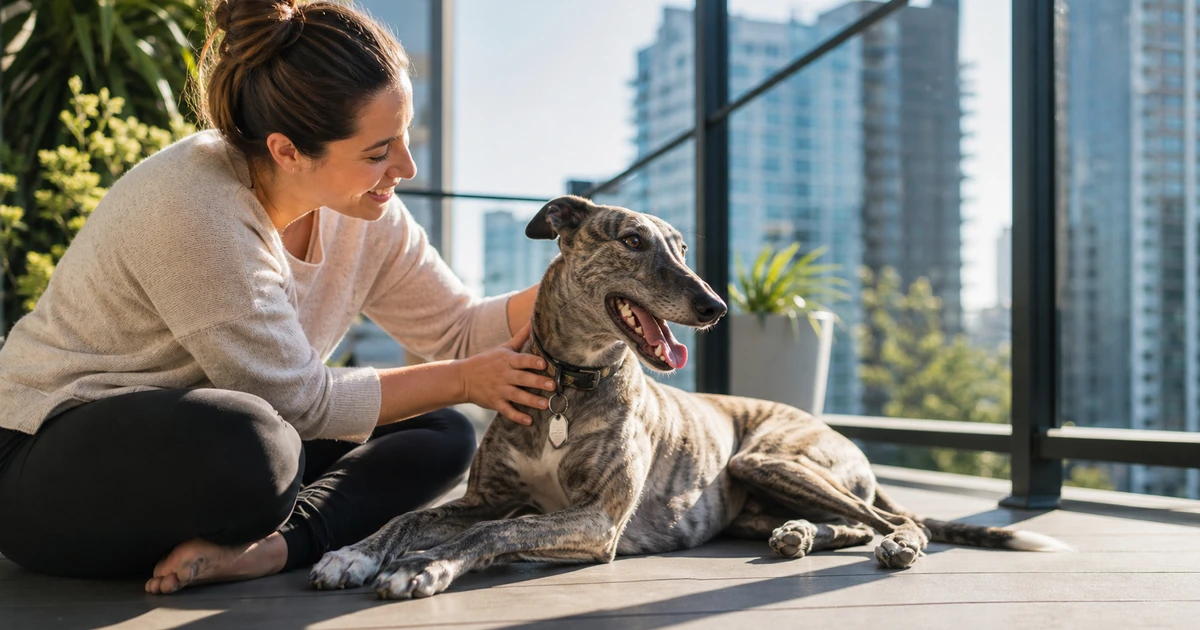
A Spanish Greyhound can adapt to apartment living better than you might expect for a giant breed, but only if you deliver the one thing that keeps this dog sane: a daily full-tilt sprint. A couple of leash walks around the block won’t begin to dent their energy. They need 30–60 minutes of off-lead running every day, broken into one or two sessions, in a securely enclosed area. Think a six-foot fenced yard, a well-fenced dog park during quiet hours, or a private field with sight-proof boundaries. Their chase instinct is absolute — never trust a Galgo off-leash in an open space, no matter how solid your recall.
If you have a house with a securely fenced yard, you’re in the sweet spot. The fence must be tall and dig-proof; an under-exercised Greyhound will find a way out. Without a yard, the commitment is steeper: you’ll need reliable access to a safe sprint spot, plus a few shorter leash walks for sniffing and potty breaks. Indoors, they’re couch potatoes, famously quiet and calm as long as their legs have been emptied.
Climate matters more than you’d guess. With paper-thin skin, hardly any body fat, and a single short coat, these dogs feel the cold keenly. Plan on a well-fitted coat for winter walks, and give them a thick padded bed off cold floors. Heat is equally dangerous — they overheat fast, so confine summer exercise to early mornings or late evenings and always carry water.
Noise-wise, they’re practically silent. Barking is uncommon; a low whine or a dramatic sigh is as loud as it gets. They won’t alert-bark at the mailman. However, a lonely or under-stimulated Galgo can voice stress through howling or persistent whining.
And that brings us to being left alone. Spanish Greyhounds bond deeply with their humans. They aren’t a breed you can leave for an eight-hour workday and expect a clean, quiet house. Separation anxiety shows up as destructive chewing, house soiling, or howling. If long absences are unavoidable, you’ll need to build alone-time tolerance slowly from day one, use food puzzles and frozen Kongs to make departures less painful, and budget for a midday dog walker or doggy daycare. A home where someone is around most of the day is ideal; the breed’s need for company rivals their need for speed.
Who this breed suits
You’ll know a Spanish Greyhound fits your life if the phrase “full-speed zoomies for ten minutes, then a six-hour nap on the softest surface available” sounds like a good Saturday. These dogs are giant couch anchors wrapped in a long, lean frame — 23 to 28 inches at the shoulder, but only 44 to 66 pounds of quiet sweetness. They thrive with people who appreciate a low-key indoor companion that’s ready to explode into a joyful sprint the moment you hit a securely fenced field.
A great match if you…
- You crave a calm house dog who’s up for bursts of real speed. A daily walk of 30–40 minutes plus a few weekly off-leash runs in a safe, enclosed area keeps a Galgo happy. They’re sprinters, not marathoners, and the rest of the day they’ll be boneless on your sofa.
- You’re a first-timer ready to learn sighthound quirks. They’re gentle, sensitive, and biddable with positive training — but they carry zero desire to please just because you said so. If you’re patient and don’t mistake independence for stubbornness, you’ll find a loyal shadow.
- You’re a senior or single adult who wants a devoted, undemanding buddy. Short-coated and startlingly clean, they shed little and have next to no doggy odor. Coat them up in chilly weather, give them a cushy bed (their thin skin and bony frame make hard floors a no-go), and you have a serene companion for quiet mornings.
- Your household has respectful older kids. Galgos tend to be affectionate and tolerant, but their slender build and love of speed mean they can accidentally knock over a toddler during a zoomie. Supervised homes with kids who understand gentle handling are a fine fit.
Think twice if…
- You can’t provide a truly secure, fenced running space. A Spanish Greyhound’s prey drive is hardwired. Squirrel, cat, or blowing leaf — they’ll bolt and be a dot on the horizon before your brain registers the leash is gone. Underground electric fencing won’t stop them; they’ll blast right through it.
- You have small pets like cats, rabbits, or free-roaming hamsters. Many Galgos live peacefully with indoor cats if raised together or carefully conditioned, but their instinct to chase small, fast-moving animals is fierce. Assume it’s always there and manage accordingly.
- You want a dog that’s off-leash reliable in open parks or hiking trails. Recall can be a dicey proposition with a sighthound in full flight. Their world disappears when they spot movement 200 yards away.
- You’re looking for a protective watchdog or a rough-and-tumble playmate. They’re sweet-natured and usually friendly with strangers, not guardy. Roughhousing with a dog this lean and thin-skinned can lead to scrapes or tears that need a vet visit.
Spanish Greyhounds rescue beautifully into calm, committed homes that respect their nature: half athlete, half houseplant, and all heart. Get the fenced yard right, respect the prey drive, and you’ll have a dog that makes a quiet house feel full and a quick sunny sprint feel like the best five minutes of your day.
Cost of ownership
Adopting a Spanish Greyhound through a rescue is the most common path in the U.S., and it shapes the upfront cost. Adoption fees typically run $300 to $500, often covering spay/neuter, microchipping, and initial vaccinations. Buying a puppy from a rare North American breeder costs more — somewhere between $1,200 and $2,500 — but responsible breeders screen for health issues that can spare you expensive surprises later.
Monthly food costs land in the $50 to $80 range. These leggy 44-to-66-pound dogs need a high-quality, protein-forward kibble; many have sensitive stomachs, so you might end up adding a probiotic or topper. A bag of good food won't break the bank like it would for a true giant breed, but cheap fillers often trigger loose stools and vet visits.
Grooming is minimal and mostly DIY. A short, smooth coat means a quick rubber curry or hound glove session once a week. You'll spend maybe $10 a month on a quality nail grinder and dental chews — dental care matters, because Galgos can be prone to periodontal disease.
Veterinary costs are where things can get unpredictable. Plan on $500 to $700 a year for routine checkups, vaccines, heartworm prevention, and flea/tick control. This breed heals differently: their thin skin tears easily, so a sprint through brush can mean stitches. Sighthounds also have unique anesthesia sensitivities, making pre-surgical bloodwork non-negotiable. Pet insurance, which typically runs $35 to $60 a month, helps offset these quirks and covers potential bloat surgery or a broken leg from a high-speed chase gone wrong.
One-time gear adds another $150 to $300 upfront. You'll need a martingale collar, a fleece or waterproof jacket for cold weather, and a raised feeder to reduce bloat risk. Factor in a solid emergency fund of at least $1,000 for that first unexpected skin tear or dental extraction.
Choosing a Spanish Greyhound
A Spanish Greyhound is as likely to land on your couch through a rescue transport as from a breeder — especially if you’re in the US, where dedicated groups have spent years pulling galgos from Spain’s grim perrera system. That means your choice starts with a clear-eyed look at what you can handle. A rescued galgo often arrives with no house manners, a fear of men or doorways, or a year of untreated leishmaniasis. Breeders, in contrast, should be producing dogs with sound temperaments, clean health histories, and early socialization — but they’re rare outside Spain. Decide whether you want the known journey of a puppy or the steep learning curve of a dog who may have never lived indoors.
If you go the breeder route, demand health clearances that go beyond a vet’s glance. Responsible breeders screen for dilated cardiomyopathy with an echocardiogram and have the results read by a board-certified cardiologist; a normal one-time test isn’t enough, so ask about the last exam and the parents’ histories. Eyes should be checked by a veterinary ophthalmologist annually, because progressive retinal atrophy and other inherited eye diseases pop up in sighthounds. Thyroid panels, not just a T4, help catch autoimmune thyroiditis. While hip dysplasia isn’t rampant in the breed, a breeder who does OFA hip radiographs is being thorough. Bloat is always a question mark in deep-chested dogs; ask if any close relatives have twisted a stomach. Anesthesia sensitivity is a real, searing concern — make it a hard rule that any vet uses a protocol safe for sighthounds, and a breeder who can’t talk specifics on that isn’t worth your time.
Red flags are loud with this breed. Run from anyone pushing a “rare” color or charging more for brindles. Avoid breeders who won’t let you meet the mother on-site (video calls don’t count when you’re buying a giant, high-strung athlete). If puppies are shoved into your arms at 6 weeks, that’s a no. Galgo pups with cowering temperament at 8 weeks aren’t just shy — they may carry a fear imprint that hardens with age. Watch out for over-exaggerated size claims; a 28-inch, 66-lb dog is the top of the standard, and anyone boasting of “90-lb giants” is breeding for bulk, not function.
A well-raised puppy greets you with curiosity, not flattening into a corner. Let the litter run loose in a safe, open space and sit on the floor. The pup that trots over, sniffs you, then flops for a belly rub is a better bet than the one that dodges your hand. Check for clear eyes, clean ears, a dry, slightly tucked-up waistline without visible ribs jutting, and a soft, slick coat. Ask what the breeder has done for noise desensitization — Spanish Greyhounds are often sound-sensitive, and a puppy raised in a silent kennel will be harder to integrate into a normal household.
With a rescue, you’re choosing an adult. Get the full veterinary intake report: 4DX snap test for tick-borne diseases, a quantitative leishmaniasis titer (not just a yes/no), dental evaluation for ground-down or missing teeth from chewing kennel bars, and a behavior assessment that notes resource guarding, startle response, and how the dog reacts to a raised voice. A foster-based group that has had the dog in a home for at least a month will give you far more truth than a shelter that hands over a leash and a shot record. Be honest about what you’re okay managing. A dog that has never seen stairs, a television, or a child will need patient, daily counter-conditioning, not just love. Whether you go with a puppy or a rescue, pick for a steady nerve and a soft eye; those are the galgos that slide into your life instead of running from it.
Pros & cons
-
Small-prey drive runs deep. A squirrel, cat, or loose small dog can trigger a full-speed chase from a standstill. Off-leash freedom is only safe inside a solid, 6‑foot fence — these dogs can clear a low barrier without a second thought.
-
Thin coat, lean build. Low body fat and a single short coat make them shiver in cold weather. You’ll need a wardrobe of dog coats and a warm, cushioned bed year-round (those bony elbows and hips need extra padding).
-
Watch the door. Many Spanish Greyhounds are escape artists. They slip through cracked doors or gates fast enough to surprise anyone not paying attention.
-
Can struggle with alone time. They bond tightly to their people and are prone to separation anxiety in homes where they’re left for long workdays. Howling and destructive chewing are real possibilities.
-
Shy with new faces. Without early, gentle socialization they can be reserved or skittish around strangers — this isn’t a tail‑wagging greeter at the dog park.
-
Anesthesia sensitivity. Like other sighthounds, they can react poorly to certain anesthetics and medications. Any vet treating them needs solid greyhound‑specific experience.
-
Dental and bloat risks. Plaque buildup comes on fast; brushing and dental care aren’t optional. Deep‑chested anatomy also puts them at risk for gastric dilatation‑volvulus — feed smaller, split meals and avoid vigorous exercise right after eating.
-
Champion loungers. Inside the house they’re calm, gentle, and often comically lazy. Two or three 20‑minute walks plus a short sprint session in a fenced area typically meet their energy needs.
-
Easy‑care coat. Shedding is minimal, there’s almost no doggy odor, and a quick wipe‑down with a damp cloth handles most dirt.
-
Affectionate without being pushy. They lean into you for contact, snuggle quietly on the sofa, and form deep bonds with every family member, including respectful children.
-
Dog‑social by nature. Most live happily in multi‑dog households and enjoy the company of their own kind — a plus if you already have another easygoing dog.
-
Quiet housemates. Barking is rare, reserved for genuine alerts rather than boredom or nuisance.
-
No drool factor. A dry mouth means you won’t be wiping slobber off walls, furniture, or your clothes.
Similar breeds & alternatives
The most natural alternative is the English Greyhound, and that’s where the differences really matter. A Spanish Greyhound at 44–66 lb lands noticeably lighter than a racing Greyhound, which typically runs 60–80 lb. The Galgo also stands a bit shorter and has a longer back, a slightly more elongated frame, and a head with a longer, almost Roman-nosed muzzle. Temperament-wise, many Galgos are less frantic after a sprint and settle indoors more readily, but they can be more independent and sensitive — you won’t necessarily get the goofy, pushy leaner that retired racers are famous for. Both breeds need a solid daily gallop in a secure area, but the Galgo’s thinner skin and lower body fat make cold weather a real issue; a coat is non-negotiable well before it’s a problem for a Greyhound.
If the Galgo’s lean 50-ish pound build appeals but you want a smaller package, the Whippet is the obvious downsize. Whippets top out around 40 lb and 22 inches tall, and they bend much more easily into apartment life — less dog, less space needed. They’re still explosive runners, but they burn off that energy in shorter bursts. The trade-off is fragility: a Whippet can’t absorb the same rough-and-tumble play a 60-lb Galgo shrugs off, and leg breaks are a genuine risk. The Galgo gives you a larger, sturdier sighthound without the heft and high prey-drive intensity you might get from a big male Greyhound.
The Hungarian Greyhound (Magyar Agár) often gets mistaken for a Galgo, but side by side you’ll see a stockier, more robust dog that carries 50–75 lb on heavier bone. That dog was built to run over rougher terrain and has a slightly thicker coat, making it a better match for cold, wet conditions. The Galgo, by contrast, is a heat-efficient desert-bred runner; his thin, close coat and minimal insulation mean he’ll hunt a sunny spot indoors even when you’re comfortable. Galgos also tend to be quieter, more socially tuned to other dogs, and a little more deliberate about where they put their affection. If you want a similar height, the Magyar Agár works, but expect a more weatherproof, often more vocal dog.
One health-specific difference worth knowing: the Galgo’s long back and deep chest put him at higher risk for spinal problems if he carries extra weight. Responsible homes keep him lean year-round — not just for speed, but for a healthy spine. That 44–66 lb range is functional, not just a show-ring preference. Compare that to a Whippet’s slighter spine, or a Greyhound’s more compact loft, and you’ll see why that extra vigilance pays off. If your dog will be around kids who may sneak treats or you prefer a more forgiving metabolism, a stockier Magyar Agár or a Greyhound might give you a little more wiggle room.
Fun facts
- Also known as the Galgo Español, one of the oldest sighthound breeds.
- Bred for coursing hare across open Spanish plains, reaching speeds up to 40 mph.
- Depicted in ancient Iberian cave paintings and medieval tapestries.
- Despite their athleticism, they are famously calm and gentle indoors.
Frequently asked questions
- Are Spanish Greyhounds good with children?
- Spanish Greyhounds are typically gentle and affectionate with children, but due to their large size and sensitive nature, supervision is advised with small kids. They can be aloof with strangers but form strong bonds with their family.
- How much do Spanish Greyhounds shed?
- Spanish Greyhounds have a short, fine coat that sheds minimally. Weekly brushing helps remove loose hair and keeps their coat healthy.
- Do Spanish Greyhounds need a lot of exercise?
- Despite their athletic build, Spanish Greyhounds are surprisingly calm indoors and require moderate exercise. A couple of daily walks and a chance to run safely in a fenced area usually suffice.
- Are Spanish Greyhounds easy to groom?
- Yes, their short coat is very low maintenance, needing only occasional brushing and baths when necessary. Pay attention to ear cleaning and nail trimming.
- Can Spanish Greyhounds live in apartments?
- They can adapt to apartment living if given sufficient exercise and mental stimulation. Their quiet nature and moderate energy indoors make them suitable for smaller homes.
- Are Spanish Greyhounds good for first-time dog owners?
- Their gentle disposition and manageable grooming needs can make them suitable for first-time owners, but they require consistent training and a secure environment due to their prey drive. Potential owners should be prepared for a sensitive dog that responds best to positive reinforcement.
Tools & calculators for Spanish Greyhound owners
Quick estimates tailored to Spanish Greyhounds — pre-filled with this breed’s size where it matters.
Articles & stories about the Spanish Greyhound
Sources & standards
This profile follows recognized breed standards from the American Kennel Club (AKC) and the Fédération Cynologique Internationale (FCI), along with established veterinary and breed-club guidance. These describe general breed tendencies — every dog is an individual.