

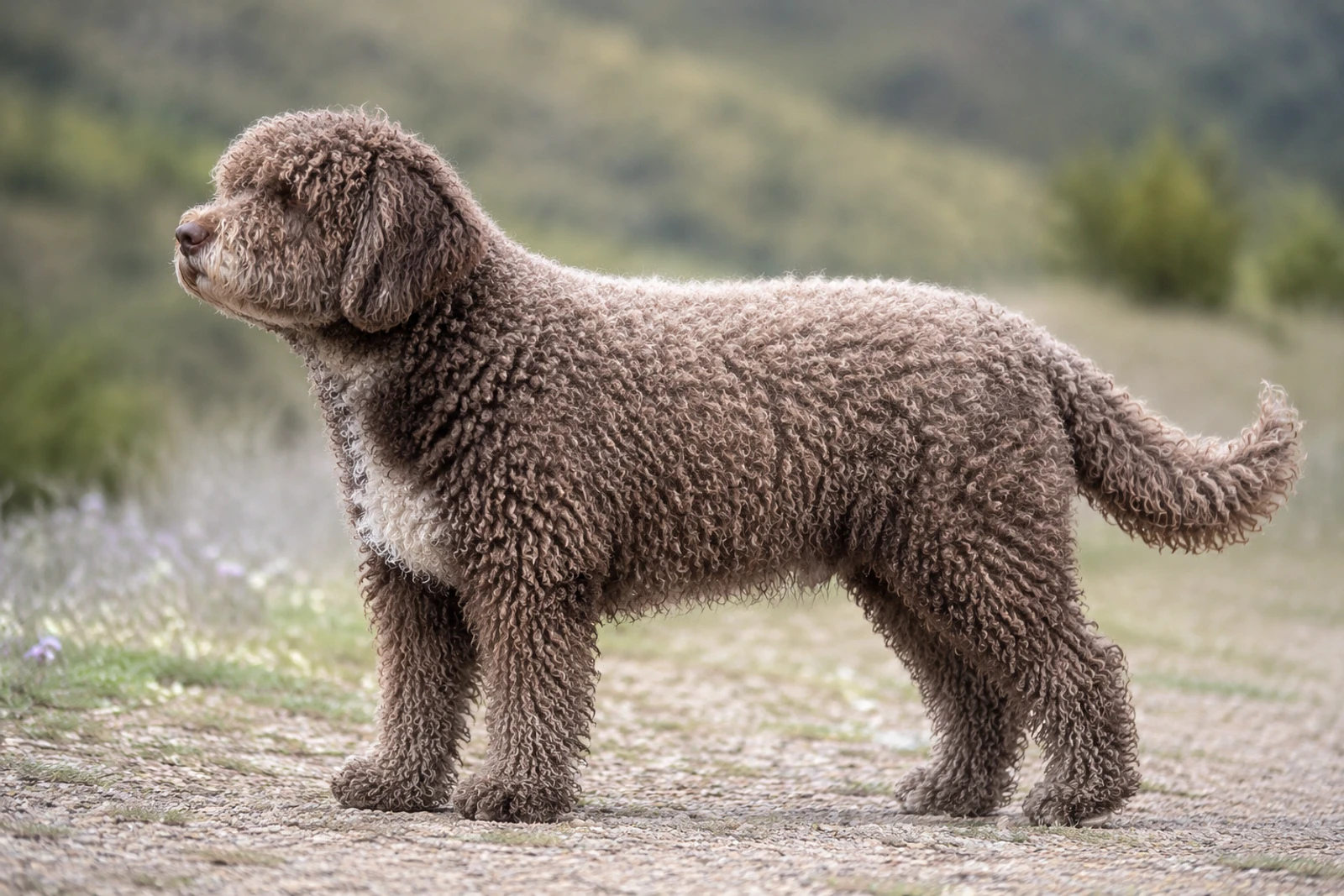
The Spanish Water Dog is a robust, medium-sized herder with a distinctive curly coat, thriving in active homes with plenty of mental and physical stimulation. Ideal for owners who enjoy canine sports, agility, or outdoor adventures, this intelligent and loyal breed forms deep bonds with its family but may be reserved with strangers. Its low-shedding, hypoallergenic coat requires regular care, and its working heritage demands consistent training and a job to do. Best suited for experienced handlers, this versatile dog excels in water activities and makes a devoted companion for those meeting its needs.
At a glance
- Size
- Large
- Height
- 16–20 in
- Weight
- 31–49 lb
- Life span
- 10–14 years
- Coat colors
- black, brown, beige, white, parti-color
- Coat type
- single, curly, woolly
- Group
- Gun
How much does a Spanish Water Dog cost?
Adopt / rescue
$75–$400
Usually includes spay/neuter, first shots, and a microchip.
Buy from a breeder
$700–$2,000
From a reputable, health-testing breeder.
Approximate USD. Prices vary widely by region, breeder, pedigree, age, and coat colour — adopting is the lower-cost and recommended route. Avoid suspiciously cheap “breeders”; they’re often puppy mills.
Estimate the full cost of a Spanish Water Dog →Want the ongoing number? Estimate the monthly food bill for a Spanish Water Dog with our dog food cost calculator.
Spanish Water Dog photos
Views
Front, side, rear and top — the full silhouette.Poses
How the breed sits, lies, moves and plays.Puppy to senior
The breed across its whole life.Expressions
The breed’s range of moods.Close-up details
Eyes, ears, nose, paws, tail and coat.Coat colors
The breed’s recognized colors.Click any photo to enlarge. We show the Spanish Water Dog from every angle — three views, poses, life stages, expressions, close-ups, coat and colors.
Appearance & size
You’ll spot the Spanish Water Dog by its curly, woolly coat first — that single, dense, rope-like coat is the breed’s trademark and the reason it looks ready to work in any weather. This is a medium-sized, well-put-together rustic dog, built more for endurance than raw bulk. The body is slightly longer than tall, giving it a balanced, rectangular silhouette without appearing leggy or cobby.
Height at the withers runs 16 to 20 inches for both males and females, with no separate ranges for the sexes in most standards. Weight falls between 31 and 49 pounds, with a fit dog carrying noticeable muscle under all that hair. The bone is moderate, never heavy, so the dog looks athletic and agile, not coarse.
The coat is the star. It’s a single coat — no undercoat — with tight, clearly defined curls that are woolly to the touch and naturally form cords as the dog matures if left unclipped. The texture is never silky or wavy; it should feel like a fleece or a dense mop. You’ll see it in solid black, beige, brown, or white, as well as parti-color (white patches on a darker base). The curls cover the body evenly, from the top of the head down the legs, creating a uniform, shaggy outline that blurs clean angles.
From the front, the chest is deep and the forelegs are straight, with plenty of bone but no heaviness. The head is well-proportioned, with a flat skull, a strong muzzle, and a nose that harmonizes with the coat color. Drop ears lie close to the cheeks and are covered in tight curls. Eyes are expressive, set slightly obliquely, and range from hazel to dark brown depending on the coat shade.
In profile, the topline is level, the neck is strong and blending smoothly into well-laid-back shoulders. The croup is slightly sloping, and the tail is usually docked to about one-third its natural length where the practice is still legal; otherwise, it’s carried in a low saber curve or with a slight upward hook when the dog is alert. From behind, the hindquarters show well-angled stifles and straight hocks, with the same woolly coverage hiding the exact muscular definition underneath. You get the impression of a compact, tireless dog that moves with an easy, ground-covering stride — never flashy, just efficient.
History & origin
The Spanish Water Dog didn’t come from a kennel, a breed club, or a single founder’s vision. It was carved out of the southern Spanish countryside by centuries of real work — a catch-all farmhand on four legs. If you trace the breed’s roots, you have to step back to the Iberian Peninsula sometime before the Middle Ages. The most common theory points to curly-coated water dogs brought by Moorish traders as early as the 8th century, dogs that then mixed with local herding stock. Old Barbet-type dogs, possibly even early poodle ancestors, likely contributed, but no one kept studbooks on a dusty Andalusian finca. What emerged was the Perro de Agua Español — a compact, 16- to 20-inch dog wrapped in a single, rustic, cord-forming coat that felt like lamb’s wool and shrugged off both the Mediterranean sun and icy marsh water.
For hundreds of years, these dogs earned their keep in three jobs at once. In the hills around Cádiz, Seville, and Málaga, they moved goats, sheep, and sometimes cattle, working with shepherds who prized a dog that could think independently but never quit. Along the coast and the Guadalquivir marshes, the same dogs dove into water to retrieve downed birds for hunters, tow fishing nets, and even carry lines between boats. The breed’s dense, ropey curls functioned as a built-in wetsuit, insulating the dog in cold water and protecting it from brush and thorns on land. No one called them “Spanish Water Dogs” then; they were simply perros de agua or perros turcos, recognized by what they could do, not by a piece of paper.
That lack of formal recognition nearly wiped them out. As motorized boats, modern livestock management, and urbanization took over during the early-to-mid 20th century, the working population shrank to scattered pockets of purebred dogs on isolated farms. By the 1970s, the breed was on the brink. A handful of Spanish enthusiasts, led by people like Antonio García Pérez, combed the backroads of Andalusia to collect the last functional specimens that fit a traditional type. From those few dozen dogs, a recovery program took shape. The Spanish Kennel Club accepted the breed in 1985, and the FCI granted full recognition in 1999. The UK Kennel Club brought it into its Gun Dog group the same year — a nod to the breed’s powerful retrieving instinct and water work, even though it spent just as many centuries herding. Today’s Spanish Water Dog still carries that split personality in its bone-deep wiring: a curly-coated multi-tool ready to move livestock or splash into a pond after a downed duck, exactly as it did when nobody was looking.
Temperament & personality
A sharp mind with a working drive
You’re not bringing home a couch potato. The Spanish Water Dog is a fast, clever problem-solver who expects to be included in your daily life—not left in the backyard. Originally bred to herd and retrieve in the wetlands of Spain, this breed bonds hard with his people and thrives on purposeful activity.
Beneath that rustic coat is a dog who reads your moods, anticipates your next move, and gets bored fast if you don’t keep him engaged. A bored SWD often turns to barking, fence-running, or destructive chewing—signals not of a bad dog, but of a neglected one. He needs at least a solid hour of vigorous exercise daily: a long off-leash run, a swim (he’s a water dog, after all), or a training session that makes him think. Respectful, consistent guidance wins his cooperation; heavy-handed corrections shut him down or make him push back.
At home with the family
With his own people, he’s deeply affectionate and a natural watchdog—reserved with strangers, but quick to settle once you give the nod. He tends to be gentle with kids he’s raised with, though his herding instinct may trigger a nip at running heels. Socialize him early and often to dial in that perfect family companion.
Know the breed’s quirks to keep harmony:
- Food and space: This dog can be possessive about meals. Teach everyone in the household—especially children—to let him eat in peace. Never disturb him while he’s at his bowl.
- Chewing: Puppies chew to relieve teething, and adults keep their jaws strong on hard objects. Provide plenty of appropriate chews and use a citrus or vinegar spray to redirect him from furniture.
- Potty training: He’s a quick study if you use positive reinforcement. The instant he eliminates outside, offer a high-value treat. Dogs associate scent with habit, so a single indoor accident can set a pattern if the smell lingers. Because dogs often define ‘home’ by your scent, not physical walls, a rarely used guest room may seem like fair game—clean any mess with an enzymatic cleaner and make those spaces part of his routine.
- Stink rolling: Don’t be shocked when he finds something foul to roll in. Whether he’s masking his own scent, announcing a “find” to his pack, or just enjoying a good stink, it’s a deeply dog thing—and a Spanish Water Dog is dog through and through.
- Body talk: He signals his feelings clearly. A stiff body and hard stare mean back away. A loose, wiggly frame, soft eyes, and a relaxed mouth are all green lights. Yawning, lip licking, or turning his head away are subtle calming signals you’ll learn to read.
The payoff for all this effort is a loyal, tireless partner who’ll hike, swim, and learn tricks with you for a decade or more, keeping you laughing along the way.
Good with kids, dogs & other pets
This dog’s steady, patient temperament makes him a solid companion for respectful children. He’s not snappy or reactive by nature, and his size—31 to 49 pounds, 16 to 20 inches tall—puts him in a sweet spot: big enough to handle rambunctious play with older kids, but not so large that he’ll bowl a toddler over without meaning to. That said, the breed’s herding background can surface as chasing or circling small moving bodies, so calm supervision is essential around very young children. Teach kids to read his cues and respect his rest space, and you’ll build a side-by-side relationship that lasts.
Other dogs
Most Spanish Water Dogs get along with other dogs, especially when early socialization sets the tone. The critical window—between 3 and 16 weeks—is when you want to expose your puppy to a variety of friendly, well-behaved dogs in controlled settings. A dog who missed that window can still learn comfortable coexistence through patient, positive experiences, but forcing adult dogs into social situations they’re not ready for adds stress. He’s naturally inclined to cooperate, not dominate, so with consistent exposure you’ll typically see easygoing play and good manners at the dog park.
Cats and small pets
Cats, rabbits, and other pocket-sized pets require a more thoughtful introduction. The breed was built to herd and retrieve; those instincts can look a lot like prey drive if not channeled early. A Spanish Water Dog raised alongside a cat from puppyhood often learns to treat it as part of the pack. An adult meeting a cat for the first time needs slow, short, leash-guided sessions where you reward calm ignoring. Even then, never leave them unsupervised. For smaller caged animals, secure enclosures and separate rooms are the rule—his interest in scurrying movement doesn’t switch off without training.
Trainability & intelligence
Spanish Water Dogs come wired to learn and work—but they don't suffer boring drills. They’ll nail a new cue in a handful of repetitions, then get inventive if you ask for the same thing 20 times in a row. Keep sessions short, varied, and laced with play, and you’ll see a dog that thrives on figuring out what you want.
Motivation goes beyond a cookie. Many will work enthusiastically for a tossed ball or a tug toy, especially if it involves water. Use that. Find what lights your dog up and make it part of training. A 40-pound dog with a working heritage needs mental exercise as badly as physical. When you give them a job—even something as simple as carrying a backpack on a hike or learning a new trick—you channel their intelligence into cooperation rather than creative mischief.
Recall is a skill you build, not a given. Their independent problem-solving streak means a solid off-leash recall takes work. Start in a boring room, layer in distance and distractions gradually, and reward like you just won the lottery every single time they come flying back. Expect to proof it around water, critters, and new people long after puppyhood.
- Early socialization is non-negotiable. They can be reserved, even suspicious, with strangers if not exposed widely before 16 weeks. Gentle, positive introductions to different people, sounds, surfaces, and other animals soften that natural caution. Rushed or forced encounters can backfire, so go at the dog’s pace.
- Harsh methods break trust fast. This breed reads your mood like a barometer. A hard correction or an impatient tone can make them shut down or become avoidant. Positive reinforcement—praise, treats, play—builds a reliable, eager partner. Trust gets you obedience; force gets you a dog who learns to dodge you.
They shine in dog sports that demand brains and athleticism: agility, herding, dock diving, advanced obedience. Use that drive. If you're consistent, creative, and keep the relationship at the center, you'll get a dog who works with you, not just for you. A sense of humor helps, too—this is a breed that will out-think you at least once a week.
Exercise & energy needs
A tired Spanish Water Dog is a cooperative Spanish Water Dog — but “tired” means something specific here. This is a medium-sized gun dog with a history of herding, retrieving from water, and working alongside fishermen. Plan for at least 60 minutes of serious exercise every day, split into two sessions. A single long walk on a short leash won’t do it. You need to get this dog moving at a trot or faster — think off-leash running, a solid swim, or a hard game of fetch.
Water work is wired into the breed. Most Spanish Water Dogs take to a pond, lake, or beach like they were born there. Swimming burns energy and spares joints, making it a go-to outlet for puppies and young adults whose growth plates haven’t closed yet. Forced running on pavement or heavy jumping should wait until they’re physically mature, but a swim session can wear them out safely.
Physical effort alone isn’t enough. These dogs have a brain that needs a job. Mental stimulation — puzzle toys, scent games, hide-and-seek with a favorite toy — hits the same satisfaction button and can tire them out in 10–15 minutes when the weather keeps you indoors. In fact, a brisk 20-minute run paired with a solid brain workout often leaves them more settled than an hour of mindless back-and-forth fetch.
If you enjoy dog sports, you’ll find a keen partner. Spanish Water Dogs shine in dock diving, agility, herding, rally, and scent work. They also make enthusiastic hiking or canicross companions. The common thread: purposeful activity, not just aimless wandering.
Skip the exercise, and you’ll pay for it in shredded baseboards, demand barking, or a dog who circles you like a nervous shark. When those needs are met, however, this is a calm, easy house companion. Bottom line: if you can’t reliably hand over two daily sweat sessions and at least a few weekly opportunities to get wet and work, the Spanish Water Dog will make sure you notice.
Grooming & coat care
Forget the usual brushing routine you’d use on a Lab or a Golden. The Spanish Water Dog wears a single, curly, woolly coat that naturally cords into felt-like strands — think dreadlocks, not fluff. That means regular “brushing” isn’t the goal; cord care is.
Brushing & Cord Care
Puppies start out with a soft, curly coat you can gently go over with a slicker brush or pin brush to remove dead hair. Once the adult cords begin forming — anywhere from 8 to 14 months — put the brushes away. From that point on, you maintain the cords by hand. Every few days, separate each cord down to the skin using your fingers. This prevents the coat from matting into one solid, painful pelt. After outdoor adventures, check for twigs, burrs, and debris lodged in the cords. If you skip cord separation for too long, the only fix is often a full shave-down.
Bathing & Drying
A SWD’s coat grabs mud and holds onto smells, so you’ll bathe more often than you might with a short-haired dog — typically every 4 to 8 weeks, plus after especially messy swims. The real commitment is drying. Cords can take 6 to 12 hours to fully air dry, and any lingering dampness invites mildew, skin irritation, and a sour smell. Squeeze water from the cords with a towel (never wring), then use a high-velocity dryer on cool or low heat until the coat is bone dry to the touch. Speed is your friend here; a forced-air dryer cuts the process to under an hour for a mid-sized dog.
Trimming & Clipping
Many pet families skip the full corded look and keep their SWD clipped into a practical 1- to 2-inch “puppy cut” all over. It drastically reduces drying time and daily cord maintenance. Even if you keep cords, a neat trim around the eyes, paws, and sanitary areas makes a big difference. Plan on nail trims every 3 to 4 weeks, weekly ear cleaning (those drop ears trap moisture), and tooth brushing a few times a week.
Seasonal & Skin Checks
You won’t deal with heavy seasonal blowing — this isn’t a double-coated shedder. Loose hairs stay trapped in the cords, so typical “brush out the winter coat” months don’t apply. Instead, watch for hidden problems in damp seasons. After swimming or a rainy hike, make sure the coat dries completely; heat and humidity inside the cords can lead to hot spots fast. A short summer clip often keeps the dog cooler and lets you spot ticks, rashes, or early skin issues without digging through a thick corded coat.
Shedding & allergies
The Spanish Water Dog doesn’t really shed in the way most people picture — you won’t find tufts of hair drifting across the floor or clinging to your sweater. That curly, single coat grabs loose hairs as they naturally release, so they stay trapped in the curls instead of falling out. The trade-off: that same coat needs serious hands-on maintenance to prevent it from becoming a matted mess.
The coat reality
This breed has a single, woolly coat with no insulating undercoat. With no undercoat blowout season to dread, the day-to-day shed level stays remarkably low. During adolescence, though, you might see a temporary uptick as the puppy coat transitions to the adult texture, but it’s nothing like a double-coated dog blowing its entire undercoat twice a year. Once mature, you’ll likely notice just a stray curl or two on the floor after a vigorous play session.
The catch (and it’s a big one)
Because those curls hang onto dead hair rather than releasing it, matting happens fast. If you’re not combing or cord-maintaining the coat every few days, tight mats form close to the skin. That traps moisture, irritates the skin, and can actually increase dander — the very thing allergy-sensitive owners are trying to avoid. So you’re signing up for regular clipping (every 6–8 weeks) or banding the coat into cords, plus line-brushing if you keep it fluffy. Neglect the grooming, and you’ll have a smelly, uncomfortable dog shedding more dander than a well-kept one ever would.
Hypoallergenic? Mostly.
No dog is 100% allergen-free — allergies are triggered by proteins in dander, saliva, and urine, not just hair. But the Spanish Water Dog comes close to the ideal. They produce less dander and drool very little (you won’t have slobber on your knees). For many people with mild to moderate dog allergies, living with a well-groomed SWD is perfectly manageable. Still, spend real time around adults of the breed before committing if allergies are a deal-breaker. A tidy house with less airborne hair doesn’t mean zero reaction for everyone.
The bottom-line reality: this is a remarkably clean dog in the home, but only if you match the grooming workload to the coat. Skip the brushing, and you’ll lose the low-shed advantage. Keep up with it, and you’ll have a nearly shed-free companion who won’t trigger the vacuum every day.
Diet & nutrition
Spanish Water Dogs are chowhounds at heart. Leave a bag of kibble open and you'll discover how quickly a 40-pound dog can turn into a furry vacuum. Many SWDs will eat until they pop, so free-feeding and eyeballed portions are not your friends here.
Stick to measured meals—morning and evening for adults—based on your dog's current weight, build, and daily exercise. A hard-charging working dog may need 2½ to 3 cups of high-quality dry food per day split in two, while a more sedate companion might gain weight on the same amount. Keep a hand on his ribs; you want to feel them easily beneath a thin layer of fat, not buried under padding. Because this is an athletic, medium-sized breed, excess weight stresses hips and elbows, making early joint trouble far more likely.
Puppy feeding schedule: Four evenly spaced meals until 4 months, then three meals until 6 months, then switch to the adult two-a-day pattern. Transition a new puppy to your preferred diet over a week, starting with puréed or lightly cooked meats, fish, fruits, and vegetables, or a quality commercial puppy formula. Around 12 weeks, supervised raw chicken wings can be a great way to build jaw strength and clean teeth.
Spanish Water Dogs do best on a meat-forward diet. Aim for roughly 60% raw or cooked animal protein, 20–30% fruits and veggies, and a small portion of extras like eggs, pearl barley, or plain yogurt. Since a dog's jaw moves only vertically and saliva lacks starch-digesting enzymes, blending or lightly processing the meal helps nutrient absorption, especially for seniors with tender mouths.
For the speed-eater: A puzzle bowl or snuffle mat turns dinner into a ten-minute brain game and cuts the risk of bloat.
Older SWDs slow down, and their calories need to follow. Shift to smaller, more frequent meals if digestion becomes an issue, and gradually drop portions as activity wanes. There's no good reason to reduce protein in healthy seniors, so keep the meat in.
Don't offer rich holiday scraps, which can spark pancreatitis. When you do share healthy leftovers—cooked vegetables, a spoonful of scrambled egg, some canned fish—put them in your dog's own bowl. That one habit keeps him from ever learning that the table equals food.
Health & lifespan
A Spanish Water Dog typically lives 10 to 14 years. Getting to the long end of that range means staying ahead of a handful of known health sensitivities and sticking to the kind of routine care that preserves a hard-working athlete.
What responsible breeders screen for
- Hips: Hip dysplasia turns up in the breed, so insist on OFA or PennHIP certification for both parents. Without it, you're gambling on a joint that carries this dog through water retrieves and long hikes.
- Eyes: Progressive retinal atrophy (PRA) can steal vision early. Reputable breeders run a yearly eye exam by a veterinary ophthalmologist—look for a CAER or OFA Eye clearance, not just a vet's glance.
- Thyroid and skin: Hypothyroidism and sebaceous adenitis (an autoimmune condition where oil glands shut down) appear in some lines. A thorough breeder runs full thyroid panels and, when there's any hint of skin trouble, a skin biopsy.
That dense curly coat is part of the breed's charm, but it's also a magnet for problems if you slack off. Mats trap moisture against the skin, creating the perfect setup for hot spots and yeast. A deep brush-out 2–3 times a week and a clip or strip every 6–8 weeks keep things dry and aired out. Flaking, greasiness, or a sour odor means a vet visit before a minor issue turns chronic.
Weight is an easy pitfall at 31–49 pounds. These are food-motivated dogs that rarely say no to an extra scoop, and even five extra pounds accelerate hip wear and tear. Use the rib test: lay your palm across their side—you should feel each rib without pressing hard. Daily off-leash movement, not just a stroll, keeps them lean and mentally satisfied.
Preventive care that holds the line
- Heartworm prevention given monthly during mosquito season and for one month after the first hard freeze is non-negotiable wherever mosquitoes breed.
- Rabies vaccination is legally required. No wiggle room.
- Annual wellness exams with bloodwork spot sluggish thyroid or early joint changes before you'd notice a limp or a dull coat.
Don't separate mental health from physical health with this breed. A Spanish Water Dog bonds fiercely and wants a job alongside you. Neglect or harsh handling can brew anxiety that surfaces as obsessive licking, barking, or stress-driven skin flare-ups. Puppy classes and fair, upbeat training are genuine preventive medicine here.
Keep the coat mat-free, watch the waistline, and use a vet who knows the breed's particular weak points—these moves put a lively 14-year run well within reach.
Living environment
A Spanish Water Dog is a working gun dog in a midsize package, and he needs an environment that keeps his body and brain fully engaged. A house with a securely fenced yard is the ideal. He’s not just a go-for-a-walk dog — plan on at least 60–90 minutes of vigorous daily exercise, broken into at least two sessions. Swimming, retrieving, agility drills, or long off-leash runs work far better than a couple of strolls around the block. Pair that with scent work, puzzle toys, or trick training to burn mental energy; without it, a bored SWD invents his own job — often destructive digging, raiding counters, or barking nonstop.
An apartment can work, but only if you realistically commit to the exercise demands. Inside, he’s calm when satisfied, but you’ll feel every shortchanged day. The breed’s curly, single coat handles both heat and cold reasonably well, yet extreme temperatures call for common sense — shade and water in summer, shorter outings during a hard freeze.
Noise requires an honest look. SWDs are alert, vocal dogs who announce visitors, squirrels, and suspicious leaves. Apartment life with thin walls or noise-sensitive neighbors is a poor fit unless you invest in solid barking redirection and enrichment from day one.
The bigger deal-breaker for many homes is being left alone. This breed bonds hard to its people and can develop serious separation anxiety if left for long stretches. Gradual alone-time training, unpredictable absences built up slowly, and a tired dog are your tools. If your schedule keeps you away 8-plus hours regularly, a dog walker or doggy daycare isn’t optional — it’s baseline. A Spanish Water Dog thrives when he’s part of your daily rhythm, not parked in a silent house for hours.
Who this breed suits
If you’re the kind of person who plans weekends around a hike, a long run, or a trip to the lake, the Spanish Water Dog will fit right in. This is a dog for owners who genuinely enjoy moving—every single day.
- For active families: A household that already jogs, bikes, or spends hours at the park can give this dog the solid hour or more of vigorous, off-leash exercise it needs. Kids who are old enough to throw a ball and not get bowled over by a bouncy, 40-pound dog will love the breed’s playful, up-for-anything attitude. Expect to channel that strong herding instinct into dog sports like agility, dock diving, or even backyard scent games to keep the brain as tired as the body.
- For singles and couples: If your ideal evening includes a trail run or a training session, you’ve met your match. The Spanish Water Dog bonds deeply, can be reserved with strangers, and makes a sharp little watchdog, so early, consistent socialization is non-negotiable. You’ll get back every bit of effort you put in.
- For first-time owners: It’s possible—barely. You’d need to be a first-timer who is all-in on puppy classes, daily positive-reinforcement work, and a real commitment to providing at least 90 minutes of high-energy output. This is not a forgiving, go-with-the-flow starter breed. If you’re timid or inconsistent, the dog’s strong-willed intelligence will outsmart you fast.
- For seniors: Only if you are already the group who runs marathons or swims laps. Without that level of daily physical release, a Spanish Water Dog turns anxious and destructive. Leash pulling and a high prey drive also make handling a challenge if your strength or balance isn’t rock-solid.
Think twice—or three times—if:
- You work long hours away from home and the dog will be alone without a midday run.
- You live in an apartment and can’t guarantee a fenced area and multiple daily outings.
- You want a low-maintenance coat. The curly, non-shedding fleece mats without weekly line-brushing or regular clipping, and it traps every burr, mud puddle, and bit of duckweed.
- You have very young children, a frail adult, or a quiet, low-energy household. This dog ricochets off furniture, herds anything that moves, and doesn’t come with an off switch just because you’re tired.
A Spanish Water Dog doesn’t just need exercise; it needs a job. If you can give it real work—even if that’s just a daily retrieval drill and a long, splashy swim—you’ll have a tireless, whip-smart partner. If you can’t, the dog’s drive will find an outlet you won’t like: chewed walls, endless barking, or an escape artist who outsmarts your fence.
Cost of ownership
Bringing home a well-bred Spanish Water Dog puppy rarely costs less than $1,800, and it’s not unusual to see prices between $2,500 and $3,500 from breeders who rigorously screen for hip dysplasia, eye disease, and thyroid issues. That upfront check gets you more than a curly coat — you’re paying for health-tested parents and a litter raised with early socialization, since this is still a relatively uncommon breed in the U.S.
Once the dog is yours, the monthly rhythm settles around $200 to $300, but the coat alone can skew that number significantly. These dogs don’t shed much, but their wooly, ropey cords or clipped curls mat easily without consistent care. A professional groom every six to eight weeks runs $80–$120 a visit; if you clip at home, you’ll still sink money into quality shears and time. Food for an active 35-to-45-pound dog eating high-quality kibble lands around $50–$70 each month. Routine vet care — annual exams, vaccines, heartworm and flea/tick prevention — adds another $40–$70 monthly, while a good pet insurance policy typically costs $35–$50. Don’t skip the policy: Spanish Water Dogs can be prone to allergies and orthopedic problems that get expensive fast.
Plan on an initial training class ($100–$200) to channel their smart, biddable energy, plus ongoing puzzle toys and chews ($20–$30 a month) to keep that working brain busy. First-year costs also spike with spay/neuter surgery, a crate, leashes, and bedding, so expect to spend $3,000 or more beyond the purchase price before that first birthday.
Choosing a Spanish Water Dog
If you’ve settled on a Spanish Water Dog, you’re choosing a whip-smart, high-energy working dog that needs a real job — not just a walk around the block. The path you take to bring one home matters enormously, so let’s break it down.
Starting with a responsible breeder
A good breeder doesn’t just hand over a puppy. They’ll ask about your lifestyle, your yard, your training plans, and why you want this breed. For Spanish Water Dogs, demand health clearances in writing. Hips are a big deal: both parents need an OFA or PennHIP evaluation (fair or better). Eyes should be checked annually by a board-certified ophthalmologist — Progressive Retinal Atrophy (PRA) exists in the breed and can blind a dog by middle age. Many breeders also test thyroid levels and screen for allergies or skin issues that can plague dogs with dense curls or cords. If they can’t show you certificates or say “my vet said they’re healthy,” move on.
Red flags pop up fast. Puppies offered before eight weeks, “rare” merle or white markings sold for extra, multiple litters at once, or a breeder who won’t let you meet the dam on-site — all signs to walk. A real breeder usually has a waitlist, not a perpetual supply of puppies, and she’ll be a resource long after you take your dog home.
Picking a puppy from a litter
You’re selecting a future family member, not just the cutest face. Watch the litter for at least 20 minutes. A pup that’s curious but not overbearing — one that investigates you, then might go back to playing — often fits a busy family best. If you’re into competitive sports, you might want the boldest in the group. Shy, hiding puppies will need extra patience because this breed can be naturally wary of strangers and quick to sound an alarm bark.
Ask the breeder what early socialization the pups got. You want exposure to household noises, different surfaces, and gentle handling from day one. Also, talk coats: that mop of curls or cords isn’t a wash-and-wear look. Puppy coats are softer, so look at the parents. Brushed-out curls need thorough wet grooming every 1–2 weeks; cords require regular separation to prevent painful mats. If you’re not up for that, this isn’t your dog.
Going through a rescue
Don’t overlook breed-specific rescues. Spanish Water Dogs sometimes end up there as adolescents or adults because their owners didn’t grasp the grooming commitment or exercise demands. The upside: you bypass puppy biting and house-training. You may get a dog who’s already lived in a home. The downside: you often lack a full health history. Ask about any limping, eye issues, or skin problems, and whether the dog has been assessed with children or other dogs. A foster-based group gives you the most honest read on what the dog’s really like.
A Spanish Water Dog expects to be your shadow and your partner, whether you’re swimming, practicing tricks, or just hanging out after a long run. Choosing your source carefully sets the tone for the next 10–14 years.
Pros & cons
Pros
- A sharp, biddable worker that’s all in with you. Bred to herd and retrieve alongside fishermen and farmers, this dog lives to have a job. In a home that channels that drive—agility, herding, advanced obedience, dock diving—you get a partner who picks up commands fast and sticks with you.
- The curly, single coat is a game-changer for allergy homes. It sheds next to nothing when cared for right. You get a dog who feels like wool, not a puffball, and you won’t be vacuuming tumbleweeds of hair off the couch. Regular clipping is the trade-off for that low-shed life.
- Medium-sized but sturdy: 31–49 lb and 16–20 in at the shoulder. This isn’t a frail herder. A Spanish Water Dog is solid enough for real outdoor work, hikes, and roughhousing with older kids, yet compact enough to load into a car without rethinking your life choices.
- Natural watchfulness without nuisance barking. Expect a dog that notices the delivery truck before you do and alerts with a single sharp bark, then settles. Early socialization shapes that into confident aloofness with strangers—not suspicion that turns problematic.
- Legs for days and a love of water. The name isn’t a gimmick. These dogs swim with real stamina and webbed feet. If your weekends involve lakes, beaches, or swim-safe ponds, you’ve got a dog who says yes every single time.
Cons
- Energy that doesn’t just fade on its own. A walk around the block is a warm-up, not an outing. This breed needs at least an hour of off-leash running, swimming, or focused work daily. Without it, you’ll see creative destruction and a dog who invents his own jobs, like reorganizing your couch cushions from the inside out.
- The corded or clipped coat demands hands-on maintenance. Left to cord naturally, that curly fleece mats into tight dreadlocks that must be carefully separated by hand—no slicker-brush shortcuts. Even a short clip means grooming every 6–8 weeks and checking for trapped moisture and debris after every swim.
- Can be reserved and even sharp with strangers if under-socialized. This is not a golden retriever who loves everyone at first sight. He’s loyal to his inner circle and needs consistent, positive exposure from puppyhood to prevent wariness from morphing into reactivity.
- Independent thinking baked into the herding DNA. While trainable, the Spanish Water Dog is used to making calls around livestock. He’ll obey brilliantly 95% of the time and then decide those geese really need gathering right now, recall be damned. You’ll need patience and a sense of humor.
- Not an easy-fit family dog for sedentary or first-time owners. That 10–14 year lifespan is a long commitment to a dog who thrives on mental challenges, boundary-setting, and physical outlets. Overlook his needs and the smart, sensitive dog in front of you becomes stressed and hard to live with—not because he’s bad, but because he’s bored.
Similar breeds & alternatives
If a curly-coated water dog with a workman’s attitude appeals to you, but you’re weighing options, a few breeds share that same active, rustic spirit. Here’s how they differ from the Spanish Water Dog.
-
Portuguese Water Dog
Slightly larger at 17–23 inches and 35–60 pounds, the Portie is the most direct comparison. Both have similar non-shedding curls and a history of working alongside fishermen. The Spanish Water Dog tends to be more aloof with strangers and naturally protective, while Portuguese Water Dogs are typically more outgoing and gregarious. Coat care is comparable — both need regular clipping or cord management — but the Spanish Water Dog is often kept in a more natural, shaggy look, whereas Porties frequently sport the iconic lion clip. -
Lagotto Romagnolo
Standing 16–19 inches and weighing 24–35 pounds, the Lagotto is a smaller, rounder alternative. Originally a water retriever like the Spanish Water Dog, the Lagotto has been redirected into truffle hunting, so it brings an intense nose-driven focus. Energy levels are high for both, but a Lagotto’s drive centers more on scent games, while the Spanish Water Dog (a gun dog) pairs retrieving instinct with a strong desire to work closely alongside you. The Lagotto’s dense, woolly curls require just as much grooming attention. -
Standard Poodle
Taller (over 15 inches, often 45–70 pounds) and more refined, the Standard Poodle is a versatile athlete with an equally hypoallergenic, curly coat. Poodles are famously easy to train and generally friendlier with strangers. The Spanish Water Dog is grittier, a bit more stubborn, and needs a firmer hand in training to channel its drive. Both thrive on advanced training and a job to do, but the Poodle adapts more readily to a less rugged household. -
Irish Water Spaniel
At 21–24 inches and 45–65 pounds, this rare breed sports a similar tight curl but stands out with a distinctive “rat tail.” Irish Water Spaniels are clownish and affectionate, whereas the Spanish Water Dog’s temperament leans more serious and reserved. The Irish’s larger size and higher energy demand a yard and heavy exercise, matching the Spanish Water Dog’s need for at least an hour of vigorous daily activity.
Fun facts
- Their webbed feet make them excellent swimmers and water retrievers.
- Historically used as herding and fishing dogs in Spain.
- Their coat can form natural cords if left unbrushed.
- Closely related to the Portuguese Water Dog.
Frequently asked questions
- Are Spanish Water Dogs good with children?
- They are typically affectionate and playful with children when raised together, but early socialization is important. Their herding instincts can sometimes lead them to nip, so supervision is advised. Overall, they make devoted family companions.
- Do Spanish Water Dogs shed a lot?
- Spanish Water Dogs have a curly, woolly coat that sheds very little, making them a good choice for some allergy sufferers. However, their coat requires regular maintenance to prevent matting, and they are not truly hypoallergenic.
- How much exercise does a Spanish Water Dog need?
- This breed is energetic and athletic, requiring at least an hour of vigorous daily exercise. They thrive on activities like swimming, running, and dog sports. Without adequate physical and mental stimulation, they may become bored and destructive.
- Is the Spanish Water Dog easy to groom?
- Their distinctive coat needs weekly brushing and occasional clipping to keep it manageable. Grooming can be challenging for beginners because the cords can mat if not properly maintained. Many owners learn to do it themselves or use a professional groomer.
- Can a Spanish Water Dog live in an apartment?
- While they can adapt to apartment living if given enough outdoor exercise, they are best suited to homes with a yard. Their high energy and potential for barking may not be ideal for close-quarters living. Consistent training and daily activity can help them adjust.
- Are Spanish Water Dogs easy to train for first-time owners?
- They are highly intelligent and eager to please, which makes training relatively easy. However, their independent nature can be challenging for an inexperienced owner. Consistent, positive reinforcement and early socialization are key to success.
Tools & calculators for Spanish Water Dog owners
Quick estimates tailored to Spanish Water Dogs — pre-filled with this breed’s size where it matters.
Articles & stories about the Spanish Water Dog
Sources & standards
This profile follows recognized breed standards from the American Kennel Club (AKC) and the Fédération Cynologique Internationale (FCI), along with established veterinary and breed-club guidance. These describe general breed tendencies — every dog is an individual.