

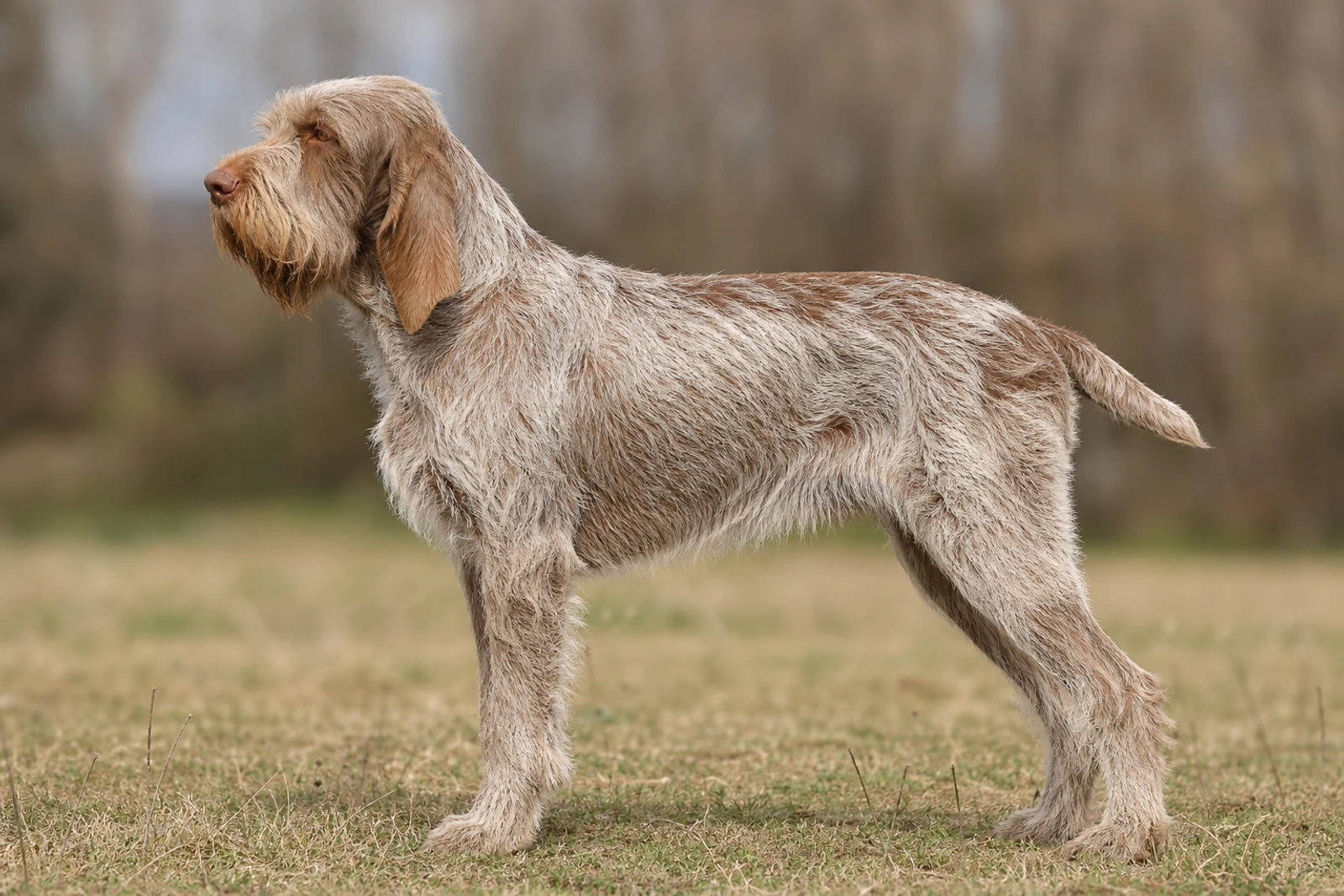
The Spinone Italiano is a calm, affectionate giant with a gentle soul, perfectly suited for active families or outdoorsy individuals. This versatile hunter from Italy boasts a wiry, weather-resistant coat and a patient, easygoing temperament. They thrive on human companionship, enjoy exercise, and are wonderful with children and other pets when socialized. Best in a home with ample space and an owner committed to their moderate grooming needs.
At a glance
- Size
- Giant
- Height
- 23–28 in
- Weight
- 65–85 lb
- Life span
- 12–13 years
- Coat colors
- White, Orange, Brown, Roan
- Coat type
- Dense, wiry, and rough
- Group
- Gun
How much does a Spinone Italiano cost?
Adopt / rescue
$75–$400
Usually includes spay/neuter, first shots, and a microchip.
Buy from a breeder
$700–$2,000
From a reputable, health-testing breeder.
Approximate USD. Prices vary widely by region, breeder, pedigree, age, and coat colour — adopting is the lower-cost and recommended route. Avoid suspiciously cheap “breeders”; they’re often puppy mills.
Estimate the full cost of a Spinone Italiano →Want the ongoing number? Estimate the monthly food bill for a Spinone Italiano with our dog food cost calculator.
Spinone Italiano photos
Views
Front, side, rear and top — the full silhouette.Poses
How the breed sits, lies, moves and plays.Puppy to senior
The breed across its whole life.Expressions
The breed’s range of moods.Close-up details
Eyes, ears, nose, paws, tail and coat.Coat colors
The breed’s recognized colors.Click any photo to enlarge. We show the Spinone Italiano from every angle — three views, poses, life stages, expressions, close-ups, coat and colors.
Appearance & size
A Spinone Italiano looks like it was built by someone more interested in function than finish — and that’s exactly the charm. Under a rough, country coat is a big, square dog with a deep chest and solid bone. Males stand 23.5 to 27.5 inches at the shoulder, females 23 to 27 inches, with weights ranging from about 65 pounds in a smaller female to 85 pounds in a substantial male. Despite the giant breed designation, this is a rangy, athletic dog, not a massive blob. You’ll notice the height at the shoulder is almost equal to the length of the body, giving it a compact, balanced silhouette.
The coat is the Spinone’s trademark: dense, wiry, and close-fitting, about 1½ to 2½ inches long, without an undercoat. It’s rough, not soft, and lies flat, with longer furnishings on the eyebrows, mustache, and beard that give the face its wise, scruffy expression. Color-wise, you’ll see solid white, white with orange or brown patches, or roan patterns (orange roan, brown roan). The white is clean, not chalky; the patches range from dark orange to rich chestnut. A darker roan often carries heavier pigmented skin underneath.
From the front, the Spinone’s human-like, ochre or dark amber eyes set well apart are its most arresting feature. They’re soft and thoughtful, not hard. The ears are triangular, rounded at the tips, and hang close to the cheeks, set just below the eye line. A pronounced occiput (that bony peak at the back of the skull) is a breed hallmark and adds to the profile’s distinctiveness. The muzzle is square and deep, with a slight Roman nose, and the beard makes the head look chiseled rather than coarse.
From the side, the topline is solid, sloping slightly from the withers to a strong, short loin. The chest drops to at least the elbow and is wide and well-sprung. Legs stand straight with heavy, round bone and short pasterns that give the front a sturdy, no-nonsense look. The rear angulation is moderate — you don’t see the overdone angles of a showy breed; instead, the thigh is well-muscled, and the hock is broad and let down. That practical build translates to a ground-covering, easy trot, not a bouncy prance. A Spinone looks like it could work a bramble-covered hillside all day and then curl up on your porch without missing a beat.
History & origin
The Spinone Italiano is one of the oldest pointing breeds on the planet. If you study a 15th-century fresco by Andrea Mantegna in the Ducal Palace of Mantua, you’ll see a dog with the same rough coat, long ears, and solemn, human-like stare that walks into American living rooms today. The breed took shape in the Piedmont region of northwestern Italy, where hunters needed a dog that could handle the extremes of Alpine foothills, flooded rice fields, and dense, thorn-choked marshland. That ancient, rugged job description explains almost everything about the Spinone you’ll meet now.
Built for brambles and freezing water
The name likely comes from spino, Italian for thorn bush—and that’s exactly where this dog earned its keep. Unlike sleek pointers bred for speed on open plains, the Spinone was built as a trotting, methodical hunter that would crash through blackberry thickets and plunge into icy water without a second thought. Its wiry, weatherproof coat, prominent beard, and bushy eyebrows aren’t cosmetic; they’re armor against slashing cover and biting cold. Hunters relied on the Spinone to find, point, and retrieve birds for the market, often working silent and steady all day. A big male can push 85 pounds, and that heft, combined with a deep chest and powerful legs, let the dog power through muck that would stop a lighter breed. The dense undercoat insulates in water, while the rough outer coat sheds briars and dries quickly. Everything about the Spinone’s body shouts “all-terrain hunter,” from its soft, almost human eyes that scan cover with patience to its webbed feet that paddle through flooded stubble fields.
A brush with extinction
Despite centuries of service, the Spinone nearly vanished. World War II decimated Italian breeding programs, and by the early 1950s the breed teetered on the edge of oblivion. A handful of dedicated Italian enthusiasts, most famously Dr. Guido Malandrucco, scoured rural farms to find the remaining purebred dogs and painstakingly rebuilt the gene pool. The breed standard had been codified back in 1897, but that scrap of paper meant little when so few dogs were left. Malandrucco and others focused on preserving the working ability, sound structure, and gentle temperament that had made the Spinone indispensable. Their success is the reason you can still meet one today.
From the Italian wetlands to modern homes
The Spinone stayed rare outside Italy until the late 20th century. The first imports to the United States arrived in the mid-1990s, and the American Kennel Club recognized the breed in 2000. Even now, you won’t see a Spinone at every dog park—annual registration numbers remain tiny compared to more popular pointing breeds. But those who bring one home get a living piece of European hunting history: a rough-coated retriever whose calm, goofy off-duty personality masks a work ethic forged in thorn bushes and freezing water for over two thousand years.
Temperament & personality
The Spinone Italiano is, at heart, a calm, people-centered companion wrapped in 65–85 pounds of shaggy, solid muscle. These dogs move through the house with a quiet, almost goofy steadiness — trailing you from room to room, content just to be near. They aren’t frantic or demanding, but they do need to be part of the pack. Left alone for long stretches, a Spinone can slide into anxiety-driven barking or chewing, so plan your schedule around togetherness.
Around the family, the breed’s gentle nature shines. Toddlers get an improbable amount of patience, and the Spinone usually coexists easily with other dogs and even cats, especially when raised alongside them. That sweetness doesn’t mean forgetting basic rules: teach kids to let the dog eat in peace. A relaxed, well-socialized Spinone greets visitors with a deep, booming bark and a lean-and-wag welcome, not suspicion. Aggression toward people or other animals is genuinely rare.
Training reveals both stubbornness and sensitivity. A Spinone will often pause to think things through—digesting the request, weighing the cold floor against the treat—and then choose. Harsh corrections shut them down fast. Respectful, consistent engagement and a sense of humor get much further. Early socialization smooths out a mild reservation toward strangers, but don’t expect a bouncy greeter; many Spinos simply offer a dignified, sniff-first hello.
Physically, the breed brings a few loveable quirks. The wiry beard and mustache turn every drink into a dripping trail across your kitchen floor. The infamous “Spinone lean”—where the dog presses his full weight against your leg—is standard operating procedure. Puppies chew to explore and soothe teething gums; adults remain devoted chewers, working hard toys to keep jaws strong and teeth clean. A solid hour of off-leash roaming, hiking, or long sniffy walks satisfies their moderate energy, after which they’ll happily collapse on the couch for hours. Expect 12 to 13 years of quiet, goofy, steadfast companionship—and plenty of wet footprints.
Good with kids, dogs & other pets
The Spinone Italiano is the kind of dog that lets a preschooler dress him in fairy wings and doesn’t hold a grudge. This breed’s patience is legendary, but at 65 to 85 pounds and standing up to 28 inches at the shoulder, a casual lean or an excited turn-and-burn in the living room can send a toddler flying. So the rule is simple: close supervision around small children, every time. Teach kids not to climb on the dog or yank those long, floppy ears, even though the Spinone will tolerate far more than most breeds ever would.
Other dogs
Spinoni typically carry that same easygoing attitude into dog-to-dog encounters. They aren’t scrappy or status-obsessed. That said, early and ongoing socialization makes the difference between a dog who greets the world calmly and one who flinches. Arrange structured puppy playdates, walk in new neighborhoods, and let your Spinone meet a variety of friendly dogs well before 12 to 16 weeks of age. An adult Spinone who’s had those steady, positive exposures rarely looks for trouble.
Cats and small pets
This is where you need a little realism. The Spinone was built to hunt, point, and retrieve, and while many live peacefully with the family cat, that doesn’t erase the genetic wiring. A squirrel darting across the yard or an unfamiliar kitten hissing under the couch can kickstart prey drive. Introductions should be gradual — leashed meet-and-greets, baby gates, and plenty of time. Never leave a Spinone unsupervised with a rabbit, guinea pig, or free-roaming bird. Raise them together from puppyhood and you stack the deck in your favor, but you’re still managing a 70-pound hunter with a soft mouth and a curious nose.
One thing that affects how they handle all these relationships: this breed hates being alone. A Spinone isolated in the backyard or shut away for 10-hour workdays grows anxious and may act out. They do best in a home where someone is around more often than not, whether that’s a parent, a kid doing homework on the couch, or another dog who can share the quiet.
Trainability & intelligence
The Spinone doesn’t respond well to a drill-sergeant approach. He’s too sensitive and too smart for it. Harsh corrections or even a stern tone can make this big dog shut down or simply wander off mentally. What works is a calm, reward-based partnership — you show him what you want, make it worth his while, and he’ll throw himself into it with a goofy, whole-hearted effort.
He’s a clever problem-solver, shaped by centuries of working independently alongside hunters in rough Italian terrain. That independence shows up in training as a quiet negotiation: what’s in it for me? Keep sessions short, upbeat, and full of food, play, or a scratch behind the ears, and you’ll see a dog that learns fast. Rely on endless repetition and he’ll find something more interesting — like a lizard on the fence or a scent trail from last night’s raccoon.
Recall is where his nose and independence can really test patience. A Spinone trailing a scent is a dog with his ears turned off. Building a reliable recall means starting in a low-distraction yard with roasted chicken or tripe treats — and slowly, over months, adding new environments. Never punish a slow return; you’ll just teach him that coming back ends the fun.
Socialization is equally critical. Between 3 and 14 weeks, expose him gently to a wide range of people, sounds, surfaces, and other animals. Without that foundation, his natural reserve can tip into fearfulness, which in an 80-lb dog becomes a genuine safety issue. Even with that early work, expect a slow maturity. Many Spinoni don’t settle into reliable adult reasoning until age 2 or 3, so patience isn’t optional — it’s the whole game. The payoff is a dog that works with you because he trusts you, not because he’s been forced.
Exercise & energy needs
Your Spinone Italiano is a hunter built for steady, all-day effort—not frantic bursts of speed. That means exercise needs are real, but they’re spread across long, meandering sessions rather than high-intensity dashes. Target 60 to 90 minutes of daily movement, split into at least two outings. A quick spin around the block won’t do it. These dogs need to cover ground, sniff, and occasionally break into a ground-eating trot.
Off-leash time in a safe, fenced area or on a quiet trail is where the breed shines. They excel at working cover, using their nose to puzzle out a scent, and will happily retrieve from water. Most Spinoni are strong, enthusiastic swimmers with a low, steady stroke that’s easy on joints. If you have access to a pond or lake, let them swim—it’s a fantastic full-body workout without pounding pavement.
Because this is a large, deep-chested breed, never exercise heavily right after a meal. A full stomach combined with vigorous movement raises the risk of bloat, a life-threatening condition. Wait at least an hour before and after eating for anything more than a mellow stroll.
Puppies and young adults deserve extra caution. Their joint plates don’t close until around 18 months. Stick to soft surfaces—grass, dirt trails, sand—and avoid repetitive jumping, hard turns, or forced running on asphalt. Short, playful sessions multiple times a day work far better than one long forced march.
Mental exercise is non-negotiable. A Spinone’s brain needs to work as much as his legs. Hide a toy or a treat-filled container in the yard and have him find it. Teach him to identify and retrieve a named object. Scent games, barn hunt, and introductory nose work classes are tailor-made for this breed. A 15-minute sniffy session can tire him out more than doubling the walk length.
Indoors, a well-exercised Spinone is famously relaxed—often goofy and happy to sprawl at your feet. Skip the exercise, and you’ll see that laid-back demeanor replaced by pacing, counter-surfing, or creative digging. They aren’t high-strung, but they are working dogs who need a job. If your schedule can’t accommodate two solid exercise blocks a day, a midday dog walker or a safe daytime yard with puzzle toys becomes a necessity, not a luxury. You’ll know you’ve hit the sweet spot when your Spinone is calm in the house yet eager to head out the moment you grab the leash.
Grooming & coat care
The Spinone’s rough, single-layered coat feels more like stiff terrier hair than soft fluff. It’s dense, wiry, and about an inch and a half to two inches long, with longer eyebrows, a beard, and a mustache that can trap water, food, and forest debris. The trade-off: this low-shedding coat needs regular, hands-on upkeep to prevent tight mats, especially behind the ears, under the legs, and in the facial furnishings.
Brushing
Use a metal pin brush or a slicker with rounded pins—soft bristle brushes slide right over the wiry surface and do almost nothing. Brush down to the skin in sections at least two or three times a week. Pay extra attention to the beard and mustache every day; food particles dry there and form hard little knots. A steel comb pulled through those areas will find snags before they become painful mats. After a day in tall grass or brush, check the coat thoroughly for burrs and foxtails, which cling aggressively to the harsh texture.
Bathing
Bathe every six to eight weeks, or when the dog rolls in something truly awful, using a mild dog shampoo that won’t strip natural oils. Over-bathing softens the wiry coat, so resist the urge to make the Spinone smell like a shampoo commercial. Rinse slowly and completely—the density of the coat hides suds, and leftover shampoo invites skin irritation.
Trimming and hand-stripping
Do not clip the body coat with electric clippers. Shaving ruins the weather-resistant wire texture and leads to a dull, cottony regrowth. Instead, remove dead hair by hand-stripping: use a stripping knife or your fingers to pull small tufts in the direction of growth. A full strip twice a year (spring and fall) keeps the coat healthy and harsh. Many owners rely on a groomer who knows wire coats for this, while they handle light neatening at home with round-tipped scissors on the feet, hocks, and stray beard hairs.
Nails, ears, and teeth
Floppy ears trap moisture, setting up infections. Check them weekly, wipe with a vet-approved cleaner if you see wax or smell something funky, and dry thoroughly after any swim or bath. Trim nails every three to four weeks, or as soon as you hear clicking on hard floors. Brush the teeth daily—or at minimum several times a week—to keep that classic Spinone beard from smelling like a trash can.
Seasonal coat care
There’s no dramatic shedding season because the Spinone lacks an insulating undercoat. Dead hair loosens gradually and stays put until you strip or brush it out. Consistency is what matters: tight mats don’t fix themselves, and a twice-a-year stripping schedule saves you from hours of painful dematting later. Keep a pair of hemostats in your kit for grass awns—the wiry coat grabs them and they can migrate into skin almost overnight.
Shedding & allergies
If you hate vacuuming, a Spinone is a pretty forgiving roommate. The rough, wiry single coat doesn’t have the kind of fluffy undercoat that drifts across the floor in tumbleweeds. You’ll find the occasional coarse hair on the couch, but it’s nothing like living with a shedding-heavy breed. Most of the dead hair gets trapped in that dense, curly jacket instead of falling out. That’s good for your dark pants, but it does mean you need to put in the work to pull it free — a quick swipe with a brush won’t cut it. Regular hand-stripping or carding is what lifts the old coat out and keeps the skin healthy.
There’s a seasonal shift, usually spring and fall, when you’ll notice a slightly heavier drop, but it’s still modest. The real mess factor here is drool. Spinoni have loose, damp flews and a legendary wet beard. After a long drink, water drips across your floor; after meals, the beard needs a wipe. And yes, the occasional string of slobber will land on your leg or the wall, especially when food is involved.
No dog is truly hypoallergenic. Allergies are triggered by dander and proteins in saliva, not just hair. So while the Spinone’s low-shedding coat can make life easier for some people with mild allergies, it’s not a guarantee. If allergies are a concern, spend real time in a breeder’s home or with an adult dog — preferably while it’s shaking its head and slinging drool — before you commit. With this breed, you manage hair through grooming and saliva with a dedicated stash of hand towels.
Diet & nutrition
Keep a sharp eye on the scale with a Spinone Italiano. These dogs love their food, and that easygoing attitude can slide into obesity before you know it — especially in a giant breed where extra weight puts real strain on hips and joints. An adult Spinone (65–85 lb) who gets a solid hour or more of daily exercise will need a diet calibrated to his actual activity level, not just the bag’s generic suggestion. Portion control is everything. Measure meals twice a day — skip the free-feeding — and adjust as his waistline dictates.
Puppies under four months do best with four evenly spaced meals; drop to three meals until six months, then settle into the adult two-meal rhythm. Transition them gradually: lightly cooked, puréed meats and vegetables, or a top-shelf commercial puppy food. Raw chicken wings can come in around twelve weeks, always while you supervise.
A Spinone thrives on a species-appropriate diet — think roughly 60% raw and cooked meat, 20–30% fruits and veggies, and 10% extras like eggs, yogurt, or grains. Because a dog’s jaw moves only up and down and lacks salivary digestive enzymes, tossing meals in a blender or food processor helps him absorb nutrients better. High-fiber pearl barley and bland white rice (great for touchy stomachs) make useful grain bases. Cook extra batches of grains, vegetables, and proteins ahead of time for quick, healthy foundations. Canned fish, cooked eggs, and unsalted vegetable cooking water can round out a meal in minutes.
Senior Spinoni slow down, so their calorie needs drop. Scale back gradually and watch for any creeping pudge. Older dogs often appreciate smaller, more frequent meals, but there’s no reason to slash protein aggressively. If your dog inhales his food, use a puzzle bowl to slow him down — it works his brain, too. Never slip him rich table scraps after a holiday feast; that’s a fast track to pancreatitis. Serve leftovers in his own bowl, never from your plate, to avoid begging habits that are a nightmare to undo.
Health & lifespan
Heading ### (None — section content directly)
A Spinone Italiano typically lives 12 to 13 years — solid for a giant breed, and not unusual to see them reach 14 or 15 with attentive care. That lifespan gives you plenty of time with a dog who ages slowly in spirit, though his body benefits from early, consistent health management.
Breed-specific concerns that responsible breeders work hard to avoid include hip dysplasia, elbow dysplasia, and bloat (gastric dilatation-volvulus, or GDV). The deep chest that gives the Spinone his classic silhouette also makes him vulnerable to bloat. Learn the early signs — pacing, drooling, a swollen belly, unproductive retching — and get to a vet immediately. Many owners opt for a prophylactic gastropexy during spay or neuter to tether the stomach.
Eye problems show up in some lines: entropion (inward-rolling lids), ectropion, and cataracts. A less common but serious inherited condition is cerebellar ataxia, a neurological disorder that affects coordination. A DNA test exists, and breeders who screen breeding stock can greatly reduce its occurrence. When you talk to a breeder, ask for OFA or PennHIP results on hips and elbows, a current CAER eye exam from a veterinary ophthalmologist, and proof of cerebellar ataxia testing.
Like many robust, food-motivated dogs, Spinoni pack on pounds easily. Extra weight isn’t just a joint problem — it also shortens their lives and raises bloat risk. Keep him lean with measured meals (split into two or three portions a day — no single huge dinner) and a true hour or more of daily exercise, not just a leisurely stroll.
Their wiry, thick coat can trap moisture, and some dogs battle recurring skin infections or seborrhea. A thorough toweling after wet walks and a diet that supports skin health go a long way. Check those long, floppy ears weekly for debris; you’ll prevent infections that hide under all that hair.
- Heartworm prevention is non-negotiable: give it monthly during mosquito season and for one month after it ends, even if you live in a cooler climate.
- Rabies vaccination is required by law; once symptoms appear, there’s no treatment.
- Schedule an annual wellness exam — more often for seniors — so your vet can catch subtle shifts in mobility, weight, or behavior.
Spinoni can be strong-willed and deeply attached to their people. Isolation or harsh corrections backfire, ramping up stress that wears on the immune system. Early, positive socialization and a low-key but consistent hand don’t just make a better companion — they lower the odds of stress-related illness later. Watch for any drop in energy, appetite changes, or a dog who starts moving like he’s sore; these guys are stoic, and a small change is often the first flag.
Living environment
Don’t let the Spinone’s giant frame fool you—indoors they’re surprisingly calm, often sprawling like a shaggy throw rug. A house with a securely fenced yard is ideal because they love to wander, sniff every blade of grass, and trot around at their own pace. Apartment living can work, but you’ll trade that yard for a bigger commitment to outdoor time. A full-grown Spinone (up to 85 pounds) takes up real floor space and has a happy tail that can clear a coffee table in one sweep, so cramped quarters aren’t great for dog or furnishings.
Daily exercise needs to be real exercise, not just a leash-and-pee loop. Plan on at least 60–90 minutes, split into two long, meandering walks or off-leash romps where they can follow their nose. They were built to cover marshy ground at a steady trot all day, so endurance is there—but it’s a low-key, sniff-driven endurance, not a sprinter’s. If you skip a day, you’ll see a restless, sulky dog. Add scent games, food puzzles, or hide-and-seek indoors to work their brain.
Climate matters more than you might think. That dense, wiry coat and webbed feet come from generations working Italy’s wet marshlands. Cool, drizzly, even snowy days are their jam. In hot or humid weather, they overheat fast. Keep summer exercise to early mornings and evenings, and always have shade and water ready.
Noise-wise, you’ll get a deep, restrained woof when someone’s at the door or a stray cat saunters past—not a yappy dog and not a frequent barker. They’d rather stare thoughtfully than sound off.
The real deal-breaker is being left alone. Spinoni bond hard to their humans and can develop separation anxiety if regularly left for long stretches. A typical 8-to-10-hour workday alone is too much. If your schedule demands that, look at a dog walker, doggy daycare, or a different breed. Work up absences gradually from puppyhood, leave frozen Kongs, and be ready for a dog who wants to be in the same room as you whenever you’re home. A second dog can ease the loneliness a bit, but what they really want is their person.
Who this breed suits
The Spinone Italiano is a 65–85 pound companion who acts like a 20-pound lap dog.
If you’re looking for a gentle, patient family dog that’s more “let’s amble and sniff” than “let’s run a marathon”—and you don’t mind a wet beard after every drink—you’re in the right place. This breed craves proximity: a Spinone wants to lean against your leg, follow you room to room, and nap with part of its body touching yours. They need true companionship, not just a backyard.
First-timers, yes—with a caveat
Spinoni are notably forgiving for a giant gun dog. They lack the nervy edge of some pointing breeds, and they’re less likely to bowl you over with frantic energy. A novice owner who commits to consistent, positive training (this breed shuts down under harsh corrections) can do well. The catch is managing 85 pounds of enthusiasm on a leash, the drool, and the beard that drips water across your floors. If that doesn’t faze you, this is one of the easier giants to start with.
Families and active households
The Spinone is famously affectionate with children. They’re steady, tolerant of being climbed on, and naturally gentle-mouthed. However, a young dog can accidentally knock over a toddler with a happy hip-check, so supervision is still a must. They typically get along well with other dogs and even cats when raised together. Daily exercise doesn’t require extreme effort—a solid 45–60 minute walk plus off-leash sniffing in a secure area satisfies most adults. They can join you for a long hike or a swim, but they won’t dismantle your house if you miss a day.
Seniors and singles
A Spinone can be a fine match for a retired couple or a single adult who works from home or has a dog-friendly schedule. The key is the dog’s deep need for human contact. Left alone for eight hours regularly, a Spinone can develop separation anxiety and destructive behaviors. If you’re home most of the time and can handle a dog that outweighs a smaller adult, the breed’s calm indoor demeanor is a big plus. Just remember that leash manners must be taught early—a squirrel sighting can test even a dedicated senior’s balance.
Who should think twice
A Spinone is a poor fit if you’re away from home for long stretches, prize crisp, drool-free furniture, or want a tidy, low-maintenance dog. The thick, wiry coat sheds moderately and traps mud, the beard requires regular cleaning, and the jowls produce slobber that ends up on walls and clothing. They’re not watchdogs: they greet strangers like long-lost friends, rarely barking. Also, this breed can be prone to hip dysplasia, bloat, and certain eye conditions; responsible breeders screen for these, but potential owners must accept the financial and emotional readiness for a large dog with a 12–13 year lifespan. If you need a clean, independent dog or a barking deterrent, cross this one off your list.
Cost of ownership
Bringing a Spinone Italiano home means planning for a rare giant breed with specific needs — and the bills that go along with them. Because reputable breeders are still fairly scarce in the US, expect a puppy purchase price of roughly $2,000 to $3,500 from someone who screens for hip dysplasia, elbow issues, eye problems (like entropion and ectropion), and cerebellar ataxia. A long waitlist is normal.
The monthly tab catches some people off guard. A 70-pound Spinone eats like the athlete he is. Budget $80 to $120 a month on a high-quality, large-breed formula; many owners soak kibble to slow down a dog who can wolf food and risk bloat. Speaking of which, if your puppy isn’t already gastropexied by the breeder, be ready for an elective stomach tack procedure that runs $300 to $600 — it’s a sound investment in a deep-chested breed.
Grooming isn’t a wash-and-go affair either. That dense, wiry coat needs hand-stripping or regular professional attention to stay healthy. Having a groomer strip and shape the coat every 6–8 weeks typically costs $80 to $120 per visit, so set aside $50 to $80 a month. You can learn to strip at home, but it’s a skill that takes time.
Vet costs track with any large, jowly dog. Ear infections crop up in those pendulous ears, especially if your Spinone loves water, and the breed can be prone to hip and joint problems. Pet insurance for a giant breed often lands between $55 and $85 a month. Routine care — annual checkups, preventatives, and the occasional ear flush — adds another $40 to $60 a month when averaged out.
Don’t overlook the small stuff that adds up quickly. You’ll go through drool towels and washable floor mats like crazy, a crate big enough for a 28-inch-tall dog isn’t cheap, and tough chew toys disappear into that soft mouth fast. A reasonable all-in monthly number, assuming insurance and professional grooming, lands in the $260 to $380 range — and that’s before factoring in any boarding kennels sturdy enough for a determined counter surfer.
Choosing a Spinone Italiano
If you want a puppy, start your search 12–18 months before you hope to bring one home. Spinoni litters are small, and breeders who do things right often have long waiting lists.
Responsible breeder vs. rescue
A good breeder treats every pairing like a careful genetic puzzle, not a convenient way to make money. They’ll ask you more questions than you ask them and can hand you OFA or PennHIP certificates for hips, plus clearances for elbows, patellas, and cardiac. You want to see a CAER eye exam done by a veterinary ophthalmologist within the last year. For the Spinone, cerebellar ataxia (CA) is a recessive neurological disease that causes progressive incoordination, usually appearing by 4–6 months. Demand a DNA test for CA—both parents should be clear, or one clear and one a carrier (carrier-to-carrier breeding is a red flag). Some breeders also screen thyroid.
Rescue is a quieter path. Spinone-specific rescue groups place adults and the occasional puppy. You skip the housebreaking and teething stage and get a known personality, but be honest about the baggage a rehomed dog might carry—separation anxiety is not rare in this velcro breed.
Red flags
Walk away from anyone who won’t produce health certificates, breeds multiple litters on the ground at once, lets puppies go before 8 weeks, or claims their dogs are “too rare” to need testing. Flashy marketing and a slick website prove nothing. Beware of breeders who fixate on a specific color—solid white dogs, for example, can have an elevated risk of deafness, and that’s not something you gamble on.
Picking your puppy
A well-raised Spinone puppy approaches you with a calm, tail-wagging curiosity—not skittish backing away or bulldozing over littermates. Avoid the pup that hides in the corner, and also the one that immediately latches onto you and ignores every other person. You want the middle-of-the-road dog who checks you out, then goes back to play. Look for clean eyes, a soft, dense coat (puppy coat is rougher than adult), and front dewclaws—Spinoni usually have them. Ask to see the parents’ temperaments, not just photos. A nervous or snappy dam is a red flag, regardless of the health papers on file. Expect to wait, and be glad when you do.
Pros & cons
Pros
- Incredibly gentle, patient temperament. This is the breed that will let a toddler lean on them and simply sigh. They’re affectionate without being needy, and they tend to get along beautifully with other dogs and even cats when raised together.
- Calm house dogs, not wired pointers. A Spinone needs a solid daily walk and some sniffing time, but they don’t ricochet off the walls. After exercise, they’re content to sprawl on a cool floor for hours.
- Long lifespan for a giant breed. 12–13 years is more than you’d expect for a 65–85 lb dog, giving you almost as much time as many midsized breeds.
- Versatile, no-fuss coat. The rough, wiry double coat traps dirt and sheds relatively little. A weekly brush and occasional hand-stripping keeps it in shape, no clippers required.
- Deeply loyal, with a soft sense of humor. They make steady hiking partners, quick to read your mood and slow to take offense.
Cons
- Stubbornness wrapped in sensitivity. You can’t drill them like a retriever. They shut down under harsh correction, yet they’ll creatively ignore a command they find boring. Training takes patience, short sessions, and a pocket full of treats.
- Slow to grow up. Expect puppy goofiness for a solid three to four years. That means a full-grown dog with the body-checking enthusiasm of a much younger animal.
- Slobber and a permanently wet beard. After every drink, water drips across your floor and onto your lap. The beard also collects food particles, so anticipate wiping faces multiple times a day.
- Big-dog durability concerns. Their deep chest puts them at risk for bloat, and responsible breeders screen for hip dysplasia, entropion/ectropion, and cerebellar ataxia. You’ll want to feed multiple small meals and skip heavy exercise right after eating.
- Strong nose, selective hearing. Off-leash reliability is a gamble. If they catch an interesting scent, your recall may vaporize no matter how much you’ve practiced. A fenced area or long line is the safer bet.
Similar breeds & alternatives
If the Spinone’s gentle patience and rustic look appeal to you but you’re turning over other options, a handful of gun-dog cousins offer different slants on energy, coat, and temperament.
-
Wirehaired Pointing Griffon — A closer match in coat and scruffy charm. The Griffon stands 20–24 inches and weighs 50–70 pounds, slightly smaller and noticeably more driven. Both have harsh, low-shedding wire coats that need hand-stripping, but the Griffon brings a higher-octane work ethic. He’s a clown, eager and busy, requiring more daily mental and physical output — expect a solid hour of hard exercise, not a long stroll. The Spinone is the softer, more deliberate choice; the Griffon suits active homes that want a versatile upland hunter with tireless bounce.
-
Bracco Italiano — The Spinone’s closest relative, and it shows. The Bracco is leggier, a rangy 21–27 inches and 55–90 pounds, with a sleek short coat in orange-and-white or chestnut roan. Temperament is similarly sweet and people-oriented, maybe a touch more demonstrative. Both are slow to mature and can be stubborn, but the Bracco sheds more and drools more. His hound-like face and clean lines appeal if a wiry beard isn’t your thing. The Spinone wins on easygoing grooming and that famously tolerant, almost human expression.
-
German Wirehaired Pointer — Sharper and more intense. He runs 22–26 inches and 50–70 pounds, also in a wire jacket, but the GWP is bred for serious drive. Genetics lean toward protectiveness and an edge of hard-headedness that a Spinone rarely shows. He needs a job, thrives on advanced training, and may not settle as calmly indoors. Choose the GWP if you want a versatile hunter with grit; pick the Spinone if a steady family companion who can hunt joyfully but doesn’t demand a daily mission fits better.
-
Lagotto Romagnolo — A smaller Italian alternative that swaps pointing for truffle-sniffing. At 16–19 inches and 24–35 pounds, this curly-coated water retriever puts less weight on the leash and lives 15–17 years. He’s bright, busy, and needs significantly less space but more brain games. The coat is dense, woolly, and near-nonshedding but needs regular clipping. No pointing instinct and a more active, vocal household presence. The Lagotto works well if the Spinone’s 65–85-pound frame and mellow trot feel like too much dog, though you’ll trade that breed’s calm stoicism for a livelier, inquisitive spark.
Fun facts
- Their name likely derives from the Italian word 'spino', meaning thorn, reflecting their ability to navigate thick underbrush.
- Spinoni have a unique, human-like expression with soulful eyes and a distinguished beard and mustache.
- They are one of the oldest Italian pointing breeds, known for their slow, methodical hunting style.
- Their wiry coat is naturally water-repellent, providing protection in harsh weather.
Frequently asked questions
- Is the Spinone Italiano good with children?
- Spinone Italianos are known for their patient and gentle nature, often making them excellent family dogs. They tend to be affectionate and tolerant, but supervision is always recommended with young kids due to their large size.
- How much shedding does a Spinone Italiano have?
- The Spinone Italiano has a dense, wiry coat that sheds minimally, though regular grooming is needed to prevent matting. This breed can be a good option for some allergy sufferers, though no dog is truly hypoallergenic.
- What are the exercise requirements for a Spinone Italiano?
- As a versatile hunting breed, the Spinone Italiano requires moderate daily exercise to stay happy and healthy. Long walks, play sessions, and opportunities to sniff and explore are ideal for this energetic but not hyperactive dog.
- How much grooming does a Spinone Italiano need?
- Their rough coat needs weekly brushing and occasional hand-stripping to maintain texture and remove dead hair. Regular ear checks are also important, as their dropped ears can trap moisture and debris.
- Can a Spinone Italiano live in an apartment?
- Due to their giant size and moderate energy, Spinone Italianos can adapt to apartment living if given sufficient daily exercise and mental stimulation. However, they thrive best in homes with a securely fenced yard where they can roam.
- Is the Spinone Italiano a good choice for first-time dog owners?
- Spinone Italianos are known for their laid-back and trainable temperament, which can make them suitable for first-time owners willing to meet their exercise and grooming needs. Early socialization and consistent positive reinforcement are key to raising a well-mannered companion.
Tools & calculators for Spinone Italiano owners
Quick estimates tailored to Spinone Italianos — pre-filled with this breed’s size where it matters.
Articles & stories about the Spinone Italiano
Sources & standards
This profile follows recognized breed standards from the American Kennel Club (AKC) and the Fédération Cynologique Internationale (FCI), along with established veterinary and breed-club guidance. These describe general breed tendencies — every dog is an individual.