

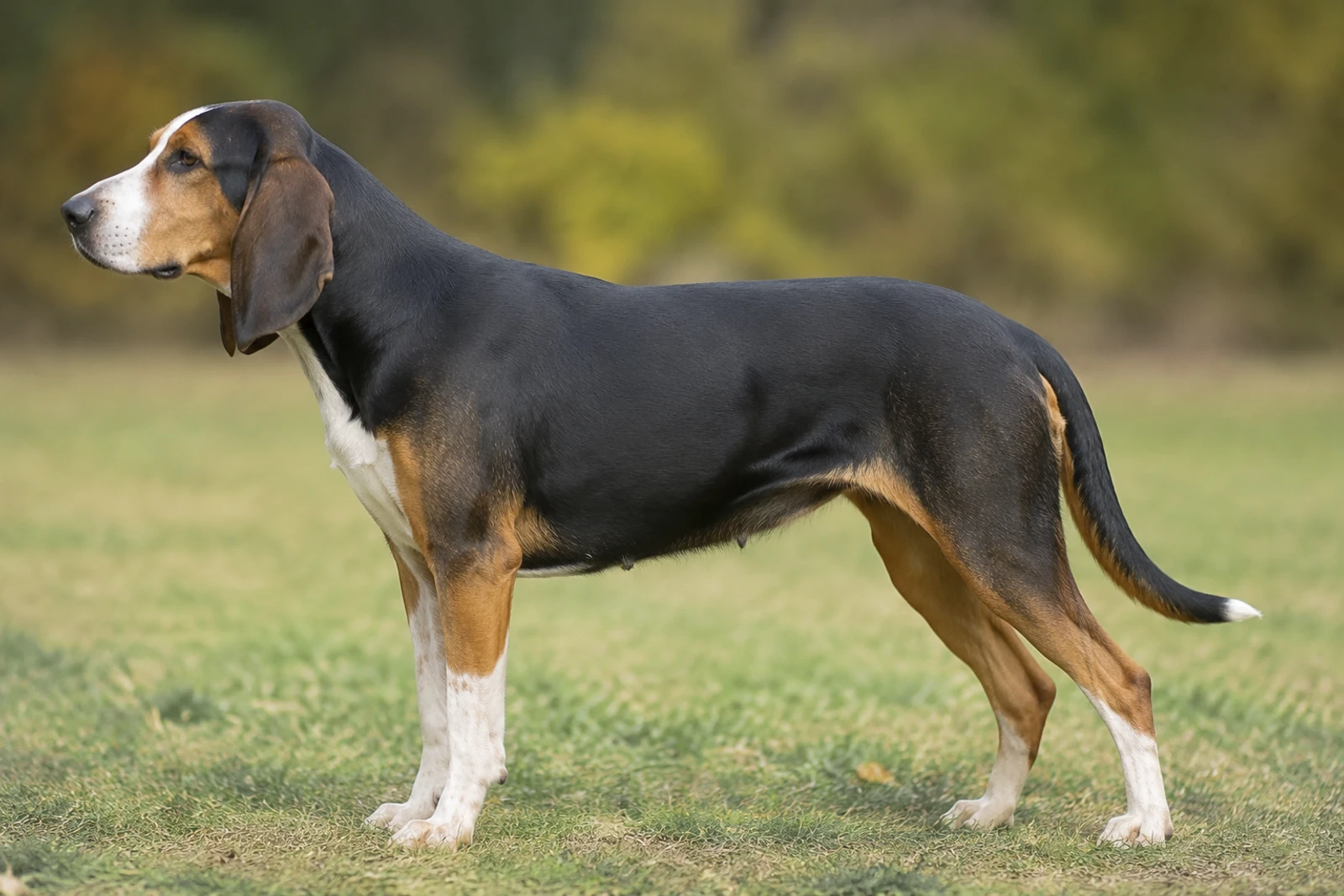
The St. Hubert Jura Hound is a devoted scenthound best suited for active outdoorsy families who enjoy hiking, running, or hunting. This medium-large breed thrives on daily exercise and mental challenges, and bonds deeply with its people. While calm indoors after sufficient activity, it needs space and is prone to baying. Not appropriate for apartments or novice owners due to its independence and high drive. With consistent training, the Jura Hound becomes a loyal, affectionate companion that excels in canine sports and mountain trails.
At a glance
- Size
- Large
- Height
- 18–23 in
- Weight
- 33–44 lb
- Life span
- 10–11 years
- Coat colors
- Tricolor, Black and Tan, Tan and White
- Coat type
- short, dense, smooth
- Group
- Scenthounds
How much does a St. Hubert Jura Hound cost?
Adopt / rescue
$75–$400
Usually includes spay/neuter, first shots, and a microchip.
Buy from a breeder
$700–$2,000
From a reputable, health-testing breeder.
Approximate USD. Prices vary widely by region, breeder, pedigree, age, and coat colour — adopting is the lower-cost and recommended route. Avoid suspiciously cheap “breeders”; they’re often puppy mills.
Estimate the full cost of a St. Hubert Jura Hound →Want the ongoing number? Estimate the monthly food bill for a St. Hubert Jura Hound with our dog food cost calculator.
St. Hubert Jura Hound photos
Views
Front, side, rear and top — the full silhouette.Poses
How the breed sits, lies, moves and plays.Puppy to senior
The breed across its whole life.Expressions
The breed’s range of moods.Close-up details
Eyes, ears, nose, paws, tail and coat.Coat colors
The breed’s recognized colors.Click any photo to enlarge. We show the St. Hubert Jura Hound from every angle — three views, poses, life stages, expressions, close-ups, coat and colors.
Appearance & size
Standing 18 to 23 inches at the shoulder and weighing 33 to 44 pounds, the St. Hubert Jura Hound reads as a large, solid scenthound that’s been scaled down from its Bloodhound ancestors without losing any of the noble presence. Picture a dog built for endurance, not bulk — a deep-chested athlete with long legs and a surprisingly light step for its size.
The body is distinctly rectangular, slightly longer than tall, with a strong, level back and a muscular loin that flexes visibly when the dog moves. The chest drops to elbow level, with well-sprung ribs that give plenty of room for heart and lungs. From the side, the underline carries a slight tuck-up behind the ribcage, so the dog never looks soft or slab-sided. The neck is moderately long, clean but with just enough loose skin to hint at the breed’s cold-trailing heritage, and it flows smoothly into laid-back shoulders.
The head is one of the most striking features — noble and substantial without being overdone. The skull is broad and slightly domed, the stop distinct, and the muzzle wide and squared at the tip with a black nose and wide-open nostrils. When the dog is alert, fine wrinkles appear across the forehead and around the eyes, but the skin never hangs in heavy folds. The eyes are medium-sized, dark brown or hazel, and set calmly under slightly drooping lower lids, giving that signature gentle, almost mournful expression. The ears are long, low-set, and hang in soft, folded leathers; pulled forward, they easily reach the nose. Inside, the ear hair is short and velvety.
The coat is short, dense, and flat-lying, with a smooth, hard texture that shrugs off rain and brambles. You don’t need to do much beyond an occasional brushing. Colors come in two classic patterns: tricolor (a black saddle or mantle over rich tan, with white markings on the chest, feet, tail tip, and sometimes a blaze up the face) and bicolor (vivid tan with a white chest, collar, legs, and tail tip, or less commonly black and tan with minimal white). The white areas are clear and crisp, not heavily flecked.
From the front, the dog shows a broad chest and straight, parallel forelegs with strong bone and slightly sloping pasterns. The feet are round, tight-arched, and cat-like — no splayed toes. From the rear, the hindquarters look powerful and well-angulated, with broad thighs and hocks that drive straight back, never cow-hocked. The tail is medium-length, thick at the base, and tapers gradually; the dog carries it saber-style with a gentle upward curve, never curled over the back.
The whole package moves with an easy, ground-covering trot. You’ll notice the Bloodhound heritage in the relaxed skin and the soulful face, but this is a tighter, more athletic build — a hound that can cover miles of rocky trails without breaking stride.
History & origin
This breed’s story begins in the unforgiving terrain of the Jura Mountains, a limestone range straddling the border of France and Switzerland. Huntsmen there needed a hound that could work at a steady, deliberate pace — moving game through dense forest and rocky slopes, not racing ahead. Local hounds had the right temperament for the job, but their scenting ability was ordinary. That changed in the 16th century when monks from the Saint-Hubert Abbey in the Ardennes sent some of their legendary black-and-tan hounds south.
Those Saint-Hubert hounds — the ancestors of today’s Bloodhound — were famous across Europe for their cold nose and grim persistence. Crossed with the lighter, more agile Jura dogs, they produced a scenthound that combined the best of both: the monks’ hound’s methodical trailing and anvil-deep voice, mated to a dog tough enough to climb all day without quitting. The result was a specialist for tracking hare and fox in the high country, and later for tracking wounded deer. It was never a flashy pack-hound meant to course game by sight. Instead, it worked deliberately, often solo or in a pair, following a cold trail with a resonant bay that the hunter could hear echoing through the valleys.
The breed — then known simply as the Jura Hound — stayed in the hands of local hunters and a few noble kennels for centuries. The French Revolution scattered those kennels, and both World Wars nearly erased what was left. By the mid-20th century, the population had dwindled to a handful of pure dogs in remote Jura farmsteads.
A small group of Swiss breeders, respecting the dog’s working character above all, began a careful revival. They gathered the last breeding stock, drafted a standard, and secured formal recognition from the FCI in 1954 under the name St. Hubert Jura Hound (Chien du Jura de Saint-Hubert). Even today, the breed remains a well-kept secret. You’re most likely to encounter one in the French or Swiss countryside, still doing what it was bred for — nose to the ground, moving with a slow, churning gait, and letting out long, rolling notes that tell the hunter exactly where the track is headed. Outside its homeland, it’s virtually unknown, kept by a small circle of enthusiasts who value a working scenthound that hasn’t been reshaped for the show ring.
Temperament & personality
The St. Hubert Jura Hound is, at heart, a calm and gentle scenthound — not a nervous barker or a hyperactive whirlwind. They take their time forming opinions, and once they do, they’re steady family companions. Standing up to 23 inches and typically weighing 33 to 44 pounds, they’re large enough for a full day in the field but not so big they can’t curl up on a dog bed afterward.
That independent nose guides a lot of their behavior. They follow scents with single-minded intensity, and if something interesting drifts by, you may find your recall command ignored completely. A securely fenced yard isn’t optional; it’s what keeps them safe when their ears turn off and the nose takes over. Inside, they’re surprisingly low-key — content to nap for hours, provided they’ve had a solid run or a long, sniff-heavy walk.
They show affection on their own terms. Expect a lean against your leg or a quiet presence at your feet rather than over-the-top enthusiasm. With children, they’re usually patient and gentle, but you have to teach kids never to disturb the dog while it’s eating. A St. Hubert Jura Hound can develop resource guarding if meal times feel threatened, and a stiff body and direct stare are clear warnings to back off.
The breed is naturally watchful. A deep, rolling bay greets strangers or odd noises, making them an effective early-warning system, though outright aggression is rare. That vocal streak can also surface if they’re left alone for long stretches; isolation often triggers anxiety-driven howling or destructive chewing. Puppy chewing is normal exploration and teething, and an adult may still chew hard items to keep jaws strong — a homemade citrus spray on off-limit furniture can help redirect the habit.
You’ll spot their mood in an instant if you know what to look for. Relaxed, loose posture and soft eyes signal a content dog. Lip licking, yawning, or turning the head away are calming signals — a subtle request for space when things feel tense. Thanks to their scent memory, a particular smell (like a vet clinic’s disinfectant) can prompt fear because they’ve linked it to a past bad experience, so pay attention to what their nose is telling you.
Quirks come with the territory. They may roll in decaying matter — a leftover from scavenger ancestors, whether to announce a find or just because they enjoy the stench. A vinegar solution neutralizes the resulting odor and also removes indoor urine marks, which is critical because leftover scent cues often trigger repeat marking. Reward outdoor elimination with a treat immediately, and you’ll house-train far faster than with punishment. Living with a St. Hubert Jura Hound means respecting a mind that was built to work scents — do that, give them steady routines, and the dog you get in return is remarkably level-headed.
Good with kids, dogs & other pets
A St. Hubert Jura Hound is one of the more naturally kid-friendly scenthounds you’ll meet. These dogs carry a patient, non-aggressive streak that pairs well with children who know how to treat a dog gently. At 33–44 pounds, they’re sturdy enough to handle a wobbly toddler’s grab without crumbling, but still light enough that a supervision lapse is more likely to end in a bumped head than a serious injury. That said, this is not a set-it-and-forget-it breed around little ones. An overexcited dog can knock a small child over, and a child who interrupts a resting hound or messes with its food can get a warning growl. Teach kids to give the dog space when it’s settled on its bed, and never let them crawl into a crate or corner the dog while it’s chewing. The real glue, though, is the breed’s deep need for companionship. A St. Hubert Jura Hound left alone in the backyard or ignored by a busy family will slide into misery — and that loneliness can surface as whining, chewing, or house soiling. Houses where someone is around for a good chunk of the day, and where the dog is included in family downtime, work best.
With other dogs, the outlook is generally bright. These hounds were built for pack work, so the default is sociable rather than scrappy. They often slide into multi-dog homes with minimal friction, especially if the introduction happens on neutral ground. Still, a boisterous young dog can pester an older, quieter one, so watch that dynamic. A dog that’s been under-socialized may need months of low-key parallel walks before it feels safe around new canine housemates; forcing interactions just amps up the stress.
Cats and small pets require a harder look. The scenting instinct that drives this breed creates a powerful chase impulse. A cat that stands its ground indoors might, over time, earn a grudging coexistence — particularly if the dog grows up with it from puppyhood. But a cat that bolts or an outdoor cat crossing the yard will trigger an explosive sprint. Keep small animals like rabbits, ferrets, or guinea pigs in a separate, secure room and never leave them unattended with the dog, even for a moment. Plan a slow, screen-door style introduction for a resident cat, and manage the environment with baby gates and elevated cat perches for life. For homes with free-roaming pocket pets, a different breed is usually the safer call.
Early socialization puts the guardrails on everything. Puppies need exposure to children, calm adults, other dogs, and the normal chaos of a household — doorbells, vacuum cleaners, quick movements — between 3 and 14 weeks of age. Without it, a hound that’s genetically sweet can grow up jumpy or hand-shy. Load those early weeks with positive, short, treat-heavy encounters, and you’ll end up with a steady family companion who handles new situations without drama.
Trainability & intelligence
A St. Hubert Jura Hound is a clever dog with a deep independent streak — smart enough to outwit a poorly latched gate, but wholly unmotivated by blind obedience. Training sticks when you pay him with what he values most: his nose and his stomach. High-value treats, a favorite squeaky toy, or a two-minute scent game will hold attention far longer than a raised voice ever could.
You’re building a partnership, not programming a robot. Reward-based methods are the only way to earn reliable responses. Catch him doing something right and mark it instantly with praise, a quick toss of a ball, or a piece of cheese. Punishment corrodes trust. A harsh correction can make this sensitive hound hand-shy or cause him to shut down entirely, and you’ll lose every bit of cooperation you’ve built.
Expect recall to be your hardest-won skill. When his nose hits a ground scent, your voice can become background noise. Practice daily on a long line in different environments, starting with zero distraction and working up to woodland trails. The reward has to be better than the trail — freeze-dried liver or warm chicken often wins. Even with months of proofing, off-leash freedom in unfenced areas is a gamble you shouldn’t take. A secure yard or a long leash on walks keeps him safe.
Patience pays. Keep sessions short and upbeat, and be ready to teach the same cue in a dozen new places before he generalizes. Early socialization is non-negotiable. Expose the puppy to men, children, unusual sounds, different surfaces, and calm dogs well before 16 weeks, and continue those positive experiences into adulthood. A hound that misses that window can become aloof or skittish, making vet visits and visitors a headache.
In the house, a consistent routine and crate training give potty training and basic manners a framework. He isn’t stubborn to spite you — he’s following a genetic directive that says check that interesting smell first. Redirect, immediately reward the choice you want, and show him that sticking with you leads to the best things in life.
Exercise & energy needs
What a St. Hubert Jura Hound really needs every day
This is a scent machine, not a neighborhood stroller. A quick lap around the block won’t even register. The Jura Hound was built to track game for miles over rough, hilly terrain, and that nose never clocks out. Give this dog at least 60 to 90 minutes of purposeful outdoor activity daily, split across two sessions. A 40–50 minute morning exploration with a 30-foot long line in a field or forest lets them follow scent trails without disappearing. The second session in the afternoon can be a shorter, 20–30 minute ramble somewhere with fresh smells.
Off-leash fenced areas work, but only if recall is locked in — once a Jura Hound locks onto a scent, everything else (including you) ceases to exist. A sturdy long line is smarter for most owners.
Physical exercise alone does not cut it. A bored scenthound is a noisy, destructive one. Pile on 20–30 minutes of deliberate nose work every day. Scatter kibble in the grass for them to sniff out, hide treats in cardboard boxes, or work a snuffle mat indoors. Real magic happens with a sport: tracking and mantrailing tap directly into the breed’s wiring, and even a beginner class teaches you how to turn that drive into a job. Urban scent detection or barn hunt also fit beautifully.
Puppies and young dogs under 18 months need softer handling while their joints mature. Four or five short, sniff-centered walks of 10–15 minutes work better than a long forced hike on pavement. Stick to grass, dirt, and uneven ground to build stability without pounding joints. Adult hounds can handle longer distances, but they still prefer winding woodland trails over a straight sidewalk jog.
Without this level of engagement, expect epic howling performances, fence-digging, and a dog that shadows you anxiously. Meet the need, and you get a focused, deeply satisfied partner who flops down and snores the evening away.
Grooming & coat care
The St. Hubert Jura Hound wears a practical, no-fuss coat: short, dense, and weather-ready, with a harsh outer layer and a softer undercoat. It’s not the kind of coat that mats or demands daily attention, but it does shed — steadily year-round, then heavily when the seasons change. A weekly once-over with a bristle brush or a rubber curry mitt does the heavy lifting. The bristles pull out loose undercoat, spread natural oils, and leave the coat gleaming without irritating the skin. During spring and fall blowouts, bump that to two or three times a week and swap in an undercoat rake to catch the dead fluff before it lands on your couch.
Bathing stays on an as-needed schedule. These dogs have a slightly oily coat that repels dirt, so a bath every two or three months — or after a particularly fragrant romp — is enough. Use a mild dog shampoo and rinse thoroughly; over-washing strips the protective oils and can make the skin itchy.
Ears, nails, and teeth
Those long, drop ears are a breed signature, but they trap moisture and debris. Clean them once a week with a vet-approved ear solution and a cotton ball, and give them a quick sniff for any yeasty or sour smell. Nails grow fast on a mostly indoor dog — if you hear clicking on hard floors, it’s time for a trim. If your hound gets plenty of roadwork on pavement, you might only need a nail touch-up every month or so. Brush teeth several times a week (daily is even better) to fend off tartar and the doggy breath that big scent hounds can develop.
Quick seasonal note
When a Jura Hound is shedding its undercoat heavily, a ten-minute session with a deshedding tool followed by a bristle brush will dramatically cut down the hair tumbleweeds. Don’t reach for a slicker brush — it’s overkill for this length and can irritate the skin. After a hunt or a hike, a fast brush-through also gives you a chance to spot ticks, burrs, and any small cuts hidden under the coat.
Shedding & allergies
If you're picturing a dog that barely leaves fur on the couch, the St. Hubert Jura Hound isn't it. This is a breed that sheds consistently, and you'll notice it. His coat is short, dense, and built for a long day in the field—typically a double coat with a harsh, protective outer layer and a softer undercoat. That undercoat is what makes the difference.
Throughout the year, expect a steady trickle of short, dark hairs winding up on floors, furniture, and clothing. Twice a year, usually in spring and fall, he'll "blow" that dense undercoat in earnest. For a few weeks, the shedding gets heavy enough that daily brushing becomes non-negotiable just to stay ahead of the fur tumbleweeds. A quick once-over with a hound glove or rubber curry comb works best to strip out the dead hair and bring some shine back to the coat.
Drool is moderate but worth mentioning. He’s not a faucet like a Bloodhound, but you’ll see wet spots after he drinks, and the jowls can get stringy when food is around. Keep a rag handy near the water bowl.
As for allergies, no dog is truly hypoallergenic. A short coat that sheds continuously spreads plenty of dander and saliva-carrying fur around your home. Someone with mild sensitivity might handle a well-groomed Jura Hound okay, but for a severe allergy sufferer, this isn’t a breed that tip-toes around the issue. Routine grooming is your best tool—it won't stop the shedding, but it keeps a remarkable amount of hair in the brush instead of the air.
Diet & nutrition
A St. Hubert Jura Hound’s nose runs the show, and with that often comes a serious interest in food. Portion control isn’t a suggestion—it’s a daily discipline. These dogs carry a lean, athletic 33–44 pounds on a frame that can run all day, so a little extra padding creeps up fast if you’re not measuring every meal. Keep a close eye on the ribs; you want to feel them easily under a thin layer of flesh.
Daily amounts. For an adult, that typically means roughly 2 to 2½ cups of high-quality kibble per day, split into two meals, or the calorie equivalent in a well-balanced raw or home-cooked diet. A dog that hunts or runs off-leash for an hour or more will need the upper end; a less active companion will pack on weight with the same amount. Adjust up or down based on body condition, not the hunger stare.
Meal rhythm.
- Puppies start with four small meals a day until about four months old, then three meals until six months. From six months on, settle into the normal twice-a-day adult rhythm.
- Seniors often do better with smaller, more frequent portions to ease digestion and keep blood sugar steady. Purée the food if teeth are missing or the mouth is sensitive—it helps pull in nutrients without the extra chewing.
What to put in the bowl. A species-appropriate diet revolves around meat. If you’re building fresh meals, a reliable starting point is around 60% raw or cooked meat, 20–30% fruits and vegetables, and 10% other ingredients like eggs, grains, or plain yogurt. Blend or process the mix; a dog’s jaw moves vertically and saliva lacks digestive enzymes, so blending gives absorption a real boost. Pearl barley and white rice are mild, digestible grains when you need a bland base. Never pour rich holiday drippings or fatty scraps over dinner—pancreatitis is a painful, expensive risk that shows up more often than you’d think.
Weight management is front and center. Even a few extra pounds stress the joints of a scenthound that jumps and twists in the field. Use a food puzzle bowl or a slow feeder if your Jura Hound inhales meals. The mental challenge burns a little energy and stops gulping. For seniors, scale portions back as exercise tapers off; obesity is one of the biggest health threats for older dogs this size.
Skip the table scraps entirely. Any healthy leftovers you want to share—a little cooked fish, some green beans—go into the dog’s own bowl, served after you’ve finished eating, so she never learns that begging at the table leads to a handout.
Health & lifespan
A healthy St. Hubert Jura Hound typically lives 10 to 11 years. That’s a respectable run for a large scenthound, and a lot of what determines whether a dog reaches the long end of that range comes down to genetics, preventive care, and staying ahead of a few breed-specific vulnerabilities.
- Ears. Those long, floppy ears trap moisture and limit airflow. Without routine cleaning, otitis externa—an outer-ear infection—sets in fast. A weekly wipe with a vet-approved cleaner and a quick sniff-check after rainy walks can head off trouble.
- Bloat (GDV). Deep-chested hounds have the anatomy that makes gastric dilatation-volvulus a real possibility. The stomach fills with gas and can twist, which becomes fatal within hours if untreated. Feeding two or three smaller meals a day instead of one large portion, and not hitting a hard run right before or after eating, lowers the risk.
- Joints. Despite a lean build (33–44 lb), hip and elbow dysplasia can still show up. Reputable breeders screen with OFA hip and elbow x‑rays or PennHIP evaluations and shouldn’t breed dogs with borderline scores. Keeping your dog at a trim weight—where you can feel ribs but not see them—takes pressure off the joints over a lifetime.
- Eyes. Progressive retinal atrophy (PRA) and cataracts appear in some lines. A current OFA eye clearance from a board-certified veterinary ophthalmologist on both parents is a green flag.
- Skin and allergies. Short-coated hounds aren’t immune to atopic dermatitis or food sensitivities. If you notice persistent paw-licking, belly rashes, or recurring ear infections, an elimination diet and environmental tweaks (like a hypoallergenic laundry rinse) can make a big difference.
What routine care looks like
Year-round mosquito protection matters. In areas with mosquito seasons, monthly heartworm prevention should continue for at least a month after the last hard freeze—heartworm treatment is brutal and the disease can be deadly. Rabies vaccination is legally required everywhere in the U.S., and there’s no effective treatment once symptoms appear.
Schedule an annual wellness exam with bloodwork, especially once the dog hits senior status around age 7. Hounds this age can develop hypothyroidism, kidney decline, or worsening joint pain that you might mistake for “slowing down.” Catching those early gives you more options.
Weight management directly affects lifespan. This breed is food-motivated and built for endurance, not bulk. Measure meals with an actual cup or scale; don’t free-feed. An extra 5 pounds on a 40‑lb frame is a lot of strain on a heart and hips.
Climate and emotional well‑being
The short, dense coat provides little insulation. In cold, wet weather, a waterproof jacket keeps a Jura Hound from shivering on the trail. In heat, they’ll follow a scent until they’re dangerously overheated—carry water and enforce breaks.
Isolation hits hard. A hound left alone in a kennel run for hours can tip into anxiety-driven barking and pacing, which elevates stress hormones that suppress immune function over time. Early socialization, nose‑work games, and calm, consistent handling—never force—keep the mental side of health as solid as the physical.
A breeder who’s transparent about hip, elbow, and eye clearances on the parents saves you from guessing later. Ask to see the paperwork before you bring a puppy home.
Living environment
A St. Hubert Jura Hound is a full-throttle nose on legs. This is not a dog you can tire out with a couple of 20-minute leash walks and a romp in a tiny yard. He needs space to sniff, track, and run—ideally, a rural or large suburban home with a securely fenced acre or more. Apartment living is a recipe for baying complaints and destroyed drywall. Even a small backyard won’t cut it unless you’re committed to daily off-site adventures in woods or fields where he can follow his nose at a dead run.
Fencing is non-negotiable. These hounds climb, dig, and completely tune out when a scent trail fires up. A 5- to 6-foot physical fence (invisible fences are useless with a dog this driven) keeps him from vanishing after a deer. If you have close neighbors, know that his voice—a deep, rolling bay—carries. He’ll sound off when bored, when tracking, or just to announce life. This is hardwired, not something you can train away entirely.
Climate-wise, his dense coat handles cold and damp well, but he can overheat quickly in high humidity or summer sun. On hot days, shift exercise to early morning or late evening and offer a cool, shaded spot to collapse in.
Left-alone tolerance is low. The breed bonds tightly with its people and grows anxious or destructive when isolated for long workdays. Expect a symphony of howling and potential jailbreak attempts. A better setup includes someone home most of the day, or a combination of dog daycare, midday check-ins, and heavy mental work—puzzle toys, frozen Kongs, and indoor scent games—to buffer the hours. Crate training and gradual desensitization help, but you’re still managing a dog that wants to be near his pack.
Realistically, if you can’t provide a big, escape-proof yard and a daily routine built around his nose—a long morning sniff walk, an off-leash run in a safe area, and an evening puzzle session—this hound will make your life loud and expensive.
Who this breed suits
Best-fit Homes
This scenthound suits an owner who genuinely enjoys getting muddy. The St. Hubert Jura Hound is a medium-large hunter — 33 to 44 pounds of sinew on a 18- to 23-inch frame, with a deep chest built for all-day tracking across the Jura mountains. If your idea of exercise is a quick leash loop, look elsewhere. He needs a minimum of a solid hour daily where his nose can lead: hiking trails, long walks with deliberate sniff breaks, or time jogging alongside a bike on safe dirt roads. A securely fenced yard is almost non-negotiable; he’ll patrol, baying at every interesting scent, which keeps his mind from going stale.
The breed bonds deeply with its family and is naturally patient with older, respectful kids. He’s not a velcro dog — bred to work at a distance from the hunter, he won’t panic when you leave for the day. That independence makes him a good fit for active singles or couples who want a weekend warrior, not a dog needing constant reassurance. But that same independence means training is a negotiation, not a command. Experienced owners who find joy in hound logic (and can laugh when he decides the hedgehog scent trumps your recall) will thrive here. He generally gets on with other dogs, especially if raised alongside them.
Think twice if…
- You’re a first-time owner. His stubbornness and selective hearing demand someone who’s already fluent in reading dog behavior and doesn’t take ignored commands personally.
- Your home is an apartment or condo. The Jura Hound’s voice — a rolling, resonant bay — travels through walls. It’s not excessive barking; it’s music to a hunter’s ear and a noise complaint to everyone else.
- Off-leash reliability is a dealbreaker. With over a century of independent tracking in his DNA, no fence or long line means a high likelihood of him following his nose straight into trouble.
- You have cats, rabbits, or backyard chickens. Prey drive is hard-wired and intense. Even with careful introductions, the risk of a tragic chase is real. A home with small mammals already running free is usually a poor match.
- You can’t manage a determined puller. When that nose locks onto a trail, a 40-pound hound can drag a surprised owner off their feet. A front-clip harness and a steady hand are daily essentials.
Fit, outdoorsy seniors who know the hound temperament can handle a Jura well, provided they have a fenced yard and backup help for longer treks. A 10- to 11-year lifespan means a long-term commitment to a dog whose happiness hinges on the simple act of following his nose — often at his own pace, and always with the volume cranked up.
Cost of ownership
Bringing home a St. Hubert Jura Hound means you’re after a rare scenthound, and that rarity shows up in the price tag. From a breeder who health-tests and knows the lines, a puppy typically runs $1,500–$2,800. A handful wind up in breed-specific rescue each year, with adoption fees closer to $300–$500—just expect to wait.
Initial supplies (crate, martingale collar, bed, bowls, a no-pull harness, and a long line for scent games) will set you back another $300–$500. Then the monthly rhythm starts.
- Food: A 33–44 lb dog with real stamina needs good quality kibble. Budget $45–$65 monthly. Treats for nose work sessions? Another $10–$15.
- Routine vet & preventatives: Annual checkup, vaccines, heartworm and flea/tick protection average out to about $40–$60 per month across the year.
- Insurance: For a large active breed, a solid policy runs $35–$55 monthly, depending on deductible.
- Grooming: The short, dense coat is wash-and-wear. A weekly brushing at home costs almost nothing. If you swing by a pro every 6–8 weeks for nail trims and ear cleaning, that’s $30–$50 a visit.
- Training: A six-week basic obedience class (a smart move for an independent hound) costs $120–$200 up front.
All in, you’re looking at $140–$210 in regular monthly expenses after the startup phase. Add another $20–$35 per day if you need dog walkers or daycare—a bored scent hound left alone will invent his own entertainment, and you’ll pay for it one way or another.
Choosing a St. Hubert Jura Hound
Finding a St. Hubert Jura Hound almost always means planning ahead. This is a rare scenthound outside its native Jura region, so breeders who treat health and temperament as non-negotiables keep waiting lists. You may need to travel to Europe or work with a stateside breeder who lines up imports. A rescue route is less predictable but possible — general scenthound rescues and the occasional breed-specific network will sometimes have an adult who lost his home because an owner underestimated his nose power and daily exercise needs.
Start with health clearances, not just promises
A sturdy build and a 10–11 year lifespan don’t mean you skip the paperwork. Responsible breeders screen for problems that can appear in larger hounds. Ask to see hard copies of the following, with the dog’s registration number clearly visible:
- Hips and elbows: OFA or PennHIP evaluations showing normal or better ratings.
- Eyes: A current exam by a veterinary ophthalmologist (OFA Eye or CERF) to rule out inherited eye disease.
- Cardiac: A baseline heart exam if there’s any murmur history in the lines; not universal, but worth asking about.
If a breeder waves off clearances with “they’re a healthy breed,” walk away.
Red flags that shout “move on”
- Puppies go home before 8 weeks, no exceptions.
- The dam is conveniently “absent” during your visit.
- Multiple litters from several breeds are under one roof.
- The breeder doesn’t grill you about your experience with hounds, your yard, or your plan for off-leash exercise — a scenthound without a secure outlet becomes a wandering liability.
Picking a puppy who fits your life
A well-raised litter lives indoors with daily handling and early scent games. Watch the whole litter; the St. Hubert Jura Hound is a pack-oriented hunter, so you want a pup who explores with his nose, engages with people, and recovers quickly from a startle. The shy one under the chair or the bossy ankle-grabber will both bring management challenges. Puppies should have clear eyes, cool clean ears without redness or odor, and a natural gait. A good breeder will point you toward a pup whose drive matches your household — a high-octane hunter in a casual pet home creates friction fast.
When you go the rescue route
An adult St. Hubert Jura Hound might come with a known history, or you might be guessing. Ask directly about prey drive and any hunting training. A trial period at home reveals more than a shelter walk ever will: does that nose lead to obsessive fence pacing, or a dog who settles after a solid run? Regardless of where your dog originates, you’ll need a size-appropriate, fenced space and a commitment to daily, sniff-heavy exercise — around 33–44 lb and 18–23 inches tall, this hound covers ground tirelessly.
Get it in writing
A contract should spell out health guarantees, a return policy if things don’t work out, and the breeder’s ongoing support. That piece of paper, not a quick Venmo payment, is what separates someone who breeds for the future of the St. Hubert Jura Hound from someone who just produces puppies.
Pros & cons
A dedicated scenthound with a nose that rarely clocks off — this breed expects work, not just a walk. How that plays out in a family home is a mix you’ll want clear before you fill the food bowl.
Pros
- Manageable medium frame — 33–44 lb and 18–23 inches tall makes a dog that’s sturdy on the trail but won’t overrun your living space.
- Short, easy-care coat. A quick weekly brush and the occasional wipe-down handles the dense, smooth fur.
- Deeply affectionate with its people. Once bonded, it’s a loyal shadow who’d rather be near you than anywhere else.
- Built for scent work. Tracking, mantrailing, barn hunt — this hound plugs into any nosework sport with fire and focus.
- Solid lifespan. A 10–11 year life expectancy is typical for a dog this size, and responsible care keeps them going strong.
Cons
- Driven by scent, not by you. Off-leash walks are a gamble; one whiff of deer and this dog is gone. A secure, high fence is non-negotiable.
- Operatic bay. Loud, frequent hound music carries for blocks — and your neighbors won’t find it charming at 6 a.m.
- Training is a negotiation. The independent streak runs deep. Progress comes through short, incentive-heavy sessions, not rigid commands.
- High prey drive. Cats, rabbits, squirrels, even small dogs can trigger an instinctive chase. Multi-pet homes need strict management.
- Demands real exertion. A 20-minute walk won’t dent it. Count on 60–90 minutes of running, hiking, or scent games daily to keep this dog sane.
- Escape artist and digger. A bored Jura Hound will tunnel under or climb over a flimsy barrier. Yard setup matters.
Similar breeds & alternatives
-
Bloodhound – The closest relative, but much larger and heavier. A Bloodhound can top 110 pounds and stands 23–27 inches at the shoulder, compared to the Jura Hound’s 33–44 pound, 18–23 inch frame. Both have an exceptional nose and a deep, rolling voice, but the Jura Hound was bred to cover rocky mountain terrain with agility; the Bloodhound is a slower, ground-scenting tank. If you don’t mind drool and need a dog that can also track lost people, the Bloodhound fits. For a more compact, high-stamina hiking partner, stick with the Jura Hound.
-
Other Swiss Hound varieties – The St. Hubert Jura Hound is one of several nearly identical Swiss Hound types. The Bernese, Lucerne, and Schwyz hounds share the same height, weight, and temperament. The difference is coat color and pattern alone: the Jura Hound is black and tan, while the Bernese is tricolor, and the Lucerne has a blue-speckled coat. If you’re flexible on looks, widening your search to any well-bred Swiss Hound can make it easier to find a puppy from a responsible breeder.
-
Basset Hound – A short-legged cousin with a similar independent streak but far less exercise demand. Bassets stand around 14 inches and weigh 40–65 pounds, so they’re bulkier but much closer to the ground. They share the Jura Hound’s stubborn, nose-first mindset, yet a couple of daily walks usually satisfies a Basset, where a Jura Hound needs a solid hour of off-leash roaming to stay settled indoors. Bassets also drool more and are harder to housebreak. If you live in an apartment or can’t commit to high-energy outings, the Basset is a more manageable scenthound.
-
Bavarian Mountain Hound – A lighter, slightly more reserved German breed. They stand 17–20 inches and often weigh 37–55 pounds, with a smooth red-brown coat. Bavarians are typically quieter in the house and form an intense bond with one person, while the Jura Hound spreads its affection more evenly across the family. Both need a securely fenced area for off-leash time—any scenthound will follow a trail without a second thought. The Bavarian risks less baying indoors but can be shyer with strangers.
Fun facts
- Bred to hunt hare and fox in the rugged Jura Mountains.
- Known for its melodious, far-carrying bay typical of scenthounds.
- Also called the Jura Hound or Bruno Jura Hound.
- Exceptionally hardy, able to work in harsh mountain weather.
Frequently asked questions
- Are St. Hubert Jura Hounds good with children?
- They are generally patient and gentle with children, especially when raised together. Early socialization helps ensure a strong bond, but supervision is recommended due to their large size and energy. Their pack-oriented nature can make them loyal family companions.
- Do St. Hubert Jura Hounds shed a lot?
- They have a short, dense coat that sheds moderately year-round, with heavier shedding during seasonal changes. Weekly brushing can help manage loose hair and keep their coat healthy. They are not considered hypoallergenic.
- How much exercise does a St. Hubert Jura Hound need?
- This active breed needs daily exercise, typically 60 to 90 minutes of walking, running, or scent work. Without enough physical and mental stimulation, they may become bored and develop unwanted behaviors. A securely fenced yard is recommended for off-leash play.
- What are the grooming requirements for a St. Hubert Jura Hound?
- Their short coat needs only basic care: weekly brushing, occasional baths, and regular nail trimming. Ear checks and cleaning are important due to their floppy ears, which can harbor moisture. Overall, they are relatively low-maintenance in terms of grooming.
- Can St. Hubert Jura Hounds live in apartments?
- They can adapt to apartment living if given sufficient daily exercise outdoors, but their size and energy level make a home with a yard preferable. Their tendency to bark when excited or on a scent may also be problematic in close quarters. Consistent training can help manage noise.
- Do St. Hubert Jura Hounds bark a lot?
- As a scenthound, they are prone to barking and baying, especially when following an interesting scent or when bored. This vocalization is a natural trait, but training can reduce excessive barking. They are not suited for noise-sensitive environments.
Tools & calculators for St. Hubert Jura Hound owners
Quick estimates tailored to St. Hubert Jura Hounds — pre-filled with this breed’s size where it matters.
Articles & stories about the St. Hubert Jura Hound
Sources & standards
This profile follows recognized breed standards from the American Kennel Club (AKC) and the Fédération Cynologique Internationale (FCI), along with established veterinary and breed-club guidance. These describe general breed tendencies — every dog is an individual.