

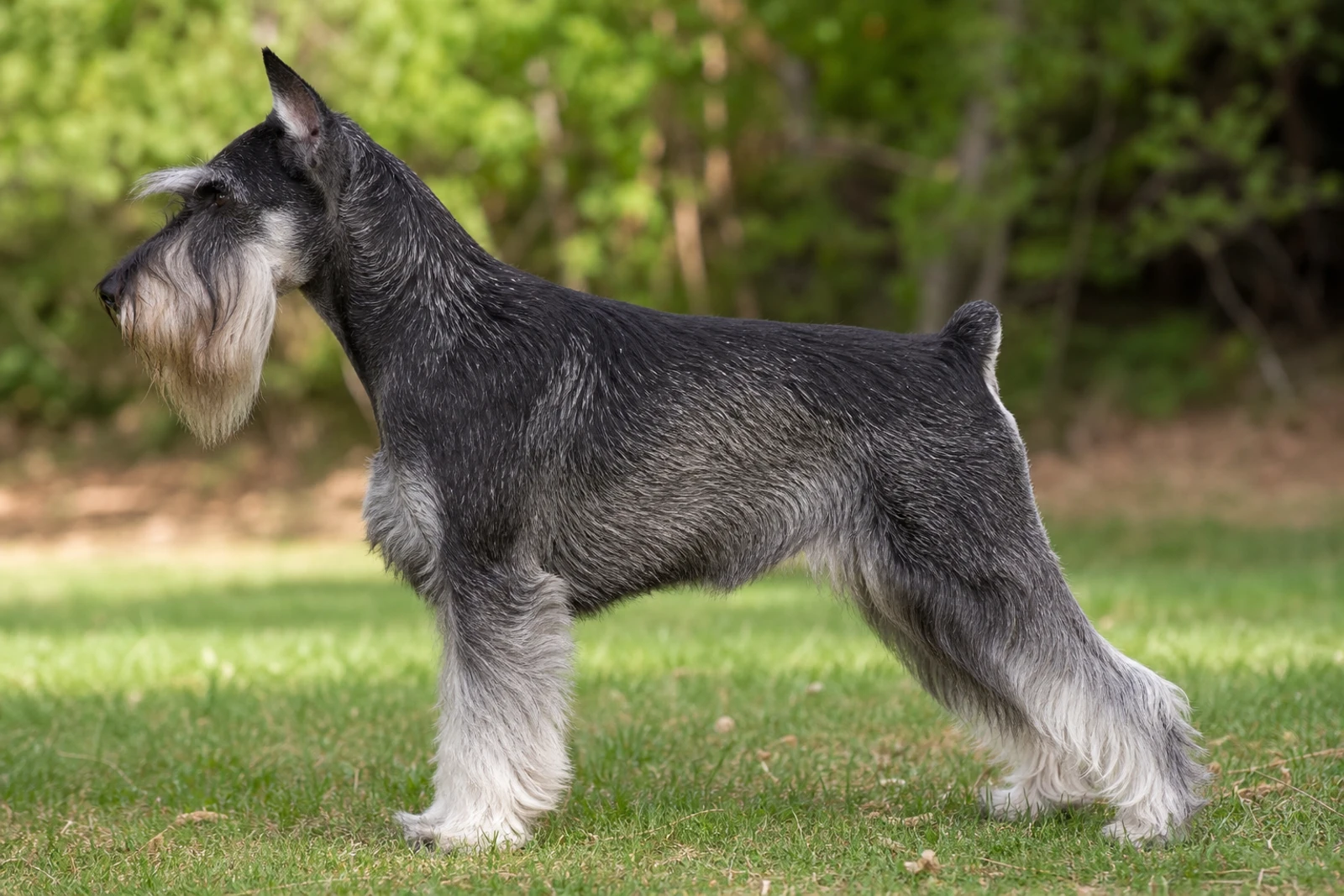
The Standard Schnauzer is a robust, intelligent, and versatile working dog, originally bred for farm duties like guarding and ratting. This spirited breed suits active families or individuals who can provide daily exercise and mental challenges. With a loyal and alert nature, they make excellent watchdogs and affectionate companions for those willing to invest time in training and consistent grooming. Their wiry coat sheds minimally, making them a good choice for allergy sufferers, though they are not completely hypoallergenic. Best suited for owners who appreciate a dog with a distinctive personality and high trainability.
At a glance
- Size
- Large
- Height
- 18–20 in
- Weight
- 31–44 lb
- Life span
- 10 years
- Coat colors
- salt and pepper, black
- Coat type
- wiry double coat
Compare Standard Schnauzer vs
Compare with any breed →How much does a Standard Schnauzer cost?
Adopt / rescue
$75–$400
Usually includes spay/neuter, first shots, and a microchip.
Buy from a breeder
$700–$2,000
From a reputable, health-testing breeder.
Approximate USD. Prices vary widely by region, breeder, pedigree, age, and coat colour — adopting is the lower-cost and recommended route. Avoid suspiciously cheap “breeders”; they’re often puppy mills.
Estimate the full cost of a Standard Schnauzer →Want the ongoing number? Estimate the monthly food bill for a Standard Schnauzer with our dog food cost calculator.
Standard Schnauzer photos
Views
Front, side, rear and top — the full silhouette.Poses
How the breed sits, lies, moves and plays.Puppy to senior
The breed across its whole life.Expressions
The breed’s range of moods.Close-up details
Eyes, ears, nose, paws, tail and coat.Coat colors
The breed’s recognized colors.Click any photo to enlarge. We show the Standard Schnauzer from every angle — three views, poses, life stages, expressions, close-ups, coat and colors.
Appearance & size
The first thing you notice about a Standard Schnauzer is that there’s nothing exaggerated or soft about him. This dog is built like a working farmhand: sturdy, square, and ready to go. From any angle, his outline says “athlete” without tipping into greyhound sleekness or bulldog bulk. He stands 18 to 20 inches at the shoulder and weighs a dense 31 to 44 pounds, with a body that’s about as long as it is tall. You can feel the substance when you put a hand on him — solid bone, a deep keel of a chest, and a spring of rib that doesn’t get slabby or barrel-chested.
Coat and color The coat is the breed’s signature. Double-layered, it has a soft undercoat and a wiry, harsh outer coat that lies tight against the body. Run your fingers through it and it’s crisp, not silky or fluffy. That texture serves a purpose: it repels dirt and weather. Colors are straightforward — pepper and salt (each hair banded with light and dark, giving an overall grey effect with a darker mask) or solid black. You won’t find merle, parti, or liver here. The pepper-and-salt dogs often have lighter furnishings on the cheeks, throat, and legs, but the body coat stays uniformly banded. Black dogs should be truly black, without rusty undercoat showing through.
Distinctive features — front, side, rear From the front, the Standard Schnauzer is all straight lines and calm confidence. The forelegs drop perpendicular, tight to the body, with elbows held close. The chest reaches at least to the elbows, and the head carries a rectangular muzzle just slightly shorter than the flat skull. Dark, medium-sized oval eyes give a keen, alert expression — never fiery like a terrier, never soft like a spaniel. The ears, if left natural, fold forward in a neat V that breaks the plane of the skull; cropped ears stand erect and pointed. But it’s the whiskery face that holds your attention: a bristly beard and thick, arched eyebrows that make the dog look perpetually interested in what you’re doing.
From the side, the topline is firm and level, ending in a well-set tail that traditionally was docked to a few inches and carried high, though you’ll see more natural tails now — thicker at the base, tapering, and often forming a slight sickle curve when the dog is moving. The neck is elegantly arched, merging into well-laid-back shoulders without a slump or a ewe-neck. The belly has a moderate tuck-up, nothing whippety, but enough to show that this dog can work all day on a farm.
From the rear, you see a parallel, well-angulated stance. The hindquarters are muscular but clean, with hocks that are short and vertical when the dog is stacked. A proper rear never looks stretched or overly bent at the stifle; it’s built for efficient trotting, not flashy prancing. The buttocks taper smoothly to the hocks, and the coat on the backs of the thighs tends to be shorter and stiffer than on the legs, which carry a bit of leg feathering.
The overall impression is one of refinement hiding serious grit. He’s not a giant schnauzer in miniature, nor is he a miniature schnauzer on stilts — he’s his own dog, a medium powerhouse with a coat you’ll never mistake for any other breed’s.
History & origin
The Standard Schnauzer didn’t appear out of nowhere as a single flashy creation. It’s the oldest of the three Schnauzer breeds, carved out over centuries by farmers in southern Germany who needed a dog that could do almost anything. The cradle of the breed stretches across Bavaria and Württemberg, where the dog earned its keep on farms, in butcher shops, and around breweries from at least the 15th century onward. You can spot its bearded silhouette in paintings by Albrecht Dürer and other Renaissance artists — that square, whiskery muzzle was already a fixture in everyday life.
Back then the dog was classed as a rough-coated Pinscher, often called a Wire-Haired Pinscher. Its jobs were unglamorous and unrelenting: kill rats in the stable, warn off any stranger who didn’t belong, herd livestock to market, and even pull small carts loaded with milk cans. The wiry double coat shrugged off weather and vermin bites. The deep bark and fearless attitude made the dog a reliable night watchman for a family whose assets walked on four legs. Agility and hardiness mattered more than looking pretty, but the Schnauzer’s distinct eyebrows, bristly whiskers, and keen expression hardened into a type that breeders began to codify in the late 1800s.
The name “Schnauzer” — from the German Schnauze, meaning snout or muzzle — emerged as a nod to the breed’s most recognizable feature. In 1879 a dog named Schnauzer took first prize at a show in Hanover, marking the breed’s official ring debut under that label. Just a year later, the first written standard fixed the look and temperament: medium-large, square-built, alert, and utterly devoted to its people. In 1895 the Pinscher-Schnauzer Klub formed in Germany, separating the rough-haired dogs into their own studbook. That standard became the blueprint for the three sizes we know today; the Standard is the original template, and both the Miniature and the Giant were developed later by sizing it up or down.
The breed’s work ethic didn’t end with mechanization. During World War I, Standard Schnauzers served as messenger dogs and Red Cross helpers. When German immigrants brought them to America in the early 1900s, the breed caught on slowly but steadily. The American Kennel Club recognized the Standard Schnauzer in 1904. For decades the dog remained a niche choice — less flashy than some working breeds, more substantial than a terrier — valued by families who wanted a highly trainable, sensible watchdog that didn’t need a sprawling estate. Today the breed’s numbers are modest, but the dog you meet is still cut from that old farm cloth: quick to learn, serious about guarding, and built to keep up with whatever the day throws at it.
Temperament & personality
The Standard Schnauzer has the mind of an engineer and the heart of a class clown — and that combination pretty much explains everything you need to know. These dogs are whip-smart, intensely curious, and wired to notice everything. They don’t just watch the front door; they patrol it, and you’ll hear about it the second a delivery truck is two blocks away. That alertness is hardwired, not something you can fully train out, so plan on some noise. But it comes with a fierce loyalty to their people that stops short of outright aggression in a properly socialized dog.
Calling them “strong-willed” is an understatement. A Standard Schnauzer isn’t the type to blindly follow commands — he’ll want to know what’s in it for him. Try to force him into a down-stay through sheer power of voice, and he’ll dig in his heels. You’ll get a lot further with clear, fair rules and a sense of humor. This is a breed that demands respectful consistency, not dominance. When you earn it, he’ll work his heart out for you in obedience, agility, or just a well-executed game of fetch.
At home, they’re affectionate without being velcro dogs. A Schnauzer will lean against your leg, tempt you into a wrestle session, then follow you room to room — but he won’t melt into a lap. Expect a playful, sometimes mischievous streak. If left bored, he’ll find his own entertainment, which often means redesigned couch cushions or a chewing project that keeps those powerful jaws busy. Provide sturdy chew toys and plenty of mental puzzles, or he’ll make his own rules.
With the household, they’re typically solid. They tend to bond with the whole family, not just one person, though their rambunctious energy can knock over a toddler by accident. Early socialization with kids and other pets is essential — a poorly socialized Schnauzer can become overly suspicious of strangers or territorial. Watch for a forward-leaning posture and a stiff stare when he’s sizing someone up; that’s your cue to redirect before things escalate. A relaxed, loose body around guests? That means you’ve raised a confident, well-adjusted dog.
House training usually goes smoothly once you establish a routine. Like many dogs, they’re driven by scent, so clean indoor accidents with an enzymatic cleaner or a vinegar spray to break the cue that says “this is my bathroom now.” Throw a treat party immediately after he eliminates outside, and he’ll catch on fast — they’re too smart not to. The quirks? Some will roll in foul-smelling stuff just because it seems like a good idea, a throwback to a scavenger’s sense of smell. You won’t change his mind, but a bath and a laugh get you through it.
Good with kids, dogs & other pets
Standard Schnauzers bring a patient, non-aggressive temperament that usually holds up well around respectful kids. But a 35–44 pound dog with a quick, bouncy play style can accidentally barrel over a toddler, so close supervision is a must — especially during the zoomies. Teach children to give the dog space when he’s eating or settling, and you’ll avoid friction that even a tolerant dog doesn’t need.
With other dogs, early and frequent socialization makes the difference. A well-socialized Standard Schnauzer enjoys playmates and reads canine body language decently, but he’s not a pushover. Same-sex scuffles can happen in intact adults, and a dog who spent his puppyhood isolated in a kennel run or pet store cage often grows up fearful, reactive, or outright aggressive. Forcing adult dogs to socialize adds stress and can trigger fights — if your rescue isn’t into other dogs, respect that. Keep interactions positive and brief while the puppy is young, ideally starting between 3–14 weeks and continuing past 16 weeks with relaxed, repeated exposures.
Cats and small pets get a mixed review. A Standard Schnauzer raised alongside a cat from puppyhood often learns to coexist peacefully. But the breed’s working roots include rodent patrol, so a fleeing hamster or a fast-moving outdoor cat can flip a prey-drive switch. Never leave them loose together unsupervised, and use baby gates and solid “leave it” cues as backup. If you have rabbits or guinea pigs, house them in secure enclosures the dog can’t reach or knock over.
The deal-breaker isn’t the breed’s nature — it’s the socialization you put in. A Standard Schnauzer needs steady, positive exposure to kids, friendly dogs, traffic noises, and weird surfaces before that 16-week window closes. Miss it, and you get a dog who defaults to wariness, not confidence. After that, ongoing low-key practice keeps him easy to live with. He’s affectionate and wants to be near his people, so leaving him isolated in the backyard for hours is a recipe for barking and distress. Meet his need for companionship and daily mental work, and he’ll return the favor with a level-headed, safe presence around the family — including the four-legged members who got a thoughtful introduction.
Trainability & intelligence
Standard Schnauzers learn fast — often in a handful of repetitions — but they’ve got a stubborn, independent streak that means training is a negotiation, not a monologue. They’ll nail a new command and then turn around and ask, “What’s in it for me this time?” Treat the dog like a thinking partner and you’ll get a willing, reliable worker who thrives on solving problems with you.
Motivation and rewards
Food is an obvious hook, but many Schnauzers will work just as hard for a squeaky toy, a tug session, or an over-the-top happy dance from you. Keep the currency unpredictable: sometimes a treat, sometimes a quick game. Short, upbeat sessions work better than long drills — a bored Schnauzer simply checks out, and a checked-out Schnauzer will start making his own fun.
The recall challenge
Getting a bulletproof recall is the single hardest skill to build. These dogs have a sharp watchdog instinct and a moderate prey drive; if a squirrel bolts, your voice can become background noise. Start in a quiet yard on a long line. Reward every check-in with a jackpot — real chicken, a game of tug, a release to run again. Never call your dog to punish him. One bad recall experience can unravel weeks of work. And if different family members enforce different rules, expect him to find the loophole every time.
Where people get stuck
Standard Schnauzers bore easily and are too smart for mindless repetition. They’ll test consistency at every stage, especially during adolescence. Harsh corrections backfire and create a defensive, anxious dog. Instead, when things go sideways, get calm and redirect to a known behavior you can reward. Also, leash skills need early attention: a 31–44 pound dog built like a tank can drag you off your feet if he learns pulling gets results. Teach loose-leash walking with constant stops, direction changes, and heavy reinforcement from day one.
Early socialization is non-negotiable
Between 3 and 14 weeks, expose your puppy to as many different people, sounds, surfaces, and safe dogs as you can. A well-socialized Schnauzer grows up confident and steady. Without it, you risk a dog who barks at every stranger or panics on a manhole cover. Ongoing positive experiences — not one and done — are what keep that adult dog bombproof.
Focus on building trust and clear communication, and you’ll have a dog who works with you, not against you, for the next decade.
Exercise & energy needs
Plan on giving a Standard Schnauzer at least an hour of real, heart-pumping exercise every day — not a leisurely stroll around the block. These 31–44 lb working dogs were built to move, think, and problem-solve, and a couple of short pee breaks won’t cut it. Split the hour into two sessions: a brisk 30-minute morning walk-and-sniff combined with a 30-minute off-leash run, hike, or vigorous game of fetch later in the day. Many owners find that turning one session into a longer 45-minute adventure and the other into a 20-minute training-heavy outing works even better, as long as the total stays near that 60–90 minute mark.
Intensity matters as much as clock time. A Schnauzer needs to pant. Jogging alongside a bike (on safe, soft trails), sprinting after a ball in a fenced area, or scrambling over logs on a woodland hike all tap into the breed’s working stamina. Short, frequent bursts often suit them better than one marathon session that leaves them overtired — they’re quick to catch a second wind, anyway.
Mental work is non-negotiable. Standards are too clever to be left with just a walk. Food puzzles, hide-and-seek with toys, and 10-minute nose-work games (hide a smelly treat, command “find it”) burn energy almost as well as a run. Combine physical movement with brainpower: practice obedience drills or rally moves during your walk, or scatter kibble in the backyard for a sniff-and-forage session.
Activities that shine with this breed: agility, barn hunt, advanced trick training, and even dock diving. Many Standards take naturally to canine sports because they love a job. Hiking with a loaded backpack (keep it light) satisfies their urge to carry things.
- Avoid repetitive high-impact jumping on hard surfaces while they’re growing; responsible breeders screen for hip health, and common sense protects growing joints.
- A bored, under-exercised Schnauzer will find his own project — typically one involving your baseboards, the trash can, or a running commentary of barking out the window. A tired Standard is a content housemate.
Grooming & coat care
A Standard Schnauzer’s wiry double coat is one of his best features—and it takes steady, hands-on care to keep it that way. Don’t expect piles of hair on your sofa; these dogs shed very little. Instead, the trade-off is that dead hairs get trapped in the harsh outer layer and need to be physically removed.
Brush him two to three times a week with a slicker brush (rounded pins) and follow up with a metal comb. Pay extra attention to the long leg feathers, armpits, and the distinctive beard and eyebrows—those spots mat if you skip a week. If you’re maintaining a show coat or want that crisp, weather-resistant texture, learn to hand-strip: plucking dead undercoat and outer hairs by hand or with a stripping knife. It keeps the coat wire-hard and the salt-and-pepper coloring bright. Many pet owners clip the coat instead, which is faster but softens the texture over time and can fade the banded hairs to a dull gray.
Bathe him only when he’s genuinely dirty, every six to eight weeks at most. Too much shampoo strips the natural oils that give the coat its character. A quick rinse of the beard after meals prevents odor.
Don’t let the grooming stop at the coat. Check and clean those ears every week—Schnauzer ears can trap moisture, setting up infections. Trim nails every 10 to 14 days; long nails throw off his square, sturdy stance and can lead to joint strain. Brush his teeth a couple of times a week (daily is better) to dodge the dental disease that often shortens a Schnauzer’s lifespan.
Seasonal shifts don’t cause dramatic shedding, but you might notice a little extra dead undercoat in spring and fall. Just add an extra brushing session each week, and run the comb through the furnishings more often. A tired, well-exercised Schnauzer cooperates better on the grooming table anyway—plenty of outdoor time helps shed dead hair naturally and keeps his skin healthy.
Shedding & allergies
Standard Schnauzers shed remarkably little — you’ll find more hair in their brush than on your sofa. That wiry, dense double coat grabs loose hair instead of dropping it around the house, which makes them a solid choice if you can’t stand constant vacuuming. The catch is that the dead hair you don’t see is still there, tangled in the outer coat, so you’re trading daily sweeping for a real grooming commitment.
- Coat type: Harsh, wiry outer coat with a soft undercoat. The texture naturally resists dirt and moisture, but it doesn’t self-clean the way some short coats do — neglect it, and you’ll end up with matted clumps.
- Shedding amount: Light, year-round. There’s no dramatic seasonal blowout like you’d get with a Husky or Lab. You might notice slightly more dead hair coming out with a comb in spring and fall as the undercoat turns over, but it rarely lands on the floor.
- Drool: Practically none. A Standard Schnauzer isn’t going to leave wet spots on your pants or sling slobber across the kitchen.
The real “hypoallergenic” picture
No dog is 100% allergen-free — allergies come from dander and saliva proteins, not just hair volume. But because Standard Schnauzers shed so little, they spread less dander around your home. Many people with mild pet allergies do fine with them. If your allergies are severe, spend time around adult Schnauzers before committing; a puppy’s softer coat can be misleading.
The kicker: that non-shedding coat requires steady manual removal of dead hair. You’ll brush with a slicker and a metal comb two or three times a week, and the dog needs either hand-stripping (plucking dead hairs to preserve coat texture) or clipping every 4–6 weeks. Hand-stripping is time-consuming and pricier, but it maintains the wiry shed-resistant feel. Clipping is easier but can soften the coat over time, making it slightly more prone to holding onto loose hairs. In return, you’ll have a near-zero fallout dog who won’t trigger the robotic vacuum every five minutes.
Diet & nutrition
Portion control is everything
A 31–44 lb Standard Schnauzer can easily tip into overweight territory if you eyeball the kibble. This breed is famously food-driven, and every extra treat or table scrap translates fast into padding you’ll see around the ribs. Measure meals with a real measuring cup, split into two daily feedings, and skip the self-refilling bowl. Most adults stay sleek on 1.5 to 2.5 cups of high-quality dry food a day, but the exact number depends on their workout. A Schnauzer logging an hour of hard running or hiking needs more fuel than one that trots around the block. Keep checking: you should feel ribs beneath a thin layer of fat, not a quilt.
Why weight matters so much here
Standard Schnauzers only average a 10-year lifespan, and extra poundage chews into that. Obesity puts serious strain on joints and the spine — a real worry for an active, medium-large dog that jumps and pivots with enthusiasm. If your dog has a joint issue or you’re working to prevent one, keeping them lean is the single most effective thing you can do. A spare 3 or 4 pounds might not look dramatic, but on a 35-pound frame it’s like you carrying an extra backpack everywhere.
What a Standard Schnauzer plate looks like
A good diet mimics what a dog’s body is built to digest. Whether you feed commercial food or home-cooked, the balance should lean heavily on animal protein. If you cook for your dog, aim for roughly 60% meat (raw or lightly cooked), 20–30% vegetables and fruit, and about 10% extras like eggs, plain yogurt, or grains. Because dogs lack salivary digestive enzymes and their jaws only move vertically, blending or finely chopping produce helps them absorb more nutrients — steamed carrots whizzed into a purée do more good than whole chunks that pass right through.
- Protein anchors the meal. Chicken, beef, turkey, canned fish (in water, no salt), or eggs are all solid go-tos.
- Stomach-soothing carbs. If your Schnauzer has a sensitive gut, white rice or pearl barley offer bland, digestible energy.
- No rich scraps. Fatty holiday trimmings can trigger pancreatitis. Offer leftovers only in their bowl, never from your plate, and keep “extras” boring: a spoon of pumpkin, a sardine, a couple of green beans.
From puppy chow to senior adjustments
Standard Schnauzer puppies grow fast and burn energy in bursts. For the first four months, split their daily ration into four meals to keep blood sugar steady and house-training predictable. From four to six months, drop to three meals. By six months, they’re on the adult rhythm of two meals a day. Start puppies on a high-quality puppy food or lightly cooked, puréed meats, fish, fruits, and vegetables, and introduce any new diet gradually over a week or so. Around 12 weeks, you can offer raw meaty bones like a chicken wing under direct supervision — it’s good for jaw strength and mental work.
Between age 7 and 8, your Schnauzer’s furnace starts to cool. Activity levels often dip, and weight can creep up even if the food bowl hasn’t changed. Gradually reduce calories, but don’t slash protein. Senior dogs need the amino acids to hold onto muscle, so a higher-protein, lower-fat senior formula or a smaller portion of their normal food usually works better than a carb-heavy “light” diet. If teeth become a problem, purée meals to keep nutrition uptake high. And for any dog that inhales meals in 30 seconds, a food-puzzle bowl turns dinner into a brain game while forcing slower, safer eating.
Health & lifespan
A healthy Standard Schnauzer typically lives around 10 years. These are sturdy, athletic dogs, but like any breed, they come with a few health vulnerabilities you’ll want to keep on your radar.
Responsible breeders screen for conditions that can show up in the breed, particularly hip dysplasia, eye disorders like cataracts and progressive retinal atrophy (PRA), and an inherited skin condition called Schnauzer comedo syndrome—essentially, clogged hair follicles that form small crusty bumps along the back. Ask any breeder you’re considering for clear OFA or PennHIP hip scores and a recent CERF eye exam for both parent dogs. These tests don’t guarantee a puppy won’t develop an issue, but they stack the odds in your favor.
Weight management matters more than most people realize. A 31–44 pound dog built for agility and endurance can pack on extra pounds quickly if meals aren’t measured and treats aren’t counted. Those extra pounds stress the hips and knees, shorten a dog’s active years, and amplify any inherited joint problem. Because Standard Schnauzers are sharp, food-motivated dogs, they’ll train you to hand out snacks if you’re not careful—keep food rewards tiny, and don’t cave to every hopeful stare.
Preventive care is mostly straightforward. Monthly heartworm prevention through mosquito season (plus one extra month) isn’t optional; it’s far better than treating the disease. A current rabies vaccine is legally required, and there’s no effective treatment once symptoms appear, so you don’t skip it. Their dense double coat gives them decent cold tolerance, but they can overheat in high humidity—plan walks for cooler parts of the day in summer and never leave them in a parked car.
Schedule an annual vet visit, and twice-yearly panels for dogs over seven. You’re looking for subtle shifts: a slight limp after play, squinting in bright light, or a sudden loss of enthusiasm for a morning walk. A Standard Schnauzer who’s been properly socialized and handled positively from puppyhood is less likely to carry chronic stress, which has a real impact on overall health. So keep those vet visits upbeat—practice exams with treats at home—and you’ll get a much more cooperative patient who catches problems early.
Living environment
A Standard Schnauzer can live comfortably in an apartment or a house with a yard — but don’t confuse “compact” with “low key.” These 31–44 lb dogs are busy, high-energy thinkers who need a job, not just a sidewalk stroll. Plan on a solid 60–90 minutes of purposeful exercise every day, split into at least two sessions. A morning jog, a long sniff-walk where they set the pace, and an afternoon of fetch, off-leash running, or a training workout hit the mark. Skip it, and you’ll get the kind of entertainment you didn’t want: barking marathons, digging, or a shredded couch.
Yard and fence
A yard is a gift, not a shortcut. It gives them space to patrol and burn off steam, but they won’t self-exercise. The fence needs to be sturdy and dig-proof — Schnauzers have a strong prey drive and a guardian’s instinct to check the perimeter, and they’ll exploit a loose board or a shallow corner. If you plan to let them off leash, secure it first.
Noise and neighbors
Standard Schnauzers are wired to alert. They bark — deliberately, loudly — when something catches their eye. In an apartment with shared walls, that can wear out your welcome fast. You can train a solid “quiet” cue and reward calm, but you’ll never erase the watchdog. If noise is a dealbreaker, this breed isn’t a great match.
Climate tolerance
Their wiry double coat sheds dirt and handles cold, damp weather well. A drizzly, 40°F walk is no big deal. Summer heat is the real concern. In hot, humid weather, shift exercise to early morning or evening and feel the pavement with your hand first. Indoors, they can overheat if air conditioning isn’t reliable.
Being left alone
Schnauzers glue themselves to their people. Left alone for a full workday, they’re prone to separation anxiety — howling, pacing, or destructive chewing. They thrive when someone’s around most of the time or when a dog walker breaks up long stretches. Puzzle toys, stuffed Kongs, and nose-work games soften the edges, but the foundation is slow, steady desensitization from puppyhood. If your week means 9-to-5 silence, choose a more independent breed.
Who this breed suits
The Standard Schnauzer fits best with an owner who doesn’t just walk the dog — they hike up the mileage, rally through an agility course, or brainstorm a backyard puzzle game. Weighing 31–44 pounds and standing 18–20 inches, this breed brings a sturdy, medium-sized body and a bottomless tank of mental fuel. If you’re an active single, a couple, or a family with older kids and a securely fenced yard, the Schnauzer slides right in as your four-legged shadow, ready for anything from a trail run to a training session in the living room.
You don’t need a marathoner’s resume, but you do need consistency. This dog lives for a challenge and has the brains to outthink a first-time owner who’s soft on rules. They respond to clear, fair leadership that doesn’t nag or repeat — say it once, make it stick, then move on. In return, you get a confident watchdog who is naturally reserved with strangers yet deeply bonded to their people. They’ll alert you to every delivery truck, so expect some vocal commentary; an apartment with thin walls is a poor match.
Households with small animals or multiple dogs of the same sex should think carefully. Aroused by movement, many Standard Schnauzers have high prey drive and short fuses with other canines, especially if they weren’t carefully socialized from puppyhood. They can learn to coexist with a well-matched dog or a cat raised alongside them, but off-leash dog parks or a free-range bunny in the yard usually spell trouble.
Who should think twice:
- First-time dog owners who are hoping for a forgiving starter breed.
- Sedentary folks or those away from home 10+ hours a day — boredom quickly turns into destructiveness, nuisance barking, or hyper-vigilance.
- Families with toddlers underfoot, unless you’re prepared to supervise constantly and teach both dog and child rock-solid boundaries.
- Anyone looking for a quiet, low-maintenance, go-anywhere lap dog.
The Standard Schnauzer doesn’t coast. This is a ten-year partnership — the typical lifespan — that requires you to stay one step ahead. If that sounds like a good time, you’ll get a razor-sharp, clownish, and fiercely devoted teammate. If not, you’ll both be miserable.
Cost of ownership
A well-bred Standard Schnauzer puppy from a breeder who screens for hip dysplasia, eye disease, and cardiac issues will run you $1,800–$2,500. Puppies from top show lines or breeding prospects can push past $3,000. If you go through a rescue, expect adoption fees in the $200–$500 range; adult dogs may already have some training under their belt. Purebred bargains usually mean corners were cut on health testing, so that lower price tends to cost more in the long run.
Once the dog is home, the monthly rhythm looks like this:
- Food: $40–$70 for high-quality kibble or raw. A 35–44 lb adult eats about 2–2.5 cups of dry food a day, more if you’ve got a real athlete.
- Grooming: This is the big one. A Standard Schnauzer’s wiry double coat needs professional hand-stripping or clipping every 6–8 weeks — usually $60–$100 per session. Between visits, you’ll still need a slicker brush and metal comb to prevent mats. If you learn to do maintenance yourself, budget $10–$15 a month for supplies; if not, figure $40–$60 a month averaged out.
- Vet & preventatives: Annual exams, vaccinations, heartworm and flea/tick meds add up to roughly $300–$500 a year. Set aside $25–$40 monthly. As the dog ages, plan on extra for bloodwork or x-rays — the breed can be prone to hip issues and progressive retinal atrophy.
- Pet insurance: $30–$50 a month for a solid accident-and-illness plan. Premiums rise with age, so starting early locks in a better rate.
- Treats, toys, waste bags, the occasional chew: $20–$30.
Initial gear (crate, bed, bowls, leash, collar, basic training class) adds $400–$600 upfront. All told, routine monthly costs sit in the $140–$200 range, with grooming making up the wildcard. Skimp on that wiry coat, and you’ll have a cranky, matted dog who hates being handled — so it’s not the place to pinch pennies.
Choosing a Standard Schnauzer
If you decide a Standard Schnauzer is your dog, how you get one matters as much as the decision itself. These are smart, sturdy, 31–44 lb dogs with a 10-year lifespan and a lot of opinions, so starting with a sound temperament from a responsible source prevents years of headaches.
Responsible breeder or rescue? Either can work, but ask hard questions either way.
Rescue is a real option. Breed-specific rescues often have young adults whose owners underestimated the breed’s drive and watchdog seriousness. You skip puppyhood and may get a dog that’s already house-trained, but you’ll need to dig into its history. Any decent rescue tests for basic temperament and will tell you frankly if the dog guards resources or isn’t good with cats. Expect a home visit and an honest conversation about your experience with assertive breeds.
A good breeder, though, gives you a puppy from lines where health and temperament have been tracked for generations. They don’t produce many litters a year and typically have a waitlist. You should be able to meet at least one parent on-site—often the dam—and that dog should be friendly, sharp, and willing to engage, not skittish or snarly.
Health clearances you ask to see (and verify)
Don’t settle for a vet check. For Standard Schnauzers, responsible breeders screen for problems that can surface mid-life. Request OFA or PennHIP hip evaluations—hip dysplasia occurs in the breed, and even mild cases can cripple a dog that expects to patrol your property and go on long hikes. Eye exams by a board-certified veterinary ophthalmologist are non-negotiable; ask for a current CERF or OFA eye clearance to rule out inherited cataracts and progressive retinal atrophy. Some breeders also test for cardiac issues via a veterinary cardiologist, so ask if there’s a history of cardiomyopathy in the lines. A breeder who brushes off these clearances or says “my vet said they’re fine” is a red flag. Walk.
Red flags that should make you pause
- Puppies always available, multiple litters on the ground at once, or pressure to put down a deposit immediately.
- No written health guarantee that covers genetic problems for at least the first two years.
- A refusal to let you see where the dogs live or to introduce the dam. (Excuses about the dam being “protective” are not normal—a properly socialized Standard Schnauzer mother is watchful but not vicious.)
- Selling puppies younger than eight weeks.
Picking your puppy
At the breeder’s, watch the litter. A Standard Schnauzer puppy that hangs back and never approaches may be overly timid; one that relentlessly bullies littermates and ignores a gentle correction may be more dog than a first-timer wants. For most families, the puppy that checks you out, plays, then settles when you hold it briefly is a good bet. Don’t ignore the breeder’s input—they’ve seen these puppies day in and day out.
A well-bred Standard Schnauzer runs toward life, not away from it. If the puppy you’re considering won’t engage or seems overwhelmed in a calm environment, trust that instinct and walk away.
Pros & cons
-
Brain and beauty in a medium package — 18–20 inches, 31–44 pounds of sturdy, square-built dog that’s sharp as a tack. They pick up new commands fast, often thinking one step ahead of you, which makes training a mix of rewarding and humbling.
-
Natural watchdog with family loyalty — a Standard Schnauzer sounds the alarm without being a nuisance barker, sizing up strangers with cool reserve. Once you’re in, you’re in: they bond hard and stay playful well into their senior years.
-
Low-shedding coat — the wiry, tight jacket drops very little hair, a real plus for tidy households. That same coat shrugs off mud and weather, so they’re game for rainy walks and bounce back clean with a quick towel-off.
-
Active, but not over-the-top — they need a solid hour of moving each day (brisk walks, off-leash runs, brain games) and then happily settle inside. Give them that and you get a calm housemate; shortchange them and that clever brain finds its own entertainment.
-
Up-for-anything versatility — equally ready for a hike, obedience drill, or terrorizing a flirt pole in the backyard. They thrive in dog sports like agility and rally, which also keeps the partnership tight.
-
Stubborn streak runs deep — they question authority. Repetition bores them, so you’ll need to vary training and stay patient. That independent mind can slide into bossiness if you let rules slide.
-
Wary with people and dogs — without early and ongoing socialization, the breed’s natural suspicion can tip into reactivity. They may posture with same-sex dogs and don’t automatically love every visitor.
-
High-maintenance grooming — that iconic beard and eyebrows collect food and water; the coat needs hand-stripping or regular clipping every 6–8 weeks to keep its texture and weather resistance, otherwise it goes soft and mats.
-
Not a low-energy companion — despite their medium size, they’re not a lapdog. A short walk around the block won’t cut it; an under-exercised Standard Schnauzer becomes restless, vocal, and destructive.
-
Health realties to watch — a typical lifespan around 10 years. Responsible breeders screen for hip dysplasia, eye disorders, and heart issues, but the breed can be prone to these as well as hypothyroidism and a rare bleeding disorder. Factor in vet costs and due diligence when choosing a pup.
Similar breeds & alternatives
If you’re drawn to the Standard Schnauzer’s wiry coat, sharp mind, and natural wariness of strangers, a few breeds sit right on either side of the size-and-temperament spectrum.
- Miniature Schnauzer (12–14 in, 11–20 lb): The downsized, more terrier-flavored cousin. You’ll get the beard and eyebrows in a tidier package that often lives 12–15 years, with the same need for mental busywork. The trade-off: far more barking, a clownish streak that can slide into pushiness, and almost none of the physical presence that makes the Standard (18–20 in, 31–44 lb) a natural visual deterrent. Where the Standard watches quietly, the Mini is likely to announce everything.
- Giant Schnauzer (23.5–27.5 in, 55–85 lb): The supersized version turns every Standard trait up eleven notches. The guarding instinct becomes a full-time job, the exercise requirement leaps to a hard 90+ minutes of running and training, and the handling experience needed is exponentially higher. You’re moving from a capable farm watchdog to a breed that demands an owner with a concrete daily work plan and zero tolerance for sloppy socialization.
- Airedale Terrier (22–24 in, 40–65 lb): The “King of Terriers” matches the wiry, non-shedding coat and high intelligence, but the temperament diverges. Airedales are more independent and outright goofy; they joke around where the Standard Schnauzer tends toward sober watchfulness and a strong handler focus. Both need similar physical outlets, but the Airedale often shows less innate suspicion of strangers and a more mischievous problem-solving streak that can override obedience unless you channel it creatively.
All three require regular coat stripping or clipping, so none offers a low-maintenance grooming escape. The Standard Schnauzer carves out a distinct middle ground: a guarding dog biddable enough for family life, large enough to be physically credible, yet not as world-bending as the giant breeds or as small-personality as a Mini. If you want the 31–44 pound, roughly 10-year commitment of a sturdy, alert partner who keeps a cool head on walks and a sharp eye at home, it’s the one that holds the center.
Fun facts
- The Standard Schnauzer is the original ancestor of the Miniature and Giant Schnauzer breeds.
- Their name derives from the German word 'Schnauze,' meaning snout, a nod to their distinctive bearded muzzle.
- They were versatile farm dogs, capable of herding, guarding, and catching vermin.
- Standard Schnauzers have been featured in artworks by Albrecht Dürer as early as the 15th century.
Frequently asked questions
- Are Standard Schnauzers good with children?
- Yes, Standard Schnauzers generally do well with children when socialized early. They are playful and faithful, but their spirited nature means interactions should be supervised to prevent accidental knocks. With training, they become loyal family members.
- How much do Standard Schnauzers shed?
- Standard Schnauzers shed minimally, but their wiry double coat does trap loose hair, so regular grooming helps manage it. This low-shedding trait can make them more suitable for people with mild allergies, though no dog is completely hypoallergenic.
- How much exercise does a Standard Schnauzer need?
- As a high-energy breed, a Standard Schnauzer requires at least 60 minutes of dedicated exercise daily. Activities like brisk walks, running, or mental challenges are essential to prevent restlessness. Without enough stimulation, they may develop unwanted behaviors.
- How often should a Standard Schnauzer be groomed?
- This breed needs consistent grooming, including weekly brushing and professional trims every 6–8 weeks. Their dense coat benefits from hand-stripping to maintain texture, but clipping is an easier alternative. Regular upkeep keeps their coat healthy and minimizes tangles.
- Are Standard Schnauzers suitable for first-time dog owners?
- Standard Schnauzers are intelligent and trainable, which can make them a good fit for dedicated first-time owners. However, their high energy and spirited personality may be challenging without consistent guidance. They thrive with an owner who can provide structure and daily activity.
Tools & calculators for Standard Schnauzer owners
Quick estimates tailored to Standard Schnauzers — pre-filled with this breed’s size where it matters.
Articles & stories about the Standard Schnauzer
Sources & standards
This profile follows recognized breed standards from the American Kennel Club (AKC) and the Fédération Cynologique Internationale (FCI), along with established veterinary and breed-club guidance. These describe general breed tendencies — every dog is an individual.