

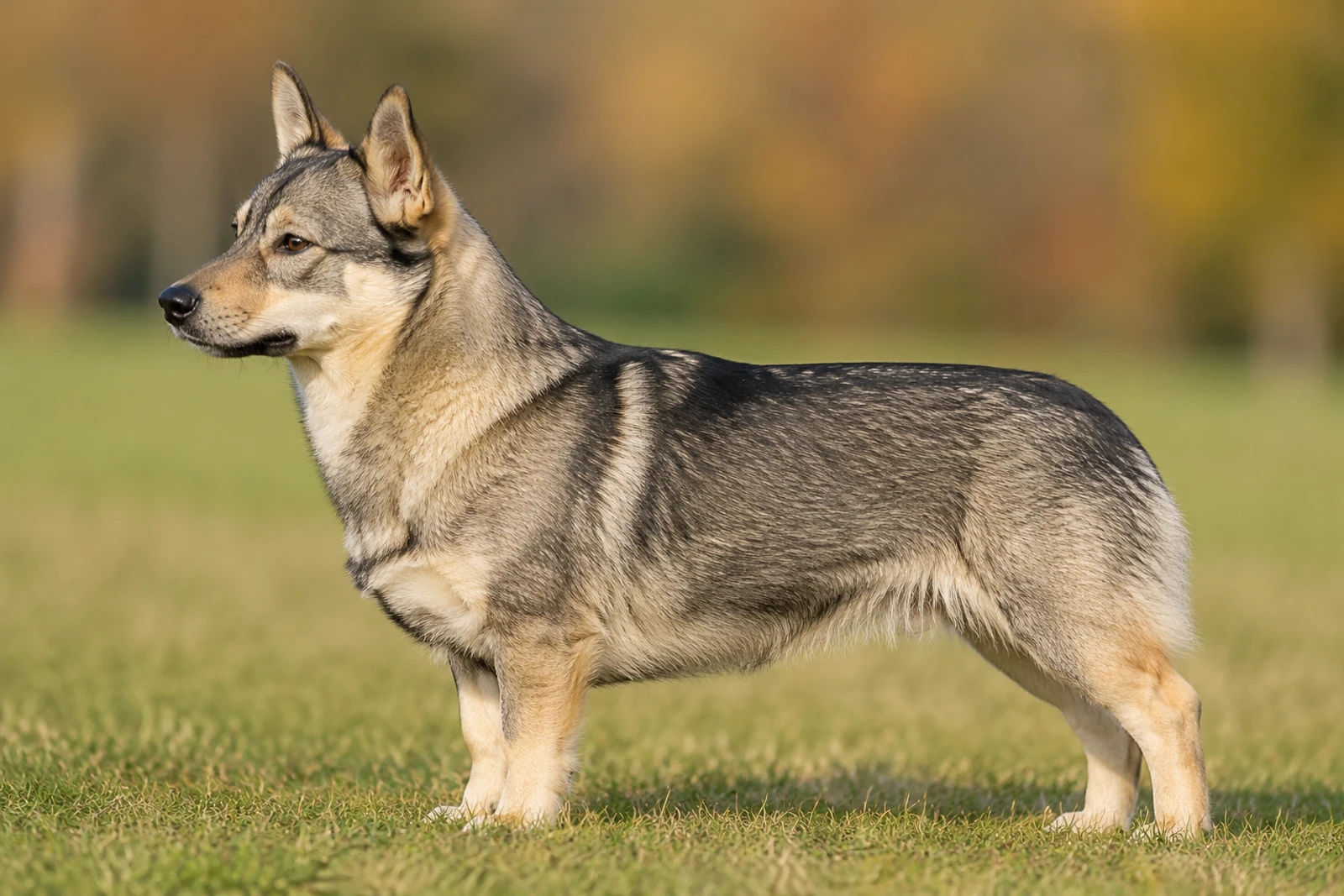
The Swedish Vallhund is a small but sturdy herding breed, brimming with energy and intelligence. Often called a 'big dog in a small body,' they excel in active households that enjoy dog sports or outdoor adventures. With their affectionate and alert nature, they form strong bonds with their families and are especially good with children. Their watchful demeanor makes them excellent watchdogs, though they can be vocal. Ideal for those seeking a loyal, spirited companion that thrives on mental and physical engagement.
At a glance
- Size
- Medium
- Height
- 12–14 in
- Weight
- 26–35 lb
- Life span
- 12–14 years
- Coat colors
- Grey, Red, Sable, Red-Brown
- Coat type
- Medium double coat with harsh texture
- Group
- Working
How much does a Swedish Vallhund cost?
Adopt / rescue
$75–$400
Usually includes spay/neuter, first shots, and a microchip.
Buy from a breeder
$700–$2,000
From a reputable, health-testing breeder.
Approximate USD. Prices vary widely by region, breeder, pedigree, age, and coat colour — adopting is the lower-cost and recommended route. Avoid suspiciously cheap “breeders”; they’re often puppy mills.
Estimate the full cost of a Swedish Vallhund →Want the ongoing number? Estimate the monthly food bill for a Swedish Vallhund with our dog food cost calculator.
Swedish Vallhund photos
Views
Front, side, rear and top — the full silhouette.Poses
How the breed sits, lies, moves and plays.Puppy to senior
The breed across its whole life.Expressions
The breed’s range of moods.Close-up details
Eyes, ears, nose, paws, tail and coat.Coat colors
The breed’s recognized colors.Click any photo to enlarge. We show the Swedish Vallhund from every angle — three views, poses, life stages, expressions, close-ups, coat and colors.
Appearance & size
Standing just 12 to 14 inches at the shoulder and weighing 26 to 35 pounds, the Swedish Vallhund is a compact powerhouse. Everything about the build says “ready to work.” The body is long in proportion to height — roughly 40% longer than tall — but not as extreme as some dwarf breeds. Bone is substantial, muscle is hard and visible, and the overall impression is of a dog who could easily duck under brush and drive cattle all day.
From the side, you see a level topline, a short, strong loin, and just enough tuck-up to allow athletic freedom. The chest reaches to the elbow, ribs are well-sprung, and the legs are short, straight, and heavily boned. From the front, those forelegs stand parallel under a deep chest with a wedge-shaped head set on a muscular neck. The rear view shows equally parallel hind legs with well-angled stifles, solid hocks, and no hint of cow-hocks — pure driving power.
The head is a clean wedge from above and the side. A flat skull, a clearly defined stop, and a muzzle slightly shorter than the skull give the Vallhund a keen, fox-like expression. Eyes are medium, oval, and dark brown, with black pigmented rims. Ears are pointy, mobile, and set high, the outer edge in line with the corner of the eye. The nose and tight lips are black.
A thick double coat handles weather and undergrowth. The outer coat is harsh, close-lying, and medium-length on the body, while it’s short and smooth on the head and lower legs. The undercoat is soft and dense. Colors run the sable-wolf spectrum: grey, grey-brown, grey-yellow, reddish-yellow, and reddish-brown, always with darker guard hairs on the back, neck, and sides forming a saddle. Lighter shading appears on the cheeks, throat, chest, belly, lower legs, and under the tail, often with a signature light harness marking across the shoulders. White is limited to a narrow blaze, neck spot, or small white on the paws, if present at all — never more than a third of the coat.
Tail carriage is variable. Some are born with a natural bob or stub, others with a full-length tail that curls loosely, not tightly over the back. The overall silhouette, whether long-tailed or bobbed, stays low, balanced, and ready to move.
History & origin
Nobody can promise you a time machine, but a Swedish Vallhund comes about as close as a dog can. This is a Viking-age herding breed, and it looks the part — a sturdy, low-slung spitz with a wolf-gray sable coat and an expression that says it’s been waiting for you to catch up for a thousand years.
The Vallhund — full name Västgötaspets, literally “spitz of the West Goths” — comes from the county of Västergötland in southwestern Sweden. No one knows exactly when the first dogs appeared, but they were almost certainly around during the Viking era, working the region’s rough pastures more than a millennium ago. Their build tells you why. Standing just 12 to 14 inches at the shoulder, they could duck under a cow’s kick and dart in to nip at the heels, driving stock forward without getting flattened. But they weren’t just cattle drovers. These were all-purpose farm dogs: they rooted out rats in the barn, sounded the alarm when a stranger approached, and kept the homestead running while the Norsemen were off doing other things. The breed’s short, powerful legs gave it the agility to turn on a dime, and the dense double coat handled bitter Scandinavian winters.
By the early 20th century, the Vallhund was nearly lost. As farms modernized and tractors replaced livestock, the little herders faded away. By 1942, only a handful remained, and no formal breeding program existed. That’s when Count Björn von Rosen stepped in. He remembered the dogs from his youth and placed a newspaper ad looking for surviving specimens. The response led him to a farmer named K.G. Zettersten, who still had a few working Vallhunds on his property. Together they tracked down other remnants — one female in particular, named Topsy, became the foundation of every line alive today. Within a year, the Swedish Kennel Club recognized the revived breed, and the count’s careful breeding pulled it back from the brink.
The Vallhund reached Britain in the 1970s and the United States not long after. The American Kennel Club granted full recognition in 2007. Today the breed is still rare — you won’t trip over one at every dog park — but it has built a dedicated following among people who want a sharp, tireless dog with the brains and heart of a working farmhand. Long drives of cattle may be a memory, but the instinct is fully intact if you want to channel it into herding trials, agility courses, or just a lively life together.
Temperament & personality
You’re getting a big personality in a compact, 26–35 pound package. The Swedish Vallhund is a working dog through and through — alert, opinionated, and way more energetic than his short legs suggest. If you want a quiet lap ornament, look elsewhere. This is a dog who notices everything and has a comment about most of it.
Energy and engagement
Plan on a solid hour of real exercise daily, not just a stroll. Vallhunds were bred to drive cattle across rough terrain, so they need to sprint, chase, and work their brain. A fenced yard helps, but they’d much rather be doing something with you — fetch, treks, or a fast-paced game of “herd the kids around the coffee table.” Without that outlet, they’ll invent their own jobs, and you probably won’t love the results. Think compulsive barking, furniture rearranging, or turning a stray sock into confetti.
Watchful and vocal
This breed doesn’t just bark; he holds a press conference. A delivery truck three streets over, a squirrel giving you side-eye, or a leaf that wasn’t there yesterday — all get announced. You can shape it into a useful “someone’s here” alert, but you’ll never extinguish it completely. Early training helps you dial the volume down, but a Vallhund’s default setting is to patrol his “house territory,” which he defines by your family’s scents, not just the front door.
Affection and family life
With his own people, he’s a warm, sometimes goofy companion. He’ll shadow you from room to room and lean into a good scratch behind the ears. Most Vallhunds get along well with respectful older kids who learn to read the dog’s body language: a stiff posture and direct stare mean back off, while a loose, wiggly body and soft eyes signal playtime. He is, however, a herder at heart. Nipping at heels and circling can surface during rowdy play, so you’ll need to redirect that instinct with toys and training, especially around small children.
Independence and smarts
This isn’t a push-button obedience breed. Vallhunds are clever problem-solvers with a stubborn streak. They respond best to respectful, consistent handling — a drill-sergeant approach just provokes a standoff. Use treats, short sessions, and a sense of humor. When you reinforce outdoor potty breaks with an immediate reward, they catch on fast, which also helps you avoid the messes that can happen when a dog’s scent-based spatial memory flags a forgotten corner of the basement as “the bathroom.”
Quirks and need-to-knows
- Chewing Puppies chew to explore and soothe teething pain; adults keep their jaws strong with hard chews. Direct them to appropriate toys and use a simple citrus spray on chair legs you want left alone.
- Rolling in questionable things Thanks to a scavenging heritage, a Vallhund may decide eau de dead worm is the height of fashion. It’s not rebellion — to him, it might just smell fantastic, or he could be sharing news of a great find with you.
- Sensitivity to isolation This breed bonds hard. Left alone for long hours without exercise or mental work, he can tip into anxiety-driven barking or destructive chewing. He’s best in a home where someone’s around for a good chunk of the day.
- Food respect Teach kids early that the dog eats in peace. Interrupting a Vallhund mid-meal can trigger food guarding, and that’s a headache no family needs.
Good with kids, dogs & other pets
Swedish Vallhunds were bred to work closely with people, and that partnership shows in how they interact with a family. They are naturally patient and rarely quick to snap, which makes them a surprisingly steady choice around children. At 26 to 35 pounds, they are sturdy enough to handle a kid’s enthusiastic play without being so heavy they’d knock a toddler over. Supervision is still non-negotiable, not because the breed is reactive, but because any dog will eventually correct a child who grabs an ear or trips onto them. Teach your kids to be gentle and respectful, and you’ll likely see a Vallhund who happily shadows them from breakfast to bedtime.
With other dogs
Early exposure decides most of what happens later. The critical socialization window for a puppy starts around three weeks and starts closing by twelve to sixteen weeks. During that stretch, calm, positive meetings with other dogs teach your Vallhund how to read canine body language and play fairly. A puppy raised with another dog usually bonds deeply and stays relaxed around familiar housemates. If you add an adult Vallhund to a multi-dog home, go slow with supervised introductions and watch for stiff posture or hard stares. This breed does not thrive when left outside alone in a kennel run — they need to be part of the daily pack.
With cats and small pets
Herding instinct doesn’t disappear just because you live in the suburbs. Your Vallhund may try to round up a running cat, a scurrying rabbit, or even a fast-moving child. That doesn’t mean coexistence is impossible, but it does mean you manage the setup early. Puppies raised with a cat from day one, with consistent redirection whenever chasing starts, often learn to coexist peacefully. Introducing an adult to a cat calls for careful, gradual exposure over days or weeks — never just tossing them into the same room. Pocket pets like guinea pigs and hamsters need a closed, elevated cage and zero unsupervised contact. Even a playful chase can quickly shift into predatory behavior with small, darting animals.
Long stretches of isolation and skipped early socialization are what cause problems, not the breed’s temperament. If you expose a Vallhund puppy to kids, other dogs, household cats, and the chaotic noise of everyday life during the first four months, you’ll set the stage for an adaptable, steady dog who fits into almost any home without drama.
Trainability & intelligence
A Swedish Vallhund picks up new commands in a handful of repetitions — this is a thinking dog built to read a handler’s body language. But a quick mind doesn’t always mean an easy one. These dogs combine herding-breed biddability with an independent streak, so the real challenge isn’t teaching them what you want; it’s convincing them it’s worth their time.
Harsh corrections backfire fast. Yell at a Vallhund or yank the leash and you’re likely to get a dog who shuts down, avoids you, or offers a warning nip. Positive reinforcement is the only gear that fits. Small, soft treats work well, but once you’ve built a bond, a squeaky ball or a 20-second game of tug often pays better than food. Figure out what makes your dog’s eyes light up and use it deliberately.
Start the day the puppy comes home. The critical socialization window slams shut around 14–16 weeks, so calmly expose them to kids, city noise, different floor textures, and friendly strangers. Without that steady early exposure, the Vallhund’s natural wariness can curdle into reactive barking or snapping at novel things later. Ongoing positive experiences — not just a puppy class — keep that confidence stable through adolescence.
Recall is where many owners hit a wall. These dogs were bred to heel cattle by circling and nipping, which means a running squirrel or a flapping tarp can hijack their brain faster than your voice. Proof the recall on a long line in boring environments first, then layer in distance and distractions over weeks, not days. Expecting a rock-solid “come” at the dog park at six months is a recipe for frustration.
Short sessions save you. Drill the same down-stay for 15 minutes and a bored Vallhund invents its own job — maybe reorganizing your couch cushions. Cap training at 5–10 minutes and weave it into daily life: a down-stay while you make coffee, a “find it” game with a hidden toy, heelwork past the recycling bin. Ten minutes of nose work or learning a new trick exhausts them more completely than an extra walk around the block.
Because these dogs thrive on precision work, they often shine in rally, agility, herding instinct tests, or advanced trick titles. They need a steady stream of mental challenges between the weekly class, not just a one-and-done homework pass.
The backbone of all of it is trust. Rush the process or lose your temper and you’ll meet a stubborn dog who second-guesses every cue. Move at the dog’s pace, reward generously, and you’ll end up with a handler-focused partner who reads your next move before you’ve said a word.
Exercise & energy needs
A Swedish Vallhund may be the size of a stumpy corgi cousin, but behind that foxy grin is a quick, athletic herder bred to move livestock all day. You won't get away with a leisurely stroll around the block. Count on at least 60 minutes of real physical exercise each day, split into two or three sessions. A 30-minute brisk walk or jog in the morning and a 20–30 minute off-leash romp, flirt pole chase, or vigorous backyard game in the afternoon usually hits the mark.
Because their long back and short legs put stress on the spine, skip high-impact jumping and repeated hard landings. Agility is fine if you keep jump heights low and work on soft footing. Better yet, channel that drive into herding practice, rally, nose work, or trick training—anything that pairs movement with a mental challenge. A Vallhund’s brain wears out as hard as their legs. Puzzle toys, snuffle mats, and 5–10 minute training bursts scattered through the day prevent the kind of boredom that turns into barking marathons and ankle-nipping.
- Daily total: 60–90 minutes, never a single marathon session.
- Good activities: brisk walks, hiking (uneven terrain is great), canicross if you start slowly, scent work, low-level agility, herding instinct tests, or advanced obedience.
- Mental workouts: hide-and-seek with a favorite toy, food puzzles, or teaching a new command sequence will leave your dog flopped on the rug as thoroughly as a run.
If yours still ricochets off the furniture, add an extra 10-minute training round. These dogs were made to move with purpose, and a tired Vallhund is a sane, happy housemate. Under-exercised, they'll invent jobs—rearranging shoes, herding the cat, or monitoring every squirrel in the neighborhood.
Grooming & coat care
The Swedish Vallhund sports a dense double coat that’s all business — a harsh, medium-length outer layer that stands slightly off the body, and a soft, insulating undercoat. That combination means you’ll deal with steady, moderate shedding year-round, and then two real blowouts in spring and fall when the undercoat lets go all at once. If you happen to be wearing black pants during those weeks, you’ll know exactly what I mean.
For most of the year, brushing two or three times a week keeps things under control. A slicker brush with rounded pins cuts through the outer coat to grab loose hair and light debris, while an undercoat rake or a metal comb reaches the soft fluff beneath before it mats. After a raking session, a quick pass with a boar-bristle brush distributes the coat’s natural oils and leaves a nice shine. During the seasonal shed, bump that routine to a daily once-over for a week or two — it’s the only way to stay ahead of the tumbleweeds.
Bathe only when he’s genuinely muddy or stinky. Over-washing strips the protective oils that keep the weather-resistant outer coat doing its job. Other than that, nail trims every few weeks, a weekly ear check with a gentle cleaner, and daily tooth brushing (or at least several times a week) round out the care. There’s no clipping or styling needed — the coat’s natural length and texture do the work of insulating without any fuss.
A solid diet and decent outdoor exercise naturally support skin health and coat turnover, but when the undercoat is in full purge mode, no food can save you from hair. Be ready with that rake.
Shedding & allergies
If you’re hoping for a dog that barely leaves a trace on the couch, the Swedish Vallhund isn’t it. This breed is a full-time shedder with a dense double coat that drops fur every day of the year, and then kicks into overdrive during two seasonal blowouts — usually in spring and fall. During those weeks, you’ll pull tufts out just by running your palm across their back, and your vacuum cleaner will earn its keep.
Daily brushing with a slicker or an undercoat rake helps manage the mess, but it won’t stop it. Expect to sweep up tumbleweeds of gray-and-sable fluff from corners and baseboards even on a good day. On the upside, Vallhunds are a low-drool breed — you won’t find slobber on your walls or clothes. That’s a win. But shedding is the real allergen carrier here, not saliva. Dander clings to that loose hair, so no amount of wishful thinking turns a Vallhund into a hypoallergenic option. If allergies are a dealbreaker in your household, spend some time with an adult Vallhund before committing — what lands in the air and on your furniture might be a lot more than you bargained for.
Diet & nutrition
Swedish Vallhunds pack a ton of energy into a compact, long-backed frame—and that long back means every extra ounce matters. Even a few extra pounds can add stress to the spine and joints, so lean body condition is non-negotiable. You should be able to feel their ribs without pressing hard.
Feed your adult Vallhund based on weight and real activity level. A typical starting point is 1 to 2 cups of high-quality dry food per day, split into two meals, but a dog who herds balls all afternoon needs more than a laid-back senior. Adjust portions to the dog in front of you, not what the bag says.
If you prefer home-prepared meals, a balanced plate looks like roughly 60% meat (raw or gently cooked), 20–30% dog-safe fruits and veggies, and the rest from eggs, grains like pearl barley, or plain yogurt. Always run a homemade plan past a veterinary nutritionist—gaps in nutrients sneak up on a growing or working dog.
Puppies burn fuel fast. Until four months old, offer four evenly spaced meals. From four to six months, drop to three, then settle into the adult two-meal rhythm. Introduce a new puppy’s food gradually, starting with softly cooked, mashed meats and vegetables, or a premium puppy kibble.
Many Vallhunds are food-motivated, which makes training a snap but also makes overfeeding easy. Use puzzle bowls or food-dispensing toys for dogs who inhale meals—it slows them down and works that sharp mind. Seniors who naturally slow down need fewer calories; divide their daily ration into smaller, more frequent meals. And never feed straight from the table. Serve any leftovers in their own bowl, or you’ll create an expert beggar who’s nearly impossible to untrain.
Health & lifespan
A healthy Swedish Vallhund often lives 12–14 years. That is a generous run for a 26–35 pound dog, and many stay active and bossy well into their teens. But like every breed, they come with a few vulnerabilities worth knowing about before you bring one home.
The most discussed issue is their long back and short legs. This body shape makes them prone to intervertebral disc disease (IVDD) — a spinal problem that can cause pain, nerve damage, or even paralysis if a disc ruptures. You can lower the risk by keeping them lean, using ramps for furniture and cars, and discouraging reckless leaps off high surfaces. A dog carrying just a few extra pounds on that frame is asking for trouble.
Hips and knees get attention too. Hip dysplasia and patellar luxation (sliding kneecaps) can crop up, though the breed is not among the worst offenders. Responsible breeders test for both. Expect to see an OFA hip evaluation and a patella exam on the parents. Eye diseases also appear: progressive retinal atrophy (PRA), cataracts, and retinopathy show up in some lines. A yearly eye exam by a veterinary ophthalmologist helps catch these early, and breeders should provide current CERF or OFA eye clearances.
Vallhunds are food-driven to a fault. They will convince you they are starving five minutes after a meal, which turns into an obesity risk almost overnight. Stick to measured portions, not free-feeding, and pair it with their required hour or more of brisk daily activity. A heavy Vallhund is a back-patient-in-waiting.
Regular wellness visits matter here. Beyond the obvious core vaccines (rabies is a legal must) and heartworm prevention during mosquito season, your vet will check for subtle signs: a slight limp, a change in gait, or a cloudy eye. Because the breed can be stoic, you need a professional second look. Dental care is not optional, either — brush those teeth several times a week, because once periodontal disease sets in, it damages more than the gums. If you are buying a puppy, ask for all health test results on the sire and dam, and bring those records to your first vet appointment. That proactive screening stack — hips, eyes, patellas — is the best leg up you can give a dog that will happily run itself ragged for you every day.
Living environment
A Swedish Vallhund can thrive in an apartment, a townhouse, or a house with acreage — but quiet, shared walls take real work. This is a vocal herding breed by nature, and a bored Vallhund will hear everything: the neighbor’s keys, the delivery truck, a squirrel three blocks away. Early, consistent training to “quiet” on cue and plenty of daily exhaustion are what make apartment living possible. Without them, expect noise complaints.
What they can’t live without is purposeful daily effort. A couple of lazy leash strolls won’t cut it. Plan on at least 60–90 minutes of real movement — a vigorous 30-minute morning walk, a lunchtime sprint-and-sniff session, and an evening where you work their brain with a puzzle toy, a scent game, or a fast-paced trick-training session. The short, frequent structure suits their herding brain far better than one marathon outing. These dogs are 26–35 pounds of coiled energy; they need to do something, not just be in a yard.
A securely fenced yard is a huge plus, but it isn’t a substitute for engagement. They’ll happily patrol the perimeter, bark at birds, and invent jobs you didn’t assign. If you rely on the yard alone, you’ll end up with a bored, dig-happy dog who thinks fence-running is his new career. The yard is best used as a safe space for off-leash tug, fetch, and short training bursts — not passive entertainment.
Climate-wise, their dense double coat is built for cold and damp. They shrug off Swedish winters, so a light drizzle or a chilly morning won’t faze them. Heat is the real enemy. In anything above 80°F, shift exercise to early morning or late evening, stick to shade, and watch for excessive panting. These aren’t dogs you can jog with at noon in July.
Being left alone is where this breed gets tricky. Vallhunds bond hard with their people and can tip into separation anxiety if that bond isn’t balanced with independent-coping skills. A puppy left alone for an eight-hour workday from the get-go will likely howl, destroy crate pads, or bark nonstop. Build up absences in tiny increments from day one, and pair your departures with a frozen Kong or a food-dispensing toy. Even an adult Vallhund typically does best with a midday break — a neighbor, a dog walker, or a staggered work schedule. If your household has someone home most of the time, you’ve just removed their biggest stressor.
Who this breed suits
If you want a dog who’s happy to amble around the block and then snooze on the couch, the Swedish Vallhund will politely decline. He’s a clever, full-throttle herder wrapped in a sturdy 26–35 pound body, and he needs an owner who sees him as a project — not just a pet. The right home is one where his mind works as hard as his legs.
Active families with kids who are steady on their feet hit a sweet spot. Vallhunds are playful and devoted, but that herding instinct can turn ankles and small running children into livestock, so expect to manage nipping and direct the drive into fetch, tug, or agility. He’ll match the energy of a household that hikes, runs, or plays soccer in the backyard — and then wants to run through a trick-training session indoors.
First-time owners can thrive here if they’re genuinely happy to enroll in a positive reinforcement class and stick with training as a daily habit. This isn’t a naturally biddable breed; he learns fast but gets bored with repetition and will make his own fun if you don’t provide it. Dedicated seniors or singles who walk briskly, practice nose work, or compete in rally will find a compact, portable partner. Just be honest about the noise. A Vallhund alerts to every squirrel, delivery truck, and suspicious leaf, so apartment living is possible only if you’re prepared to manage the barking and give him a long, lung-filling outing every morning.
Think twice if:
- You picture a quiet, low-shed lap dog. He blows coat prodigiously and has strong opinions he’s determined to share.
- Your schedule keeps you away for eight-plus hours regularly. Understimulated Vallhunds unravel into barking, digging, and obsessive herding of shadows or vacuum cleaners.
- You have very young toddlers and aren’t ready to supervise every interaction. Even well-socialized adults can be too quick to correct wobbly little people with a nip.
- You prefer a dog who settles easily without a job. A walk around the block is just a warm-up for this guy; he needs puzzles, training, or scent games to truly tap out.
Cost of ownership
Purchase price
Expect to pay $1,500–$3,000 for a well-bred Swedish Vallhund from health-tested parents. Show- or performance-prospect pups sometimes push toward $3,500. Because the breed is still uncommon in the U.S., a responsible breeder will likely have a waitlist. Beware of anyone selling at a deep discount without documented hip and eye clearances — that “bargain” often leads to much higher vet bills later.
Monthly costs
Plan on $120–$200 a month for predictable expenses once your Vallhund is settled in. Here’s where it goes:
- Food: $30–$50. A 26–35 lb dog with a typical Vallhund’s workmanlike energy does well on quality kibble; active adults may need a performance formula that bumps the cost toward the higher end.
- Grooming: $10–$15. The short, dense double coat needs weekly brushing and a bath every month or two — you’ll do almost all of it yourself. That covers a slicker brush, decent shampoo, and an occasional nail grind if you don’t own a Dremel.
- Routine vet care: $40–$70. Annual exams, core vaccines, year-round heartworm prevention, and flea/tick control (averaged across the year). A medium dog’s preventives make up the bulk of this.
- Pet insurance: $30–$60. Accident-and-illness coverage for a medium purebred generally falls in this range. Alternatively, park that same amount in a dedicated savings account. Responsible breeders screen for hip dysplasia and progressive retinal atrophy, but no line is risk-free; a surprise cruciate tear can run $4,000+.
Plan on one-time puppy costs, too: a crate, bed, bowls, leash, collar, and a basic obedience class ($150–$250) or two. Over a 12–14 year lifespan, the monthly outlay adds up to roughly $20,000–$30,000, so knowing the numbers upfront keeps the joy where it belongs — on the dog, not the budget.
Choosing a Swedish Vallhund
A Vallhund isn’t a dog you stumble into at a pet store or a puppy-mill website. This is a rare working breed, so your search almost always starts with a responsible breeder — and often a year-long wait. You can occasionally find a Vallhund through breed-specific rescue, but adults from those situations may need extra patience; many were surrendered because someone underestimated the energy and herding drive packed into that short-legged frame.
Health Clearances You Need to See
Health clearances are non-negotiable. Both parents should have passing hip scores from the Orthopedic Foundation for Animals (OFA) or PennHIP, current CAER eye exams, and a DNA test for progressive retinal atrophy (the Swedish Vallhund retinopathy mutation). Elbow clearances are becoming standard as well. Ask to see the actual certificates or look up the dog’s OFA registration number yourself — “the vet checked them out” doesn’t count.
Red Flags That Should Make You Walk Away
Skip any breeder who can’t or won’t hand you those results. Other dealbreakers: multiple litters available at once, selling puppies younger than eight weeks, no written contract, or zero questions about your home. If the breeder seems more interested in your credit card than in your plan for a digging, barking, high-energy herder, you’re in the wrong place. Watch out for anyone pushing a “rare” blue, merle, or mini Vallhund — those don’t exist in a health-focused program.
Picking Your Puppy
When you visit, the place should smell clean and the pups should approach you willingly, not cower. A breeder who matches puppies to homes based on temperament, not coat color, did the hard work. Tell them honestly about your activity level so they can steer you to a middle-of-the-road pup: confident enough to bounce back from a sudden noise, but not the one already herding littermates into a corner. Expect to answer as many questions as you ask, and make peace with a waiting list. The right dog — whether a carefully raised puppy or a rehomed adult — is worth the time.
Pros & cons
Pros
- Compact and sturdy: 26–35 lb and 12–14 inches tall means a dog that fits into apartment living, road trips, and on-leash city walks without giving up any toughness.
- Sharp and eager to work: Swedish Vallhunds pick up new commands fast. They live for trick training, agility, herding trials, or anything that challenges their brain—food motivation only sweetens the deal.
- Big-dog stamina in a small frame: This is a true working breed. A solid hour of off-leash running, a long hike, or a vigorous game of fetch is a daily baseline they’ll appreciate, not something that wipes them out.
- Tight family bond: Expect a dog that shadows you from room to room, then curls up on the couch once the day’s energy is spent. With early socialization, they’re patient and playful with kids.
- Wash-and-wear coat: The short, dense double coat sheds dirt and dries quickly. Weekly brush-throughs handle maintenance most of the year, with a little extra work during shedding season.
Cons
- Heavy seasonal shedding: Twice a year, the undercoat drops in clumps, and you’ll find fur on every surface. Even between blowouts, a steady trickle of hair is the norm—not ideal if you hate vacuuming.
- Opinionated and vocal: Herding heritage means barking is their default way of expressing excitement, alerting you to a doorbell, or telling off the neighbor’s cat. Teaching quiet takes consistent work from day one.
- Mouthy with movement: The instinct to nip at heels is baked in. Without redirecting that drive to toys and structured games, kids running past and other pets can feel those quick little teeth.
- No shortcuts on exercise: A leash stroll around the block won’t cut it. Aim for 60–90 minutes of active, panting exercise plus puzzle feeders or training sessions to keep a Vallhund from inventing its own (destructive) jobs.
- Doesn’t do well alone all day: Deeply people-oriented, they can slide into separation anxiety if left for long hours—expect barking, chewing, or house-soiling unless you build up alone time gradually.
- Health screenings matter: This breed can be prone to hip dysplasia, patellar luxation, and progressive retinal atrophy. Responsible breeders screen parents and share the results upfront. A 12-to-14-year lifespan is typical with good care.
Similar breeds & alternatives
If the Swedish Vallhund has caught your eye, you’re clearly drawn to a brainy, compact herder with a wolfish grin. The most obvious alternatives are the Pembroke Welsh Corgi and Cardigan Welsh Corgi—both share the short legs and cattle‑droving roots, but they differ in ways that matter day to day.
- Pembroke Welsh Corgi: Slightly shorter (10–12 in) but similar weight. Pembrokes are peppy, social, and famously people‑oriented; a Vallhund tends to be more reserved with strangers and a touch more independent on the job. The Vallhund’s grey sable “wolf” coat and harness markings set it visually apart from the Pembroke’s typical red, sable, or tricolor with white trim. Exercise demands are close—an hour of hard movement daily—and both will bark with real conviction.
- Cardigan Welsh Corgi: Heavier‑boned (up to 38 lb) with a full tail. If you want a slightly mellower herder that’s still sharp and watchful, a Cardigan can be a better fit than the high‑octane Pembroke or the intensely focused Vallhund. Expect less stranger‑reserve but more laid‑back pacing at home, plus coat colors that range from brindle to blue merle.
- Norwegian Buhund: The leggy Nordic cousin. At 16–18.5 inches tall, the Buhund is a spitz built for running rather than ducking under kicks. It shares the Vallhund’s alert, no‑nonsense temperament, heavy shedding, and need for vigorous daily work. The trade‑off: normal leg length means this one clears baby gates without a second thought, and the barking is just as enthusiastic.
Early socialization and consistent training keep nipping and noise from becoming a household headache with any of these breeds. If the Vallhund’s smarts appeal but you want a quieter dog, none of these are a true swap—they all come with strong opinions and a built‑in alarm system.
Fun facts
- The Swedish Vallhund is an ancient breed, possibly dating back to the Vikings.
- They are often called 'Viking dogs' and were used to herd cattle and control vermin.
- Natural bobtails are common, but some are born with long tails.
- They are known for their expressive, smiling faces and big-dog attitude.
Frequently asked questions
- Are Swedish Vallhunds good with children?
- Swedish Vallhunds can be excellent family dogs and are typically good with children when properly socialized. They are playful and energetic, making them great playmates, but supervision is recommended for very young kids due to the dog’s herding instincts. Early socialization helps ensure they are gentle and patient.
- How much do Swedish Vallhunds shed?
- Swedish Vallhunds have a dense double coat that sheds moderately year-round, with heavier shedding during seasonal changes. Regular brushing, two to three times a week, can help manage the shedding. They are not considered hypoallergenic.
- What kind of exercise does a Swedish Vallhund need?
- As a working breed, Swedish Vallhunds require regular daily exercise, including walks and playtime, to stay mentally and physically stimulated. They enjoy activities like fetch, agility, or herding trials, and need at least 30–60 minutes of activity per day. Without enough exercise, they may become bored and develop unwanted behaviors.
- Can Swedish Vallhunds live in apartments?
- Swedish Vallhunds can adapt to apartment living if their exercise needs are met consistently. They are active indoors and do best with daily walks and mental challenges. However, their tendency to bark, especially when bored or alerting, might be an issue in close quarters, so training to manage barking is important.
- Are Swedish Vallhunds a good choice for first-time dog owners?
- Swedish Vallhunds are intelligent and eager to please, which can make training relatively easy, but their strong herding instincts and high energy might be challenging for novice owners. They respond best to positive reinforcement and consistent training. First-time owners who are committed to providing ample exercise and mental stimulation can do well with this breed.
Tools & calculators for Swedish Vallhund owners
Quick estimates tailored to Swedish Vallhunds — pre-filled with this breed’s size where it matters.
Articles & stories about the Swedish Vallhund
Sources & standards
This profile follows recognized breed standards from the American Kennel Club (AKC) and the Fédération Cynologique Internationale (FCI), along with established veterinary and breed-club guidance. These describe general breed tendencies — every dog is an individual.