

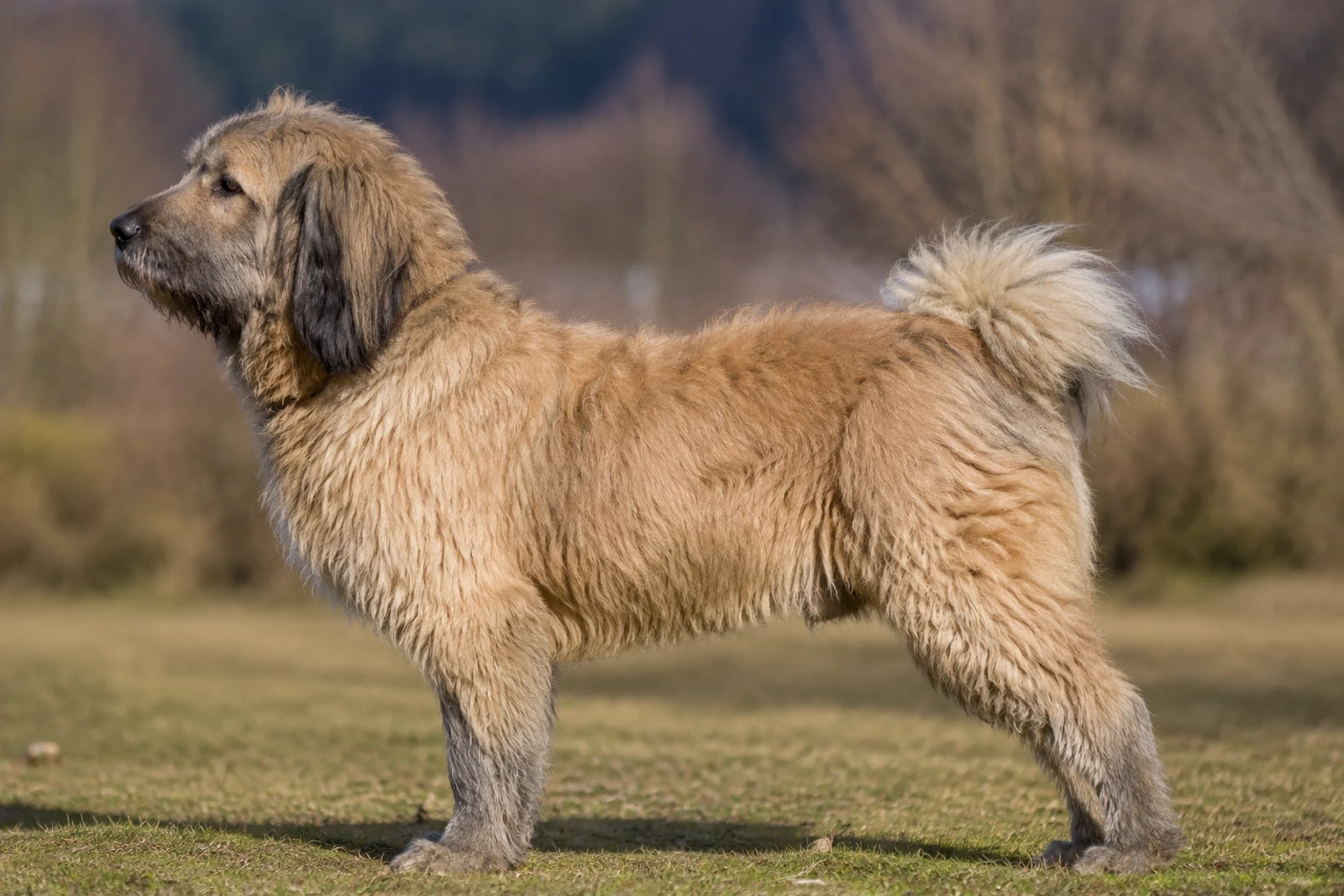
The Tibetan Kyi Apso is a rare giant guardian breed from Tibet, renowned for its protective instincts and dignified demeanor. This independent and loyal dog thrives with experienced owners who can provide consistent training and ample space. With a thick, bearded coat and a strong will, it excels as a family guardian but requires early socialization. Suited to rural or spacious homes, it is not ideal for first-time owners or apartment living.
At a glance
- Size
- Giant
- Height
- 22–28 in
- Weight
- 68–84 lb
- Life span
- 7–10 years
- Coat colors
- Black, Black and Tan, Gold, Gray, Brindle
- Coat type
- Long, harsh double coat with distinct beard
- Group
- Working
How much does a Tibetan Kyi Apso cost?
Adopt / rescue
$75–$400
Usually includes spay/neuter, first shots, and a microchip.
Buy from a breeder
$700–$2,000
From a reputable, health-testing breeder.
Approximate USD. Prices vary widely by region, breeder, pedigree, age, and coat colour — adopting is the lower-cost and recommended route. Avoid suspiciously cheap “breeders”; they’re often puppy mills.
Estimate the full cost of a Tibetan Kyi Apso →Want the ongoing number? Estimate the monthly food bill for a Tibetan Kyi Apso with our dog food cost calculator.
Tibetan Kyi Apso photos
Views
Front, side, rear and top — the full silhouette.Poses
How the breed sits, lies, moves and plays.Puppy to senior
The breed across its whole life.Expressions
The breed’s range of moods.Close-up details
Eyes, ears, nose, paws, tail and coat.Coat colors
The breed’s recognized colors.Click any photo to enlarge. We show the Tibetan Kyi Apso from every angle — three views, poses, life stages, expressions, close-ups, coat and colors.
Appearance & size
You see a rugged mountain dog built to shrug off blizzards and stare down predators. The Tibetan Kyi Apso stands 22 to 28 inches at the shoulder and tips the scale at 68 to 84 pounds, but don’t let those numbers fool you — heavy bone, a barrel chest, and a profuse double coat make him look far larger than the scale suggests. This is a giant-boned, substantial working dog, just compact enough to pivot and chase off a wolf in tight quarters.
The coat is the Kyi Apso’s signature. A thick, weatherproof double layer: the outer guard hairs are coarse and straight, the undercoat is dense and woolly. You’ll find a pronounced mane and ruff around the neck and shoulders, heavier in males, giving the dog a lion-like silhouette. Feathering drapes the backs of the legs and tail. Colors run the gamut — solid black, rich gold, every shade of brown, brindle, and black with tan points. White markings on the chest, feet, and chin are common and perfectly acceptable.
A Kyi Apso’s head is unmistakable. From the front, you’ll see a broad, bear-like skull, deep-set almond eyes that sit wide apart, and a heavy topknot that drops forward over the forehead, often shading the eyes. That topknot, paired with a full beard and mustache, gives him a perpetual squint that reads as wise and slightly aloof. The ears are V-shaped, drop, and lie flat against the head.
From the side, the body shows a level, solid topline with well-sprung ribs that reach deep past your knees. The chest drops at least to the elbows, and the strong, slightly arched neck flows cleanly into the shoulders. Viewed from the rear, the hindquarters are muscular and broad, with a tail that curls proudly over the back in a single dense plume. He moves with a deliberate, powerful gait — not flashy, but ground-covering, each step driving from a strong rear. His pasterns are straight and feet are compact and cat-like, built to navigate scree and frozen ground without complaint.
History & origin
You’d be hard pressed to find a Tibetan Kyi Apso that doesn’t look like it means business — and that’s exactly what generations of Himalayan nomads counted on. While many Western dog lovers mistake it for a shaggier cousin of the Tibetan Mastiff, the Kyi Apso earned its own distinct place in the high-altitude camps of Tibet, where survival hinged on a dog that would plant itself where you told it and guard without needing constant direction.
The breed’s name practically tells its history. In Tibetan, kyi means “dog” and apso — which you might recognize from the Lhasa Apso — means “bearded” or “tied.” And tying is exactly what people did. Herders and caravan traders kept these dogs on a rope or chain near tent openings, corrals, and supply piles. The Kyi Apso wasn’t a patrolling flock guardian in the way a Great Pyrenees roams hillsides; it was a stationary sentinel that erupted into full-throated alarm the moment anything — wolf, snow leopard, two-legged intruder — came within striking distance. At 68 to 84 pounds and standing up to 28 inches at the shoulder, the dog was big enough to back up the bark with real force if pressed, yet manageable enough to move camp on short notice.
No one can pin an exact century on the Kyi Apso’s beginnings, but the pieces add up. It shares ancient roots with other Tibetan mastiff-type dogs that traveled trade routes across the roof of the world. Written references to fierce, heavy-coated Tibetan guard dogs appear in Chinese records as far back as the 13th century, and travelers’ accounts from the 1800s describe a dog that matches the Kyi Apso’s profile: corded leg hair, a facial “beard” that sheds snow, and a coat that resisted the region’s brutal freeze-thaw cycles. Still, the Kyi Apso remained a practical tool rather than a documented breed for most of its existence.
The dog stayed under the radar outside its homeland until the mid-20th century, when a handful of Westerners living in or traveling through Tibet began exporting what they sometimes called “bearded Tibetan Mastiffs.” The Kyi Apso landed in the United States and Europe as a curiosity, often confused with its more famous relative. It wasn’t until 2006 that the United Kennel Club recognized it as a separate breed in the Guardian Dog Group, codifying the traits that nomadic breeders had quietly selected for all along: a completely calm resting demeanor paired with instant vigilance, a blunt-edged territorial instinct, and a ragged, weatherproof coat that sheds dirt and ice.
Today’s Kyi Apso remains rare. Breeding programs are small, and finding a well-bred puppy often means a long wait. The dog that arrives in a modern home still thinks like a tied-out guardian — a fact you’ll notice the first time it claims the front door as its post and lets you know exactly who’s approaching.
Temperament & personality
A Kyi Apso doesn’t warm up to strangers quickly — and that’s exactly the point. Bred to guard livestock and homesteads in the Himalayas, this is a dog who views every unfamiliar face as a potential threat until proven otherwise. That wariness isn’t shyness; it’s a calm, measured judgment. A relaxed, solid posture and soft eyes signal he’s off duty with his own people, but stiff body language and a hard stare surface the moment a stranger approaches the gate. You need to read those signals accurately because a forward-leaning center of gravity can telegraph intent, not just curiosity.
With his family, the Kyi Apso is staunchly loyal and quietly affectionate — on his own terms. He defines “home” by the scents of the people he trusts, not just the walls of the house. That scent-based memory runs deep: he may recognize a family member’s scent years later, yet a novel perfume or the smell of a strange dog can trigger suspicion or aggression. This isn’t a dog who dishes out slobbery greetings to everyone. He might press his head against your leg, follow you from room to room, or simply park himself where he can watch the door. The bond is real, but it’s intense and territorial.
Energy and quirks. Don’t mistake his giant frame (68–84 lb, 22–28 in at the shoulder) for a couch potato. A Kyi Apso needs a solid hour of purposeful movement — long walks, patrolling a large fenced yard, or structured work — not just a casual stroll. Mental exercise is just as critical. If he’s left neglected in the backyard, that quiet guardian can tip into anxiety-driven barking, destructive chewing, or obsessive urine marking along fence lines. Speaking of marking: this breed takes scent communication seriously. He may over-mark where other dogs have passed, using his own urine to reassert territory, and he’ll sniff the same spot repeatedly to “read” the message. Indoors, even a residual accident smell can trigger repeat soiling, so cleaning with an enzymatic neutralizer (or a homemade vinegar spray) is non-negotiable.
Living with a Kyi Apso. This breed comes with real management requirements. His strong will and low friendliness toward strangers — and sometimes toward other dogs — make him a poor match for a first-time owner or a household with frequent visitors and young, unpredictable kids. If you have children, teach them never to approach while he’s eating; food guarding can develop if meals feel threatened. Adult Kyi Apsos often chew hard objects like thick bones or antlers to keep their jaws strong, so provide appropriate outlets to save your furniture. He may also roll in foul-smelling things — a leftover scavenger instinct some compare to a human dabbing on perfume. It’s messy, but it’s part of the package.
Training can’t rely on force. A dog this independent and physically powerful will shut down or push back if you try to dominate him. Respectful, consistent engagement works far better: reward him the instant he eliminates outdoors, redirect unwanted chewing with a citrus spray, and use calm body language to defuse tension. Catch him mid-yawn or lip-licking — those are natural calming signals he might offer when uncertain. You’ll need to be just as observant as he is. If you can provide firm, patient leadership and a home where the dog is woven into daily life, you’ll have a fiercely devoted guardian — but that devotion never comes cheap.
Good with kids, dogs & other pets
A Kyi Apso’s patient, non-confrontational nature makes them a surprisingly safe choice with children—but their size means you’re managing a 68–84-pound dog that can accidentally topple a toddler just by turning around. They rarely snap or startle when grabbed, but they won’t enjoy being climbed on. Teach kids to respect the dog’s space and you’ll see a quiet tolerance that many smaller, snappier breeds never offer. Still, active supervision is non-negotiable until your children are old enough to move predictably around a giant dog.
Around children
Expect a steady, low-drama companion, not a rowdy playmate. A Kyi Apso may lean into a gentle hug but will walk away if they’ve had enough—and that’s your cue to intervene. The real danger is accidental: a hip-check during a hallway zoomie or a heavy paw on a bare foot. For families with kids under six, physical management (baby gates, crates, separate zones) gives everyone breathing room. Short, calm greetings when both child and dog are quiet set a tone of mutual respect.
With other dogs
Kyi Apsos tend to be reserved with unfamiliar dogs. They’re not the dog-park social butterfly who thrives on chaotic group play. Early, structured puppy classes—starting between 8 and 14 weeks—lay the groundwork for polite leash greetings and brief sniffs. Even with stellar socialization, many adults prefer to keep their circle small. Forced interactions backfire; if your dog stiffens, turns away, or yawns stressfully, end the meet-up. A peaceful walk together with a known canine buddy usually beats a free-for-all.
Cats and small pets
A Kyi Apso raised alongside cats from puppyhood often curls up with them without fuss. That acceptance rarely extends to unfamiliar strays or to small, fast-moving critters like ferrets, rabbits, or guinea pigs. The breed’s guardian instincts can fire up as a chase impulse when something darts. Introduce them through baby gates, reward calm indifference, and never leave them unsupervised with pocket pets. Even resident cats need escape routes and high perches until you’ve seen months of relaxed, tail-up coexistence.
The socialization clock
The prime window slams shut around 16 weeks. Between 3 and 14 weeks, your puppy needs dozens of calm, positive exposures: kind children of different ages, well-behaved dogs, the household cat, vacuum cleaners, doorbells, handling by strangers. Every encounter that ends with a treat or a scratch behind the ears builds a template for “this is normal.” Once that window closes, you’re managing adult preferences, not starting from scratch. If you adopt an adult Kyi Apso who’s aloof or wary, honor those limits. A dog who’s content with their immediate family is not a problem to fix. Keep outings low-pressure, never force a greeting, and let the dog decide when they’re ready.
A tired Kyi Apso who’s had a long sniffy walk and a frozen Kong before the kids get home is far less likely to body-check a child in the hallway. Good household harmony usually comes down to that: meet their brain and body needs first, and the patience around little people naturally follows.
Trainability & intelligence
Intelligence is never the problem with a Tibetan Kyi Apso—the challenge is that he doesn’t see you as the boss simply because you’re holding the leash. This is a thinking dog, not a born pleaser. He’ll pick up a new cue in a handful of repetitions, but he’ll also weigh whether it’s worth his time at that particular moment. Cooperation isn’t automatic. It has to be earned through a relationship where the dog trusts that listening to you pays off.
The training approach that works is 100% reward-based and deeply consistent. Harsh corrections or punishment unravel that trust fast, and in a breed with guardian roots and an 80-pound frame, the fallout can be serious—anything that raises anxiety or defensiveness undermines the safety of everyone around him. What locks in compliance is immediate, genuine reinforcement: a high-value treat, a quick game of tug, or calm praise the instant he gets it right. Patience is your real currency. Work in short sessions, keep your expectations fair, and never turn training into a battle of wills. He’ll remember a fight far longer than he’ll remember what you were asking.
The clock on socialization starts ticking in the whelping box. Between 3 and 14 weeks, that brain is a sponge for what’s safe and what’s not. Use every day of it. Expose the puppy gradually to a parade of new faces—kids, delivery drivers, bearded men, people in hats—as well as different surfaces, city sounds, and calm, well-vaccinated dogs. Pair every novelty with a treat or play so the experience gets stamped as “good.” Don’t stop there. Carry that positive exposure straight into adolescence and beyond, because a Kyi Apso who only saw the same four walls as a puppy can become suspicious and reactive to the wider world. That’s a 70-plus-pound dog you’ll struggle to manage on a sidewalk.
Recall demands particular honesty. This isn’t a dog who’s going to gallop back to you just because you called; he’s independent and perfectly capable of deciding that the scent in the hedgerow is more interesting. Build reliability by proofing “come” at increasing distances and distractions, always rewarding it like a jackpot. If you can’t enforce it, don’t say it—every ignored command waters down the cue. A long training line and a fenced area are your allies while you build that history.
- Start early: work basic cues like “sit,” “stay,” and “leave it” into daily puppy life long before he’s big enough to pull you over.
- Reward immediately: a piece of real chicken or a tossed ball within a second of the behavior, so the cause-and-effect stays crystal clear.
- Expose broadly: invite friends over, take him to hardware stores (in a cart, safely), walk him on gravel, grass, and wet pavement.
- Never punish: a sharp yank or yell can transform a calm-look into a hard stare you can’t take back.
When the trust and communication are in place, the Kyi Apso’s sharp mind shines. He’ll read your routines before you even finish your coffee. But that clarity relies entirely on the foundation you lay. For a dog who will top 80 pounds, a solid “drop it” or a recall built on mutual respect, not muscle, is what prevents a close call from becoming a disaster.
Exercise & energy needs
Think of the Tibetan Kyi Apso’s exercise needs less in terms of exhausting a high-octane athlete, and more in terms of giving a serious, watchful guardian a daily job. This is a giant working breed built for endurance, not speed, and mental drain matters just as much as physical.
Plan on a solid 60 to 90 minutes of daily activity, split into at least two sessions. A couple of brisk 30–45 minute walks morning and evening is a baseline—not just a quick stroll. They do best when movement has purpose, so long, sniffy hikes over varied terrain are far more satisfying than a mindless jog beside a bike. Your Kyi Apso will naturally patrol your yard, but that doesn’t replace a structured outing with you.
Because giant breeds can be prone to joint issues, especially during the long growth period (they aren’t fully mature until well past age two), avoid repetitive high-impact pounding. No forced running on asphalt or jumping drills. Instead, lean into activities that engage the brain: scent work and hide-and-seek games tap their sharp nose and give them a problem to solve. Puzzle toys, frozen Kongs, and training sessions that practice down-stays or recall in new environments all chip away at restlessness. A Kyi Apso with a mental job settles indoors; one without it will find his own—often by barking at every threat he perceives.
Good outlets include backpacking (gradually add light weight once joints are mature), cart-pulling, or long off-leash rambles on safe, private land. Just don’t expect a ball-chasing fanatic. Many prefer to watch, think, and then move with deliberation. Tailor the day to that temperament, and you’ll have a tired, content guardian who’s less prone to anxiety-driven reactivity.
Grooming & coat care
That dense, weatherproof coat is the real deal — not just for looks, it’s a working double layer built for Himalayan winters. It also sheds and mats like clockwork if you skip a day, so commit to daily brushing before you bring this dog home.
Grab a metal slicker brush with rounded pins and a sturdy pin brush to work through the long outer guard hairs and the thick undercoat. A wide-toothed metal comb helps you find tangles lurking behind the ears, under the elbows, and around the britches — these spots knot up fast. During spring and fall blowouts, switch to an undercoat rake for 10–15 minutes of daily de-shedding to keep the fur tumbleweeds under control. Outside of shedding season, a solid 5–10 minutes a day keeps the coat healthy and cuts down on loose hair in the house.
Bathe every 6–8 weeks, or when your dog finds something truly foul to roll in. Double-coated breeds take forever to dry to the skin, so use a high-velocity dryer or towel-dry thoroughly to avoid damp, irritated skin. Never shave this breed down; the coat insulates against both cold and heat, and shaving can ruin the texture permanently.
Nails need a trim every 3–4 weeks — those giant paws on hard floors will click if they’re overdue. Check and clean ears weekly with a damp cotton ball to clear out dust and wax that can lead to infections. Dental-wise, daily brushing with a dog toothpaste keeps the teeth and gums in shape, because a 68–84 lb dog with bad breath is a very up-close problem.
Shedding & allergies
This breed sheds. A lot. The Tibetan Kyi Apso carries a thick double coat built for brutal Himalayan winters — a dense, woolly undercoat topped by a longer, coarser outer layer — and at 68 to 84 pounds, there is a whole lot of dog to spread that fur around your home.
You’ll see a steady, moderate sprinkle of hair year-round, but the real event hits twice a year. During spring and fall blowouts, the undercoat comes out in clumps and tufts that drift into corners, stick to upholstery, and reappear minutes after you vacuum. Expect to pull handfuls of loose fluff during a brushing session, and expect that session to be a daily necessity through the shedding peak. Running a slicker brush or an undercoat rake every day when the dog is blowing coat is the only way to keep the tumbleweeds manageable and prevent painful mats from forming in the mane, pants, and behind the ears.
Drool adds another layer to the clean-up equation. The Kyi Apso isn’t the wettest-mouthed mastiff-type, but those loose jowls mean you’ll still find wet spots on floors after a long drink and occasional slingers after meals.
On the allergy front: this is not a hypoallergenic dog by any stretch. The heavy shedding spreads dander everywhere, and the dense coat traps skin flakes and saliva proteins that fire up allergic reactions. If someone in the house has dog allergies, living with a Kyi Apso typically means a constant battle with sneezing, itchy eyes, and a robotic vacuum that never gets a day off. If you need a low-shed or low-allergen breed, this one’s a hard pass.
Diet & nutrition
Keeping a Tibetan Kyi Apso lean is one of the most direct ways you can protect his heavy frame. At 68–84 pounds, this is a giant breed with a life span of just 7–10 years, and extra weight punishes the hips, elbows, and spine — joints that may already be predisposed to trouble. Feel his ribs weekly: you should be able to find them under a thin layer of skin, not buried beneath padding.
How much to feed
Start with the bag or can’s guide for your dog’s ideal weight, then tweak. A moderately active 75-pound Kyi Apso might land around 1,800–2,200 calories a day, but a dog who walks twice daily versus one who hikes hard needs different portions. Some Kyi Apsos never stop acting hungry, while others are indifferent. If yours acts like every meal is his last, measure everything — free-feeding is a fast track to obesity.
Puppy feeding rhythm
Puppies burn through fuel quickly. Up to 4 months, spread food across four even meals. From 4 to 6 months, drop to three meals. By 6 months, two meals a day work like an adult’s. Transition any new diet gradually over a week, starting with lightly cooked and puréed meats, fish, fruits, and vegetables, or a high-quality large-breed puppy kibble. Raw chicken wings can be introduced around 12 weeks under close supervision — they’re a natural way to work those jaws, but never leave a puppy alone with one.
What goes in the bowl
This is a meat-eater’s digestive system. Aim for a diet built around animal protein — roughly 60% raw and cooked meat and fish, supported by 20–30% vegetables and fruits, plus extras like eggs, plain yogurt, or cooked grains. White rice and pearl barley are gentle when his stomach is off. Skip any vegetarian or vegan approach; it deprives him of nutrients his physiology expects.
Real-world habits that matter
- Slow him down if he inhales his food. A puzzle bowl or scattered kibble in a snuffle mat makes eating a 10-minute brain game instead of a 30-second gulp.
- Never feed from the table. A single handout teaches begging, and once it’s established, it’s a tough habit to undo. If you have leftover cooked vegetables, lean meat, or eggs, put them in his own bowl later — on your terms.
- Avoid holiday-season pancreatitis landmines. Rich, fatty scraps (turkey skin, ham drippings, buttery sides) can trigger a serious episode. If you want to celebrate, give him a small portion of plain cooked white meat or a few green beans in his regular bowl.
- Seniors need adjustments. As activity naturally drops, cut food gradually so he doesn’t pack on pounds. Older dogs with missing teeth or sore mouths do better when meals are puréed — it also helps nutrient absorption. Smaller, more frequent meals can be easier on an aging gut, but there’s no need to slash protein unless a vet tells you otherwise.
If you batch-cook grains, vegetables, or proteins earlier in the week, you’ll always have a healthy foundation ready. Just remember: a Kyi Apso who stays rib-feel lean from puppyhood through old age has a real shot at every single year that 7–10 range offers.
Health & lifespan
A Tibetan Kyi Apso typically lives 7 to 10 years. That’s a tight window for a giant breed, and every year hinges on the preventive choices you make right now. Responsible breeders screen for joint and structural issues that can appear early. Insist on seeing OFA or PennHIP x-rays for hips and elbows—these dogs carry significant mass on a frame that can be 28 inches tall, and dysplasia will sideline them fast.
Gastric dilatation-volvulus (bloat) is another condition that can hit deep-chested, large breeds without warning. Split meals into two or three smaller portions, avoid vigorous exercise right after eating, and learn the early signs: unproductive retching, restlessness, a swollen belly. A prophylactic gastropexy during spay or neuter is worth a conversation with your vet.
At 68 to 84 pounds, even a few extra pounds grind on joints and trim lifespan. Keep him lean enough to feel ribs under a thin layer of coat. The dense double coat that insulates him against Himalayan cold makes him vulnerable to heat exhaustion. In any weather above 75°F, limit midday exercise, offer shade, and run the AC. You’ll see him seek out tile floors on his own.
The same heavy coat can hide skin trouble—hot spots, yeast, or dull dander if moisture gets trapped. Check the underbelly and neck folds regularly, especially during shedding season, and address changes in diet before they become chronic inflammation.
Stay religious about monthly heartworm prevention through mosquito season and one month beyond. Rabies vaccine is non-negotiable: the law requires it, and there’s no cure once symptoms surface. A giant breed hits senior status by age 6. Schedule twice-yearly bloodwork and an annual cardiac exam after that point, because dilated cardiomyopathy and other aging conditions can be quiet until they aren’t.
Don’t underestimate the health payoff of early, calm socialization. A Kyi Apso that trusts handling and vet visits isn’t just happier—he’s safer. Lower stress means a steadier heart rate, fewer cortisol spikes, and a dog you can actually examine for lumps or limp. Start those hip and heart screens young, and you’ll have a clearer picture of what the next decade looks like.
Living environment
Think country estate, not city studio. A Tibetan Kyi Apso is a giant, 68–84 pounds of guardian instinct, and cramming one into an apartment is a recipe for nonstop barking and a stressed-out dog. You’ll need a house with a serious fence—four feet won’t cut it, and an invisible line means nothing to a breed bred to patrol. A securely fenced yard where they can roam, sniff, and watch over their territory is the bare minimum.
That thick double coat tells you these dogs laugh at subzero temperatures. They’ll curl up in a snowbank happily. Summers are another story. In hot weather, you’ll have to shift walks to dawn and dusk, keep the AC running, and watch for signs of overheating. This isn’t a dog that does well in a humid, southern climate without constant indoor refuge.
As for noise: yes, they bark. Loud, deep, and with purpose. It’s not nuisance barking for fun—it’s a working dog doing its job. You can teach a “quiet” cue, but you’ll never erase the instinct. If you have close neighbors, expect complaints.
Alone time is tricky. Kyi Apsos aren’t Velcro dogs, but they form a fierce bond with their people. Left alone for 8 or 10 hours a day, they’ll often become destructive or howl—not out of spite, but boredom and isolation. If you work long hours, plan on doggy daycare or a second, compatible dog to keep them company. Early, positive alone-time training helps, as does leaving puzzle toys stuffed with food. Without a job and companionship, a bored Kyi Apso can dismantle drywall.
You’ll need to provide at least 60 minutes of daily exercise, split into two low-impact sessions while they’re growing to protect those giant joints. Mental work—scent games, training drills—tires them out just as well as a long walk. A tired guardian is a quiet guardian.
Who this breed suits
A Tibetan Kyi Apso is a serious livestock guardian in a giant, heavy-boned body, not an easygoing family companion. This breed suits exactly one type of owner: an experienced handler who needs a no-nonsense property guardian and understands that independence, aloofness, and strong territorial instincts come baked in. The dog will push back on a wishy-washy leader, so confidence and consistency aren’t optional.
Best fits
- Experienced singles or couples with a large, securely fenced property where the dog has a real job — patrolling a homestead, watching over other animals, or keeping wildlife and strangers at bay.
- Owners who have successfully raised a guardian breed before (think Tibetan Mastiff, Central Asian Shepherd, or Kangal) and don’t expect a tail-wagging, eager-to-please shadow. This dog bonds deeply but doesn’t live for your approval.
- Homes without close neighbors who’ll complain about barking. A Kyi Apso alerts loudly and often — it’s a feature, not a flaw.
Think twice if you fall into these groups
- First-time dog owners. This is not a starter breed; the combination of giant size (up to 84 pounds and 28 inches at the shoulder) and a mind that’s been shaped for independent decision-making can go sideways fast without early, rigorous socialization and lifelong boundaries.
- Families with young children or frequent small visitors. The breed’s guarding drive and sheer mass mean even a well-meaning bump can knock a child over, and rough play can trigger a protective response.
- Apartment dwellers or anyone with a tiny yard. Confining a working guardian to a small space breeds frustration, destructive digging, and excessive barking.
- Seniors or anyone who can’t comfortably handle an 80-pound dog that might suddenly lunge at a perceived threat. Leash manners require real physical strength and technical skill.
- People who want an off-leash hiking buddy or a dog-park regular. Kyi Apsos are naturally suspicious of strange dogs and people; forced social situations invite fights, not play.
The seven-to-ten-year lifespan is yet another reality to weigh — you’re signing up for a powerful, demanding guardian whose body may show age by the time a retriever is still bouncing. If you genuinely need a fierce, tireless sentry and have the space and experience to match, the breed delivers. If you’re picturing a fluffy couch companion who rolls over for strangers, keep looking.
Cost of ownership
The Tibetan Kyi Apso is rare outside its Himalayan homeland, and that scarcity shows up in the price tag. A puppy from a responsible breeder who does hip, elbow, and eye screenings typically costs $2,500 to $4,500, and you'll almost certainly face a waiting list. Rescue options do pop up occasionally for far less, but they're the exception, not the rule.
Once you bring one home, the big numbers don't stop. This is a giant, deep-chested guardian built to patrol rough terrain, which means your monthly bills lean heavily into food and medical prep.
- Food: A 70–85 lb working dog with a moderate activity level still eats like a furnace. Budget for 4–5 cups of quality large-breed kibble a day — roughly $100 to $140 per month. Splurging on a raw or fresh diet can push that past $200 easily.
- Grooming: The double coat is thick, weather-resistant, and sheds in seasonal clumps. You'll brush it out 2–3 times a week yourself, but a professional groom every 6–8 weeks to manage undercoat and nails adds $80 to $120 per visit.
- Vet & preventatives: Giant breeds carry built-in vulnerabilities — bloat, hip dysplasia, and elbow issues are known concerns. Annual checkups, year-round heartworm and flea/tick meds, and bloodwork routinely hit $800 to $1,200 a year. Add one emergency GDV surgery or orthopedic consult and you're staring at $3,000–$7,000 in a single swipe.
- Insurance: Given the short 7–10 year lifespan and those genetic risks, monthly premiums for a decent accident/illness policy land between $70 and $100, often with a high deductible.
A realistic monthly spend, without surprises, sits around $250 to $400. Over the dog's lifetime, you'll likely spend $25,000 to $35,000 or more just on routine care — and that's before the cost of the dog itself. A separate emergency fund of at least $5,000 is smarter than hoping the worst won't happen.
Choosing a Tibetan Kyi Apso
This is a rare breed, so your search will almost certainly begin and end with a responsible breeder. Adult Kyi Apsos occasionally appear in Tibetan Mastiff rescues or giant-breed foster networks, but they are few and far between. If you go the rescue route, expect a home visit and a frank discussion about the dog’s guarding intensity; some adults need a quiet, highly structured environment.
Start with a breeder who puts health first
A good breeder screens every breeding dog with the same basic tests. For a Kyi Apso, ask to see OFA hip scores (anything less than “fair” is a hard pass), a recent thyroid panel, and an annual CERF or OFA eye exam to rule out entropion and ectropion. Many also run elbow and cardiac evaluations. Since this is a giant breed with an average lifespan of 7–10 years, a breeder should be able to tell you the age and cause of death for grandparents and great-grandparents. If they shrug off longevity questions or claim the line “never has health issues,” walk away.
Red flags pile up fast. Avoid anyone who:
- Ships a puppy without ever meeting you or at least video-chatting your home setup.
- Refuses to let you meet the mother (or at least a full sibling from a previous litter, if the dam is offsite).
- Has multiple litters on the ground at the same time or a waiting list that always clears in a week.
- Sells puppies younger than 10 weeks — these dogs need that extra time with littermates for bite inhibition and canine social skills.
- Uses fluffy marketing language (“gentle giants,” “hypoallergenic,” “couch potatoes”) instead of talking squarely about guardian instinct, independence, and early socialization demands.
A real puppy contract spells out a spay/neuter deadline, a return-to-breeder clause if you can’t keep the dog, and a health guarantee that covers genetic hip and eye issues for at least two years. The breeder will also grill you about your experience with protective breeds, your fencing, and your daily routine. That interview is a green flag.
Picking a puppy from a litter
When you visit, watch the dam first. She should be aloof but not cowering or cringing away from you — a stable Kyi Apso accepts a stranger’s presence without melting or lunging. The puppies should be curious, bold enough to approach, and able to settle down after a brief startle. Don’t pick the shyest pup hoping it will be “calmer” or the most forward one thinking it’s “confident.” With this breed, extreme timidity often hardens into fear-based snapping, and pushy boldness can morph into adolescent resource guarding. Ask the breeder which puppies have consistently shown a balanced recovery response — a moment of wariness that resolves with a sniff and a wag — and choose from that middle group.
Pros & cons
Pros
- Natural guardian with a deep, intimidating bark that sends a clear message, yet they won’t waste energy on false alarms once they understand your normal routine.
- Fiercely loyal to their own people and surprisingly gentle with children they’ve grown up with—this is a dog that weighs a serious 68–84 lb and takes that job without being asked.
- Calm indoors when given a solid daily walk and a defined territory to watch. Left alone without purpose? That’s when you’ll see the 22–28 inch dog start to make his own entertainment.
- Weather-resistant double coat that sheds very little for most of the year, then blows heavily once or twice a season. You’ll have a few intense cleanup weeks, not constant fur.
- Independent thinking built into their livestock-guarding DNA. They’ll assess strangers and situations without looking to you for a cue, which can be a huge asset on a property.
Cons
- Not a novice dog. If you’re uncomfortable reading subtle body language and setting firm, consistent rules, a Kyi Apso will walk all over you—literally and figuratively. They need an owner who respects their independence but never lets them call the shots.
- Reserved to outright suspicious around strangers. Without early, relentless socialization, an 80-pound guardian can become a liability. Expect to manage introductions for life.
- Same-sex aggression is common and many don’t tolerate bossy dogs of any sex. Multi-dog households require careful, experienced management.
- Coat blows are extreme —when that dense undercoat lets go, it fills trash bags. The rest of the time you might forget they shed, but the twice-a-year shed is a memorable event.
- Short lifespan of 7–10 years means you’ll say goodbye far too soon, and heartbreak hits hard with a breed this devoted.
- Health risks include hip dysplasia, hypothyroidism, and bloat (a genuine emergency in deep-chested giants), so expect higher-than-average vet bills and possible surgery costs.
Similar breeds & alternatives
If the Kyi Apso’s intense guardian streak and rarity give you pause, a few other giants deliver similar presence with different trade-offs.
Tibetan Mastiff
This is the Kyi Apso’s closest cousin, and the two are often confused. A male Tibetan Mastiff can top 150 pounds — almost double the Kyi Apso’s 68 to 84 pounds — with heavier bone and a massive ruff that gives it a lion-like silhouette. The Kyi Apso is the more athletic, moderate choice: lighter on its feet, with a characteristic beard and a “fall” of hair that drapes over the eyes. Both are aloof with strangers and hardwired to guard, but the Kyi Apso’s smaller frame can be easier to manage on a leash and inside a family home. If sheer size and a dramatic mane appeal, the Mastiff fits. If you want a more agile, slightly less imposing watch dog, lean Kyi Apso.
Central Asian Shepherd
Like the Kyi Apso, this is an ancient flock guardian from a harsh climate. You’ll get a similar height range but often a stockier, more powerful dog, with coat types from short to long. The bigger difference is temperament. Central Asians are frequently more dog-aggressive and can be even harder to socialize out of their territorial default. They suit experienced owners on rural property who need a no-excuses perimeter guardian. The Kyi Apso, while still a serious protector, usually coexists better with other family dogs when raised together and tends to form a tighter bond with its people rather than treating the whole property as its primary focus.
Great Pyrenees
If you want a giant white livestock guardian that’s easier to find in North America, the Great Pyrenees is the obvious stand-in. They reach 85 to 160 pounds, stand 25 to 32 inches tall, and have a thick, weatherproof double coat. The key difference: Pyrs often view strangers as potential friends until proven otherwise. They bark a ton at night but typically lack the Kyi Apso’s sharp suspicion. That makes them a better fit for homes with frequent visitors. The trade-off is less watchful intensity — a Pyr won’t give you the same silent, calculating assessment of every new person, and they mature a bit slower mentally.
Leonberger
If the Kyi Apso’s guardian nature feels like more than you can handle but you still want a giant, furry, impressive dog, consider the Leonberger. Males routinely reach 120 to 170 pounds, but they are bred specifically to be gentle family companions. They lack the hardwired stranger-wariness of a Kyi Apso and are much more biddable. The downside: heavy shedding, copious drool, and a lifespan that often mirrors the Kyi Apso’s 7 to 10 years. You’ll gain an easygoing temperament but give up the self-sufficient, no-nonsense watch dog that a Kyi Apso owner prizes.
Fun facts
- Its name 'Kyi Apso' means 'bearded dog' in Tibetan.
- It is a rare breed even in its homeland.
- Traditionally, it was a multipurpose guardian for livestock and households.
- It is often confused with the Tibetan Mastiff but has a distinct beard and longer coat.
Frequently asked questions
- Are Tibetan Kyi Apsos good with children?
- They can be gentle and protective with their own family, but their large size (68–84 lb) means supervision is needed around small children to avoid accidental knocks. Early socialization and training are essential to encourage calm, well-mannered interactions.
- How much exercise does a Tibetan Kyi Apso need?
- As a working breed, the Tibetan Kyi Apso tends to be moderately active and benefits from daily walks of 45–60 minutes along with mental stimulation. They can be calm indoors and aren’t typically hyperactive, but regular exercise helps prevent boredom behaviors.
- Do Tibetan Kyi Apsos shed a lot?
- This breed has a thick double coat that sheds moderately throughout the year, with heavier seasonal shedding typically twice a year. Weekly brushing and more frequent grooming during shedding periods helps manage loose fur around the home.
- Are Tibetan Kyi Apsos suitable for apartment living?
- Due to their giant size and watchful nature, they are usually better suited to homes with a securely fenced yard. They can adapt to apartment life if given sufficient daily exercise and mental engagement, but their protective barking may be challenging in close quarters.
- What is the typical lifespan of a Tibetan Kyi Apso?
- The average life span is 7 to 10 years, which is common for giant breeds. A healthy diet, regular veterinary care, and maintaining an appropriate weight can support a longer, healthier life.
Tools & calculators for Tibetan Kyi Apso owners
Quick estimates tailored to Tibetan Kyi Apsos — pre-filled with this breed’s size where it matters.
Articles & stories about the Tibetan Kyi Apso
Sources & standards
This profile follows recognized breed standards from the American Kennel Club (AKC) and the Fédération Cynologique Internationale (FCI), along with established veterinary and breed-club guidance. These describe general breed tendencies — every dog is an individual.