

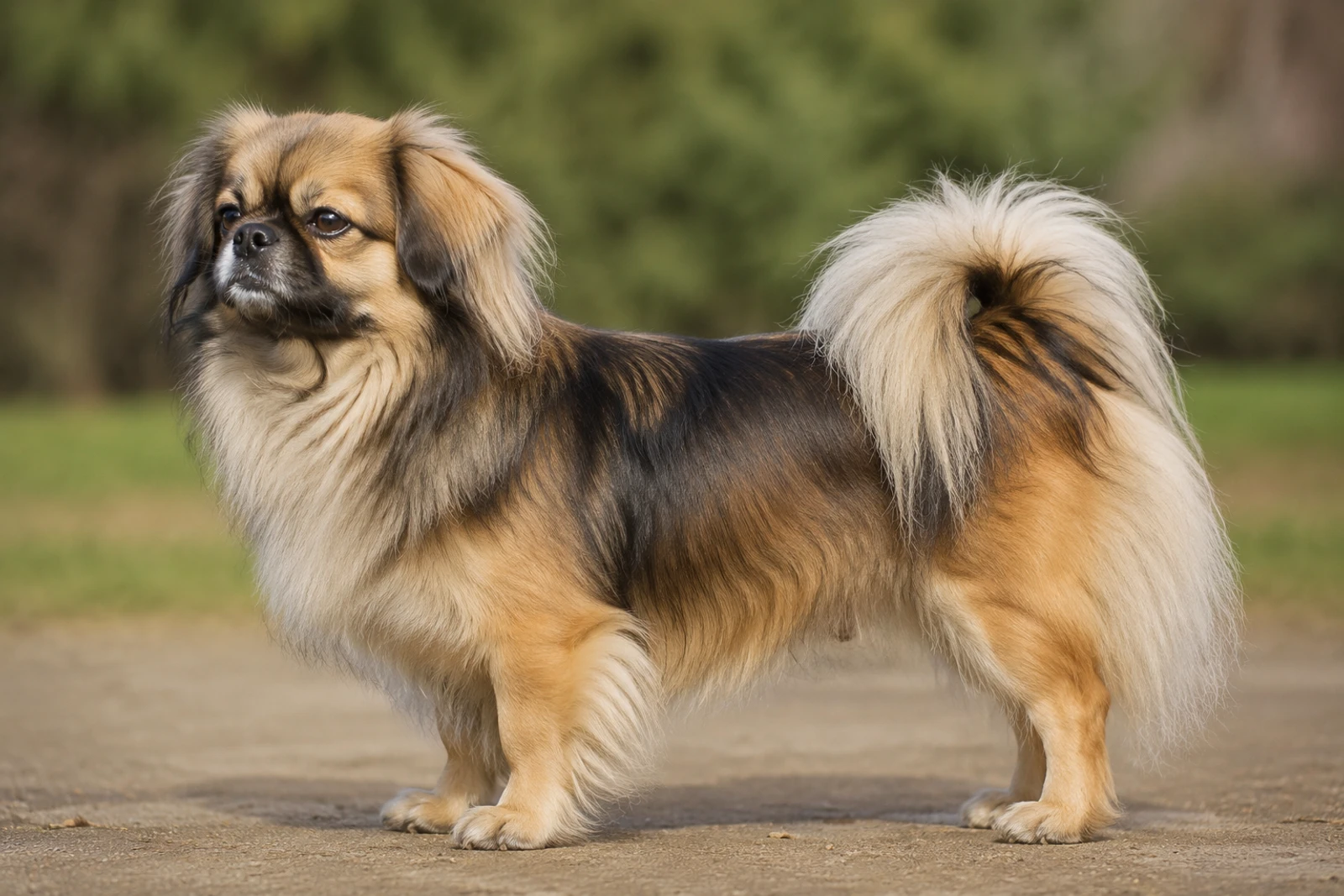
The Tibetan Spaniel is a small, intelligent, and alert breed originally from Tibetan monasteries, where they served as companions and watchdogs. They are affectionate with their families but reserved around strangers, making them excellent apartment dogs. With moderate energy, they enjoy short walks and play but are equally content lounging. Their independent nature requires patient training, but they thrive with consistent, gentle guidance. Best suited for homes with older, respectful children, they can coexist with other pets if socialized early. Ideal for owners seeking a loyal, low-maintenance lapdog that provides quiet companionship and a watchful eye.
At a glance
- Size
- Small
- Height
- 10 in
- Weight
- 9–15 lb
- Life span
- 12 years
- Coat colors
- Gold, Cream, Fawn, Red, White, Black, Black and Tan, Parti-Color
- Coat type
- Silky double coat with mane and feathering
How much does a Tibetan Spaniel cost?
Adopt / rescue
$75–$400
Usually includes spay/neuter, first shots, and a microchip.
Buy from a breeder
$700–$2,000
From a reputable, health-testing breeder.
Approximate USD. Prices vary widely by region, breeder, pedigree, age, and coat colour — adopting is the lower-cost and recommended route. Avoid suspiciously cheap “breeders”; they’re often puppy mills.
Estimate the full cost of a Tibetan Spaniel →Want the ongoing number? Estimate the monthly food bill for a Tibetan Spaniel with our dog food cost calculator.
Tibetan Spaniel photos
Views
Front, side, rear and top — the full silhouette.Poses
How the breed sits, lies, moves and plays.Puppy to senior
The breed across its whole life.Expressions
The breed’s range of moods.Close-up details
Eyes, ears, nose, paws, tail and coat.Coat colors
The breed’s recognized colors.Click any photo to enlarge. We show the Tibetan Spaniel from every angle — three views, poses, life stages, expressions, close-ups, coat and colors.
Appearance & size
You’d never mistake a Tibetan Spaniel for a fragile lap dog. Under that silky coat is a solid little animal built on a rectangular frame, standing about 10 inches at the shoulder and weighing anywhere from 9 to 15 pounds. The body is noticeably longer than it is tall—without appearing low-slung—with a level topline that conveys balance, not delicacy.
Look at one head-on and the first thing you’ll notice is the mane. A heavy ruff of longer hair frames the face and drapes the neck, especially in males, giving the breed its miniature-lion appearance. The chest is moderately broad, and the forelegs are straight with a slight arch of bone. Feathering trails down the front of the legs and breaks cleanly at the paws.
From the side, the silhouette really makes sense. A well-sprung ribcage goes back far into a short, strong loin and a subtle tuck-up. The standout feature is the tail—set high, carried in a richly plumed curl over the back whether the dog is standing or moving. A tail that hangs low is not typical. The overall side view is compact, proud, and bigger in substance than those small numbers suggest.
Move behind and you’ll see moderately angulated hindquarters with good width of thigh. The rear legs are straight when viewed from behind, and the feathering there adds a soft finish without hiding the muscle tone underneath.
The double coat is silky, lying flat or slightly wavy; it should never feel woolly. Feathering also shows up on the high-set, pendant ears, giving them a fringed outline. Color is wide open: solid gold, cream, red, fawn, black, black-and-tan, and various parti-color patterns all appear. Sable coats with banded hairs are common, too. About the only pigment you won’t find in a well-bred Tibbie is liver or chocolate, which points to crossbreeding somewhere behind the dog.
That small, slightly domed head carries a one-of-a-kind expression. Dark, oval eyes sit wide apart, and the muzzle is medium length with a definite—but not extreme—undershot bite. When the mouth is closed, neither teeth nor tongue should show. The result is an alert, almost apelike look that separates this breed from every other small companion dog.
History & origin
The dog you see perched on the back of a sofa, quietly surveying the room, is acting on instincts far older than your furniture. The Tibetan Spaniel was never a spaniel in the European sporting sense—early Western visitors just thought the silky coat and plumed tail resembled a toy spaniel’s. The breed’s real identity traces back over 2,000 years to the Buddhist monasteries of the Himalayas.
Monastery Sentinel
Monks selectively bred these small, square dogs to function as living alarm systems. A Tibbie would sit on the high monastery walls, scanning the valleys for approaching strangers, wolves, or snow leopards. The moment something moved, the dog erupted in a sharp, insistent bark, alerting the larger Tibetan Mastiffs that patrolled the ground. That high-perch vigilance never left the breed; today’s 9–15 pound house companion still seeks out window ledges and chair backs to monitor everything. The dogs also doubled as portable warmth, tucked into a monk’s robe on frigid nights—a role that made them intimate companions, not kennel-housed animals.
A Sacred Gift
Because lions held deep symbolic meaning in Buddhist iconography, the monks prized dogs with lion-like manes, a blunt muzzle, and a confident, forward-leaning carriage. They called them “little lions” and refused to sell them. The only way to acquire a Tibetan Spaniel was to receive one as a gift, an honor reserved for esteemed visitors or neighboring lamas. This practice kept the breed genetically stable and culturally insulated for centuries, slowly spreading them into China, Bhutan, and other parts of Asia as diplomatic tokens.
The Journey West
The first few reached England in the late 1890s, but real breeding efforts didn’t start until the 1920s and ’30s. Dr. Agnes Greig, a physician in India, received a Tibbie from a grateful Tibetan patient and eventually imported several dogs from monasteries, laying the foundation for Western lines. The breed weathered two world wars in small numbers, then gained a steady following. The American Kennel Club recognized the Tibetan Spaniel in 1984. Even today, with a lifespan bumping against 12 years, the breed’s habit of aloof observation and selective barking carries the unmistakable stamp of its monastery watchman past.
Temperament & personality
A Tibetan Spaniel is a small dog with a big sense of self. He’s not a pushover lapdog who lives to please. Expect an independent, intelligent roommate who genuinely likes you but will also decide the best spot for a nap is the back of the sofa—by himself, ten feet up, surveying the room like a tiny emperor.
Affection is on his terms. When he’s in the mood, he’ll curl up beside you or press his forehead against your leg for a scratch. When he’s not, he’ll move just out of reach. This isn’t coldness; it’s the breed’s famous cat-like self-possession. With his own family, he’s deeply attached and shadows you from room to room. Strangers, however, get a reserved once-over and perhaps a sharp bark before he retreats to his perch. That watchfulness is hard-wired. Bred to act as monastery sentinels in the Himalayas, a Tibbie will alert you to anything unusual without becoming a nuisance barker—provided you don’t leave him bored and alone for ten hours.
Energy needs are modest but specific. A half-hour walk plus a couple of short, spirited play sessions satisfies him. He’s not a jogging partner. What he craves is mental engagement: puzzle toys, hide-and-seek, training games where he can figure things out. Without it, that sharp mind turns to creative mischief—chewing a chair leg, raiding the trash, or expressing his displeasure through an extended bark concert. Anxiety-driven behaviors like house soiling or marking often pop up when a Tibbie is isolated. His sense of “home” is tied to your scent, not the floorplan; a room nobody uses might become his unofficial bathroom. Clean any accident immediately with an enzymatic cleaner or a vinegar spray to neutralize the odor, because a dog’s spatial memory is scent-based. He will go back to that spot if it smells like urine.
Training a Tibetan Spaniel requires finesse, not force. He’s strong-willed and will dig in his heels if you get loud or pushy. Positive reinforcement—treats, a happy voice, short sessions—works because he wants the arrangement to be mutually beneficial. Harsh corrections shut him down. Housebreaking can take longer than with some breeds; a treat the instant he eliminates outside teaches him far more than scolding ever will. He also benefits from learning that people near his food bowl are not a threat. Teach kids to let him eat in peace.
He’s generally good with older children who respect his boundaries. Toddler chaos and grabby hands often offend his dignity, leading him to retreat or, if cornered, snap. With other dogs and indoor cats he can coexist happily, though he won’t necessarily seek out rough-and-tumble play. Many Tibbies have a pronounced quirky streak: fastidious self-grooming with a paw, a talent for finding the highest vantage point, and an unexplained fondness for rolling in foul-smelling substances—a leftover scavenger instinct that you might never fully extinguish.
Give this breed a consistent but respectful daily rhythm, a window ledge, and your company, and you get a loyal companion with a dry wit—never needy, never subservient, always completely himself.
Good with kids, dogs & other pets
This is a companion dog who builds his world around the people he lives with. With kids, a Tibetan Spaniel’s patient, non-aggressive nature makes him a good fit, but his 9‑ to 15‑pound body means he’s not a rough-and-tumble playmate. Toddlers who haven’t learned gentle handling can accidentally hurt him, so supervision is non‑negotiable. School‑age children who respect a dog’s space and enjoy quiet lap time often find a loyal, affectionate buddy.
The breed’s deep attachment to his humans is a double‑edged sword. He can become distressed if left alone for long stretches or housed outdoors with little interaction. That sensitivity also shows up around larger, bouncier dogs. A Tibbie usually does fine with other dogs given slow, positive introductions, but don’t expect him to enjoy a rowdy dog‑park free‑for‑all. He’s more of a “tea and quiet conversation” type. With cats, many Tibetan Spaniels coexist peacefully, especially when they’re raised together. Because he’s small and not driven by a high prey instinct, a resident cat often ends up the boss. Small pets like rabbits or guinea pigs are a separate conversation — always supervise those meetings and use a secure barrier until you’re sure of the dynamic.
Early socialization locks all of this into place. The sensitive window closes around 12 to 16 weeks, so expose the puppy gently to a variety of calm kids, friendly dogs, and everyday household sounds before that door shuts. An adult who missed that window may be timid or reactive; forcing him into social situations he’s uneasy about only adds stress and can backfire. If your older Tibbie is perfectly content with just you and your family, that’s fine — he doesn’t need a wide circle of dog friends. Respect his boundaries, and you get a slightly aloof but deeply devoted little shadow who saves his confetti‑tail wags for his inner circle.
Trainability & intelligence
A Tibetan Spaniel won’t knock you over with slavish obedience, because that’s not how his mind works. He’s quick, observant, and perfectly capable of learning whatever you teach—but he’s also independent enough to ask why before he does it. You’ll get further with a partner mindset than a drill-sergeant one.
Motivation matters more than repetition. This is a dog who tunes out pressure fast. Use tiny, high-value treats, a squeaky toy, or a burst of genuine praise the instant he gets something right. He’s sensitive; a harsh tone shuts him down and erodes trust. Keep sessions under ten minutes, end on a win, and stay upbeat. He remembers how you made him feel.
Start young, go everywhere. A Tibetan Spaniel’s natural reserve with strangers can tip into fear-based reactivity if you skip early socialization. Expose your puppy to friendly strangers, different surfaces, household sounds, and calm other dogs between 3 and 14 weeks. Make each new encounter brief and pleasant—a treat, a quiet voice, no looming. Well-socialized Tibbies stay watchful but not spooky.
Recall is a negotiation, not a guarantee. A scent or a squirrel can override even a well-trained Tibetan Spaniel, so practice recalls in low-distraction spots first, reward heavily, and never chase him if he ignores you (that turns it into a game). A long line gives you safety while he learns.
What works: short, positive, relationship-based training that respects his brains and his boundaries. What backfires: punishment, nagging, or expecting him to perform like a Labrador. Build clear communication, and you’ll have a dog who’s more than willing to cooperate—once he trusts you’re on the same team.
Exercise & energy needs
Your Tibetan Spaniel needs daily movement, but this isn’t a dog that will beg for a 5-mile run. Aim for about 30 minutes of activity total, broken into two or three short sessions. A 15-minute sniffy walk in the cool morning paired with a couple of indoor play bursts later in the day is right for most Tibbies.
Because that pushed-in face makes them brachycephalic, they overheat quickly and can struggle with prolonged or intense exercise. Skip the midday pavement in warm weather, and never push if he’s panting heavily or lagging. Comfort matters more than distance.
Mental exertion counts just as much as physical. These clever little problem-solvers bore easily and will invent their own entertainment — like unrolling the toilet paper or excavating the laundry basket. Puzzle toys, a snuffle mat with hidden kibble, or five minutes of trick training drain that busy brain faster than extra laps around the block. Even a game of hide-and-seek indoors works great.
- Good fits: brief, scent-focused walks on a harness; indoor fetch with a soft toy; low-impact flirt pole sessions (keep jumps close to the ground); learning new tricks; nose games like “find the treat.”
- Be cautious with: high jumps off furniture. That slightly long back is vulnerable to injury. A ramp or pet steps near the sofa is a wise investment.
A couple of 10- to 15-minute mini-sessions scattered through the day usually keep a Tibetan Spaniel physically and mentally satisfied. Lean into brain games, respect his flat-faced limits, and you’ll have a content companion who’s far more likely to nap than cause chaos.
Grooming & coat care
The Tibetan Spaniel’s double coat is far easier to live with than it looks. That silky topcoat and soft underlayer don’t mat nearly as readily as a long, continuously growing coat, so you’re off the hook for daily sessions. A thorough brushing twice a week with a pin brush or slicker brush (the kind with rounded tips) pulls out loose hair and keeps the neck ruff from tangling. During spring and fall blowouts, bump that to every other day — a 15-minute session with a comb behind the ears and under the legs catches the worst of it before it lands on your sofa.
Bathtime is strictly as-needed. Tibbies are naturally fastidious, with little doggy odor, so a bath every two or three months — or after a truly muddy adventure — is plenty. When you do bathe, always work a conditioner through the longer feathering on the tail and haunches; otherwise, the guard hairs can get dry and brittle.
This is a no-clipper breed. No shaving, no major trimming. The only touch-ups you might do are tidying the hair that grows between the paw pads for traction and snipping any wispy ends along the back of the hocks if they drag. Ear care deserves a weekly peek: flip back those pendant ears and wipe the inner flap with a damp cotton ball to keep debris from building up. Nails grow fast on a 9–15 lb dog who might prefer the couch to pavement, so plan on nail trims every three to four weeks. Overgrown nails can splay the feet and make a little dog rock backward, messing with his movement.
Teeth are the one spot where you can’t coast. Small breeds like the Tibetan Spaniel can be prone to early dental disease, so daily tooth-brushing with a dog-safe paste makes a real difference. Even a quick wipe with a finger brush every other day is better than nothing.
Seasonal shedding looks dramatic — you’ll pull out fistfuls of gray fluff — but it passes in a couple of weeks if you stick with the brush. A rubber curry comb during a warm bath helps loosen the undercoat all at once. And because you’re running your hands over the dog regularly, you’ll catch any hotspots, bumps, or ear redness before they turn into a vet visit. That’s the hidden value of grooming a Tibbie: the routine itself acts as a quick health check on a breed that can be stoic about discomfort.
Shedding & allergies
The Tibetan Spaniel’s soft, silky double coat sheds plenty for a small dog. You’ll find hair on the couch year-round, and twice a year — usually in spring and fall — the shed cranks up hard. During those blowout periods, undercoat comes out in tufts, and a quick brushing session fills the comb fast.
- Year-round shedding: Moderate, steady, but noticeable on dark pants and carpets. A weekly once-over won’t cut it; aim for a brush two or three times a week to keep the loose fur from migrating everywhere.
- Seasonal blowout: Expect heavy shedding for a few weeks when the coat cycles. Daily line brushing with a slicker or pin brush keeps the worst off your floors and prevents matting in the feathering behind the ears and legs.
- Drool: Almost zero. This breed is dry-mouthed and tidy by nature.
No dog is truly hypoallergenic, and the Tibetan Spaniel is no exception. They produce dander — the real culprit for allergies — along with all that shed hair. If someone in your house is allergic to dogs, spend time around adult Tibbies before committing. You might manage reaction levels with frequent grooming, HEPA filters, and a good vacuum, but don’t expect a low-shed miracle. The upside? A small dog means less total fur volume than a big double-coated breed, so the mess is contained to a smaller footprint. Still, this is not the breed for a spotless house or a severe allergy sufferer who can't tolerate any airborne dander.
Diet & nutrition
A 9–15 lb Tibetan Spaniel gains weight alarmingly fast if you eyeball portions instead of measuring them. These little charmers know how to work a kitchen audience, and many are genuinely food-obsessed. That combination turns “just a bite” into a fast track to obesity, which is especially hard on their joints and can aggravate any predisposition to patellar luxation or back trouble. A lean Tibbie is a healthier Tibbie.
An adult typically does well on about ½ to 1 cup of high-quality dry food per day, split into two meals. The exact amount depends on metabolism, age, and how much genuine exercise they get — a couple of brisk walks and indoor play, not just couch time. If you can’t easily feel their ribs with light pressure, cut back.
Puppies need four meals a day until four months, then three meals until six months, and after that you can move to the adult twice-daily schedule. Start pups on a high-quality commercial puppy formula or lightly cooked, puréed meats, fish, fruits, and vegetables. Raw chicken wings or necks can be introduced around 12 weeks under close supervision.
Slow eaters with a picky streak? Respect it, but don’t cater to demands. Fast eaters? Use a food puzzle bowl — it stretches out mealtime and gives their brain a job. If you prepare home-cooked meals, aim for roughly 60% meat, 20–30% fruits and vegetables, and the rest from eggs, grains, or plain yogurt. Blending or processing the food helps a dog’s vertical-chewing jaw extract more nutrients, and cooked pearl barley or white rice work well for sensitive stomachs.
As your Tibbie ages and slows down, switch to smaller, more frequent meals and watch the scale like a hawk. Don’t cut protein without a vet’s reason. And never feed from the table — if you have healthy leftovers (cooked veg, a bit of egg, plain fish), put them in their own bowl, away from your feet. It’s the simplest way to keep the begging habit from taking root.
Health & lifespan
A well-bred Tibetan Spaniel typically reaches 12 years, and many sail past that mark with attentive, year-round care. They’re a small breed—9 to 15 pounds—so even a couple of extra ounces can strain joints and organs. Keep them lean, and you stack the deck in their favor.
What responsible breeders screen for
Progressive retinal atrophy (PRA) is the big one. It’s an inherited disease that gradually steals a dog’s sight, and there’s no cure. Ethical breeders DNA-test for it and have a veterinary ophthalmologist examine the parents’ eyes annually. Patellar luxation—a kneecap that pops out of place—is another common small-dog nuisance; a vet can grade it during a physical exam, and keeping your Tibbie fit reduces the load on those knees. Some lines may also carry portosystemic shunt (liver shunt), where blood bypasses the liver. Reputable breeders screen for this congenital defect, but it’s something to ask about. Cherry eye (a prolapsed third-eyelid gland) shows up from time to time and is usually fixed with a straightforward surgery.
Everyday health you can manage
Tibetan Spaniels have a short muzzle and a thick double coat, so they can overheat fast in summer. Give them shade, cool water, and exercise in the cooler parts of the day—heatstroke isn’t worth the risk. Dental disease is rampant in tiny mouths: brush regularly and budget for professional cleanings. Skin allergies (itching, hot spots, recurrent ear infections) aren’t unusual and often trace back to food or environmental triggers. If your dog obsessively licks paws or shakes their head, a food trial or allergy workup can calm things down.
Because these dogs are sensitive and bond tightly, harsh handling or long stretches of isolation can spark anxiety that shows up as digestive upset, overgrooming, or barking fits. A steady, positive home keeps stress—and the health troubles it can trigger—from taking root.
Like any dog, a Tibetan Spaniel needs monthly heartworm prevention during mosquito season and a legally required rabies vaccination. Stick to a yearly wellness exam for the first several years, then switch to twice-a-year visits once your dog hits senior status. Watch for subtle shifts: squinting, hesitating on stairs, or drinking more water than usual often flag a problem before it gets big.
Living environment
A Tibetan Spaniel fits an apartment easily — just 9–15 pounds — but the real test is how much time you’re actually home. These dogs bond hard and can develop serious separation anxiety when left alone for long stretches. A household where someone works from home or comes and goes throughout the day works far better than one that’s empty from 8 to 6.
A fenced yard isn’t necessary. A couple of brisk 15-minute walks, split into morning and evening, plus some indoor play usually covers their energy. Multiple short sessions suit them much better than one long slog, especially since their flat face makes breathing inefficient and heat tolerance poor. In warm weather, skip midday pavement; they overheat fast and do best in air-conditioned rooms. Their double coat handles moderate cold decently, but they’re still house dogs — not built to live outside in extreme temperatures.
Inside, these are natural watchdogs. They’ll use a surprisingly loud voice to announce delivery trucks, visitors, or the neighbor’s cat. Training a reliable “quiet” cue early on makes apartment living with thin walls far less stressful, but a totally silent Tibbie is rare.
The biggest challenge is alone time. Tibetan Spaniels love deeply and often panic when isolated. Start with short departures in puppyhood, and always leave a stuffed puzzle toy or a treat-release chew to make your absence less of an event. Even with great training, they’re not a breed that thrives with minimal human contact. Expect to structure your day so they’re rarely solo for more than a few hours — a bored, lonely Tibbie won’t stay quiet about it.
Who this breed suits
If you value a dog that behaves more like a self-possessed cat than a needy shadow, a Tibetan Spaniel might be your perfect match. Standing about 10 inches and weighing just 9–15 pounds, these little monks from the Himalayas are independent thinkers who bond deeply but on their own terms. They’ll happily perch on a sofa back for hours, surveying their kingdom, then demand a brisk walk or a spirited game before settling back into your lap — or just out of reach.
First-time owners who understand that “smart” and “stubborn” often come as a set can do wonderfully here. Tibbies are clean, adaptable, and need only moderate exercise — two 20-minute walks plus some indoor zoomies typically keep them content. The trade-off: they aren’t push-button obedient. Housetraining takes extra patience, and you’ll get cooperation through treats and clever negotiation, not sharp commands. If you dream of a dog that heels off-leash on the first ask, this isn’t your breed.
Seniors and singles often find an ideal companion in a Tibetan Spaniel. They’re quiet indoors (though they’ll announce visitors with a surprisingly deep bark), content with a window view and a warm lap, and can handle being alone for a few hours once they’ve settled in. They’re perfect for someone who’s home a lot but doesn’t need a constant shadow.
Families with gentle older children — think 8 and up — can thrive, but a Tibbie’s fine-boned frame and strong sense of personal space don’t mix well with toddlers who grab or stumble. For active families who stick to moderate hikes, these sturdy little dogs can keep up, but they aren’t built for all-day, high-impact outings; when they’re done, they’ll plop down and wait for you to catch the hint.
Think twice if you expect a silent dog. Tibetan Spaniels are natural watchdogs and will bark at noises, passersby, and suspicious squirrels — it’s not nonstop yapping, but it’s reliable. Their double coat sheds dirt and weather well, but it drops seasonally; a weekly brush is enough outside of shedding season, and then you’ll want a rake to keep fur off your trousers. More importantly, think twice if you need a dog that obeys like a Border Collie or a lap ornament with no opinions. A Tibbie is a loyal, slightly bossy, perpetually amused housemate who’s convinced she runs the place — and if that makes you smile, you’ll share roughly 12 years with a dog that fits like a glove.
Cost of ownership
A Tibetan Spaniel puppy from health-tested parents typically costs between $1,500 and $2,500. Breeders who screen for progressive retinal atrophy (PRA), luxating patellas, and other hereditary issues charge at the higher end; show-quality pups can run closer to $3,000. Adoption, when available, ranges from $200 to $500.
Food is a small line item. At 9–15 lb, an adult Tibbie eats roughly ½ to 1 cup of high-quality kibble daily—translating to $20–$30 per month. Treats and dental chews might add another $10. Their silky double coat needs a good brushing two or three times a week, but you can keep professional grooming to a minimum. A session every 6–8 weeks for a trim, bath, and nail grind costs $40–$60; many owners learn to handle it at home with a pin brush and metal comb.
Veterinary expenses deserve a closer look. Annual wellness exams, core vaccines, and heartworm prevention average $200–$400. Small mouths make dental disease common, so budget $300–$600 for a professional cleaning every year or two. Eye problems (PRA, cherry eye) and patella issues can surface, which is where insurance becomes a practical buffer. A policy that covers hereditary conditions generally runs $25–$45 per month. Without it, a single knee surgery might hit $2,000–$4,000. Tuck away an emergency fund of at least $1,000 even if you insure, because deductibles and routine surprises add up fast. Over a 12-year lifespan, a realistic total—purchase price, food, grooming, basic vet care, and insurance—lands between $10,000 and $14,000, with the first year skewing higher thanks to spay/neuter and puppy shots.
Choosing a Tibetan Spaniel
Adoption First
Check Tibetan Spaniel–specific rescues before contacting a breeder. These small dogs (9–15 pounds, about 10 inches tall) often land in rescue when an owner underestimates their watchdog tendencies or a longer-than-expected 12-year commitment. An adult Tibbie skips the housebreaking phase and you see exactly what you’re getting: the independent catlike charm, the preference for perching on the back of the sofa. The downside is spotty health history, but a solid rescue will tell you what they know.
Finding a Responsible Breeder
Health clearances matter more than a cute face. A Tibetan Spaniel can be prone to patellar luxation and progressive retinal atrophy (PRA) , so ask for proof—not just a vet glance. Insist on:
- OFA patella certification (knees graded normal).
- Annual eye exam by a veterinary ophthalmologist (OFA Eye or CERF registration), current within the past year.
- A cardiac evaluation, because some lines carry heart issues.
A breeder who says they “don’t need” those tests, or who offers only a “vet check” and a bag of food, is a red flag. Walk away from anyone selling “teacup” or “imperial” Tibbies—the breed standard is already small, and deliberately downsizing invites structural and health nightmares.
Red Flags and Puppy Picking
Puppy-mill warning signs are easy to spot if you look: multiple breeds on the property, a refusal to let you meet the dam, litters always available, dirty or cramped conditions, and puppies released before 8 weeks. A conscientious breeder will grill you, too—they’ll want to know about your lifestyle and why you want a dog that’s equal parts affectionate and stubbornly feline.
When you meet the litter, watch the pups move. Healthy puppies have clear eyes, clean ears, no nasal discharge, and silky coats without bald patches. Spend time with each one. A well-socialized Tibbie puppy is curious but not frantic, confident enough to approach you without being the loudest in the room. Pick the puppy that feels like a good fit for your household’s energy level—not just the one that climbed into your lap first. A rushed choice, or a breeder who lets price override fit, often leads to a mismatched home.
Pros & cons
A Tibetan Spaniel brings a watchful, cat-like independence in a sturdy 9–15 lb package — equal parts endearing and stubborn.
Pros
- Pint-sized and portable at about 10 inches tall, with modest exercise needs; a couple of brisk 20‑minute walks plus indoor play does the trick.
- Born watchdog who misses nothing, yet tends to be “alert, not yappy” when you teach a quiet cue early.
- Surprisingly tidy: they groom themselves fastidiously and often house‑train quickly with a consistent routine.
- A loyal shadow without being clingy — they’ll happily curl up nearby while you work, no constant attention required.
- Long-lived (around 12 years) so you get a decade‑plus of quirky companionship.
Cons
- Self‑directed thinker. Training is a negotiation — they may blow off a known command if there’s something better on offer, so patience and creativity win the day.
- Reserved with strangers and not a guaranteed lapdog; affection is on their terms, which can feel aloof to someone expecting instant snuggling.
- Moderate seasonal shedding from the double coat. Expect to brush a few times a week, and have a lint roller handy during coat‑blowing season.
- Can dig in their heels on leash; a short, stubborn sit‑in is classic Tibbie when they decide the route isn’t to their liking.
- Better suited to homes with older, dog‑savvy kids. Rough handling or a chaotic household runs counter to their dignified, let‑me‑think‑about‑it nature.
- Alert barking can snowball if left unchecked, so early guidance on “enough” is a must.
- Can be prone to patellar luxation, progressive retinal atrophy, and dental issues; responsible breeders screen, but future vet bills are worth a candid look.
Similar breeds & alternatives
If the Tibetan Spaniel’s blend of independence, alertness, and “little watchdog” charm hits the mark but you’re weighing other options, a few breeds share some of those traits while taking them in different directions.
-
Pekingese: At a similar 10–14 pounds, Pekes match the Tibbie’s small stature and self-assured attitude. Both were bred as companions in ancient monasteries and palaces, so they carry a dignified, opinionated streak. The difference is primarily in build and maintenance. Pekingese have a much flatter face, which can lead to breathing and heat sensitivity issues, and their longer, heavier coat needs daily brushing. A Tibbie’s moderate snout and simpler double coat make them more tolerant of warm weather and active play, while a Peke is often content with shorter, gentler strolls.
-
Japanese Chin: Chin are even more cat-like than Tibbies, often described as dainty, fastidious, and graceful. They weigh around 7–11 pounds and stand 8–11 inches tall, so size is comparable. The Chin’s single, silky coat mats less than a Tibbie’s thicker fur, but they tend to be more dependent on their person and less bold—expect a lap-warmer, not a little sentinel who will bark at every door knock. If you want a quiet, elegant shadow, the Chin wins; for a dog with more self-employed confidence, stick with the Tibbie.
-
Shih Tzu: Weighing 9–16 pounds and standing 9–10.5 inches at the shoulder, Shih Tzu overlap almost exactly with the Tibetan Spaniel’s footprint. Both are sturdy, proud little dogs with a fondness for perching on furniture and surveying their domain. The Shih Tzu’s hallmark is an outgoing, people-loving nature—they typically greet strangers with a wag rather than a reserved once-over. They also demand more coat work (daily brushing and frequent trims) unless kept in a puppy cut. A Tibbie offers a more moderate grooming load and a more discerning, watchful personality.
Fun facts
- Bred by Tibetan monks and known as 'little lions' for their resemblance to guardian statues.
- Historically given as gifts and never sold, symbolizing high esteem.
- Despite the name, they are not spaniels; early Western visitors mistook them for toy spaniels.
- Possess a unique 'hare foot' with front feet slightly turning outwards.
Frequently asked questions
- Do Tibetan Spaniels shed a lot?
- Tibetan Spaniels have a double coat that sheds moderately throughout the year and more heavily during seasonal changes. Regular brushing a few times a week helps control loose hair. They are not considered a hypoallergenic breed.
- Are Tibetan Spaniels good with children?
- They can be good companions for older, respectful children who handle them gently. Due to their small size, interactions with younger kids should always be supervised. Early socialization helps them become more comfortable around children.
- How much exercise does a Tibetan Spaniel need?
- Tibetan Spaniels are moderately active and thrive with daily short walks and indoor play. They do not require extensive exercise but benefit from mental stimulation like puzzle toys. A secure space for exploration can help meet their activity needs.
- What grooming does a Tibetan Spaniel require?
- Their silky double coat needs brushing two to three times per week to prevent mats and tangles. They may need occasional baths and regular nail trimming. Grooming frequency should increase during shedding periods in spring and fall.
- Are Tibetan Spaniels suitable for apartment living?
- Yes, their small size and moderate energy make them well-suited to apartments. They are generally quiet indoors but may alert bark, which can be managed with training. Daily walks and playtime inside keep them content in smaller spaces.
- Do Tibetan Spaniels bark a lot?
- They tend to be alert and will bark to announce visitors or unusual sounds. With consistent positive training, excessive barking can be reduced. They make good watchdogs but are not known to be excessive barkers without reason.
Tools & calculators for Tibetan Spaniel owners
Quick estimates tailored to Tibetan Spaniels — pre-filled with this breed’s size where it matters.
Articles & stories about the Tibetan Spaniel
Sources & standards
This profile follows recognized breed standards from the American Kennel Club (AKC) and the Fédération Cynologique Internationale (FCI), along with established veterinary and breed-club guidance. These describe general breed tendencies — every dog is an individual.