

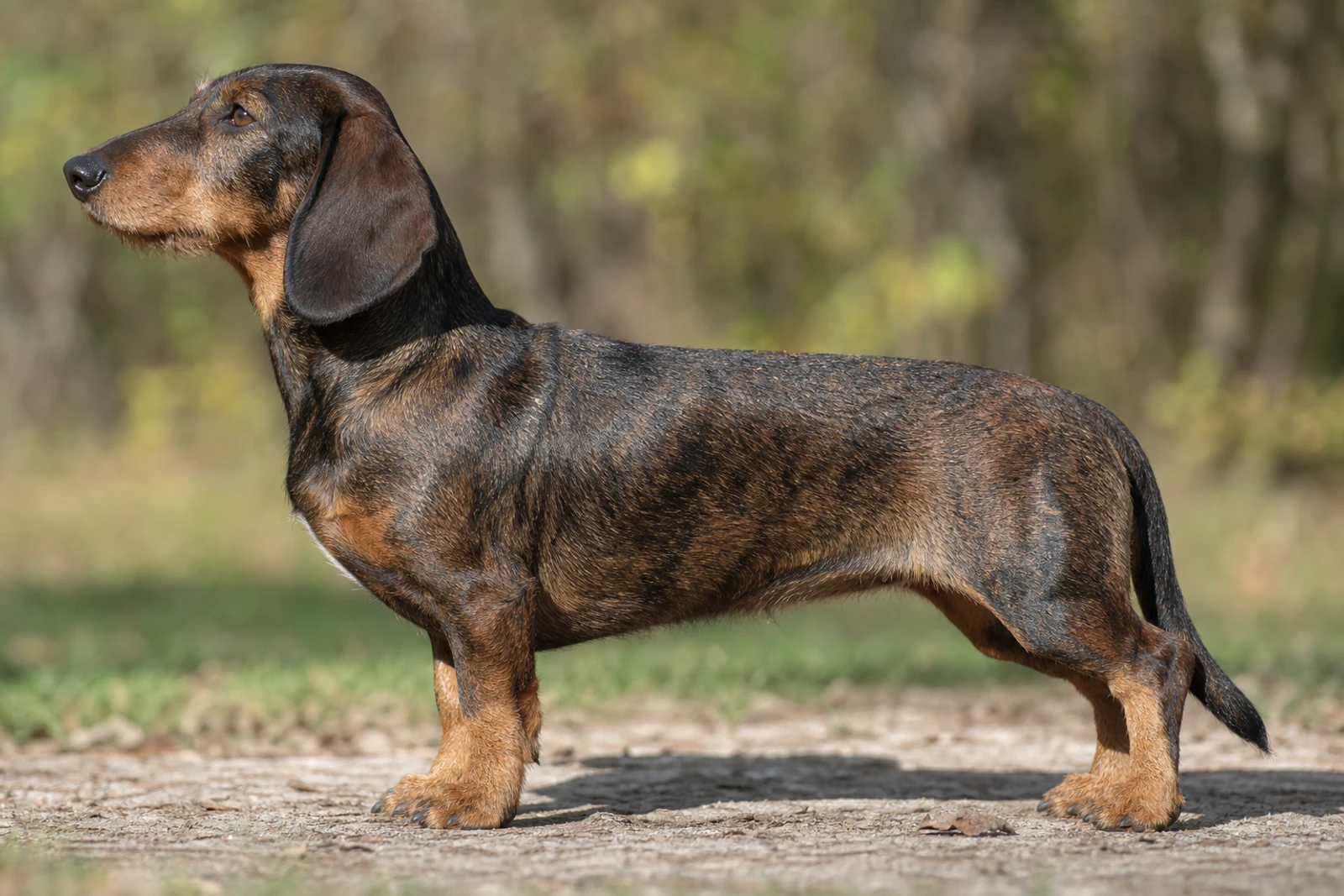
The Westphalian Dachsbracke is a loyal and tenacious small hunting dog originating from Germany, where it excels at tracking downed game over challenging terrain. With its sturdy, low-slung build, keen nose, and calm yet determined demeanor, this breed makes an excellent companion for active individuals or families who love the outdoors. It thrives on regular exercise and mental stimulation, bonding closely with its people while maintaining an independent streak. Best suited to rural or suburban homes with secure yards, the Westphalian Dachsbracke is a rare gem for experienced dog owners seeking a versatile, affectionate hound.
At a glance
- Size
- Medium
- Height
- 12–15 in
- Weight
- 33–40 lb
- Life span
- 10–12 years
- Coat colors
- Red, Yellow, Black and Tan, Brindle
- Coat type
- short, dense, and harsh double coat
How much does a Westphalian Dachsbracke cost?
Adopt / rescue
$75–$400
Usually includes spay/neuter, first shots, and a microchip.
Buy from a breeder
$700–$2,000
From a reputable, health-testing breeder.
Approximate USD. Prices vary widely by region, breeder, pedigree, age, and coat colour — adopting is the lower-cost and recommended route. Avoid suspiciously cheap “breeders”; they’re often puppy mills.
Estimate the full cost of a Westphalian Dachsbracke →Want the ongoing number? Estimate the monthly food bill for a Westphalian Dachsbracke with our dog food cost calculator.
Westphalian Dachsbracke photos
Views
Front, side, rear and top — the full silhouette.Poses
How the breed sits, lies, moves and plays.Puppy to senior
The breed across its whole life.Expressions
The breed’s range of moods.Close-up details
Eyes, ears, nose, paws, tail and coat.Coat colors
The breed’s recognized colors.Click any photo to enlarge. We show the Westphalian Dachsbracke from every angle — three views, poses, life stages, expressions, close-ups, coat and colors.
Appearance & size
The Westphalian Dachsbracke is a medium-sized scent hound built low to the ground, but not as exaggerated as a Dachshund. You’re looking at a sturdy, elongated dog who stands just 12 to 15 inches at the shoulder and tips the scale between 33 and 40 pounds. That compact frame hides surprising substance — the chest is deep and broad enough to house plenty of heart and lung, and the bone is substantial without being coarse.
From the front
When you face a Westphalian Dachsbracke straight-on, the chest stands out first. It’s moderately wide, with a prominent prosternum that projects slightly ahead of the shoulder points and drops down to the elbows. The forelegs are straight, well under the body, and end in tight, round feet with thick, dark pads. The head is noble and elongated, with a slightly domed skull, a distinct stop, and a long, strong muzzle that’s nearly as long as the skull. Dark, oval eyes give a calm, gentle expression, framed by broad, high-set ears that hang flat against the cheeks and reach roughly to the nose when pulled forward.
Viewed from the side
Run your eye along the dog’s silhouette, and the proportions tell the story. The body is noticeably longer than tall — the back is firm and level, the loin slightly arched, and the croup gently sloping. A deep, well-sprung ribcage reaches far back, contributing to that low-slung, powerful outline. The belly tucks up just slightly behind the ribs, giving a hint of grace without sacrificing any working capacity. The coat, a short, dense, harsh double layer that lies flat, adds to the no-fuss, weather-ready look. Colors stay in typical hound territory:
- Solid red to rich yellow, sometimes with a darker overlay
- Black and tan, often with a black saddle or mantle
- Nearly all variations include white markings — a blaze on the muzzle, a white chest patch (the “Bracken star”), white toes or socks, and a white tail tip
The tail is set on high, thick at the base, and tapers to a slight brush. On the move, it’s carried saber-like, never curled over the back.
From the rear
From behind, the hindquarters look muscular and drive the dog efficiently. The thighs are well developed, and the hocks are straight and parallel when the dog stands naturally. The tail emerges from a level croup and hangs down at rest, just reaching the hocks. Overall, the rear view reinforces the impression of a compact, no-nonsense tracker built to push through underbrush all day without tiring.
History & origin
The Westphalian Dachsbracke was built for a single, gritty job: trailing wounded game through the kind of tangled undergrowth a taller hound can’t belly through. Everything about its build and temperament flows from that purpose.
The breed took shape in the forests of Westphalia, in western Germany, during the 19th century. Hunters needed a dog with a nose cold enough to follow an hours-old blood trail, the persistence to stick with it for miles, and a body that could slide under deadfall and weave through blackberry thickets without wasting energy. The solution was a cross between the short-legged, tenacious Dachshund — already a master of underground and dense-cover work — and small local Bracken, most notably the Sauerländer Bracke. The result was a compact, low-slung scenthound the Germans call the Westfälische Dachsbracke, literally the Westphalian badger-hound.
Don’t let the name fool you into thinking it was a badger specialist. “Dachsbracke” refers to its Dachshund ancestry and its short-legged, long-bodied shape, not a primary quarry. Its real value was in Nachsuche: the patient, methodical tracking of wounded red deer, wild boar, and roe deer long after the shot. A driven hunt can wound an animal that travels a mile before bedding down. The Westphalian Dachsbracke was bred to unravel that trail with a calm, steady voice, giving the handler time to follow on foot. Speed wasn’t the goal; accuracy and stamina were.
Organized breeding got serious in the early 1900s. The first formal standard was drafted around 1910 by the Deutschen Brackenverein, and the breed’s working style was tightly preserved by foresters and professional hunters who depended on it. The Fédération Cynologique Internationale (FCI) recognized the Westphalian Dachsbracke in 1955, placing it among the small hounds.
Today, the breed remains a well-kept secret outside Germany. It’s still primarily a working dog in the hands of German hunters, with a small presence in other European countries and a rarity in North America. Unlike some breeds that split into show and field lines, the Westphalian Dachsbracke has stayed remarkably unchanged because its keepers never stopped using it for the work it was built to do. A healthy dog still stands 12 to 15 inches at the shoulder and weighs between 33 and 40 pounds, a size that lets it disappear into the brush while trailing game at a pace a hunter can match on foot.
Temperament & personality
At heart, the Westphalian Dachsbracke is a calm, steady companion indoors who turns into a single-minded scent machine the moment you step outside. Don’t let the relaxed sofa demeanor fool you — this 33–40-pound hound was built to follow a trail for hours, and her brain demands that kind of work.
Inside the home, she’s typically quiet and affectionate with her people, often content to sprawl nearby as long as she’s had sufficient exercise. Outside, that exercise is non-negotiable: a quick leash stroll won’t cut it. Plan on a solid hour of walking, sniffing, and exploring, or broken up into two vigorous sessions. A fenced yard helps, but she’ll still need structured outings because her sport is following her nose, not just running laps.
With family she’s gentle and patient, but that friendliness hinges on early socialization. She can be watchful and will announce visitors with a deep bark, though she’s no guard dog. Her scent drive means she may be tempted to mark territory indoors, especially if she can still smell previous accidents. Use an enzymatic cleaner or a homemade vinegar spray (white or cider vinegar) to neutralize odors completely — otherwise, that scent memory will cue repeat marking.
Training a Dachsbracke means respecting her independent streak. She’s strong-willed, not defiant, and responds to calm, consistent guidance and high-value treats. Harsh corrections backfire. Because she’s so nose-driven, off-leash reliability is a genuine challenge; a long line in open areas gives her freedom without the risk of her vanishing after a deer. The forward-leaning, stiff body language she shows on a scent is all business, so learn to read that shift from relaxed house dog to hunter on a mission.
She has a few classic hound quirks. Chewing is a lifelong hobby — provide sturdy chew toys to support clean teeth and strong jaws, and keep a citrus or vinegar spray handy to protect furniture legs. The same nose that makes her a brilliant tracker can also lead her to roll in unmentionable finds; many Dachsbrackes seem to revel in masking their scent with something foul. Baths are just part of the deal.
Kids and other dogs usually get a warm reception, but small pets like rabbits or cats can trigger prey drive. Teach children never to interrupt her while she’s eating, as even a normally sweet dog may guard food. She bonds closely and can develop anxiety-driven behaviors — excessive barking, chewing, indoor marking — if left isolated for long stretches. A home where someone is around most of the day suits her best.
Good with kids, dogs & other pets
The Westphalian Dachsbracke is a patient, steady-natured dog that generally fits smoothly into a household with respectful kids. At 33–40 lb and low to the ground, they aren’t fragile, but a sudden lunge from a young child can startle any dog, and a Dachsbracke’s broad chest can topple a toddler without meaning to. Teach children to approach calmly, avoid grabbing ears or tail, and never disturb the dog when it’s eating or sleeping. This breed thrives on close companionship: they form tight bonds with their families and can become anxious if left isolated in a yard or home alone for long stretches. A Dachsbracke belongs indoors with its people.
With other dogs, they tend toward easygoing coexistence, especially when they’ve shared a home since puppyhood. Their pack-hunting background gives them a social instinct, but don’t mistake that for an automatic off-leash friend at the dog park. Early and ongoing positive exposure to a variety of dogs – and careful supervision around unfamiliar dogs – keeps interactions friendly and prevents territorial spats.
Small pets are another story. This is a scent hound bred to track hare and fox over rugged terrain. That prey drive doesn’t shut off indoors. Cats, rabbits, or pocket pets can trigger a chase response, and even a Dachsbracke that seems indifferent can change in a flash. With a cat they’ve been raised alongside from early puppyhood, calm coexistence is possible, but never leave them unsupervised with small animals. The critical socialization window closes around 12–16 weeks, so use that time to introduce your puppy gradually to cats, different dog breeds, children, and everyday hustle.
If you’re bringing home an adult Dachsbracke with an unknown background, don’t force introductions. Pushing a dog that shows fear or intense focus on a cat can backfire. Instead, lean on management – baby gates, separate spaces – and positive conditioning. A well-socialized Westphalian Dachsbracke is a charming family companion, but their nose-led instincts mean small critters are never fully safe off the hook.
Trainability & intelligence
A Westphalian Dachsbracke learns fast when there’s something in it for him — and “something” usually means food or a fresh scent trail. This is a hound built to solve problems on his own in the woods, not wait for directions. He’s plenty smart, but that intelligence comes with a heavy dose of independence. You’re not training a retriever who lives to please; you’re bargaining with a nose on legs.
Use short, upbeat sessions and real currency. A few pieces of hot dog or stinky cheese will get you miles further than a pat on the head. Fade the treats gradually, but never expect the behavior to happen “just because you said so.” If a rabbit track crosses your path mid-recall, your voice becomes background noise. That means a reliable off-leash recall is the single hardest skill to build — and for many Dachsbracken, it’ll never be 100% in unfenced areas.
- Motivation: Track-driven and food-driven. Praise alone won’t cut it during high-distraction moments.
- Common challenges: Selective listening outdoors, pulling toward scent, blowing off known commands when a trail is hot.
- What works: Positive reinforcement only. Any force or harsh corrections erode trust fast and teach the dog to tune you out completely. Keep repetition low — he gets bored drilling the same thing. Instead, hide treats or add scent games to hold his attention.
- Recall reality: Train it young with a long line, a unique whistle or word, and a reward that beats whatever’s out there. Even then, plan on secure fencing and leash walks in stimulating environments.
Start socialization by 4–5 weeks if you’re working with a breeder, or the day you bring your puppy home. Expose him calmly to new people, sounds, and surfaces before 16 weeks, but don’t flood him. A few positive experiences at his own pace prevent the suspicion and noise reactivity that can pop up in an under-socialized hound. Because this breed can be slow to warm up, ongoing low-pressure exposure through adolescence makes a real difference in how he handles new situations as an adult.
Exercise & energy needs
Your Westphalian Dachsbracke was built to follow a cold trail for hours through thick cover, not to sprint circles in a park. Plan on 60–90 minutes of daily exercise, but the shape of that time matters more than the number. Chop it into two or three sessions rather than one long forced march. Long, wandering sniff-walks on grass or forest paths give him the ground-level movement his body needs while sparing his back the pounding of pavement or repetitive jumping.
Keep it low-impact. A Dachsbracke’s stretched build — short legs, long spine — puts him at higher risk for slipped discs and joint trouble. Skip high-speed games with sudden stops and never encourage leaping off furniture. Instead, let him set the pace on a long line, nose to ground, sniffing every branch and tussock. That’s where he lights up.
Physical exercise alone won’t satisfy this breed. He’s a scent-obsessed hound, and a day without a mental challenge is an invitation for barking, digging, or furniture demolition. Nose work is non-negotiable. Hide his meals in puzzle toys or rolled-up towels. Scatter kibble in the yard, play hide-and-seek with smelly treats, or take a tracking or barn hunt class. You’ll drain far more energy with 20 minutes of structured scent games than with an hour of leash-walking that bypasses his brain.
Real-world good activities include:
- Sniffari-style walks on soft terrain
- Nose work or introductory tracking classes
- Barn hunt or scent obstacle courses
- Gentle, off-lead rambles in securely fenced areas (never unfenced — his nose overrides recall)
- Two or three short sessions in a day rather than a single marathon — a 30-minute morning walk, a midday puzzle session, and a longer evening explore keeps him balanced
Miss a day and you’ll know it: restlessness, alert barking, or a sudden crater in your flower bed. Stay consistent, lean hard into scent work, and your Dachsbracke settles into a calm, well-exercised companion who’s far too tired to make his own entertainment.
Grooming & coat care
This is a wash-and-wear hound, and that's one of the breed's quiet pleasures. The Westphalian Dachsbracke wears a short, dense, hard-textured coat that lies tight to the body — exactly what you'd expect from a dog bred to push through underbrush without collecting half the forest.
A weekly once-over with a rubber curry brush or a natural bristle brush pulls out loose hairs and spreads the natural oils that keep the coat glossy and weather-resistant. During the spring and fall shed, step it up to two or three quick sessions a week with a hound glove or grooming mitt; your furniture will thank you. The coat holds a light, protective oiliness that repels mud fairly well, so a wipe-down with a damp towel often does the job between baths. Save the full bath for every few months, or whenever your dog finds something truly rank to roll in. Over-washing strips that oil and leaves the coat dull.
Floppy ears mean air circulation isn't great, so check inside weekly. A sniff test tells you a lot — any funky odor, redness, or dark gunk warrants a quick wipe with a damp cloth or a vet-approved ear cleaner. Never dig into the canal. Trim nails roughly once a month if they don't wear down on hard surfaces; too-long nails alter the foot's shape and can make a dog sore. Brush teeth a few times a week with dog-formulated toothpaste to keep tartar in check.
In the field or the backyard, the occasional tick check behind the ears and under the legs is part of the routine. It’s a fast, straightforward grooming rhythm that leaves you plenty of time for what this dog really wants — a long, meandering walk with a nose to the ground.
Shedding & allergies
You won’t find clouds of undercoat floating around, but don’t mistake a short, smooth coat for a shed-free dog. The Westphalian Dachsbracke drops a steady supply of stiff, needle-like hairs year-round. Those hairs work their way into upholstery, car seats, and your favorite fleece jacket with surprising determination. Twice a year—usually in spring and fall—the shedding ramps up noticeably, though it never hits the tumbleweed stage you’d get from a double-coated breed.
A weekly session with a rubber curry brush or a hound glove does most of the heavy lifting by catching loose hairs before they scatter. During the spring blowout, bumping that to two quick brushings a week keeps your floors and clothing from wearing a permanent layer of short brown-and-tan confetti.
Drool is a non-issue here. The breed has tight lips, so you won’t be wiping ropes of slobber from walls or your pant legs. Some individuals drip a little after drinking, but nothing a towel near the water bowl can’t handle.
The allergy reality: no dog is hypoallergenic, and the Dachsbracke is a clear mismatch for most allergy sufferers. Because the coat sheds constantly, dander spreads through the house right along with the hair. If someone in your home reacts to dogs, a short coat doesn’t reduce the risk—it just means the offending particles are smaller and harder to see. Spend time around adult dogs of the breed before committing, and plan for a vacuum that actually works on short pet hair.
Diet & nutrition
A Westphalian Dachsbracke can out-eat a dog twice his size if you let him. That food drive makes portion control non‑negotiable — because every extra pound lands directly on his long, low back. An adult between 33 and 40 pounds burns through roughly 900 to 1,100 calories a day when he gets his normal woods-romping exercise. Break that into two meals, and measure the kibble with an honest cup, not a guess. The best gauge is his waistline: you want to see a tuck from the side and feel ribs under a thin layer of fat, not a solid barrel.
Feeding amounts by age
- Puppies (8 weeks–4 months): four evenly spaced meals. Start with high-quality commercial puppy food meant for medium breeds, or lightly cooked, puréed meats, fish, and veggies.
- 4–6 months: drop to three meals. Raw chicken wings (supervised) can be introduced around 12 weeks for chewing and variety.
- 6 months and up: two meals a day, the routine you’ll stick with for life.
- Seniors: if activity fades, split the same daily total into three small meals to prevent weight creep. There’s no reason to slash protein on an older dog; just reduce total calories gradually as he slows down.
Keeping a Dachsbracke lean
A long spine and short legs mean joist joint and disc trouble run in the breed’s family tree. Even three pounds overweight is like keeping a backpack on him all day. Weigh him monthly. Cut back food slightly if he starts losing that tuck, and never free-feed. If he gulps meals, a puzzle bowl or slow-feeder mat turns dinner into 10 minutes of problem-solving and protects against bloat.
What to feed (and what to skip)
A roughly 60% meat / 20-30% vegetables and fruit / 10% extras approach works well whether you’re feeding raw, cooked, or a high-quality dry food. Lean meats, offal, cooked pumpkin, apples, and digestible grains like pearl barley or white rice (great for a sensitive stomach) build a sturdy base. Hard‑baked commercial kibble is fine — just pick one without empty fillers and follow the bag’s weight‑range chart as a starting point, then adjust to your dog’s real condition.
Avoid rich, fatty trimmings and holiday leftovers; they can trigger pancreatitis in an otherwise healthy hound. Plain cooked vegetables, canned fish (in water, no salt), and eggs make fast, healthy add-ins. And never feed from the table — a Dachsbracke learns “table = food” in one try, and begging is a habit that sticks. Serve any leftovers in his own bowl, on his mat, and he’ll stay a much pleasanter dinner companion.
Health & lifespan
A Westphalian Dachsbracke who stays lean and active often reaches 10 to 12 years. That’s a solid run for a medium scenthound, but a couple of inherited vulnerabilities mean you’ll want to pay close attention to his frame and his weight from day one.
The biggest concern is the breed’s long back paired with short legs — the classic recipe for intervertebral disc disease (IVDD). A ruptured disc can cause anything from mild pain to paralysis. You can’t prevent every case, but you absolutely can stack the odds in your favor by keeping your dog at a lean 33–40 lb and discouraging high-impact jumps off furniture. Use ramps if he’s a couch dog. Responsible breeders screen breeding stock for spinal health and won’t pair two dogs with a family history of early disc trouble. Ask to see that documentation.
Weight management matters more here than in many other breeds. This is a food-motivated hound who will convince you he’s starving two minutes after a meal. Measure his kibble, not his enthusiasm. Extra pounds put constant stress on the spine and joints, and arthritis shows up faster in a heavy dog. Annual bloodwork helps catch thyroid or metabolic shifts that might nudge his weight up despite your best efforts.
Floppy, drop ears need weekly cleaning and a quick dry after wet hunts or baths; otherwise you’re looking at recurrent yeast or bacterial infections that smell sour and itch relentlessly. Nail trims and paw checks matter too, especially if he’s running in rough cover — a torn dewclaw or embedded cheatgrass can go unnoticed under all that drive.
Routine care is straightforward but non-negotiable. Keep him current on core vaccines including rabies, which is legally required and has no effective treatment once clinical signs appear. Monthly heartworm prevention during mosquito season — and for a month after the last frost — is far easier than treating heartworm disease. Schedule a thorough physical once a year, twice a year after age seven, to catch early signs of eye changes, joint stiffness, or heart murmurs.
This is a breed that thrives on human contact and purpose. Social isolation can bleed into stress-related behaviors like obsessive barking, which in turn churns out cortisol that wears down overall health. A dog who gets daily nose-work, long rambles in the woods, and time indoors with his people is simply sturdier. Catching a slipped disc early — when a dog suddenly hesitates to jump, yelps when picked up, or drags a paw — can be the difference between medical management and a surgical emergency.
Living environment
This isn’t a dog that needs a palace, but it is a dog that needs a purpose. A house with a securely fenced yard is the ideal setup—not for mindless laps, but so that nose can lead the way on its own terms. Underground electronic fences are a gamble with a scent-driven hound; a strong prey odor erases boundary training in a heartbeat. The fence itself should be at least 6 feet, because a 33-pound Dachsbracke who catches a whiff of rabbit can scramble with surprising determination.
Apartment living works only if you’re genuinely committed to multiple daily outings in all weather. This breed was built to follow cold trails for hours, and a quick pee break doesn’t touch that need. Plan on at least 60 minutes of walking split into two sessions, but honestly, a leashed walk isn’t the full answer. Real satisfaction comes from nose work—hiding treats in the yard, working a long line in a park, or structured scent games inside. Puzzle toys help, but they’re a side dish, not the main course. Without that mental drain, a bored Westphalian Dachsbracke may convert excess energy into barking.
Speaking of which: the voice. This is a hound, and when on a hot track or excited, they throw a resonant, carrying bay. Your neighbors will know you own a dog. You can’t train the instinct out, but you can manage it with consistent exercise and by redirecting to a chew or game before the barking spirals.
Climate-wise, the short, dense coat handles moderate cold fine but isn’t built for deep snow or a midday Texas summer. In hot weather, exercise early or late to protect those joints—hounds can overheat pushing through brush when humidity spikes. Watch for limping or stiffness; responsible breeders screen for patellar issues, and keeping a lean weight is your best defense.
The bigger vulnerability is being left alone. Developed to work closely with a hunter, this breed forms a tight bond with its people. Long hours of isolation can trigger howling, chewing, or full-blown separation anxiety. If your household is gone all day, this isn’t the right fit. When alone time is unavoidable, start gradual desensitization early—leave for five minutes, return calmly, and slowly extend. Frozen Kongs and treat-dispensing toys in a quiet, crate-trained space help, but no toy replaces human contact for a dog wired to check in with you on the trail.
Who this breed suits
This is a dog for someone who truly enjoys the outdoors—not just a stroll, but muddy boots, early mornings, and long hours in the woods. If your weekends revolve around hiking, hunting, or tracking, the Westphalian Dachsbracke will keep right up. He’s a short-legged powerhouse built to trail game through rough underbrush, and he brings that same tenacity to every walk. Expect him to cover miles before he’s ready to call it quits.
You’ll do best if you have experience with independent hounds. This isn’t a push-button obedience breed. He was bred to hunt and think for himself, so training requires patience, consistency, and a good sense of humor. A first-time owner will likely struggle with his selective hearing when a scent trail beckons.
A securely fenced yard is non-negotiable. His nose rules his brain. He’ll dig under or climb over if a rabbit hops past, and off-leash reliability in unfenced areas is a fantasy for most. Apartment living can work only if you’re genuinely committed to hitting the trails daily—an hour of vigorous walking plus scent games or nose work classes. A bored Dachsbracke becomes a loud, destructive one, and his bay carries right through drywall.
- Well-suited to: Active singles or families with older kids who understand dog body language. Hunters who appreciate a close-working, slow-stalking hound. Retirees who walk briskly for 60–90 minutes a day and want a sturdy, loyal companion who’s always up for an adventure.
- Think twice if: You have small pets like cats or free-range rabbits—his prey drive is hardwired. You crave a quiet house; he’s vocal and will bellow when he catches an interesting scent, even inside. You work long hours away; he bonds tightly and can develop separation anxiety. You’re a first-time dog owner; his stubborn streak and need for structured outlets are a lot to handle without prior know-how.
He’s an affectionate, game little dog who thrives when his nose gets to work. Just know that your idea of a lazy Saturday and his will rarely, if ever, match.
Cost of ownership
Getting a Westphalian Dachsbracke in the US is more about finding a breeder than negotiating a price. These short-legged scenthounds are commonplace in Germany but barely register on this side of the Atlantic, so you’ll likely join a waitlist and pay $2,000–$3,500 for a puppy from health-tested parents. Importing tacks on flight and paperwork fees that can push your initial outlay closer to $5,000. Rescue is almost unheard of stateside.
Once the dog is home, monthly costs for a 33–40 lb adult settle between $150 and $300. Food runs $40–$70 for a quality kibble; a raw or fresh diet easily doubles that. Grooming is light — a short, dense coat only needs occasional brushing, weekly ear checks, and nail trims. If you own basic tools, you’ll spend under $20 a month on supplies, and professional trips are optional.
Veterinary care is the big variable. Routine annual exams, vaccines, and year-round heartworm/flea/tick prevention typically total $500–$700 per year. Set aside extra for the breed’s long back: IVDD and joint trouble aren’t guaranteed, but they show up often enough in long-bodied, short-legged dogs that pet insurance ($30–$60 monthly) or a dedicated emergency fund makes sense. Chews, a sturdy no-pull harness, scent-work toys, and maybe a training class siphon another $30–$60 a month. The real recurring cost here is feeding their nose — puzzles and tracking games will do more for your budget than fancy beds ever could.
Choosing a Westphalian Dachsbracke
This is a rare breed in the US, so expect to wait for a litter and be vetted carefully by a breeder. A quick online “puppies for sale” post with no health testing or breed club involvement is a dead giveaway to keep looking. The Westphalian Dachsbracke is a working scent hound, not a casual companion, and the right breeder will want proof you understand what that means.
Start with a responsible breeder
Reach out through the parent club or the American Kennel Club’s breeder referral if the breed is recognized (currently only in the Foundation Stock Service). Good breeders hunt or compete with their dogs and know every inch of the breed standard: a solid, low-stationed hound standing 12–15 inches tall and 33–40 pounds of muscle. They’ll tell you honestly about the breed’s bark, its intense nose, and the prey drive that kicks in the second a rabbit scent hits the ground.
Health clearances to ask for
The Westphalian Dachsbracke lives 10–12 years and is generally a sound breed, but responsible breeders don’t guess. Ask to see written results for hips (OFA or PennHIP), patellar luxation, and a current eye exam by a veterinary ophthalmologist. Because drop ears trap moisture, ask how the breeder keeps ears clean and whether the line has any chronic ear infections—this is as much a management issue as a heritable one. No breed is free of surprises, but a breeder who screens gives you your best odds.
Red flags that send you walking
- No health clearances, or excuses instead of paperwork.
- Breeding dogs younger than 2 years.
- Multiple litters on the ground at once or a “puppy mill” setup where you never meet the dam.
- The breeder doesn’t ask about your lifestyle, fencing, or experience with high-drive hounds.
- Puppies available immediately with no waitlist for a breed this uncommon.
- Price that seems like a bargain—well-bred, health-tested Dachsbracke puppies are an investment, not an impulse buy.
Meeting the litter and picking a puppy
Watch the whole litter interact. You’re looking for a bold, curious puppy who investigates new smells without constant barking or cowering. A pup that hangs back and startles easily can turn into a nervous hound that’s hard to manage, while the over-the-top one who bowls over littermates may be more dog than you want to live with. Pick up each puppy gently and check for clear eyes, a clean coat, no limping, and a plump belly (not distended). Ask to see the dam’s hunting or tracking title if applicable, and have the breeder show you how they’ve introduced the litter to crates, car rides, and different footing—early socialization matters enormously for a dog driven by scent rather than handler attention.
The rescue option
Westphalian Dachsbracke rescues are rare because the breed is scarce. If you find one through a breed-specific network or a hound rescue, expect to provide proof of a securely fenced yard and experience with a driven nose. An adult dog’s history may be thin, so evaluate the dog in front of you: willingness to follow a scent, comfort around people, and any sign of resource guarding. A vet check and a temperament test are worth every penny. Skip the rescue route entirely if you need a quiet, no-fuss house dog—these hounds live to hunt, and a bored Dachsbracke will make its own entertainment.
Pros & cons
-
A handy medium size (33–40 lb, 12–15 in) that’s easy to crate, car-travel, and live with indoors without sacrificing toughness in the field.
-
Off-switch indoors with a catch: after honest exercise they tend to crash calmly in the house — not a bouncing-off-the-walls breed when needs are met.
-
The nose is no joke. Bred to untangle cold trails for hours, they’re a natural for scent work, tracking, or long sniffy hikes where you can let them lead. That focus makes them a rewarding partner if you enjoy watching a dog do what it was literally made for.
-
Surprisingly people-focused for a scenthound. They form tight bonds, often stick closer than you’d expect, and are generally patient with kids when raised together.
-
Low-maintenance coat. The dense, short double coat sheds seasonally; weekly brushing and the occasional towel-down after wet outings is all it takes.
-
Recall is a gamble you’ll lose off-leash without serious work. Once a Westphalian Dachsbracke locks onto scent, your voice becomes background noise — unfenced areas are a risk.
-
Stamina out of proportion to size. They need a real hour-plus of off-leash running, sustained scent games, or purposeful hiking; a couple of leash strolls around the block won’t keep them settled.
-
Baying is part of the package. They were selected to give tongue loudly on the trail, and they will voice excitement, boredom, or the arrival of the delivery truck with the same gusto. Apartment walls and noise-sensitive neighbors take note.
-
Training demands creativity, not repetition. They’re independent problem-solvers who bore fast; you’ll need short, varied sessions and a good sense of humor when they decide they know better.
-
Drop ears and deep chests bring practical health watchpoints. Those heavy ears trap moisture and can lead to infections if not periodically checked and dried. A deep chest means a higher chance of bloat, so splitting meals and limiting exercise right after eating matters.
Similar breeds & alternatives
If the Westphalian Dachsbracke’s combination of low-slung build, reliable nose, and steady temperament has you curious, a few other short-legged scenthounds offer clear trade-offs worth weighing before you decide.
- Drever – The Swedish Dachsbracke runs a little heavier (35–44 lb) and shows more white in the coat, but you still get the same dense double coat and a tireless trailing instinct. Drevers are typically bolder and more outgoing with strangers than the Westphalian, which can make them a better fit for active, social households where the dog regularly meets new people.
- Alpine Dachsbracke – Harder to source outside Austria, the Alpine version is built for rough terrain with heavier bone and a dense, deer-red coat that often carries a darker cheek mark. Size is nearly identical, though the Alpine’s temperament leans more stubborn; early, consistent training matters even more. It’s a rugged alternative for a home that wants a pure working hound and doesn’t mind a little extra persistence.
- Standard Smooth Dachshund – If you want a more compact, easier-to-find cousin, the standard Dachshund (16–32 lb) channels the same tunneling heritage into a smaller frame. Exercise drops from the Westphalian’s hour of running down to a long walk and lively playtime, but Dachshunds can be more protective and snappy around small children or unfamiliar dogs. You also get more coat choices (smooth, wire, long) if shedding or weather resistance is a priority.
- Basset Hound – When the Westphalian’s stamina sounds like too much, a Basset Hound trades agility for couch-potato calm. At 40–65 lb, this heavier, slower scenthound is content with a couple of leisurely walks and a lot of napping. The catch: you give up the Dachsbracke’s quickness and gain drool, plus a famously selective sense of hearing once a scent trail gets interesting.
Fun facts
- Bred specifically to track wounded game over long distances in Westphalia, Germany.
- Known for its stamina and a nose that can follow cold trails for hours.
- One of the smallest German hounds, with a distinctive short-legged, elongated body.
- Recognized by the FCI and kennel clubs worldwide as a versatile scenthound.
Frequently asked questions
- Are Westphalian Dachsbrackes good family dogs with children?
- They can be patient and affectionate with children, especially when raised together. Their gentle nature makes them suitable family companions, but supervision is recommended around very young kids due to their moderate energy. Early socialization helps ensure a well-mannered playmate.
- How much exercise does a Westphalian Dachsbracke need?
- As a hunting breed, they require daily exercise like long walks or scent games to stay content. Aim for at least an hour of physical activity each day, plus mental stimulation. Without enough exercise, they may become restless or vocal.
- Do Westphalian Dachsbrackes shed heavily?
- They have a short, dense coat that sheds a moderate amount year-round. Regular brushing a couple times a week helps manage loose hair. They are not considered high-shedding, but some upkeep is needed.
- Are Westphalian Dachsbrackes easy to train for first-time owners?
- They can be independent and single-minded, typical of scent hounds, which makes training a challenge. Consistent, positive reinforcement works best, but first-time owners might need patience and possibly professional guidance. Their strong nose can lead to selective deafness on walks.
- Do Westphalian Dachsbrackes bark a lot?
- They are vocal dogs, known for a distinctive bark or bay, especially when on a scent trail. This makes them prone to barking more than some breeds, which can be a concern in noise-sensitive neighborhoods. Training can help moderate excessive barking.
- Can a Westphalian Dachsbracke live in an apartment?
- They can adapt to apartment life if given sufficient daily exercise and mental stimulation. However, their tendency to bark and need for outdoor exploration makes a home with a yard more ideal. Long walks and scent work can compensate in smaller spaces.
Tools & calculators for Westphalian Dachsbracke owners
Quick estimates tailored to Westphalian Dachsbrackes — pre-filled with this breed’s size where it matters.
Articles & stories about the Westphalian Dachsbracke
Sources & standards
This profile follows recognized breed standards from the American Kennel Club (AKC) and the Fédération Cynologique Internationale (FCI), along with established veterinary and breed-club guidance. These describe general breed tendencies — every dog is an individual.