

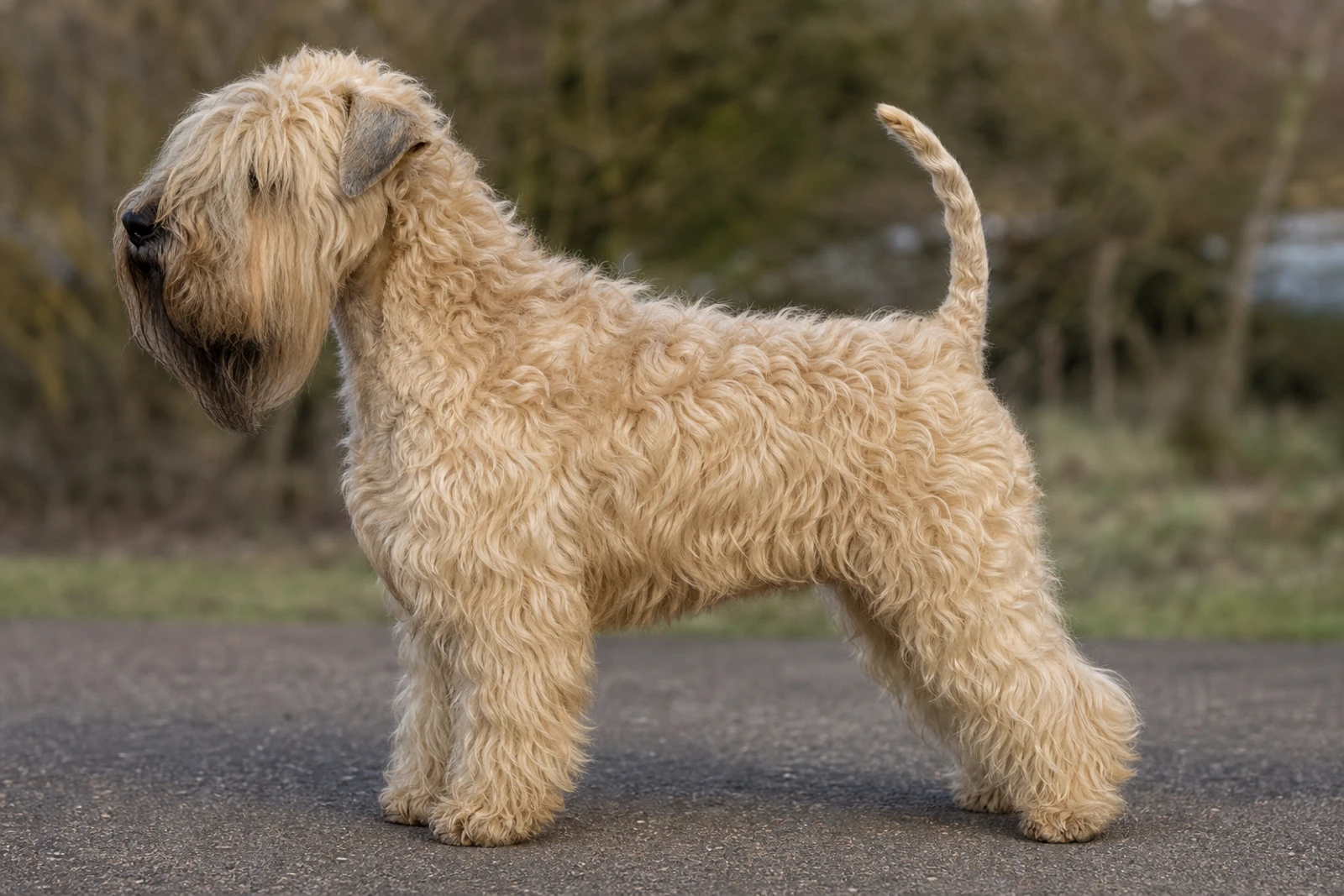
The Soft Coated Wheaten Terrier is a spirited, friendly medium-sized dog from Ireland, known for its silky wheaten coat and affectionate nature. They make excellent family companions for active households, as they are playful, good with children, and generally sociable with other pets. Their hypoallergenic coat requires regular grooming but sheds minimally. Wheatens are intelligent and eager to please, though they can be stubborn, needing consistent training. They adapt well to various living situations if given daily exercise. This breed suits owners seeking a loving, fun-loving terrier with a soft touch.
At a glance
- Size
- Medium
- Height
- 18–19 in
- Weight
- 35–46 lb
- Coat colors
- Wheaten
- Coat type
- Soft, silky, single coat
How much does a Wheaten Terrier cost?
Adopt / rescue
$75–$400
Usually includes spay/neuter, first shots, and a microchip.
Buy from a breeder
$700–$2,000
From a reputable, health-testing breeder.
Approximate USD. Prices vary widely by region, breeder, pedigree, age, and coat colour — adopting is the lower-cost and recommended route. Avoid suspiciously cheap “breeders”; they’re often puppy mills.
Estimate the full cost of a Wheaten Terrier →Want the ongoing number? Estimate the monthly food bill for a Wheaten Terrier with our dog food cost calculator.
Wheaten Terrier photos
Views
Front, side, rear and top — the full silhouette.Poses
How the breed sits, lies, moves and plays.Puppy to senior
The breed across its whole life.Expressions
The breed’s range of moods.Close-up details
Eyes, ears, nose, paws, tail and coat.Coat colors
The breed’s recognized colors.Click any photo to enlarge. We show the Wheaten Terrier from every angle — three views, poses, life stages, expressions, close-ups, coat and colors.
Appearance & size
The first thing you’ll notice is that shaggy, wheaten coat laying in loose waves or soft curls — it’s the hallmark of the breed and the source of his name. But don’t mistake him for a fluffy lap dog. Under all that hair is a squarely built, medium-sized terrier with real bone and substance. Males and females stand 18 to 19 inches at the shoulder and run between 35 and 46 pounds, compact enough to curl up next to you but sturdy enough to hike all day.
That coat is unique among terriers: a single, silky layer with no harsh outer guard hairs and no insulating undercoat. The texture feels soft to the touch, almost like human hair, and it drapes in long, flowing waves rather than tight ringlets. Puppies are born with a dark brown or black coat that gradually lightens — by age two, it should clear to any shade of wheaten, from a pale beige to a rich, warm gold. You’ll often see darker tips on the ears or muzzle, and a small white spot on the chest is allowed, but the overall impression is a solid, gleaming wheaten glow.
From the front, the Wheaten looks alert and mischievous, thanks to a head framed by that trademark fall of hair over the eyes. Dark, medium-sized, almond-shaped eyes give a keen, intelligent expression. Ears are small, breaking forward at or just above skull level, and carried slightly erect at the base with the tips dropping down — never hound-like or heavy. A strong muzzle, clean scissors bite, and a distinct beard and mustache balance the face.
The body is where you see the working terrier. Viewed from the side, the topline runs level from the withers to a tail set moderately high and carried with a gay, upright curve (docked to roughly two-thirds its natural length where legal, otherwise a natural tail that often reaches the hock). The neck is strong and smoothly set into well-laid-back shoulders. A deep chest reaches to the elbows, giving plenty of heart and lung room, and the tuck-up is moderate, not whippety. From the rear, you’ll see a muscular, well-developed thigh and a nicely bent stifle, with hocks set low and parallel — all of which translates into a ground-covering, effortless trot. Move with him and you’ll see a free, smooth gait that covers lots of ground without wasted bounce, the head and tail carriage bold and businesslike.
History & origin
The Wheaten Terrier started out in Ireland as the poor farmer’s answer to having one dog that could do it all. Where a wealthier landowner might keep a pack of hounds, a farmer in counties Cork or Kerry needed a single tough dog that would put food on the table, protect the property, and rid the barns of vermin—without costing much to feed. That’s where these soft-coated, wheaten-colored terriers proved their worth.
They earned the nickname “Poor Man’s Wolfhound” because they were used for everything from hunting badgers and otters to herding sheep and guarding the homestead. Their medium build—solid muscle on an 18–19 inch frame weighing 35 to 46 pounds—meant they were big enough to face a cornered badger yet small enough to go to ground after rats. For generations, Irish tenant farmers bred for the pale, wheat-toned coat that let them tell their own dog apart from the darker Kerry Blue Terriers and Irish Terriers working nearby farms. The coat wasn't for show; it was a practical, water‑resistant jacket on a dog that worked in all weather.
For a long time, the Wheaten was kept strictly within Ireland and rarely seen outside the countryside. Breed enthusiasts didn’t push to formalize it until the 1930s, and by then the traditional farm terrier was fading as small holdings declined. The Irish Kennel Club recognized the breed in 1937 under the name “Soft-Coated Wheaten Terrier.” A few determined breeders scoured the farms to gather the remaining stock and standardize the type. Just a handful of Wheatens reached the United States in the 1940s, but serious breeding didn’t pick up until the 1950s. The American Kennel Club granted full recognition in 1973, placing the breed in the Terrier Group.
What separates the Wheaten from its scrappier terrier cousins is that it was never narrowed to a single‑purpose killer. While other terrier breeds were refined for pit fighting or intense ratting, the Wheaten remained a generalist. That history left a dog with an even‑keeled temperament and a tendency to greet strangers with a bounce rather than a snarl—a direct inheritance from generations of living and working side by side with the family on the farm. You still see that farm‑dog versatility today, even if the modern Wheaten’s job is mostly to keep your feet warm.
Temperament & personality
A Wheaten Terrier’s personality boils down to this: you’re getting an enthusiastic, people-obsessed shadow who believes life is a group project. Expect a 35–46-pound dog that routinely forgets it’s not an actual lap dog, wiggling its way onto the couch the second you sit down. The breed’s farm-dog roots show up as a restless curiosity — they want to be in the middle of everything, and isolation is the fastest way to trigger anxiety-driven barking or destructive chewing.
Energy-wise, a Wheaten isn’t wired like a border collie, but still needs a solid 45–60 minutes of active movement daily. A quick walk around the block won’t cut it. They live for off-leash romps, tug games, and any excuse to dash after a squirrel. After exercise, though, they tend to crash hard and cuddle.
Training a Wheaten requires a thick skin and a light hand. These dogs are smart and strong-willed. You’ll get nowhere using force; a respectful, consistent approach with food rewards and short, varied sessions works far better. Without that, you’ll likely see the famous “Wheaten greetin’” morph into a full-body launch on every guest. Teach an alternative like a sit early, or you’ll have airborne terriers.
Around the house, most are gentle and patient with kids when raised together, but the terrier tenacity means you must teach children to leave the dog alone during meals. Food guarding can surface, and the rule “never bother a dog while it’s eating” is non-negotiable. Body language gives clear warnings — a stiff posture and hard stare says “back off,” while the soft eyes and loose, wiggly stance mean the dog is calm and ready to play. Watch for lip licking and head turns; those are stress signals that tell you the dog needs a break.
Because Wheatens attach hard to their people, they don’t do well in homes where everyone is gone 10 hours a day. If you spot your dog rolling in something disgusting on a walk, just know it’s likely following an ancient scavenger impulse or maybe just enjoying the stink. There’s no deep message — just a very pleased terrier.
Good with kids, dogs & other pets
With kids
A well-bred Wheaten is practically designed for family life — patient, playful, and rarely quick to snap. Those 35 to 46 pounds come with a bouncy, exuberant streak, though. A dog who greets your six-year-old with a full-body wiggle can easily knock over a toddler who’s still unsteady on their feet. Teach your kids to keep their faces out of the dog’s space during excited moments, and never let small children tug ears, tail, or fur. The terrier’s famously soft mouth doesn’t mean they’ll tolerate rough handling indefinitely.
Supervise play sessions, especially during the puppy landshark phase when nipping is normal but needs redirection. Families with slightly older kids who can read dog body language will get the most out of this breed’s affectionate, goofy personality.
With other dogs
Most Wheatens are naturally sociable and won’t be the instigator at the dog park. That calm reputation doesn’t replace early socialization, however. Puppies need repeated, upbeat introductions to friendly adult dogs before the 14-week window closes. Miss that, and you risk raising a dog who reacts with uncertainty or shrill barking around unfamiliar canines.
If you adopt an adult Wheaten who’s comfortable only with his own household, don’t force new dog friendships. Forced meet-and-greets can backfire into stress or scuffles. Gradual desensitization and positive reinforcement can still improve things, but some Wheatens simply prefer their own pack and are fine with that.
With cats & small pets
A Wheaten’s farm heritage as an all-purpose ratter means a fleeing cat, rabbit, or guinea pig can trigger a hardwired chase response. Raise a puppy alongside a confident, dog-savvy cat, and coexistence usually clicks — especially if the cat stands its ground. Separate them during your dog’s high-arousal zoomie hours, and never leave them alone together until you’ve seen months of calm, ignore-each-other behavior.
Small caged animals like hamsters or ferrets need a secure, off-limits room. A terrier’s prey drive doesn’t negotiate, even with a dog who’s gentle with children. Lock cages securely and keep them out of sight when the dog is loose.
These dogs are velcro companions. They crave constant contact and don’t do well in a home where everyone’s gone for eight-plus hours. If your household is full of gentle hands, another friendly dog, and a midday walker in the picture, a Wheaten slides right into the rhythm.
Trainability & intelligence
A Wheaten Terrier’s brain works as fast as its legs, but motivation is everything. This is a breed that learns a new trick in a handful of repetitions—and gets bored just as quickly if the rewards aren't worth it. You’re not dealing with a blindly obedient dog; you’re negotiating with a clever, sometimes headstrong partner who needs a reason to cooperate. Skip the drill-sergeant approach. Force and punishment erode trust and can turn a naturally bouncy Wheaten into a shut-down, anxious dog.
What training approach actually works
- Keep sessions short and game-like. A couple of five-minute bursts scattered through the day beat a long, repetitive slog. Switch up treats, toys, and real-life rewards—a thrown ball, a belly rub, a chance to sprint down the hall.
- Positive reinforcement is non-negotiable. A Wheaten will work hard for genuine praise, a sliver of cheese, or a squeaky tug toy. Reward the behavior you want the instant it happens, and ignore or redirect the stuff you don’t. They’re sensitive souls; harsh corrections fast-track distrust.
- Consistency across the household. If “down” means “lie on the floor” to you, it has to mean the same thing to your partner and kids. Mixed signals create a dog who tunes you out, and a Wheaten’s independent streak can amplify that into selective hearing.
Early socialization sets the stage
Wheatens have a terrier’s alertness, and without careful introductions, natural wariness can slide into reactive barking or skittishness. Start before 16 weeks—carry your puppy to busy parking lots, invite friends over in controlled doses, walk on wobbly surfaces, and offer treats every time something new shows up. Keep the experiences positive and never flood them. Ongoing exposure through adolescence and adulthood locks in that easygoing confidence you want at café patios and on neighborhood walks.
Recall and the independent streak
Off-leash reliability is the big challenge. A Wheaten’s prey drive and curiosity aren’t malicious, but they’re strong. Training a solid recall means building a bank of trust and using ultra-high-value rewards (think real meat, not kibble) in low-distraction environments first. Gradually add distance and distractions while keeping the reward history rich. If you punish a slow come or a short-lived sprint toward a squirrel, you teach the dog that returning might end the fun—and that’s a lesson you’ll spend months un-teaching. Pair a calm, consistent recall practice with a solid hour of exercise, and you’ll have a much more focused partner.
Exercise & energy needs
A Soft-Coated Wheaten Terrier is a farm dog at heart, not a couch potato with a pretty coat. Plan on giving this 35-to-46-pound athlete a solid 60 minutes of daily exercise, broken into at least two sessions. A quick lap around the block won’t cut it. These dogs carry real stamina from their all-purpose farm roots — herding, ratting, guarding — and they need to burn that energy off or they’ll find their own outlets, like redecorating your baseboards or barking at every squirrel within a mile.
A good rhythm for most adults is 30 to 45 minutes in the morning and another 20 to 30 minutes later in the day. Mix up the intensity. A brisk walk or hike on uneven trails uses both body and brain; off-leash running in a secure area, a long game of fetch, or a wrestling session with a canine buddy all hit the spot. Wheatens are also naturals at dog sports. Agility, rally, flyball, and even barn hunt let them tap into their quick, clever terrier wiring while wearing out those spring-loaded legs. Because they’re medium-sized and generally sound, you don’t need to guard against impact the way you would with a tiny or brachycephalic breed, but be sensible with puppies. Hold off on repetitive high jumps and forced running on hard surfaces until growth plates close.
Physical exercise is only half the equation. A Wheaten’s mind needs to work, too. Spread 10- to 15-minute mental challenges throughout the day: scatter kibble in a snuffle mat, freeze meals in a puzzle toy, or play hide-and-seek with a favorite tug. Training sessions that teach new tricks or reinforce impulse control (think “stay” during a doorbell knock) are doubly valuable — they burn mental energy and take the bounce out of the infamous “Wheaten greetin’.” Without that daily blend of physical and mental outlets, the breed’s effervescent spirit can curdle into restlessness, nuisance digging, or reactive barking. Keep the sessions coming, keep them varied, and you’ll have a happy, tired dog who settles into the house instead of bouncing off the walls.
Grooming & coat care
The Wheaten Terrier’s soft, silky single coat is one of the breed’s defining features — and the single biggest day-to-day commitment. Unlike double-coated dogs that drop a seasonal blizzard of fur, a Wheaten sheds very little. Instead, that wavy hair grows continuously and tangles into tight mats against the skin, especially behind the ears, under the legs, and along the belly. Plan on brushing every day or at the absolute minimum every other day with a metal slicker brush that has rounded pins, followed by a greyhound-style metal comb to find any hidden knots. Skipping even a couple of days can turn a small tangle into a painful mat that needs to be cut out.
Bathing happens roughly every 4 to 6 weeks, or more often if your dog romps through mud — the single coat picks up dirt, and a dirty coat mats faster. Always fully brush out the coat before a bath, because water tightens any existing tangles into solid felt. After a bath, towel dry and then blow-dry while brushing to keep the hair from clumping as it dries.
The coat itself has a distinct life stage. Puppies start with a dark, soft, fluffy coat that gradually lightens to the adult wheaten color between 1.5 and 2.5 years. During this transition, the texture changes and matting can spike, so you’ll need to be extra vigilant.
A Wheaten in a full-length show coat requires professional grooming every 4 to 6 weeks to scissor the fall over the eyes, shape the furnishings, and trim the feet and sanitary areas. Most pet owners opt for a practical “puppy cut” or “sporting trim” that keeps the body hair an inch or two long all over, which cuts brushing time dramatically and makes the dog more comfortable between baths. Even with a shorter trim, you’ll still need to brush several times a week.
Beyond the coat, ears need weekly attention. The soft, dropped ears trap moisture and easily develop yeast infections if you don’t clean them with a vet-approved ear cleaner and keep the inner hair plucked or trimmed for airflow. Nails grow fast on these active dogs; grind or clip them every 2 to 3 weeks — if you can hear them clicking on the floor, they’re overdue. Teeth benefit from daily brushing, but aim for at least three times a week to head off the periodontal disease that’s common in medium breeds.
Seasonally, Wheatens don’t undergo a dramatic shedding cycle, so you won’t find clumps of hair all over the couch. They do, however, suffer from winter dryness that can make the coat brittle and static-prone, and summer humidity that encourages tangles. A light spritz of conditioning spray before brushing helps year-round. Because the coat has no insulating undercoat, a wet or clipped Wheaten will feel the cold quickly, so a waterproof jacket in winter isn’t just a fashion statement — it keeps grooming sessions sane when you come in from a wet, muddy walk.
Shedding & allergies
You’ll find surprisingly little hair on your couch. The Soft Coated Wheaten Terrier has a single coat with no underlayer, so he sheds very minimally—often less than many so-called low-shed breeds. There’s no seasonal blowout because there’s no dense undercoat to dump. Instead, dead hair stays trapped in the soft, wavy coat, which means it doesn’t end up on your clothes or floor, but it does create a grooming chore.
Left alone, that trapped hair quickly tangles into tight mats that pull painfully at the skin. You’ll need to line-brush down to the skin at least three times a week and schedule a professional trim every six to eight weeks to keep the coat healthy and comfortable.
The low-shed nature means less airborne dander, so many allergy sufferers find Wheatens easier to live with. However, no dog is truly hypoallergenic. Allergens still hide in saliva and skin glands; while a Wheaten might not trigger your allergies, a neighbor’s might. Visit the breeder and spend time around adult dogs before you commit if allergies are a deciding factor.
Drool is virtually zero—you won’t be scrubbing slobber off walls or furniture. The real trade-off: you swap heavy vacuuming for a steady brushing routine that keeps both of you happier.
Diet & nutrition
A Soft-Coated Wheaten Terrier rarely turns down a meal, and that happy-go-lucky attitude around food means you have to be the one who says “enough.” Extra weight sneaks on easily under that shaggy coat, and even a few extra pounds can stress joints on a dog bred to bounce and pivot all day. Keep your adult Wheaten lean—you should be able to feel ribs with only a light fat cover, and a tuck at the waist should be visible when you’re looking from above.
Plan on feeding an adult in the 35–46 lb range about 1½ to 2½ cups of high-quality dry food daily, split into two meals. The exact amount depends on age, build, and how much real exercise he gets—an off-leash hour of running burns more fuel than a couple of leash walks. Use the bag’s chart as a starting point, then adjust based on body condition every couple of weeks. If you home-prepare meals, aim for roughly 60% animal protein (lean meat, fish, eggs), 20–30% vegetables and fruit, and the rest from digestible grains like pearl barley or white rice, plus a little plain yogurt. Puréeing ingredients can help a dog’s limited digestive enzymes pull more nutrients out.
Puppies need more frequent feedings: four evenly spaced meals until about four months old, then three meals until six months, then switch to the adult two-meal routine. Transition any new food gradually over a week, starting with lightly cooked and puréed proteins and vegetables, or a high-quality commercial puppy formula. You can introduce raw meaty bones like chicken wings around twelve weeks, always under your direct eyes.
Wheatens aren’t typically prone to food allergies, but a few individuals do better on a single-protein recipe. If your dog scratches excessively or gets recurrent ear trouble, talk with your vet about an elimination diet trial.
- Snag the extras before he does. Rich, fatty table scraps—especially post-holiday trimmings—can trigger a dangerous bout of pancreatitis in this breed. Even “healthy” leftovers belong in his own bowl, not from the counter or your plate, to avoid teaching begging.
- Slow down a speed-eater. If your Wheaten inhales his food, a puzzle bowl or scatter-feeding on the lawn makes him work for it and adds mental engagement.
- Senior adjustments. As the years stack up and activity drops, older Wheatens still greet the food bowl with enthusiasm, so you’ll need to gradually dial back portions to hold a healthy weight. Switching to three smaller meals can be easier on an aging digestive system. There’s no evidence that cutting protein helps healthy seniors; just keep an eye on the scale and the rib check.
Health & lifespan
A healthy Wheaten Terrier typically enjoys a lifespan of 12 to 14 years, and it’s not unusual to see them hit 15. That longevity, though, leans heavily on the genetic hand they’re dealt and how early you catch trouble.
Wheatens carry a few inherited vulnerabilities that a responsible breeder screens for aggressively. The big one is a pair of protein-wasting diseases: protein-losing enteropathy (PLE) and protein-losing nephropathy (PLN). In simple terms, the dog loses vital proteins through the gut or kidneys, leading to fluid build-up, weight loss, and often a crisis that shows up in middle age. They share a genetic link, and a DNA test exists for the marker associated with PLN. Any breeder you consider should test for it and openly share results.
- Renal dysplasia – malformed kidneys that can fail early in life – is another concern. Affected pups may drink and pee excessively. Reputable breeders track pedigrees to avoid doubling up on it.
- Addison’s disease is sneaky. The adrenal glands quit producing enough cortisol, causing vague symptoms like intermittent vomiting, lethargy, and poor appetite. It can mimic a stubborn stomach bug until a stress event triggers a full-blown crash. An observant vet and routine bloodwork catch it, and once diagnosed, it’s manageable with daily medication.
- Skin and ear issues are practically a breed signature, not a rarity. Atopic dermatitis, food sensitivities, and yeast overgrowths flare up if allergens or diet aren’t managed. Expect to experiment with high-quality food and stay on top of grooming to keep the coat dry and skin calm.
Hip dysplasia is less common than in larger breeds but still appears. OFA hip evaluations and annual CERF eye exams for conditions like progressive retinal atrophy (PRA) are standard in health-tested litters.
Weight management matters a lot here. A Wheaten should stay lean – that 35 to 46 lb frame carries more joint stress with every extra pound. Combine a measured diet with real exercise, and you put a dent in skin problems and orthopedic wear-and-tear.
Routine care isn’t glamorous but it’s non-negotiable. Monthly heartworm prevention during mosquito season (and one month after) keeps a silent killer at bay, and rabies vaccination is legally required, with no treatment once symptoms appear. Catch subtle shifts – a drop in activity, picky eating that drags on – and get a vet involved early, especially as the dog ages past seven or eight.
A Wheaten who comes from lines screened for PLN, PRA, and hip health, and who stays at a working weight, stacks the deck hard in favor of those 14 good years.
Living environment
Apartment vs. House
A Wheaten adapts surprisingly well to an apartment — if you’re serious about daily exercise. These aren’t sofa-pillow dogs; they need to burn off that terrier energy. Two 30-minute brisk walks, or a single hour-long off-leash romp where they can really run, is non-negotiable. Skip it, and you’ll get a restless 35–46-pound dog inventing its own jobs, like un-stuffing couch cushions. A house with a secure fenced yard makes life easier, giving them room for spontaneous zoomies, but the walk and the mental work still have to happen.
Yard Needs
A fenced yard is a bonus, not a substitute. Plant it with digging in mind — Wheatens can excavate a flowerbed in minutes if bored. The fence should be at least 5–6 feet tall and sunk into the ground or reinforced at the base; a terrier’s prey drive can send them after a squirrel right under a gap. Supervise first, trust later.
Climate Tolerance
Their single, silky coat doesn’t pack an insulating underlayer, so they thrive in moderate weather. In summer, once temperatures push past 80°F, shift walks to early morning or evening and carry water. On freezing winter days, a clipped Wheaten benefits from a coat; a full-length coat offers some protection but won’t handle a blizzard. Hot pavement also burns their pads — check with your hand first.
Noise and Barking
You’ll get an enthusiastic, cheerful bark when someone approaches the door — they’re natural watchdogs, not silent partners. Beyond that, a well-exercised Wheaten isn’t a nuisance barker. If they start alarm-barking at every leaf, it’s usually a sign they need more physical or mental outlets. Train a “quiet” cue early and reward calm behavior.
Alone Time
This is the sticking point. Wheatens glue themselves to their humans and can unravel if left alone too long — they’re prone to separation anxiety. Four hours solo is about the ceiling; push past that regularly and you may come home to chewed baseboards or howled complaints. Apartments work best when someone is home for large chunks of the day or a dog-walker swings by midday. Start alone-time training from puppyhood: leave for short, calm absences, provide a frozen Kong or scent puzzle, and never make arrivals and departures a big drama. They do best in households where people don’t vanish from 9 to 5.
Who this breed suits
If you can match a dog’s friendly, joyful energy and you don’t mind a little terrier stubbornness, a Wheaten often slides into your life like they’ve always been there. They thrive with people who see them as a true companion, not just a yard ornament.
- Active families get a spirited playmate who can keep up with kids over four or five (smaller children might get bowled over by that bouncy “Wheaten greetin’” hop). A 35–46 lb dog with a sturdy build handles hours of backyard zoomies, then crashes on the couch with zero dignity. Expect a solid hour of daily exercise — walks, fetch, or a good run in a fenced area.
- First-time dog owners can do well here, provided they’re willing to sign up for a training class and stay consistent. Wheatens are smart but bore easily; short, upbeat sessions work better than drilling. They’re not a “set it and forget it” breed.
- Singles and couples who want a medium-sized, people-focused dog find a shadow. A Wheaten wants to be where you are — working from home, hiking on weekends, or just supervising your coffee. They don’t do well stuck in a crate for eight hours.
- Seniors with an active routine can be a fine match if the grooming and exercise needs feel manageable. The breed’s 18–19 inch height and manageable weight mean they won’t drag you down the street, but that initial burst of energy on a leash still needs some training.
Who should think twice? Anyone who believes the “hypoallergenic, non-shedding” label means low-maintenance. That soft, silky coat matts if you skip brushing for a few days, and a full groom every 6–8 weeks isn’t optional. If you want a dog who ignores squirrels or the neighbor’s cat, a Wheaten’s terrier instincts will frustrate you. They’re also not a good fit for a quiet, orderly household that expects a dog to stay off the furniture — a Wheaten’s life mission is to be on the couch, preferably touching you. Skip the breed if you can’t commit to early and ongoing socialization; an under-socialized Wheaten can become excessively barky or leash-reactive.
Cost of ownership
The sticker price for a well-bred Wheaten Terrier from a responsible breeder typically lands between $1,800 and $3,500. Puppies with champion bloodlines or from breeders who do extensive health testing (hips, eyes, and DNA panels for PLN and degenerative myelopathy) often push toward the higher end. A lower price tag usually means cutting corners on those screenings, so that "deal" can cost you down the road.
Once the puppy's home, your biggest routine expense hits every 6–8 weeks: professional grooming. That soft, silky coat matts easily and needs a full clip, scissor work, and tidy-up that runs $80–$120 per session with a good groomer. You'll also need to brush at home several times a week with a pin brush and metal comb, and invest in quality detangling spray and shampoo—small costs that add up.
Monthly food costs for a 35–46 lb dog eating high-quality kibble come to about $40–$70, depending on brand and activity level. Factor in training treats and the occasional bully stick.
Veterinary care deserves a hard look because Wheatens have a known risk for protein-losing enteropathy (PLE) and protein-losing nephropathy (PLN) , plus Addison's disease and hip dysplasia. Routine annual wellness exams, vaccines, and heartworm/flea prevention run $400–$700 a year for a healthy adult. That's before any diagnostic work if something goes sideways. Pet health insurance typically costs $45–$75 per month for a Wheaten—policies that exclude pre-existing conditions won't help with hereditary issues, so enroll early.
All in, expect to spend roughly $200–$350 a month on the essentials, not counting emergency vet bills or that first-year gear (crate, bed, leash, bowls). A separate savings account with a couple thousand bucks stashed for a surprise PLE scare or orthopedic surgery is the smartest thing you can do.
Choosing a Wheaten Terrier
You can bring a Soft Coated Wheaten Terrier home from a responsible breeder or through rescue—both are solid paths, but they ask for different homework.
Health clearances to demand
Wheatens can be prone to a few serious inherited conditions, and a breeder who waves them off isn’t someone you want to hand money to. Ask for written proof that both parents have been screened through the Orthopedic Foundation for Animals (OFA) or a comparable registry. The non-negotiables:
- Hips: OFA hip evaluation (fair or better; borderline is a red flag).
- Eyes: Annual CERF or OFA eye exam by a veterinary ophthalmologist, current within the last year.
- Kidneys and gut: This is the big one. Wheatens carry risk for protein-losing nephropathy (PLN) and protein-losing enteropathy (PLE). There’s no single DNA test that clears a dog; responsible breeders use a combination of pedigree research, renal dysplasia DNA testing, and regular urine protein:creatinine ratio (UPC) screening on breeding stock. Ask to see those UPC results—a normal result is under 0.5. A breeder who doesn’t know what UPC is or says “my lines don’t have that” without paperwork is a hard pass.
Red flags that send you walking
- Pups always available, no waitlist. Good breeders breed sparingly.
- Won’t let you meet at least one parent on-site (ideally the dam). You want to see the adult dog’s temperament firsthand.
- Offers the puppy before 8 weeks. Wheatens need that time with their littermates to learn bite inhibition—this is a mouthy breed.
- Pressure to “put a deposit down today.” A real breeder interviews you as much as you interview them.
Puppy or rescue: what to look for
With a puppy, watch the litter for 15–20 minutes. A Wheaten should be curious and people-oriented, not shrinking in a corner or bullying littermates. That middle-of-the-road pup who trots over, sniffs your hand, and then pounces a toy is often the steadiest choice. Avoid the over-the-top greeter who can’t settle—34 pounds of unbridled enthusiasm is a lot to channel in a city apartment.
Wheaten rescues are out there, often from families who underestimated the grooming or the adolescent energy surge (it’s real, around 8–18 months). When adopting, ask about any known health history and whether the dog has shown resource guarding or leash reactivity. Even a rescue with an unknown background can be a gem if you’re honest about your experience level and what the foster home has observed.
Whether you go breeder or rescue, factor in the grooming commitment before you commit. A Wheaten’s silky coat mats if you blink, and the 18–19 inch, 35–46 pound frame is deceptively strong. You’re not just choosing a puppy—you’re choosing a full-time member of the family who needs daily handling from day one so grooming doesn’t become a wrestling match.
Pros & cons
Pros
- A full-throttle, people-loving terrier that stays puppy-playful for years—ideal for families who want a 35–46 lb shadow with a constant grin.
- That soft, low-shedding coat is a genuine plus for tidy homes and mild allergy sufferers, though it’s not maintenance-free.
- Medium size (18–19 in at the shoulder) means a sturdy hiking buddy who won’t pull you off your feet, yet still fits in a mid-sized SUV.
- Quick to pick up tricks and dog sports if you keep sessions short and upbeat; they work for food, play, or a chance to bounce alongside you.
- Generally healthy, with a lifespan of 12–14 years, and the breed’s joyful, adaptable nature makes them a favorite for active owners who include the dog in daily life.
Cons
- That signature silky coat is a full-time job: expect daily brushing and a professional clip every 6–8 weeks to stop painful matting behind the ears, legs, and belly.
- High exercise needs aren’t optional—an hour of hard running, flirt-pole sessions, or off-leash sprints, not just a leashed walk around the block.
- Stubborn streaks run deep. Training demands patience, consistency, and positive methods; corrections quickly sour the relationship and teach them nothing.
- Jumping up and mouthing are hardwired enthusiasm, not aggression, but a 40-lb dog launching at guests is a liability you’ll need to manage daily.
- Strong prey drive can turn a squirrel sighting into a full-blown chase, so a securely fenced yard and a long-line are non-negotiable for off-leash outings.
- Watchdog barking at every delivery truck or neighbor can spiral into a noise problem without early, consistent “quiet” work.
- The breed carries a heavy genetic load: responsible breeders screen for protein-losing enteropathy, renal dysplasia, and hip dysplasia, but you’re still buying a living creature whose health can shift despite your best vet care.
- The infamous “Wheaten greetin’”—a leaping, face-seeking welcome—might charm you but will terrify a toddler or topple an elderly relative if not curbed early.
Similar breeds & alternatives
If the Wheaten’s soft coat and easy grin have you interested but you’re still weighing other paths, a few breeds share some of that package — and split off in ways worth a hard look.
-
Kerry Blue Terrier (18–19.5 inches, 33–40 pounds): The Wheaten’s closest Irish cousin. Same non-shedding, soft-coat grooming grind — both mat to the skin if you skip a brush. The Kerry brings a steel-blue coat, a more intense watchdog streak, and a higher probability of same-sex dog aggression. Early socialization isn’t optional here. You trade some of the Wheaten’s goofy bounce for a sharper, more calculating terrier mind.
-
Irish Terrier (18–20 inches, 25–27 pounds): Less dog — literally. This wiry, red-coated breed weighs 10–20 pounds less than a Wheaten and sheds very little, but the coat needs hand-stripping if you want to keep that tight, weather-resistant jacket. Personality-wise, the Irish Terrier is all reckless courage. They’re quicker to escalate a scuffle and far less likely to let a slight roll off their back. A solid family dog, but one for someone who genuinely enjoys a terrier’s fire — not just the coat.
-
Lagotto Romagnolo (16–19 inches, 24–35 pounds): An Italian truffle hunter with a dense, curly coat that doesn’t shed but demands clipping every 6–8 weeks. Smaller and lighter-boned than a Wheaten, the Lagotto is biddable, comical, and built for nose work. You lose the terrier stubbornness and prey-drive edge, but you gain a dog that doubles as a living vacuum for scattered food. They can be reserved with strangers and need early confidence-building — not identical to terrier sass, but still a real factor.
-
Portuguese Water Dog (17–23 inches, 35–60 pounds): If you want that no-shed, wavy-or-curly coat but need a bigger, more athletic partner, look here. A Portie can push 60 pounds and needs a serious outlet — an hour of hard exercise plus a job, whether that’s retrieving, dock diving, or chasing waves. They’re generally more trainable and less scrappy than a Wheaten, but the energy bill is steeper. No terrier DNA means a much lower chance of same-sex posturing around other dogs.
Fun facts
- Originated in Ireland as all-purpose farm dogs.
- Their coat color can range from pale beige to gold.
- Puppies are born with a dark coat that lightens to wheaten by age two.
- They are known for their 'Wheaten greetin'' - jumping up to greet people.
Frequently asked questions
- Do Wheaten Terriers shed a lot?
- Wheaten Terriers are known as a low-shedding breed, thanks to their single-layered, silky coat. While no dog is completely hypoallergenic, they tend to produce less dander and loose hair than many other breeds. Regular grooming helps minimize any stray hairs around the home.
- Are Wheaten Terriers good with children?
- Wheaten Terriers generally have an affectionate and playful nature that makes them well-suited for families with children. They tend to be patient and enjoy joining in games, but as with any breed, early socialization and supervision are important. Their medium size and sturdy build mean they can handle gentle play without being overly delicate.
- How much exercise does a Wheaten Terrier need?
- Wheaten Terriers have moderate energy levels and thrive with about 30 to 60 minutes of daily exercise. This can include brisk walks, play sessions, or off-leash running in a secure area. Without enough physical and mental stimulation, they may become restless or develop unwanted behaviors.
- Are Wheaten Terriers suitable for apartment living?
- Wheaten Terriers can adapt to apartment life if their exercise needs are consistently met and they receive plenty of attention. They are not typically excessive barkers, but some individuals may be alert to noises, so early training helps. Their medium size and moderate activity level make them a viable choice for apartments with nearby parks.
- Is a Wheaten Terrier a good choice for first-time dog owners?
- Wheaten Terriers can be a good fit for first-time owners who are committed to positive, consistent training. They are intelligent and eager to please, but may also show a stubborn streak and benefit from early socialization. Their grooming needs are higher than some breeds, so new owners should be ready for regular brushing and professional clipping.
Tools & calculators for Wheaten Terrier owners
Quick estimates tailored to Wheaten Terriers — pre-filled with this breed’s size where it matters.
Articles & stories about the Wheaten Terrier
Sources & standards
This profile follows recognized breed standards from the American Kennel Club (AKC) and the Fédération Cynologique Internationale (FCI), along with established veterinary and breed-club guidance. These describe general breed tendencies — every dog is an individual.