

Quick answer: “Low-maintenance” should mean lower day-to-day friction across more than one signal—not simply an easy coat. This guide screens for kid-friendly, apartment-friendly, and first-time-owner-friendly profiles with lower or manageable energy, grooming, and barking scores. It is not a medical-cost forecast or a promise that any individual dog will be easy.

Choosing & ComparingBy Best Family Dog Breeds Editorial Team
Best Low-Maintenance Dog Breeds for Kids: Easy Does Not Mean Effortless
A practical, whole-profile comparison of low-maintenance dog breeds for kids: coat work, energy, barking, size, and the trade-offs that remain.
Family decision guide
Need a family dog with a more manageable routine?
Best for: Households comparing grooming, exercise, training friction, and realistic daily workload.
Watch out: Low maintenance never means no maintenance; health, training, and companionship still matter.
This page answers the narrower question best low maintenance dog breeds for kids and families. For the full shortlist across sizes and lifestyles, start with our best dog breeds for families guide, or use the Family Dog Fit Matrix.
How this guide fits the topic
This guide adds the child-and-family constraint. For the broad low-maintenance comparison, start with the collection below.
Low Maintenance Dogs →What this guide counts as low-maintenance
For a family, an easy-care coat does not cancel a high need for activity, noise management, training, or space. That is why a breed with a simple coat but energy 4/5 and barking 4/5 does not belong in this particular list. The profiles below are selected for a more balanced daily picture:
- grooming, energy, and barking are all 3/5 or lower;
- our breed data marks them good with kids, apartment-friendly, and first-time-owner-friendly;
- each still has an honest trade-off, because no family dog is maintenance-free.
Seven lower-friction family profiles
| Breed | Profile facts | Why it qualifies | The trade-off to plan for |
|---|---|---|---|
| French Bulldog | 24–29 lb · energy 2/5 · grooming 1/5 · barking 1/5 · shedding 3/5 | Low scores for coat work, energy, and barking | Shedding remains 3/5 and training is still a family responsibility |
| Pug | 13–18 lb · energy 2/5 · grooming 2/5 · barking 2/5 · shedding 3/5 | Lower energy and barking in a small body | Shedding is moderate and trainability is 2/5 |
| Bulldog | 51–55 lb · energy 2/5 · grooming 2/5 · barking 1/5 · trainability 2/5 | A low-energy, low-barking profile | A larger, 50-plus-pound dog still needs calm handling and consistent rules |
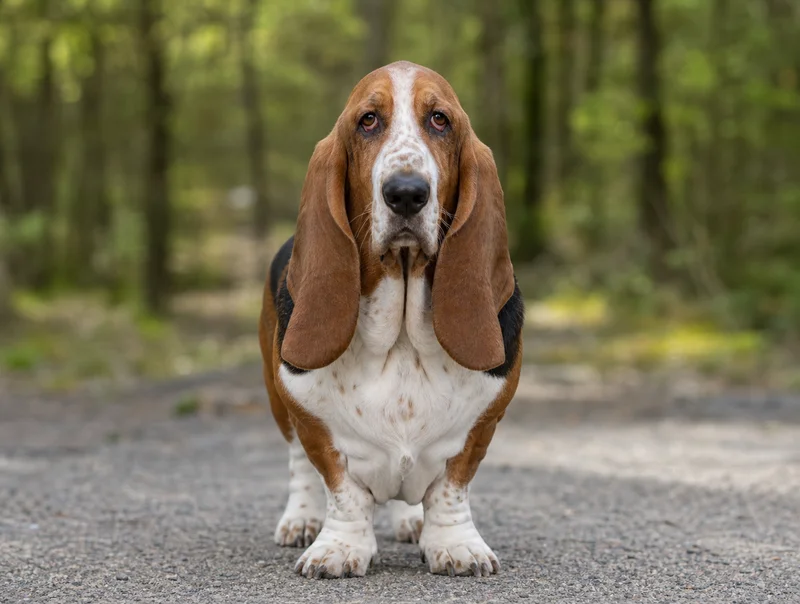
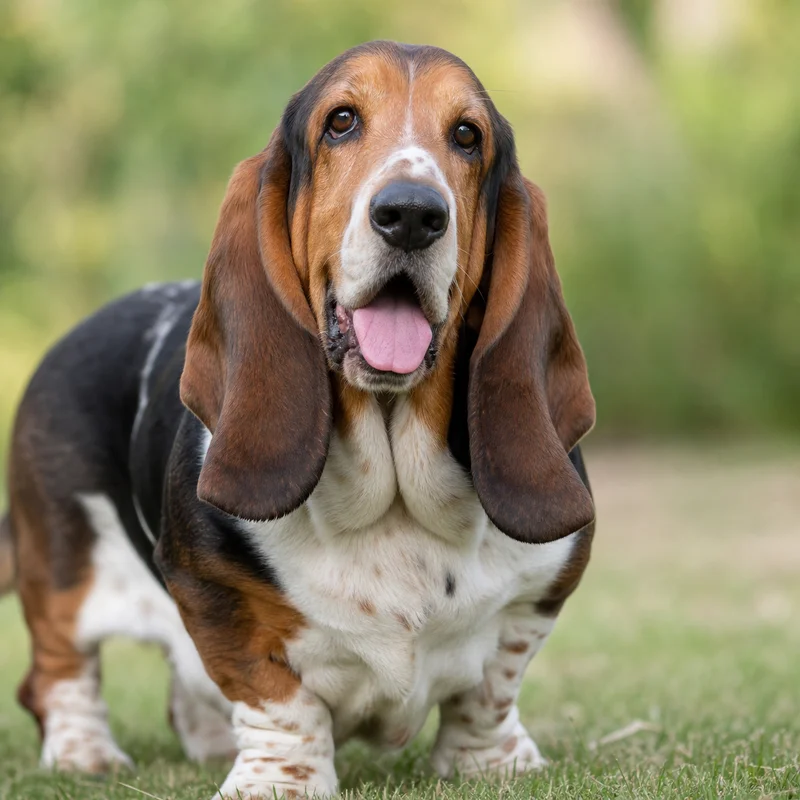
| Basset Hound | 40–60 lb · energy 2/5 · grooming 2/5 · barking 3/5 · shedding 3/5 | Lower energy with manageable grooming and noise scores | Moderate shedding, lower trainability, and a large body remain part of daily life |
| Greyhound | 60–66 lb · energy 3/5 · grooming 1/5 · barking 1/5 · shedding 2/5 | Low coat-work and barking for a family that can accommodate a large dog | Size changes space, handling, and supervision needs |
| Whippet | 24–40 lb · energy 3/5 · grooming 1/5 · barking 2/5 · shedding 2/5 | Low coat-work and lower barking in a smaller package than a Greyhound | A 3/5 energy score still calls for a regular, predictable routine |
| Cavalier King Charles Spaniel | 11–18 lb · energy 3/5 · grooming 3/5 · barking 2/5 · trainability 4/5 | Balanced scores plus a higher trainability signal | Smaller size calls for gentle child handling and the coat still needs attention |
Read the trade-offs before choosing a favorite
Low grooming is not the same as low responsibility
French Bulldog, Greyhound, and Whippet have grooming scores of 1/5, while Pug, Bulldog, and Basset Hound are 2/5. That helps families who want less coat work. It does not remove training, feeding, ordinary care, or the need to notice whether the individual dog is comfortable in the home.
Low energy is not the same as “no activity”
Pug, French Bulldog, Bulldog, and Basset Hound have energy scores of 2/5. Greyhound, Whippet, and Cavalier King Charles Spaniel are 3/5. These profiles can feel more manageable than a high-energy choice, but they still need a routine that the adults have agreed to maintain.
A good-with-kids label is not a supervision plan
Every breed here is marked good with kids in our data, but the safest household pattern is the same across the list: adults set the rules, children do not climb on or interrupt a resting or eating dog, and the dog has a calm place to step away. This is especially important with smaller dogs and during the first weeks in a new home.
A five-minute reality check for parents
Before bringing home a dog, name the answer to each question:
- Do we need the lowest coat-work score, the lower barking score, or the lower energy score most?
- Is our home ready for a 60-plus-pound dog, or do we need a smaller profile?
- Which adult will keep training and child-safety rules consistent?
- What happens when the household schedule changes unexpectedly?
- Have we met the individual dog and checked our housing rules?
The right answer is not the breed with the fewest chores on paper. It is the profile whose remaining chores fit the life you actually have. For a broader comparison, visit low-maintenance dogs or explore the best dog breeds for families before narrowing the shortlist.



Breeds mentioned in this article
 Greyhound
 Pug
Pug Whippet
Free dog tools
Useful calculators for dog owners
🍫Chocolate Toxicity CalculatorEstimate the risk from the type and amount of chocolate your dog ate, by weight.🍖Dog Food CalculatorEstimate dry-food cups, wet-food containers, or fresh-food grams from daily calorie needs and your label.💧Dog Water Intake CalculatorHow much water your dog should drink per day, by weight, activity and food type.🦴Dog Treat Calorie CalculatorUse the 10% treat rule to calculate a safe daily treat budget and food adjustment.🎂Dog Age CalculatorConvert your dog’s age to human years using the modern, size-adjusted formula.⏳Dog Lifespan CalculatorEstimate life expectancy from breed size and weight, with tips to add healthy years.
Dog Diary
More articles you might like

Health
Hypoallergenic Dog Grooming: A Practical Guide for Allergy-Aware Homes
Low-shedding dogs still need thoughtful coat care. Learn what grooming can—and cannot—do in an allergy-aware home.

Tips
Best Large Dogs for Apartments: Calm Big-Breed Options and Real Constraints
Large dogs can fit apartment life when their energy, barking, grooming, and household fit align. Compare six database profiles.

Tips
Low-Maintenance Dogs for First-Time Owners: What “Easy” Really Means
“Low maintenance” is a fit between a dog’s scorecard and your routine—not permission to ignore a dog. Compare six first-time-friendly profiles.

Tips
Big Hypoallergenic Dogs: Large Low-Shedding Breeds and Their Trade-Offs
A larger low-shedding dog can still demand grooming, activity, and thoughtful household planning. Compare six profiles before choosing one.
Find your perfect dog
Browse our in-depth breed guides:
Share