

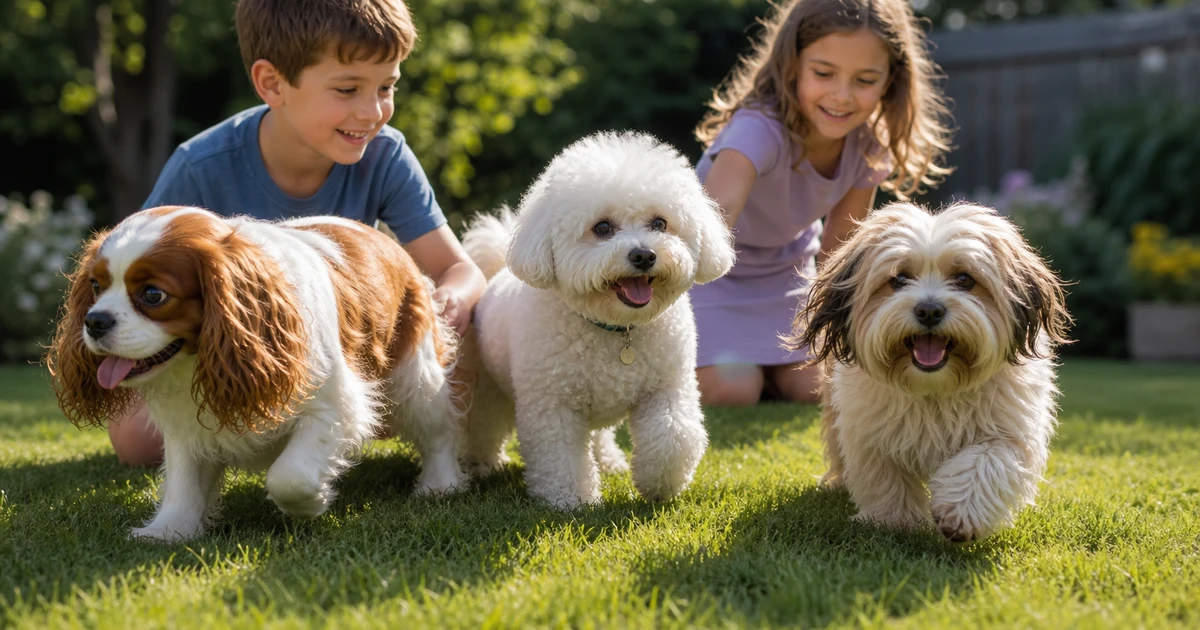
Small dogs for families are not automatically easier dogs. A five-pound companion may be simple to carry but too delicate for a toddler's impulsive hug; a sturdier 20-pound dog may cope better with bustle but need far more exercise, training, or noise management.
This is a shortlist for families who want a genuinely smaller companion without treating size as the whole decision. We compared the daily questions that change life at home: how much activity a dog needs, how much coat work it creates, how easily it learns household rules, how vocal it may be, and whether adults can supervise children and training consistently. Every dog is an individual, so meet the actual dog before deciding.
What makes a small dog work in a family home?
A useful family dog is not defined by a single friendly-looking photo or a single temperament label. The most durable match is one whose physical size, daily routine, and training needs work with the people who will actually care for it.
Sturdiness and handling
Small does not always mean child-ready. A dog at the lower end of the toy range can be hurt by falls, rough carrying, or a busy doorway. A compact but more solid dog may be easier for a family to live with, even if it weighs a little more. Adults should manage lifting, leash walking, feeding, and introductions; children can participate, but they should not be the dog's primary handlers.
Activity and noise at home
The table's energy and barking scores are useful prompts, not guarantees. A Beagle can be small enough for many homes but has 4/5 energy and 4/5 barking in our data. A Miniature Schnauzer has low shedding but the same 4/5 barking score. That can be a fine trade for an active household that enjoys training, and a poor one for a home with thin walls and no time for daily outlets.
Coat care is part of the schedule
Low shedding does not mean low work. Bichons, Havanese, and Poodles shed little, but their grooming scores are 4/5, 4/5, and 5/5. A Boston Terrier's short coat needs far less routine grooming, while a Cocker Spaniel's feathered coat requires much more. Decide who will brush, book grooming, and pay for it before the dog arrives.
Trainable does not mean self-training
The strongest first family fit is usually a dog whose learning style you can support. Poodles score 5/5 for trainability, while Cavaliers, Bichons, Havanese, Boston Terriers, and Cocker Spaniels score 4/5. Those numbers still require a calm plan: reward-based lessons, consistent rules, and adults who prevent children from practicing rough or confusing interactions.
Compare at a glance
Tap any breed name to jump to its full write-up.
| Breed | Size | Weight | Energy | Barking | Grooming | Trainable | Kids | Apartment |
|---|---|---|---|---|---|---|---|---|
| Medium | 11–18 lb | ✓ | ✓ | |||||
| Small | 11–15 lb | ✓ | ✓ | |||||
| Small | 7–13 lb | ✓ | ✓ | |||||
| Medium | 11–24 lb | ✓ | ✓ | |||||
| Medium | 20–24 lb | ✓ | — | |||||
| Medium | 13–15 lb | ✓ | ✓ | |||||
| Medium | 15–31 lb | ✓ | ✓ | |||||
| Toy, Miniature, and Standard varieties | Varies by variety | ✓ | ✓ |
The 8 best small dog breeds for families
Cavalier King Charles Spaniel
A gentle companion with a manageable size and an affectionate, people-oriented temperament.
Medium · 11–18 lb · 12 yr
At 11–18 pounds, the Cavalier King Charles Spaniel is light enough to fit a smaller home without being as tiny as the most fragile toy dogs. Its profile combines 5/5 affection, 4/5 trainability, and a low 2/5 barking score, which explains why many families notice its easygoing, people-oriented style first.
The trade-off is that this is not a wash-and-go dog. The long, slightly wavy coat sheds at 3/5 and needs 3/5 grooming, so a family should plan regular brushing rather than assume a small spaniel is effortless. Energy is a moderate 3/5: short daily walks, play, and time with people are still part of the job.
For a family that wants a gentle companion and can keep routines steady, the Cavalier is a strong starting point. It is less convincing for a home that expects the dog to tolerate rough handling or long periods without company.
Bichon Frise
Cheerful and trainable, with a low-shedding coat that trades loose hair for regular grooming.
Small · 11–15 lb · 12 yr
The Bichon Frise gives a family a small 11–15-pound dog with a cheerful temperament, 4/5 trainability, and a 5/5 affection score. It is flagged as good with kids and apartment-friendly, so it can work for households that want a compact dog involved in daily life rather than a purely decorative pet.
Its low 1/5 shedding score is often attractive, but the curly coat has a 4/5 grooming score. Loose hair stays in the coat instead of falling around the house, which means brushing and grooming appointments are part of responsible ownership. Energy is 3/5, making regular walks and play important but not extreme.
Choose a Bichon because your family can keep up with care and training, not because the fluffy look seems low effort. In return, the breed offers a lively, affectionate companion in a manageable size.
Havanese
A social small dog that can suit family life when its coat care and companionship needs are realistic.
Small · 7–13 lb · 14–16 yr
A Havanese is one of the smaller options here at 7–13 pounds, but its profile is not passive: it is outgoing, affectionate, and scores 4/5 for trainability. With 3/5 energy, it can adapt well to a family routine that includes daily walks, indoor games, and adults who enjoy involving a dog in normal home life.
The coat is the main commitment. Shedding is low at 1/5, while grooming is 4/5. Families who prefer less loose hair need to be honest about brushing, mat prevention, and regular professional care. The breed's 5/5 affection score also suggests a dog that is likely to value companionship rather than being treated as an independent background pet.
This is a sensible small-family candidate for a home that wants social interaction and can protect a very small dog from rough play. It is not the easy answer for a household that has little time for people contact or coat care.
Boston Terrier
Compact, lively, and easier to groom than many fluffy small breeds.
Medium · 11–24 lb · 13 yr
The Boston Terrier is a compact 11–24-pound dog with a short, smooth coat and the lowest grooming score in this group at 1/5. That makes it a useful contrast to the low-shedding curly coats: it sheds at 2/5, but routine coat work is straightforward. It also combines 4/5 energy and 4/5 trainability with a low 2/5 barking score.
That profile can suit a family that wants a small dog ready for daily games and walks without a heavy brushing schedule. The dog is flagged as good with kids and apartment-friendly, but its liveliness means adults still need to teach greetings, settling, and polite play instead of relying on size to keep activity contained.
For families that enjoy an active, people-oriented small dog and prefer simple coat care, the Boston Terrier deserves a closer look. The key question is whether your household can provide a reliable daily outlet for its energy.
Beagle
A sturdier small hound for active families, with a louder and more independent side to plan for.
Medium · 20–24 lb · 13 yr
A Beagle is more solidly built than many toy companions, weighing 20–24 pounds in this data. Its friendly, curious temperament and good-with-kids flag can appeal to families that want a smaller dog capable of joining a busy household. It also has a simple 2/5 grooming score and a moderate 3/5 shedding score.
The realistic trade-off is activity and sound. The Beagle scores 4/5 for energy and 4/5 for barking, with 3/5 trainability. That does not make it a poor family dog; it means it needs adults who can provide walks, scent-based enrichment, recall management, and patient training. An under-stimulated hound is unlikely to be a quiet apartment neighbor.
Choose a Beagle if your family likes being outside and can manage a dog with its own opinions. Do not choose one merely because its body is compact or its face is familiar.
Miniature Schnauzer
A bright, compact dog with low shedding, regular grooming needs, and a watchful voice.
Medium · 13–15 lb · 14 yr
The Miniature Schnauzer offers a compact 13–15-pound frame, low 1/5 shedding, and a bright, alert personality. Families often like the combination of a low-shedding wiry coat, 4/5 energy, and good-with-kids and apartment-friendly flags. It can be a rewarding small dog for a household that likes training and wants an involved companion.
The trade-off is visible in the same data: grooming is 4/5 and barking is 4/5. A low-shedding coat needs upkeep, and an alert dog needs early, consistent practice with visitors, doors, and neighborhood sounds. Trainability is 3/5, so the family should be prepared to teach rather than expect instant compliance.
This is a good fit for owners who enjoy a spirited, watchful dog and are willing to work on manners. It is a weaker fit for a home that wants a quiet, low-intervention pet simply because it does not shed much.
Cocker Spaniel
An affectionate sporting spaniel for families ready for activity, coat care, and ongoing training.
Medium · 15–31 lb · 12–15 yr
The Cocker Spaniel sits near the upper end of a small-dog search at 15–31 pounds, but it gives a family a soft, affectionate sporting-dog temperament with 5/5 affection and 4/5 trainability. It is flagged as good with kids, apartment-friendly, and first-time-owner-friendly, which can make it attractive for an involved household.
This is not a low-maintenance pick. Energy is 4/5, grooming is 5/5, and the long, feathered double coat sheds at 3/5. Families need time for activity, brushing, and regular coat and ear checks as part of routine care. A sensitive dog also benefits from consistent, calm training rather than chaotic handling.
For a family ready to make grooming and exercise part of the rhythm, a Cocker can be an affectionate companion. If your goal is the least daily work, a short-coated or lower-energy choice may be more honest.
Poodle
Exceptionally trainable in a small size, with a low-shedding coat that needs consistent professional care.
Small · 7–9 lb · 12 yr
The small Poodle profile in this guide is 7–9 pounds and about 11 inches tall, combining a dense curly single coat with 5/5 trainability. It is flagged for children, apartments, and first-time owners, and it gives a family a very small dog that can still enjoy structured learning, games, and close interaction.
The common misunderstanding is treating low shedding as low maintenance. This Poodle's shedding score is 1/5, but grooming is 5/5. The coat needs routine brushing and professional care to stay manageable. Energy is 4/5 as well, so a bright dog of this size still needs walks, training, and mental work.
The Poodle is a strong match for a family that wants to teach a dog and will genuinely keep grooming appointments. It is not ideal if the household wants a quiet, low-energy, minimal-care companion because it happens to be small.
How to choose a small family dog without guessing
Start with the least flexible part of your week. If the adults are away for long workdays, a highly social companion may be a harder match than its cheerful profile suggests. If your children are young, put physical sturdiness and close supervision ahead of a tiny "lap dog" look. If close neighbors matter, put barking and training time ahead of coat color.
Compare your real routine
Write down who handles the morning walk, school-run hours, evening training, grooming, and veterinary visits. A family that enjoys a brisk daily walk may be well placed for a Beagle or Boston Terrier. A household that wants lower loose hair but can commit to brushing may prefer a Bichon, Havanese, Miniature Schnauzer, or Poodle. The right answer is the dog whose most demanding need fits your ordinary Tuesday, not your best weekend.
Meet the individual dog
Breed patterns help you narrow a list; they cannot predict a particular puppy or rescue dog. Spend time with the dog in a calm setting, ask the breeder or rescue what it has experienced around children, visitors, and other animals, and observe whether it can settle after excitement. A responsible source should welcome questions about temperament, care, and the dog's current routine.
Set family rules before arrival
Give the dog an undisturbed sleeping place, make adults responsible for food and handling, and teach children not to climb on, chase, corner, or disturb a dog that is eating or resting. Those rules protect both sides of the relationship.
Before you decide
Do not use a breed list as a promise that a child and dog will be compatible without supervision. Even a dog that is generally gentle can become uncomfortable when tired, frightened, in pain, or repeatedly handled roughly. Young children need active adult supervision around every dog, especially during meals, sleep, arrivals, and play.
Avoid choosing only on the word "small." A 7-pound dog is easy to transport but may be too physically delicate for a high-contact toddler household. A 20-to-30-pound dog can be sturdier, but it may bring more pulling force, exercise, and food costs. Likewise, low shedding shifts work toward brushing and trims; a short coat may be easier to maintain but still sheds.
If you are adopting, an adult dog can make the decision clearer because its size and day-to-day temperament are already visible. If you choose a puppy, plan for house training, socialization, interrupted sleep, chewing, and several months of intensive adult oversight.
Related reading



Dog-owner tools & calculators
Free calculators to help you plan, budget, and care for your dog — here's what each one does:
AI Tools
Compare & choose
Health & breeding
- Dog Heat Cycle CalculatorEstimate the four stages of your dog's heat, her fertile window, and when the next cycle is likely.
- Dog Age CalculatorConvert your dog’s age to human years using the modern, size-adjusted formula.
- Dog Lifespan CalculatorEstimate life expectancy from breed size and weight, with tips to add healthy years.
- Dog Quality of Life CalculatorScore comfort, mobility, appetite and good days vs. bad to support hard end-of-life decisions.
- Puppy Weight CalculatorPredict your puppy’s adult weight from its current age and weight.
- Dog Pregnancy CalculatorEstimate the whelping (due) date and key milestones from the breeding date.
- Dog Vaccination Schedule CalculatorSee your puppy’s DA2PP and rabies dates from birth, and what’s due now and coming up.
- Dog Body Condition Score CalculatorIs your dog a healthy weight? A guided 9-point body check with an ideal-weight range by size.
- Dog Skin Symptom CheckerUpload a skin photo and symptoms for cautious AI triage, red flags, and vet-visit guidance.
- Dog Spay & Neuter Timing CalculatorWhen is the right age to spay or neuter? Get a window by size and sex, with the trade-offs.
Care & feeding
- Dog Water Intake CalculatorHow much water your dog should drink per day, by weight, activity and food type.
- Dog Walking CalculatorHow much daily walking your dog needs by breed and age — and the calories you both burn.
- Dog Food CalculatorEstimate dry-food cups, wet-food containers, or fresh-food grams from daily calorie needs and your label.
- Homemade Dog Food CalculatorEstimate cooked homemade dog food portions, meals, ingredient split, and batch prep by calories.
- Dog Treat Calorie CalculatorUse the 10% treat rule to calculate a safe daily treat budget and food adjustment.
- Dog Veggie Prep CalculatorConvert raw dog-friendly vegetables into cooked yield, freezer bags, and plain cooking notes.
Cost & planning
- Dog Cost CalculatorWhat a dog really costs — upfront, monthly, and lifetime — adjusted for your country and dog size.
- Dog Insurance Cost CalculatorHow much is pet insurance? Estimate a monthly and yearly premium range by size, age, and region.
- Dog Food Cost CalculatorEstimate daily and monthly food cost from calorie needs, package price, and total package calories.
Sizing
Safety
- Onion Toxicity for Dogs CalculatorEstimate whether the amount of onion your dog ate is a toxic dose for their weight.
- Raisin & Grape Toxicity CalculatorGauge the risk after your dog eats grapes or raisins, and when to call the vet.
- Chocolate Toxicity CalculatorEstimate the risk from the type and amount of chocolate your dog ate, by weight.
- Can Dogs Eat It? Food Safety CheckerSearch any human food — chocolate, grapes, xylitol — to see if it’s safe or toxic for your dog.
Frequently asked questions
- What is the best small dog for a family?
- There is no single best small dog for every family. Cavaliers, Bichons, Havanese, Boston Terriers, Beagles, Miniature Schnauzers, Cocker Spaniels, and Poodles offer different balances of trainability, activity, grooming, and noise. Choose the dog whose most demanding need fits your household.
- Are small dogs good with toddlers?
- Some can be, but a small body can also be fragile. Put adult supervision, calm child behaviour, and the dog's individual temperament ahead of size alone. Do not allow toddlers to carry, climb on, chase, or disturb any dog.
- Which small dogs shed the least for families?
- In this comparison, Bichon Frises, Havanese, Miniature Schnauzers, and Poodles have low shedding scores. Their coats also need regular brushing and professional grooming, so low shedding is a different workload rather than no workload.
- What small dog is easiest to train?
- The Poodle has the highest trainability score in this list at 5/5. Cavaliers, Bichons, Havanese, Boston Terriers, and Cocker Spaniels score 4/5. A trainable breed still needs short, consistent, reward-based lessons from the adults in the home.
- Are Beagles good small family dogs?
- Beagles are friendly, sturdy, and flagged as good with kids in our breed data, but they are not a quiet or low-energy choice: their energy and barking scores are both 4/5. They suit a family prepared for walks, scent-driven behaviour, and training.
- Are small dogs better for apartments?
- Size helps with space, but it does not settle the apartment question. Barking, exercise, ability to settle, and the household's training habits matter just as much. A compact but vocal or under-exercised dog can be harder for neighbors than a larger, quiet dog.
- Should a family get a small dog puppy or adult dog?
- An adult dog often makes the fit easier to assess because its size and routine are already known. A puppy gives a family more time to shape routines, but it also requires house training, socialization, close supervision, and patience through adolescence.
- How can children help care for a small dog safely?
- Children can help with calm, age-appropriate tasks such as refilling water with an adult, reading a training cue, or gently brushing when the dog is comfortable. Adults should remain responsible for feeding, walking, veterinary care, lifting, and deciding when the dog needs space.
Sources & methodology
This guide is published by the Best Family Dog Breeds Editorial Team. Rankings reflect an editorial assessment of temperament, trainability, and suitability for this use, informed by recognized breed standards and reference materials. They describe general breed tendencies — every dog is an individual, so meet the dog, not just the breed.
- American Kennel Club (AKC) breed standards
- Fédération Cynologique Internationale (FCI) breed standards
- The Kennel Club (UK) Breed Information Centre
Keep exploring
- Best Dog Breeds for FamiliesCompare family-dog profiles by child fit, size, care, and the daily trade-offs behind the label.
- Small Fluffy Dog BreedsPint-sized, soft-coated companions that are all floof.
- Best Service Dog BreedsIntelligent, steady, highly trainable breeds suited to assistance work.
- Browse all dog breeds →
- Try the Dog Heat Cycle Calculator →