

Quick answer: Busy parents need a dog whose daily trade-offs are visible before they fall in love with a photo. This guide compares energy, coat work, barking, trainability, size, and kid-friendly flags from our breed profiles. It does not score a dog for being left alone: that depends on the individual dog, its history, and the routine you can actually provide.

Choosing & ComparingBy Best Family Dog Breeds Editorial Team
Best Dog Breeds for Busy Families: Routine and Care Trade-Offs
Compare kid-friendly dog profiles for busy homes by energy, grooming, barking, size, and training—without mistaking a breed list for an alone-time promise.
Family decision guide
Can a dog fit your family’s actual weekly schedule?
Best for: Busy parents comparing exercise, alone-time tolerance, grooming, and training commitments.
Watch out: No dog thrives as an afterthought; realistic time budgets matter more than a “low-maintenance” label.
This page answers the narrower question best dog breeds for busy families. For the full shortlist across sizes and lifestyles, start with our best dog breeds for families guide, or use the Family Dog Fit Matrix.
How this guide fits the topic
This guide focuses on the constraints of a packed family week. Use the broader comparison to weigh family-dog fit across all lifestyles.
Best Dog Breeds for Families →Busy is not the same as an empty home
There is an important difference between a family with a full calendar and a household where everyone is away for most of the day. A breed name cannot turn long, unplanned absences into a low-maintenance arrangement. If the adults' work schedules and the children's school hours leave no reliable care window, solve that household constraint before choosing a dog.
Use this guide when the family can offer a predictable routine, adult-led training, and calm supervision around children. Then use the comparison to reduce the friction that is most likely to wear the household down: coat work, noise, high energy, or a dog that is too large for the space.
The eight profiles at a glance
| Breed | Profile facts | What it can simplify | What it still asks of the family |
|---|---|---|---|
| Pug | 13–18 lb · energy 2/5 · grooming 2/5 · barking 2/5 · trainability 2/5 | A small, lower-energy and relatively quiet profile | Shedding is 3/5; training still needs patient adults |
| French Bulldog | 24–29 lb · energy 2/5 · grooming 1/5 · barking 1/5 · trainability 3/5 | Very low coat-work and barking scores | Shedding is 3/5; a predictable routine still matters |
| Bulldog | 51–55 lb · energy 2/5 · grooming 2/5 · barking 1/5 · trainability 2/5 | Low energy and low barking in a larger body | A 50-plus-pound dog still needs calm handling and consistent training |
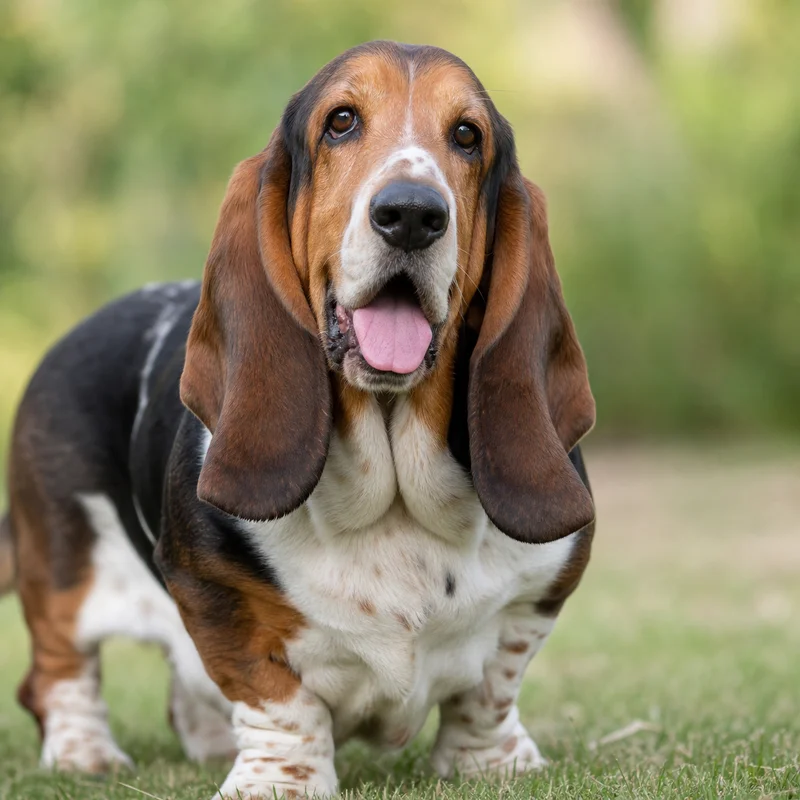
| Basset Hound | 40–60 lb · energy 2/5 · grooming 2/5 · barking 3/5 · trainability 2/5 | Lower energy and simple coat-care score | Moderate barking, shedding 3/5, and lower trainability are real trade-offs |
| Greyhound | 60–66 lb · energy 3/5 · grooming 1/5 · barking 1/5 · shedding 2/5 | A quieter, low-grooming profile for families comfortable with a large dog | Size still changes space, handling, and supervision needs |
| Whippet | 24–40 lb · energy 3/5 · grooming 1/5 · barking 2/5 · shedding 2/5 | Low coat-work and lower barking without a giant-dog footprint | This is still an active, individual dog—not a decorative couch accessory |
| Cavalier King Charles Spaniel | 11–18 lb · energy 3/5 · grooming 3/5 · barking 2/5 · trainability 4/5 | A small, trainable profile with lower barking | Coat work and gentle child handling are part of the deal |
| Boston Terrier | 11–24 lb · energy 4/5 · grooming 1/5 · barking 2/5 · trainability 4/5 | Low coat-work and strong trainability for a family that enjoys training | Energy 4/5 means play and engagement cannot be an afterthought |
Scores describe a profile, not a guarantee. A lower barking score does not replace training; a lower grooming score does not replace ordinary care; and a good-with-kids flag does not remove the need for adult supervision.

Choose the pressure point that matters most
If coat work is the constraint
Start with Greyhound, Whippet, French Bulldog, or Boston Terrier. Their grooming scores are 1/5. That reduces one recurring task, but does not make the rest of the household plan disappear. A family that wants the least coat work but has little appetite for daily play should not treat the Boston Terrier's energy score of 4/5 as a footnote.
If noise in a shared home is the constraint
The French Bulldog, Bulldog, Greyhound, Whippet, Cavalier King Charles Spaniel, and Boston Terrier have barking scores of 1/5 or 2/5 in our profiles. That is a useful starting signal for apartment living, not a promise about a particular dog's behavior. Check lease rules and meet the individual dog before deciding.
If a packed routine needs simpler energy demands
Pug, French Bulldog, Bulldog, and Basset Hound have energy scores of 2/5. They may make more sense than a high-energy profile when a family wants calmer day-to-day expectations. Every dog still needs daily care, a stable routine, and training that is led by adults rather than delegated to children.
If the household wants a smaller, more trainable starting point
The Cavalier King Charles Spaniel and Boston Terrier each have trainability scores of 4/5. Their size can be easier to manage than the larger choices here, but a smaller dog is not automatically safer for young children. Calm handling, rest space, and supervision matter at every size.
Make the household plan before the breed shortlist
Before contacting a breeder, rescue, or foster, write down the answers to these questions:
- Which adult owns the daily care and training decisions when the calendar gets crowded?
- What will change on school-event days, travel days, or when a child is sick?
- Where can the dog rest without being interrupted while eating or sleeping?
- Which constraint is non-negotiable: coat work, noise, space, energy, or size?
- Does the individual dog you meet match the household's actual pace—not an imagined future routine?
The best family choice is rarely the breed with the prettiest description. It is the dog whose trade-offs your household has already planned to carry. For a wider first pass, compare the best dog breeds for families and low-maintenance dogs guides, then return to the profile details before making a commitment.




Breeds mentioned in this article
 French Bulldog
 Greyhound
 Pug
Pug Whippet
Free dog tools
Useful calculators for dog owners
🍫Chocolate Toxicity CalculatorEstimate the risk from the type and amount of chocolate your dog ate, by weight.🍖Dog Food CalculatorEstimate dry-food cups, wet-food containers, or fresh-food grams from daily calorie needs and your label.💧Dog Water Intake CalculatorHow much water your dog should drink per day, by weight, activity and food type.🦴Dog Treat Calorie CalculatorUse the 10% treat rule to calculate a safe daily treat budget and food adjustment.🎂Dog Age CalculatorConvert your dog’s age to human years using the modern, size-adjusted formula.⏳Dog Lifespan CalculatorEstimate life expectancy from breed size and weight, with tips to add healthy years.
Dog Diary
More articles you might like

Health
Hypoallergenic Dog Grooming: A Practical Guide for Allergy-Aware Homes
Low-shedding dogs still need thoughtful coat care. Learn what grooming can—and cannot—do in an allergy-aware home.

Tips
Best Large Dogs for Apartments: Calm Big-Breed Options and Real Constraints
Large dogs can fit apartment life when their energy, barking, grooming, and household fit align. Compare six database profiles.

Tips
Low-Maintenance Dogs for First-Time Owners: What “Easy” Really Means
“Low maintenance” is a fit between a dog’s scorecard and your routine—not permission to ignore a dog. Compare six first-time-friendly profiles.

Tips
Big Hypoallergenic Dogs: Large Low-Shedding Breeds and Their Trade-Offs
A larger low-shedding dog can still demand grooming, activity, and thoughtful household planning. Compare six profiles before choosing one.
Find your perfect dog
Browse our in-depth breed guides:
Share